The Smallest Lights in the Universe by Sara Seager
Published 2021
Grade: A-
Paperback $14.99 on Amazon
336 pages
A brilliant young scientist begins her career that will take her to the elite echelons of exoplanet research. She finds love. Has two kids. Buys a house. And then her husband dies.
Dr. Seager shares her personal and professional story with us in The Smallest Lights in the Universe. She shows great courage in her honesty: she confesses her real emotions over those painful, turbulent years as her strong, outdoorsman husband develop cancer and dies, leaving Sara to find a way forward. This is not a happy book. There are no beautiful images. But it is a real book, an honest book. Although we learn about various exoplanet programs and her efforts to find Earth-like planets orbiting other stars, the book is carried by the honesty, the determination and the courage of one woman dealt a tragic life-turning blow. And she just happens to be a brilliant scientist.
Of note to AAAP members, Dr. Seager spent 1999-2002 at Princeton University. Chapter 4 begins: “Einstein’s oasis at the Institute for Advanced Studies felt more like a launchpad to me, the seeds of ignition in every blade of grass. I sat under those enormous trees throughout the fall of 1999 and pondered the next step in my journey to the farthest reaches of the galaxy.” And later, “The word ‘no’ was banned from our gatherings. David Spergel was our team’s local committee lead, and we met every week at Princeton’s Peyton Hall. A practically visible current leapt like voltage from one dreamer to the next, each new idea lighting up the room a little more brightly. For a brief spell we had the budgets and youth to imagine a seriously fantastical future.”
So why an A- and not an A? I am probably being unfair (after all, the subtitle is “A Memoir”), but I guess the book took a toll on me emotionally. I would have gladly traded some pages of her grief to hide in cold-hard science. Maybe I’d rather be confused by complex science than saddened by the family’s suffering. I even put the book down for a week to get some distance as her husband reached his final days.
As the book nears its end, Dr. Seager’s personal life and career finally find new footing. She writes, “Sometimes you need darkness to see. Sometimes you need light.” I thought this was a profound observation for all of us amateur astronomers.
As I finished the book, I began to wonder: is it less important to find intelligent life on other planets as it is to find compassionate life on our own?
The “Lucy” spacecraft was launched recently on a twelve year mission to visit asteroids. Asteroids are left over remnants from the sculpting of the solar system about four and half billion years ago. Spacecraft in the past have visited asteroids. Both as flybys and landings. What is different about this mission is the number and types of asteroids to be visited over a longer span of time when the spacecraft crisscrosses the orbit between Earth and Jupiter a few times. After launch the spacecraft was found to have a minor handicap in terms of a lack of confirmation of the latching of one of the two solar panels. Regardless, the spacecraft has been pushed out of the Earth’s bounds on its way to the asteroids. Will Lucy be lucky and complete its mission ?
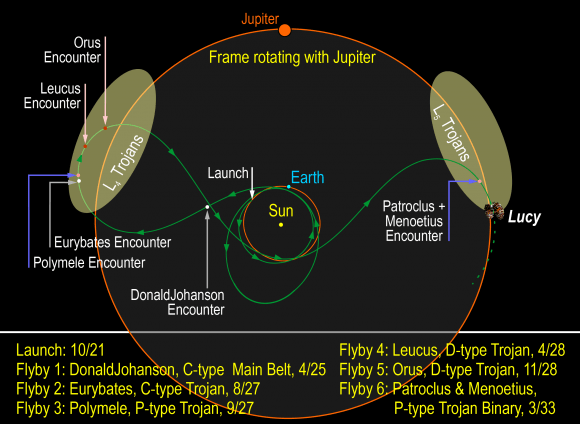
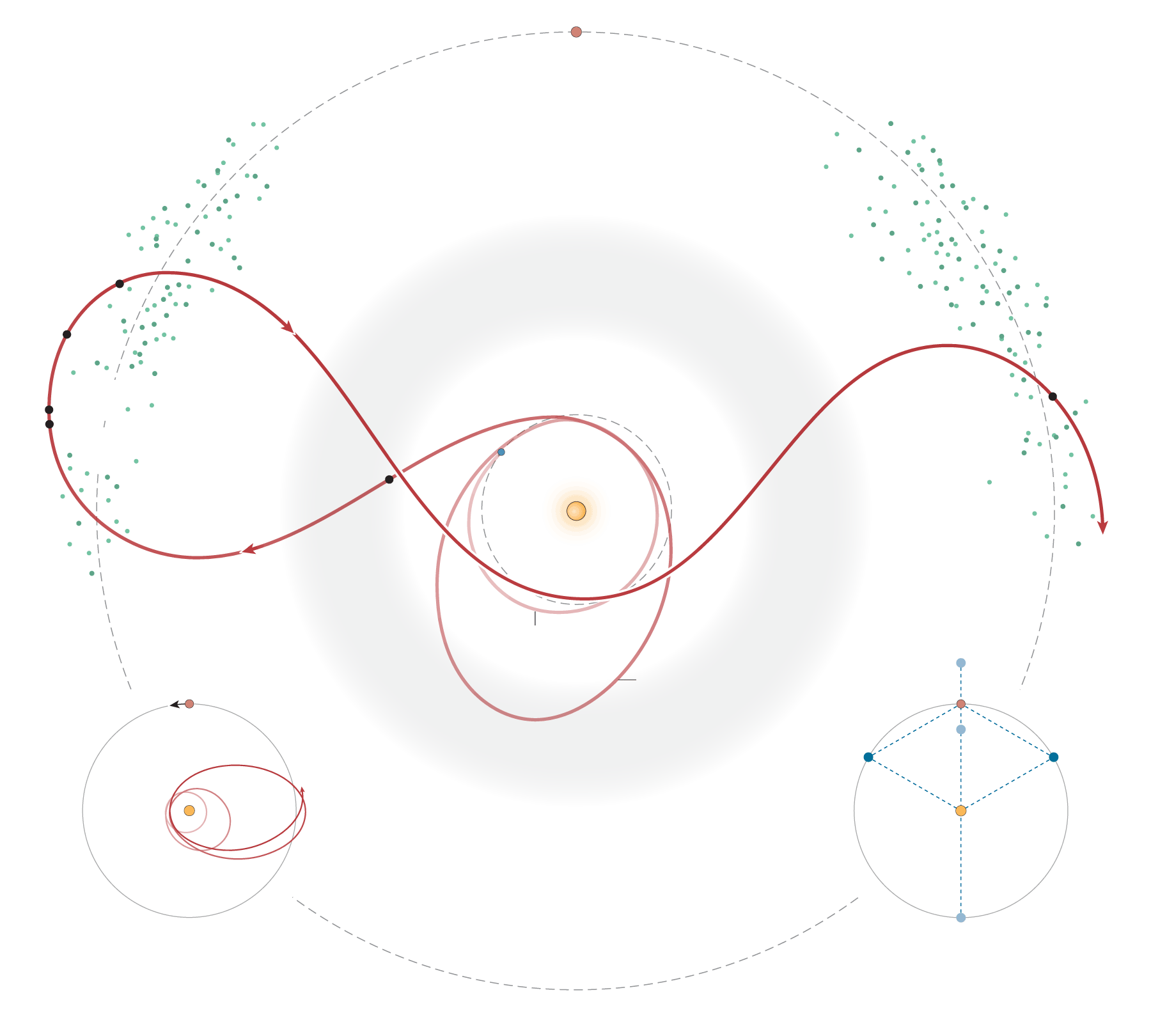
Asteroids are pretty interesting as they are the left over building materials from the formation of our solarr system. It is like some pieces of bricks, stone, wood, pipes and electrical cables lying around even after a building is complete. They offer some clues about how the building was constructed. Majority of asteroids are located in the asteroid belt between Mars and Jupiter. Thousands of pieces orbiting the Sun in a narrow band. In addition, there are some asteroids in the vicinity of Jupiter. Jupiter being such a massive planet – a big ball of gas, has its own entourage of remnant debris as it orbits the Sun. These asteroids are called Trojans. They move in the same orbit as Jupiter moves around the Sun. Not around Jupiter. They are concentrated in two areas in Jupiter’s orbit around the Sun. These areas are called Lagrange points – named for a French mathematician called Joseph Lagrange. At these points in space, the gravity of Jupiter is negated by the gravity of Sun and the asteroids can park themselves peacefully without the pulls of the massive bodies. There can be 5 possible Lagrange points named L1 through L5 for any two massive objects in space. In case of Trojans, the asteroids are parked in L4 and L5 points. The picture below shows the asteroids and the path Lucy will take. It is a great picture courtesy Southwest Research Institute. Lucy would be visiting one main asteroid (named Donald Johanson) and 7 Trojan asteroids as per the picture below.
Now let us come to the naming of the spacecraft. Lucy is named for a 3.2 million year old hominid skeleton (a human like ancestor) discovered in 1974 by a paleoanthropologist named Donald Johanson. And where did Johanson get the name from ? From a Beatles song “Lucy in the sky with diamonds” which was playing at the campsite in Africa when the discovery was made. In 2025, Lucy will reach the main asteroid between Mars and Jupiter, not surprisingly named Donald Johanson. Other Trojan asteroids will follow later as per schedule given in the picture. These encounters are all flybys with no orbiting or landing on any of the asteroids. Extensive imaging will be done as Lucy flies by each of the asteroids. The images will be captured in multiple wavelengths in order to determine the detailed geophysical features.
The mission is planned for twelve years but could be extended on how things go. A lot depends on the power source for Lucy. Typically spacecraft going that far out from Sun do not depend on solar energy as Sun’s light dims with the distance. Lucy is being powered by two massive solar arrays each generating about five hundred watts of energy at such distances. Closer to Earth they generate a lot more power. All the electronics on the Lucy are expected to operate within this power budget. The power generated is about half of a typical household iron used for pressing clothes. It is a great design indeed !
Because of the size of the solar arrays, they have been folded at the time of launching from Earth. They are expected to unfurl once in space and latch so that they retain the shape on the journey to the asteroids. One of the arrays did not confirm the latching process. It seems to be functioning fine regardless. The lack of confirmation may just have been a miss. Keeping the power generation in mind, Lucy has been steered beyond the confines of the Earth. Mission control will keep an eye on the journey and whatever they can do to fix or get a confirmation that everything is OK. They have a few years to work out the kinks during this long journey. It is like watching a car move while checking remotely on what is wrong with it and hopefully fix. Good luck to Lucy mission to achieve its goals and much more!
“No Time to Die,” the latest James Bond movie was released to theaters in October. Ahead of watching Daniel Craig’s latest film as the timeless James Bond, I decided to re-watch a few films, including “Quantum of Solace.” The explosive climax occurs in the desert where Commander Bond has to rescue the girl and dispatch with the evil Dominic Green amidst a fusillade of gunfire and burning buildings.
I wondered where this was shot, so I googled it and learned the scene was shot at the European Southern Observatory (ESO) Paranal in the Atacama Desert. This location is perhaps best known among astronomers as the host site for the Very Large Telescope (VLT). The website for ESO Paranal has a lot of great information and can be found at: https://www.eso.org/public/teles-instr/paranal-observatory/.
Meteorite Crashes Through Ceiling and Lands on Woman’s Bed After a fireball streaked through the Canadian sky, Ruth Hamilton, of British Columbia, found a 2.8-pound rock the size of a large man’s fist near her pillow. She was fast asleep in her home in British Columbia when she awoke to the sound of her dog barking, followed by “an explosion.”…more
-NYT
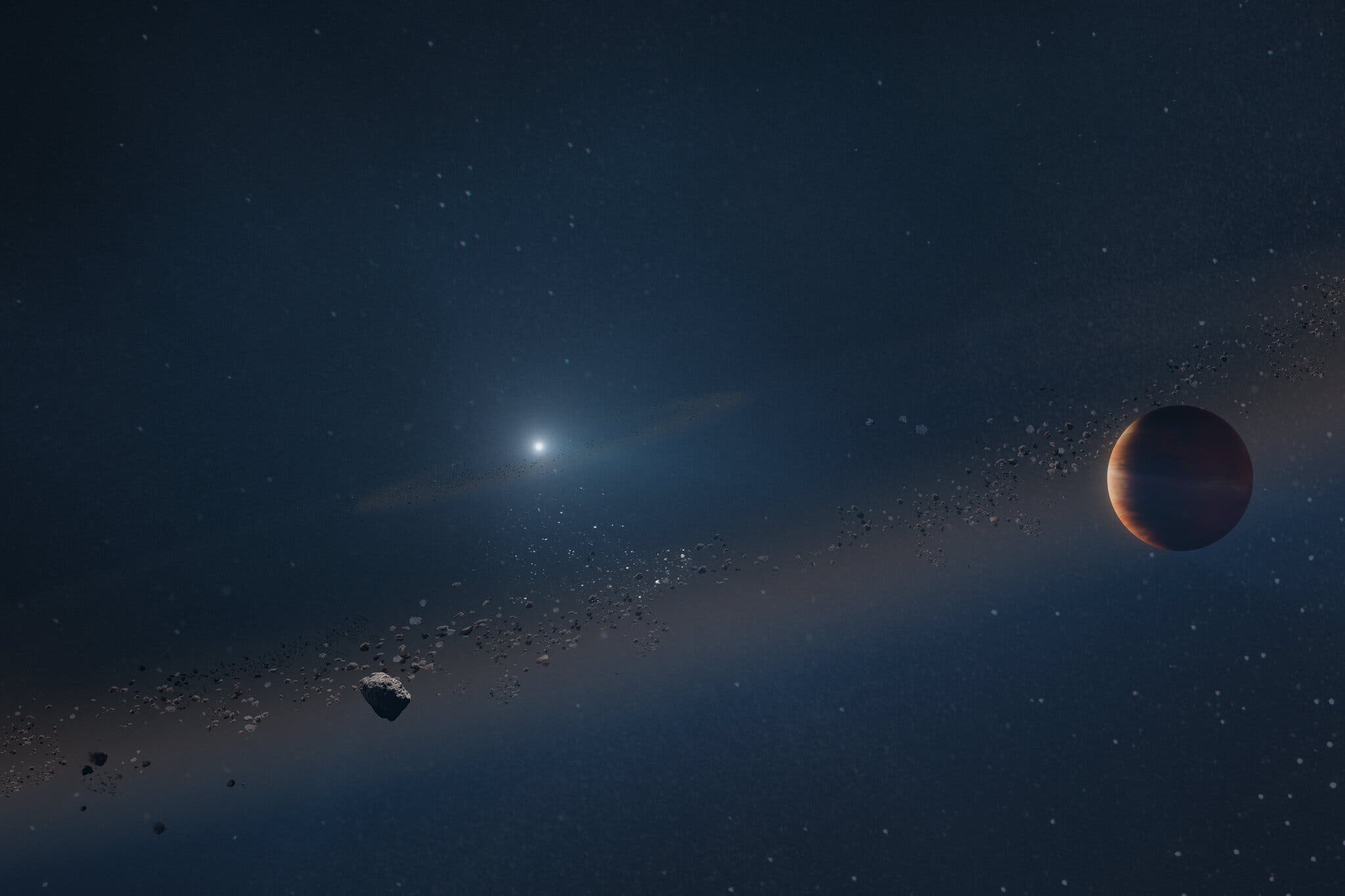
Astronomers Found a Planet That Survived Its Star’s Death The Jupiter-size planet orbits a type of star called a white dwarf, and hints at what our solar system could be like when the sun burns out. When our sun enters its death throes in about five billion years, it will incinerate our planet and then dramatically collapse into a dead ember known as a white dwarf. But the fate of more distant planets, …more
-NYT
Why NASA Launched a Robotic Archaeologist Named Lucy NASA launched a probe toward clusters of asteroids along Jupiter’s orbital path. They’re known as the Trojan swarms, and they represent the final unexplored regions of asteroids in the solar system. The spacecraft, a deep-space robotic archaeologist named Lucy. In a vast odyssey across the solar system, the mission will study asteroids known as Trojans that may contain secrets of how the planets ended up in their current orbits….more
-NYT
$10bn James Webb Space Telescope unpacked in Kourou The $10bn successor to the Hubble observatory arrived at Europe’s Kourou spaceport five days ago after being shipped from the US. Engineers have unboxed the James Webb Space Telescope in French Guiana and will now prepare it for launch. It’s now been relieved of its transport container and…more
-BBC
Orion: Nasa’s Moon-ship is attached to SLS megarocket Nasa’s next-generation spaceship has been lifted onto the rocket that will launch it to the Moon this year or in early 2022. The Orion spacecraft was attached to the powerful Space Launch System (SLS) rocket at Nasa’s Kennedy Space Center in Florida. For its upcoming flight, Orion will fly around the Moon without astronauts…more
-BBC
Neutrino result heralds new chapter in physics A new chapter in physics has opened, according to scientists who have been searching for a vital building block of the Universe. A major experiment has been used to search for an elusive sub-atomic particle: a key component of the matter that makes up our everyday lives…more
-BBC
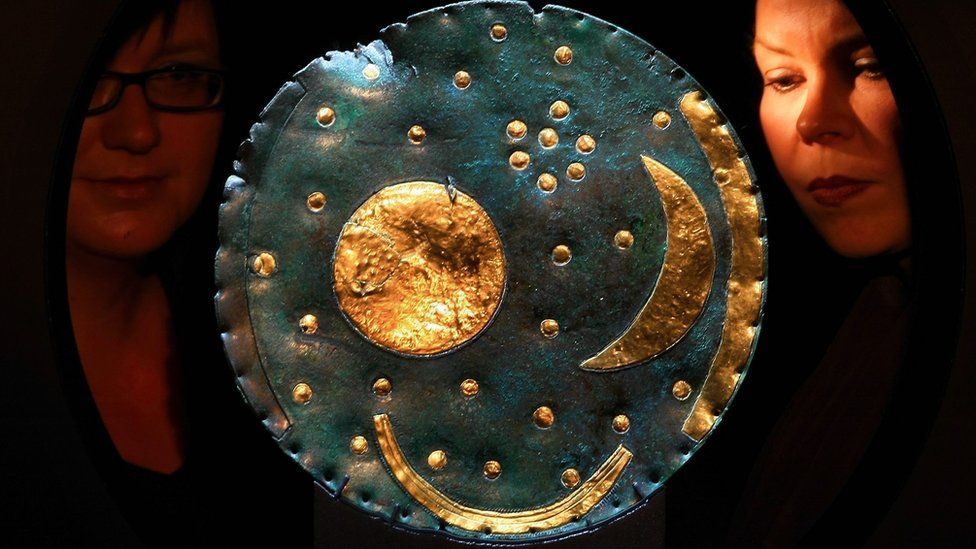
Nebra Sky Disc: British Museum to display world’s ‘oldest map of stars’ An ancient object thought to be the world’s oldest map of the stars is to go on display at the British Museum. The Nebra Sky Disc is widely believed to be 3,600 years old, dating from the Bronze Age. The bronze disc was unearthed in Germany in…more
-BBC
Signs of first planet found outside our galaxy Astronomers havefound hints of what could be the first planet ever to be discovered outside our galaxy. Nearly 5,000 “exoplanets” – worlds orbiting stars beyond our Sun – have been found so far, but all of these have been located within the Milky Way galaxy…more
Connection to the Mother Ship. AAAP has a wonderful history connecting our club with Princeton University and its Department of Astrophysical Sciences. Through the years we have had the privilege to meet in the auditorium at Peyton Hall with space-themed murals and top notch audio-visual devices for our meetings. The number of science talks by Princeton faculty and post-docs through these years are beyond count. Now in our new fall 2021 season of meetings naturally we look forward to returning to Peyton once COVID settles down. However, despite our hopes, for the rest of the fall at least we will not be able to meet in person at Peyton Hall. Complicating our return is a major construction project getting underway on campus across from Peyton Hall which will make parking distant and difficult. So, while our virtual meetings with Zoom must continue until our eventual return to the Mother Ship, let’s keep the Princeton connection strong in our minds’ eyes and let it inspire us as we “do astronomy.”
Doing astronomy is, of course, a little different when we cannot meet in person for our regular meetings. During Zoom sessions, club activities and member conversations highlight the second hour after the main speaker has finished. Here we seek to elevate the art, science, and joy of amateur astronomy, thus we have evolved the practice the informal “Journal Club” presentation by (usually) one member each month. Yes, I am asking you dear reader to step up to volunteer to give a Journal Club! This is typically a short 10 minute talk about an astro topic you especially care about — doesn’t need to be scholarly, just to be fun and engage other members with what you care about. This works very well with audiovisuals through Zoom screen share (e.g., PowerPoint slides, JPEGs) from your home computer or mobile device. To take on a Journal Club for an upcoming meeting, contact me at director@princetonastronomy.org or program chair Victor Davis at program@princetonastronomy.org.
Fall Observatory Season Extended. As summer transitioned to fall the sky conditions improved, and we have had a few excellent observing public nights at the Washington Crossing Observatory. In view of the generally warmer trends in fall weather and the desire to be able to meet as club members, the board has taken the following actions.
Public Friday Nights this fall are extended through the end of November.
Member Friday nights will be extended through the end of December.
Keyholder participation for the above nights is optional, and sessions will be coordinated by the Observatory Chair, weather permitting as usual.
Performance Test – AAAP’s ZWO Astro Camera. Along with several AAAP members I have been extolling the virtues of astrophotography and astrovideo for our club for a while now. For those of you interested in getting more involved in imaging, this may be a good time to revisit the technical and aesthetic side of the topic. You may have seen at the Observatory and in our “astrovideo live” Zoom sessions the remarkable live imaging performance of the newer generation of astro cameras. The technique of live stacking astro images in the field without extensive processing has come to be called Electronically Assisted Astronomy (EAA). In this technique, surprisingly clear images of deep space objects can be displayed in near-real time after stacking a series of short, typically 5-20 second exposures using specialized software. No post-processing is done other than what the software does immediately to smooth out the noise and enhance the signal in real time.
The club’s ZWO ASI294MC Pro camera is a technological marvel and a good example of how CMOS sensor technology continues to displace the CCD in astronomy applications. The camera features a CMOS Bayer-matrix (RGGB) color sensor, the Sony IMX294. The sensor is relatively large at 19 x13 mm with diagonal 23mm (this is the so-called “4/3-inch” in sensor terminology), which is key to wider-field images. The pixel array is 4144 x 2822 for 11.3M pixels at 4.6 um pixel size. It has great sensitivity, with quantum efficiency approaching 80%, although the exact figure has not been published by ZWO. The camera has 14-bit native bit depth, very fast download rate, low read noise, and cooling to ~30 deg C below ambient to reduce dark current noise. Results below confirm that these newer-generation CMOS color cameras are a revolutionary step forward for EAA.
To control this specific camera and run live stacking we have 3 software options. These programs are on the club’s computer at the Observatory and available for members to learn. The first two are free to download on your PC: (1) ZWO ASI Live, part of the ASI Studio package, the native software designed specifically for ZWO cameras; (2) Sharp Cap, free but with an added-cost Pro version; and (3) TheSkyX, which includes a Live Stacking component in the camera control section of the software. The only other software required is the ZWO camera driver, downloaded from the website and installed on the PC.
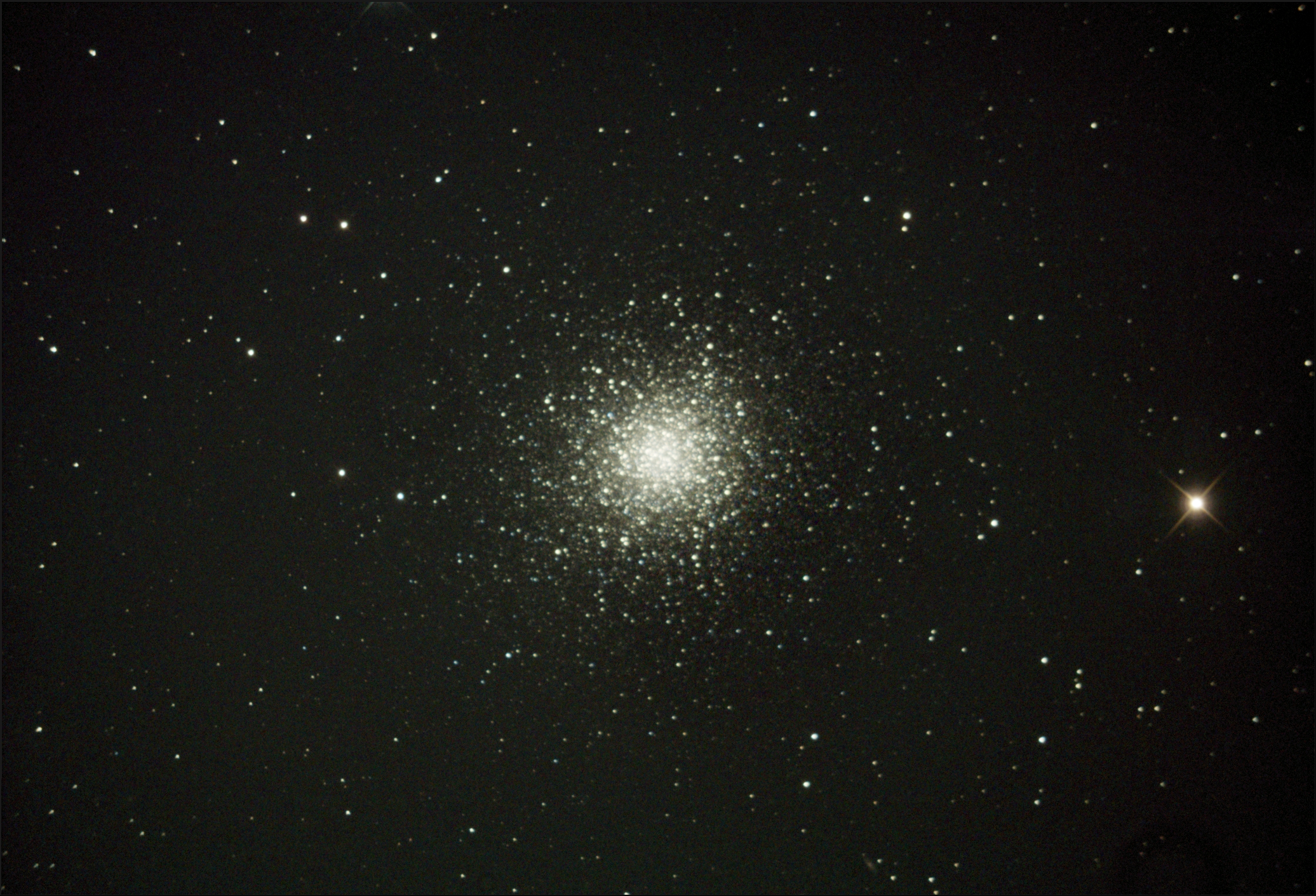
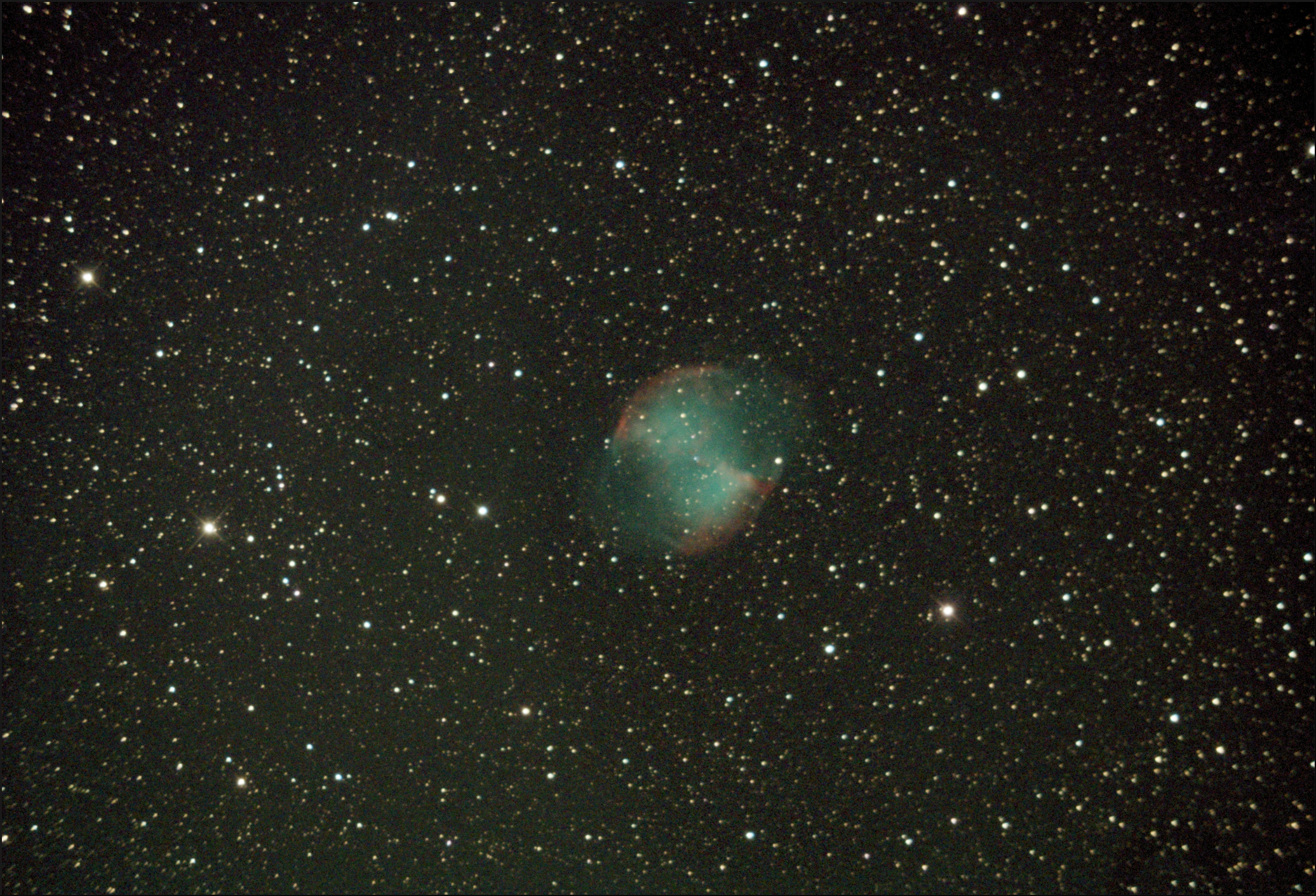
A while back I borrowed the ASI294 camera from the AAAP Observatory and hooked it up to my 12.5” f/6.7 telescope at home. My test was carried out under far from ideal conditions, a waxing gibbous moonlit night in mid-July with hazy skies, and I even left the deck light on here at home and could barely see the stars! I connected the camera to my AG Optical iDK 12.5” reflector scope at f/5 (using a 0.75x focal reducer on the native f/6.7 scope to give FL = 1610 mm) on a Paramount-MX running TheSkyX. The ZWO camera sensor was cooled to -10 deg and the gain set at mid-level, the default deep sky setting. Below are unprocessed JPEGs of screen shots showing what you’d see as live images in real-time with the ZWO. These are all 3 to 5 minute stacks of 15 second subframes (i.e., 12 or 20 subframes have been averaged) with no post-processing or stretching beyond what the live image showed on the computer screen.
Members can generate EAA images similar to the ones I pasted below using the club’s camera and Celestron C-14 with f/6.3 focal reducer at the Observatory. If you have not already been trained to use the equipment, you can get going by contacting the observatory chair at observatory@princetonastronomy.org. And yes, I did return the camera to the observatory (:>).
M13 Globular Cluster in Hercules, ZWO294 – 15 sec live image stacked for 3 min
M27 Dumbell Nebula in Vulpecula, ZWO294 – 15 sec live image stacked for 3 min
M16 Eagle Nebula in Sagittarius, ZWO294 – 15 sec live image stacked for 5 min
Cirrus Nebula East in Cygnus, ZWO294 – 15 sec live image stacked for 5 min
3 New Roles – Members Help Needed. Here are some opportunities for members to contribute to the inner workings of AAAP by as facilitators of club activities. These are increasingly important as we move further into the virtual meeting era. Recently, the Board defined the following new roles and we are looking for members to take these on. I am happy to note that member Rich Sherman has volunteered to take on the role of merchandise facilitator described last month. If you can help by taking on one of the roles below, please e-mail me at director@princetonastronomy.org.
Provide contents and update our ongoing AAAP Twitter, Facebook and YouTube accounts. Look into other forms of social media and how they could be utilized for the club’s benefit. Develop means for members to privately contact/message other members in or out of our current email and newsletter systems for daily chat, invitations to observatory, share stories or photos, etc. This could be a message board or similar function so that members can connect. Facilitator Benefits: Connect with members and public who are heard but not necessarily seen. Utilize various resources to learn more about astronomy. Interact with members and share knowledge. Broaden our network of AAAP followers. Pass the knowledge on to new generations of members and public.
Promote the ongoing link between AAAP and NSN. Sort through the various NASA/JPL Night Sky Network toolkits we’ve received and determine how best to utilize them in our outreach and public night events. Practice with the toolkits and train others how to use them. For the NSN website go to https://nightsky.jpl.nasa.gov/index.cfm. Facilitator Benefits: You get to explore interesting packages delivered from NSN. Learn about astronomy from well thought out materials for all age groups — cool stuff to play with. Interact with members and public. Get to teach astronomy facts and concepts.
The club owns a few telescopes and related equipment and occasionally receives donations which we keep or sell. The role here would be to set up and run a loaner telescope program for members. Learn about, practice with, maintain, and possibly store the telescopes and make them available for members to use. Train members on how to use telescopes. Develop a system to keep track of loaner whereabouts and ensure good condition of the equipment. Facilitator Benefits: You get to graciously accept occasional donations from the public. Learn how to evaluate telescope completeness and condition. Learn how to set up and use different scopes and mounts, eyepieces and cameras. Get to play with donated scopes at your leisure. Interact with members and share knowledge.
The October 2021 meeting of the AAAP will take place (virtually) on Tuesday, October 12th at 7:30 PM. (See How to Join the October Meeting below for details). This meeting is open to AAAP members and the general public. Due to the number of possible attendees, we will use the Waiting Room. This means when you login into Zoom you will not be taken directly to the meeting. The waiting room will be opened at 7:00 PM. Prior to the meeting start time (7:30 PM) you may socialize with others in the waiting room. The meeting room has a capacity of 100 people.
For the Q&A session, you may ask your question using chat or may unmute yourself and ask your question directly to the speaker. To address background noise issues, we are going to follow the rules in the table below regarding audio. If you are not speaking, please remember to mute yourself. You are encouraged, but not required, to turn your video on.
Meeting Event
Participant Can Speak?
Participant Can Self-Unmute?
Director Rex’s General Remarks
Yes
Yes
Program Chair Victor’s Speaker Introduction
Yes
Yes
Speaker Presentation
No
No
Q&A Session
Start All on Mute
Yes
5-minute bio break
Yes
Yes
Journal Club presentation (none scheduled)
Start All on Mute
No
Business Meeting
Start All on Mute
Yes
Director’s closing remarks
No
No
Only the Business part of the meeting will be locked.
Featured Speaker: Dr. Tansu Daylan is a TESS Postdoctoral Associate at Princeton University’s Department of Astrophysical Sciences. His presentation is entitled, “Exoplanets Transiting Faint Stars in the TESS Full Frame Images.” The Transiting Exoplanet Survey Satellite (TESS) is proceeding with its mission of discovering small planets transiting bright stars. TESS is able to determine the mass of these host stars and hence bulk and atmospheric characterization of the transiting exoplanets. Exoplanet searches using TESS have so far focused on bright host stars or on specific populations (e.g. young) of stars. Dr. Daylan has been working on extending the TESS survey to fainter host stars with a limiting magnitude of about T=13.5. Toward that end, he uses the Quick Look Pipeline (QLP) light curves to construct summary metrics from the full frame images to vet Threshold Crossing Events by excluding false positives such as eclipsing binaries, stellar variability, and other factors. Preliminary results of this effort recently pushed the number of TESS Objects of Interest above 4400, with a further 1500 candidates expected by the end of the extended mission. This projected yield is especially important to achieve a full-sky demographic survey of exoplanets with a well-characterized selection function.
Dr. Daylan describes himself as a self-conscious and inquiring ingredient of our Universe, pondering on its constituents, origin, evolution, and elegant symmetries. Before that, he was a collection of elements spread throughout a molecular cloud in the pre-Solar neighborhood that eventually collapsed to become the Sun and its retinue of planets. Subsequently, he became a curious child growing up in the beautiful city of Istanbul. Dr. Daylan graduated from the Robert College, and completed undergraduate studies in electrical and electronics engineering and physics at Middle East Technical University (METU) in Ankara, Turkey. He completed his PhD at Harvard working on constructing novel statistical methods to search for signatures of dark matter. Dr. Daylan is now a TESS postdoctoral associate at MIT with a visiting appointment at Princeton University. Dr. Daylan is active in teaching and outreach aimed at communicating and advocating the scientific method across cultures and generations.
AAAP webcast: This month’s AAAP meeting, beginning with Rex’s opening remarks and ending at the break before the business meeting, will be webcast live on YouTube and recorded for subsequent public access on AAAP’s YouTube channel. Be aware that your interactions during this segment, including questions to our guest speaker, may be recorded for posterity.
This session will be recorded and saved on YouTube. Send me an email at program@princetonastronomy.org if you have any concerns.
Using Zoom: While we are social distancing, the AAAP Board has chosen to use Zoom for our meetings, based our belief that many members have already have used Zoom and its ease of learning. One of its great features is you can choose whether you want to install the software on your computer or use it within your browser.
How to Join the October Meeting: For the meeting, we are going to follow a simple two-step process:
Please make sure you have Zoom installed on your computer. You do not need a Zoom account or need to create one to join the meeting. Nor are you required to use a webcam.
WANTED: Members with interesting stories to tell. During the past months, we’ve enjoyed interesting and informative talks from AAAP members, and we’d like to keep the momentum going! We hope to make these short presentations a regular feature of our monthly meetings. We’d like to know what members are doing or what members are thinking about in the broad range of topics encompassed by astronomy. A brief ten-minute (or so) presentation is a good way to introduce yourself and the topics you care about to the club membership. If you are interested in presenting a topic of interest, please contact either director@princetonastronomy.org or program@princetonastronomy.org.
A look ahead at future guest speakers:
November 9, 2021 Jesus (Jesse) Rivera, Visiting Assistant Professor of Astronomy at Swarthmore College, will discuss radio astronomy and his work researching dusty star-forming galaxies (DSFGs).
December 14, 2021 Joleen Carlberg will talk about her work as a Support Scientist on the Space Telescope Imaging Spectrograph (STIS) team.
January 11, 2022 Robert Williams, former director of the Space Telescope Science Institute (STSci), will talk about his controversial and courageous decision to commit about 100 hours of time on the HST to staring at what was at the time considered to be a relatively bare patch of sky, creating what is now known as the Hubble Deep Field.
February 8, 2022 Chris Spalding a 51 Pegasi b postdoctoral fellow in astronomy at Princeton University, will talk about his research to understand planet formation by way of simple theoretical descriptions of planetary dynamics.
As always, your comments and suggestions are gratefully accepted.
● Director Rex Parker opened the Zoom meeting at 7:30 P.M. There were 13 attendees
● The agenda included:
* club finances and membership.
* upcoming season meetings (speakers, Peyton Hall availability).
* observatory update.
* member involvement opportunities.
● Treasurer Michael Mitrano reviewed a newly-updated organization balance sheet for the fiscal year ending June 30, 2021. John Miller initiated a motion for discussion regarding simplifying (his term) general membership renewal schedule from a fiscal year term to a calendar-year term. A discussion ensued and the motion to change to a calendar-year renewal time frame was passed.
● Rex contacted Susan Duncan, Department Manager at Princeton University’s Department of Astrophysical Sciences. John Miller had a meeting with Department Chair Michael Strauss. The outcome of these discussions was: the AAAP will be restricted from using Peyton Hall for the foreseeable future. Both Covid-19 and a massive construction project across from Peyton Hall were cited. John Miller and Larry Kane agreed to investigate alternative physical meeting locations.
● Program Chair Victor Davis reviewed the upcoming season’s guest speaker roster. He has commitments through the Spring of 2022. The Board agreed Victor arranged for an excellent schedule.
● The idea of locating an appropriate vendor to produce new AAAP logo merchandise, e.g. baseball caps, golf shirts, etc. was well received.
● The Board is still at a stalemate concerning having an engineering vendor submit a letter and drawings, required by the State, to proceed with the observatory repair.
● David Skitt proposed keeping the observatory open for Public Friday Nights through November, to make up for Covid closures. The Board agreed and the Key holders will be notified to see if enough are willing to participate.
● The idea of a telescope loaner program was proposed. Portable telescopes owned by the AAAP could be borrowed by members for a pre-set period. The Board agreed with the idea, with details and rules to be determined. A facilitator is needed for the project.
Social media activity expansion by the AAAP was reviewed. Len Cacciatore and John Miller talked about integrating a third-party online merch store into the club website.The meeting adjourned at 9:45 P.M.
The season of Nobel prizes is coming soon, in a week or so. It has been more than a century of Nobel prizes for the highest human achievements in the field of Sciences,Literature, Economics and Peace. Some controversies and some supposed misses have occurred in the past. I would like to mention three such cases involving women.
Recently, Anthony Hewish died. He won a Nobel prize in physics in 1974 along with Martin Ryle for the discovery of Pulsars, which are now known as spinning neutron stars. This discovery was made using a Radio telescope. The Radio astronomy group in Cavendish Laboratory in Cambridge was headed by Martin Ryle. Here Hewish was working with a graduate student Jocelyn Bell. In 1967, it was Bell who discovered a pattern in the data from the radio telescope. She painstakingly looked at a lot of data and firmly established that the data was all coming from an unknown type of astronomical object, a new source of radio signals.
Subsequent discoveries revealed that some massive stars at the end of their lives turn into neutron stars which are very dense objects. Such spinning objects emit radio waves which is what Bell discovered. When time came for awarding a Nobel prize for this discovery, Ryle and Hewish won, leaving Bell out. The Nobel committee never explains their decisions. Fred Hoyle, the famous physicist who came up with the Steady state theory of the Universe, criticized the Nobel committee about the decision to leave Bell out. Was it because she was just a Phd student at the time of discovery ? Was it because of gender inequality ?
Hoyle himself got left out later. Other than steady state theory which he admitted was wrong after the evidence for cosmic background radiation was firmly established and the Big bang theory gained prominence, he did pioneering work for nucleosynthesis which explained how stars including our sun generate energy through nuclear fusion reactions. And how most of the elements in our Universe are formed in the stars. When time came for the awarding of a Nobel prize, Willy Fowler, Hoyle’s collaborator, along with Subramanyan Chandrasekhar received the prize. But not Hoyle. Was it because of his insistence on steady state theory and derision of the Big bang theory ? Was it because of his criticism of the Nobel committee for leaving Bell out earlier?
Henrietta Leavitt was one among a group of women who worked in the Harvard Astronomy department and were known as computers. This was before the actual computers came into the picture. These women analyzed the data and did all the computations by hand to derive conclusions. Leavitt analyzed data from a group of stars known as Cepheids. These stars blink with a certain regularity. She found a relationship between the period of fluctuation and apparent brightness from a group of Cepheids in the Magellanic cloud. By measuring the distance to one such star (through other methods like parallax wherein measuring the position of the same star during different places of the Earth or at different times), a standard candle has been established. The distance of any other Cepheid can be measured by the period of its blinks. Using the same standard candle, Edwin Hubble found that Andromeda is a separate galaxy and is very far away (about 2 million light years).
It is reported that the Nobel committee was very impressed with the discovery of the standard candle and wanted to nominate Leavitt for a Nobel prize. By the time they made their inquiries, she was already dead (died of cancer in 1921). Hubble’s discovery paved the way for other distant galaxies and that they are all moving away from each other. After he died, a Nobel committee member told his widow that Hubble was being considered for a Nobel prize when he died.
The last example is of a chemist whose discovery impacted the life sciences, not astronomy. Rosalind Franklin worked on X-ray crystallography, which uses X-rays to bombard any given substance and then the resulting diffraction is used to determine the structure of the molecules. In one of her studies, she pictured a double helical shape. Francis Crick and James Watson saw those pictures and they got ideas that the structure of the DNA molecule is similar. She also corrected their model of the DNA molecule. She died of cancer at an early age of 37 in 1956. Watson, Crick and Franklin’s boss Maurice Wilkins won the 1962 Nobel prize for the discovery of DNA structure. While Franklin did a lot of work in other areas like structure of coal and viruses, she did not get any credit for the DNA molecule, which contains the script of life.
I am not interested in speculations, scandals and complaints, but to salute the people who made significant contributions and put them on the same pedestal as their lucky counterparts.
Here’s an astronomy book that isn’t filled with science. Rather, this newly-released book is the story of the men and women that battled for more than a decade to get the Europa Clipper mission approved. After years of despair, and countless losses to Mars-obsessed administrations, the turning point finally came in 2012 when the Hubble Space Telescope revealed 200 km high vapor plumes shooting from Jupiter’s icy moon Europa. The Mission details the passion and foresight of a group of people, and tells us a bit about the lives (and death), their personal and professional struggles, and their enduring commitment to get an orbiting spacecraft to Europa.
“Orbiters are all about getting a global view. Here is where Cassini comes in. Each time it orbits Saturn, Cassini swings by Titan to change its orbital plane—its angle of travel. Titan is an enormous moon and has the perfect gravity for that. So Titan lets Cassini fly higher or lower over Saturn and see different parts of its rings. And every time Cassini flies by Titan, it keeps its science instruments switched on and gets some new slice of the mysterious moon. By orbiting Saturn, we have been able to capture eighty-five percent of Titan…because of all those flybys. So if we want a global view to understand Europa at Jupiter, we can do it just like Cassini: with multiple flybys.”
The author, David W. Brown, has a very distinctive style—I would call it “casual conversation”—and this quickens the pace of a 400 page book (480 pages including the acknowledgements, notes, and index). In addition, Mr. Brown includes a handy list of more than two dozen individuals and their roles in the front of the book. Because The Mission details the various setbacks and challenges and the many people impacted, the book jumps around temporally and I found it easy to get lost on the sequence of events. I think the book could have benefited from a timeline of events as a reference. There are 16 pages of black and white photographs in the center of the book which are primarily images of the people (so don’t expect any “wow” images of Europa or Jupiter).
I enjoyed the book—it gave me great insight into the passion and commitment of the people behind the science and imagery. Thanks to The Mission, I am now following the Europa Clipper mission online, and you can too, at: https://www.jpl.nasa.gov/missions/europa-clipper.
If you are fascinated by galaxies and love great photos of galaxies, then this is the book for you. I thoroughly enjoyed Govert Schilling’s book—the writing was excellent, the photographs were outstanding, and the graphics were well-done.
A large, expensive, hardback book like this must have great photographs, and this book is packed with fascinating images—dozens are spread over two pages which makes for exceptional viewing. For example, pages 220-221 show 27 images of galaxies taken by the Hubble Space Telescope that are, or are almost colliding. Very cool. The photo credits listed at the back of Galaxies span two full pages and four packed columns. In short, the pictures alone are worth the price of the book.
The graphics are also helpful and well done. My favorite is perhaps the graphic (page 168) that shows the movement through space of the Laniakea Supercluster of galaxies. Then on page 210, a two-page spread shows four galaxies as they appear today, and how they might have looked four billion and 11 billion years ago.
There are six chapters: Our Milky Way, Cosmic Neighbors, A Gallery of Galaxies, Monsters and Gluttons, Galaxy Clusters, and Birth and Evolution. The writing is excellent, and complex subjects, like the Epoch of Reionization, and Dark Energy are handled with enough detail to provide a basic understanding, but without so much detail that your head starts spinning.
I will end with a quote. In noting that matter only constitutes about 4% of the universe, Schilling writes, “The true nature of this mysterious dark energy is still unknown. Nor do we know whether there may be a relationship to the equally mysterious dark matter already mentioned in this book. The fact is that the universe hasn’t become more comprehensible in recent decades.”
This is a wonderful book to add to your “astro library” and I hope you enjoy it as much as I did.










 Amateur Astronomers Association of Princeton