The meeting was convened on Zoom by Director Dr. Rex Parker at 1930 with the agenda for the evening. He reported that Some 21 members had participated in the latest “Astrovideo Live! Winter Session” involving half a dozen scopes on February 4. He reviewed his challenge to observe Apollo Asteroid 7482 / Minor Planet 1994PC1 on its closest approach on January 18. It appeared as a streak in his 10-second-exposure astrophoto, and he did a series of calculations to compute its speed based on the length of the streak, coming within 3% of professional estimates.
At 1943 Program Chair Victor Davis introduced featured speaker Dr. Christopher Spaulding who presented “Upside-down, Inside-out Solar Systems.” As the search for exoplanets has revealed increasing numbers of other planetary systems, some are found to be bizarrely organized, with planets orbiting opposite their host star’s rotation, planets at inappropriate distances, and planets with widely diverse axial tilt. He began with a historical review before getting into how these newly discovered systems are challenging our theories of planetary formation.
Following a 5 minute break at about 2100 we reconvened for an Unjournal Club Presentation on light pollution by member Surabhi Agarwal. She detailed the many deleterious effects of light pollution way beyond its effect on astronomy and offered guidance on how to attack it in your local community.
In the business meeting Rex reported that Treasurer Michael Mitrano had – at long last – been able to get a definitive answer from the state about what they needed to consider permitting us to repair the observatory columns. He has sent the engineering drawings, complete with raised-seal authentication, and we are hoping for a rational and prompt response.
Observatory Co Chair Dave Skitt announced that a pipe had frozen and split, causing minor leak. It was the result of a perpetually leaking valve in the water line that feeds out observatory from Nature Center. Steps had been taken to guard against further freezing and repairs were scheduled.
There was discussion about the AAAP Discord Server, the AAAP Online Merchandise Shop, and the Astrovideo Sessions.
The meeting was formally adjourned shortly after 2200 but informal discussions continued until nearly 2230.
The Apple TV+ television series For All Mankind was recommended to members. It is an alternate history drama imagining that the Soviets had achieved the first manned landing and the space race had never ended. According to Wikipedia, it has been renewed for its third season. The first episode is free, but the rest require a subscription @ $4.99/month.
Some 56-58 people attended the speaker’s presentation and 59 were Zoomed in at the start of the business meeting.
All membership renewal reminders have been caught up from the transition in dues policy and in manning the Secretary position. Current membership officially stands at 198, though 3 have failed to respond to multiple renewal reminders and are expected to be dropped at the end of February.
I recently joined as a new member of AAAP and I am excited to be part of it.
A bit about me:
My wife and I have been residents of Flemington NJ for over 30 years. We have a daughter who works in Sonoma County CA as an Eye Surgeon and we also have a son who lives with us. He has Autism and he attends a job training program nearby.
I am quite involved in a non-profit here in Hunterdon County called Hunterdon Outreach Programs. We host recreational programs for individuals with disabilities (at no cost to them) supported by volunteer students from local high schools. We host Basketball, Soccer and Tennis. I run the Tennis program as I’m a huge fan of Tennis. This Program has been very rewarding to me and also my son has enjoyed it all these years.
I have a B.S. in Electronics Engineering from Mysore India and an M.S. in Computer Science from Villanova University, PA.
I have been in the Telecom industry in various capacities for a bit over 4 decades now and a good part of my career was in Bell Labs/Lucent Technologies (Arno Penzias was still at BL when I first joined). I currently work for Verizon Wireless in Basking Ridge NJ.
My interest in joining the club came after I had audited an introductory course in Astronomy at Rutgers University last Spring where I learned the basics of the structure of the Sun, Stellar lives, Galaxies etc. and I was quite fascinated by all of it.
I would love to pursue this field as a new hobby and since I’m starting as a novice I’m hoping to learn from all of you. I’d love to help out in any way possible.
On a recent trip to Houston, Texas to attend a friend’s daughter’s wedding, I took the opportunity to visit the Johnson Space Center. It was a good tour of the facility with some space exhibits and historical artifacts from the years of the Apollo manned mission to the moon. Of the several NASA space centers setup across the country during the 1960s, Johnson Space Center, named for ex-President LBJ (Lyndon B. Johnson), is charged with the role of mission control and astronaut training.
Johnson was the vice-President at a time when the cold war centered around the space race between the US and the USSR. After the USSR launched Sputnik, the first man-made satellite to go into space, President Kennedy made his famous declaration of landing a man on the moon by the end of the 1960s.
While one of the earliest rocket launches ended with a blow up on the launch pad, NASA was in distress with no strong leader to guide. President Kennedy assigned the task to Johnson whose job was to put the space program on a firm pedestal. He did that with several successes during Kennedy’s remaining years and his own one and half terms as a President.
The space race was won when Apollo 11 landed on the moon with Neil Armstrong as the mission Commander. By that time, President Nixon had taken over at the White House. But the bulk of the heavy lifting was done during the Johnson years. Since Johnson is from Texas, this Space Center in Houston was named in his honor.
Rockets are mostly launched from Kennedy Space Center in Florida, closer to my home. Once the launch is complete, the control of the mission transfers over to Houston. Till the mission is completed, the controllers at Houston are responsible for guiding and taking decisions. We are used to seeing on TV a mission control center with some giant screens and people sitting in front of monitors and jumping in joy when things go well. Given below is a picture of the historic mission control room which controlled the space missions during the 1960s.
The mission control room is not used anymore. But it has been reconstructed for tourists to get a feel for how it looked like in its glory days. The equipment is all original or close to original. The newer mission control room is in the same building, one floor below. Currently, the International Space Station is controlled from the new mission control room. The building itself is named for Chris Kraft, the first mission control Director. He was a legend and wrote the book on how mission control should be performed.
This mission control room was the one where the first distress call “Houston we have a problem” came from the crippled Apollo 13 spacecraft which was on its way to the moon. Hundreds of controllers and engineers directed Apollo 13 from this room to bring it safely back to Earth. The mission control Director was Gene Kranz whose famous words “America has never lost a man in space. It shall not lose a man in space. Certainly not under my watch. Failure is not an option”.
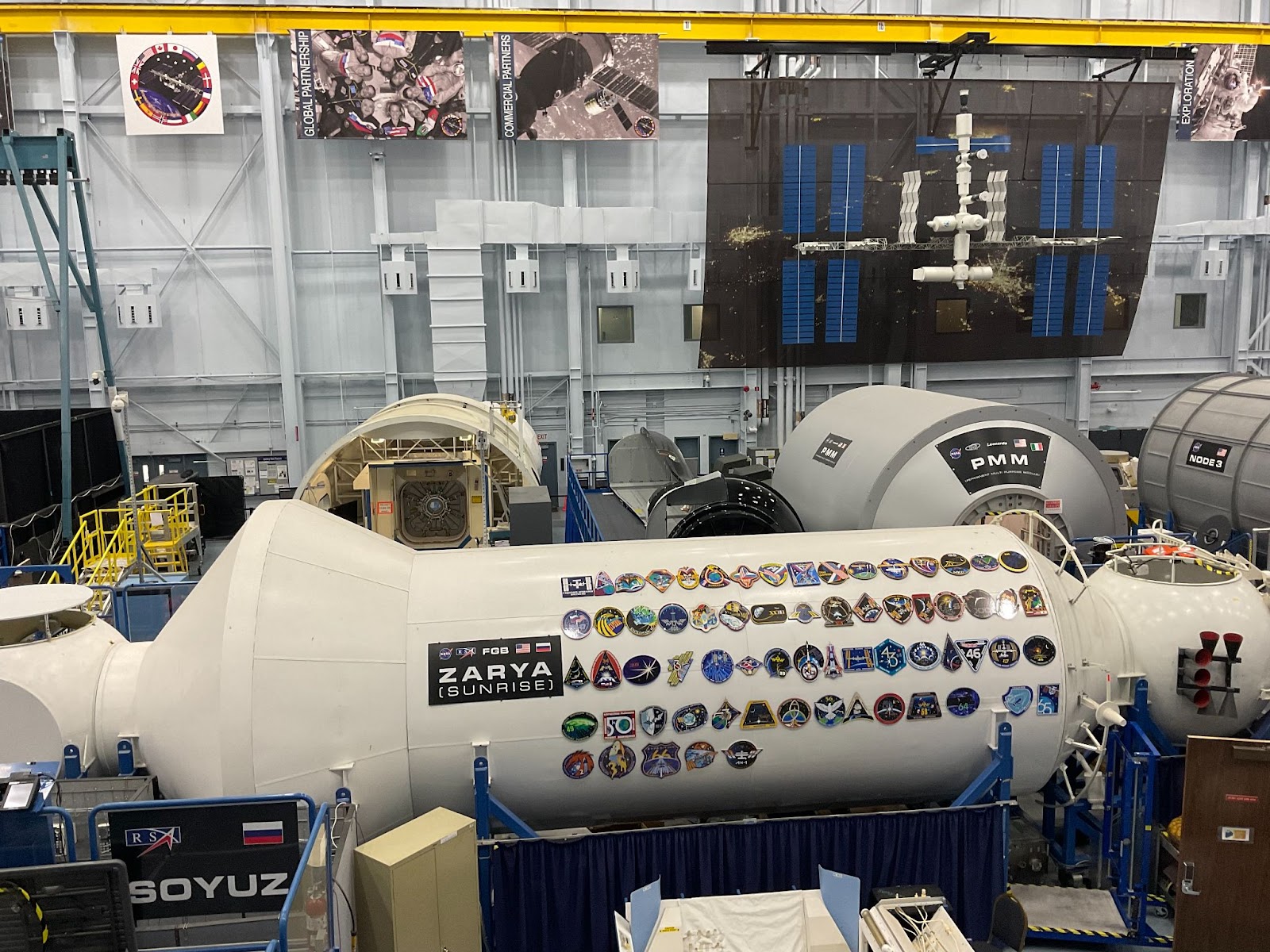
Before the Astronauts even get into the rocket and into space, they need to get trained. Houston is the training facility for the Astronauts. Other than doing physical training like weightlessness, they get into simulators to understand how the spacecraft feels like and what controls and systems it has. The picture below shows a segment of the International Space Station called “Zarya” which means sunrise in Russian. Russia contributed this segment to the International Space Station.
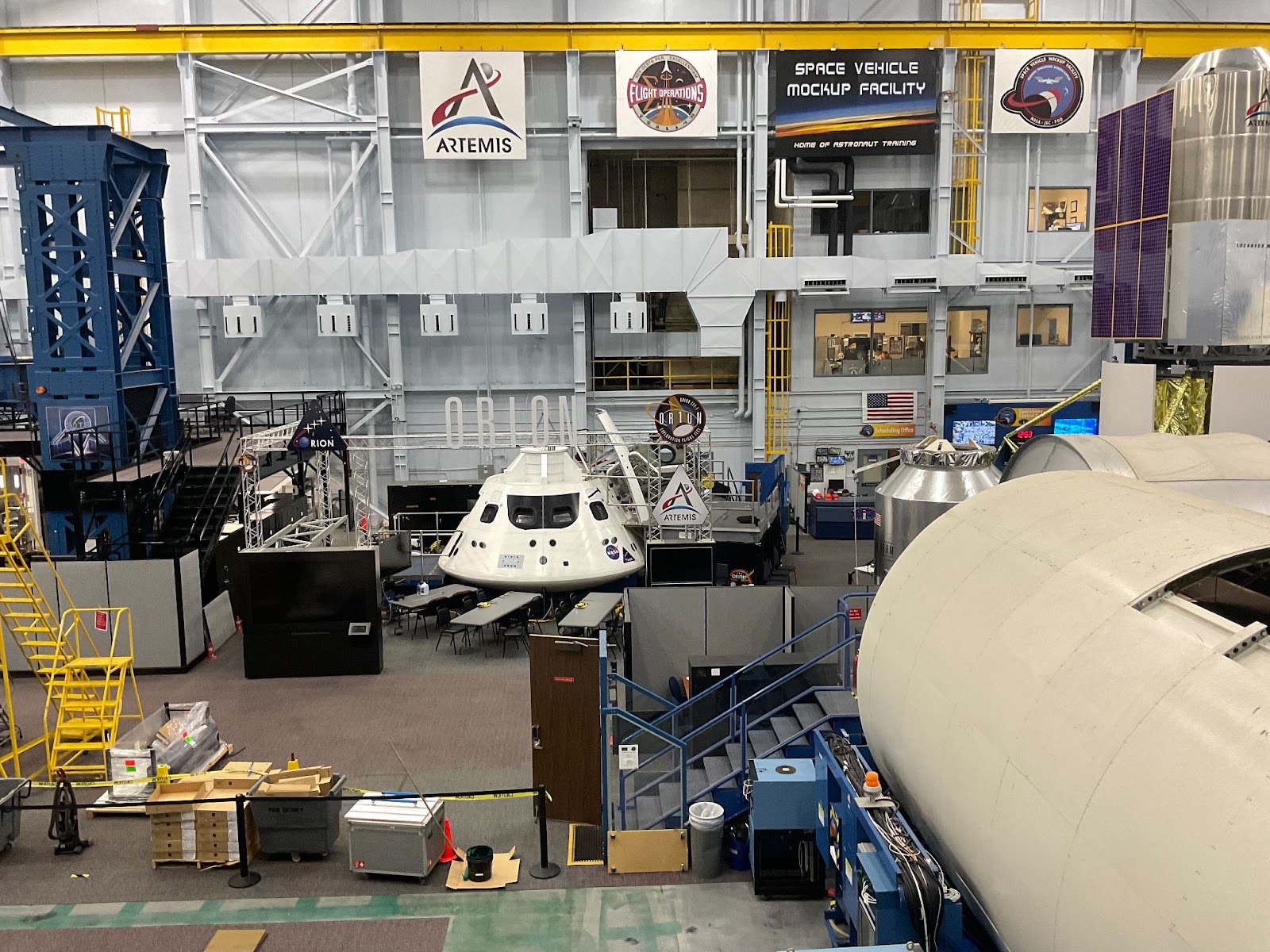
The picture below shows the mock up simulator of Artemis, the bell shaped compact white colored structure towards the rear of the room, right below the banners, the new spacecraft which is scheduled to carry astronauts to the moon in 2025.
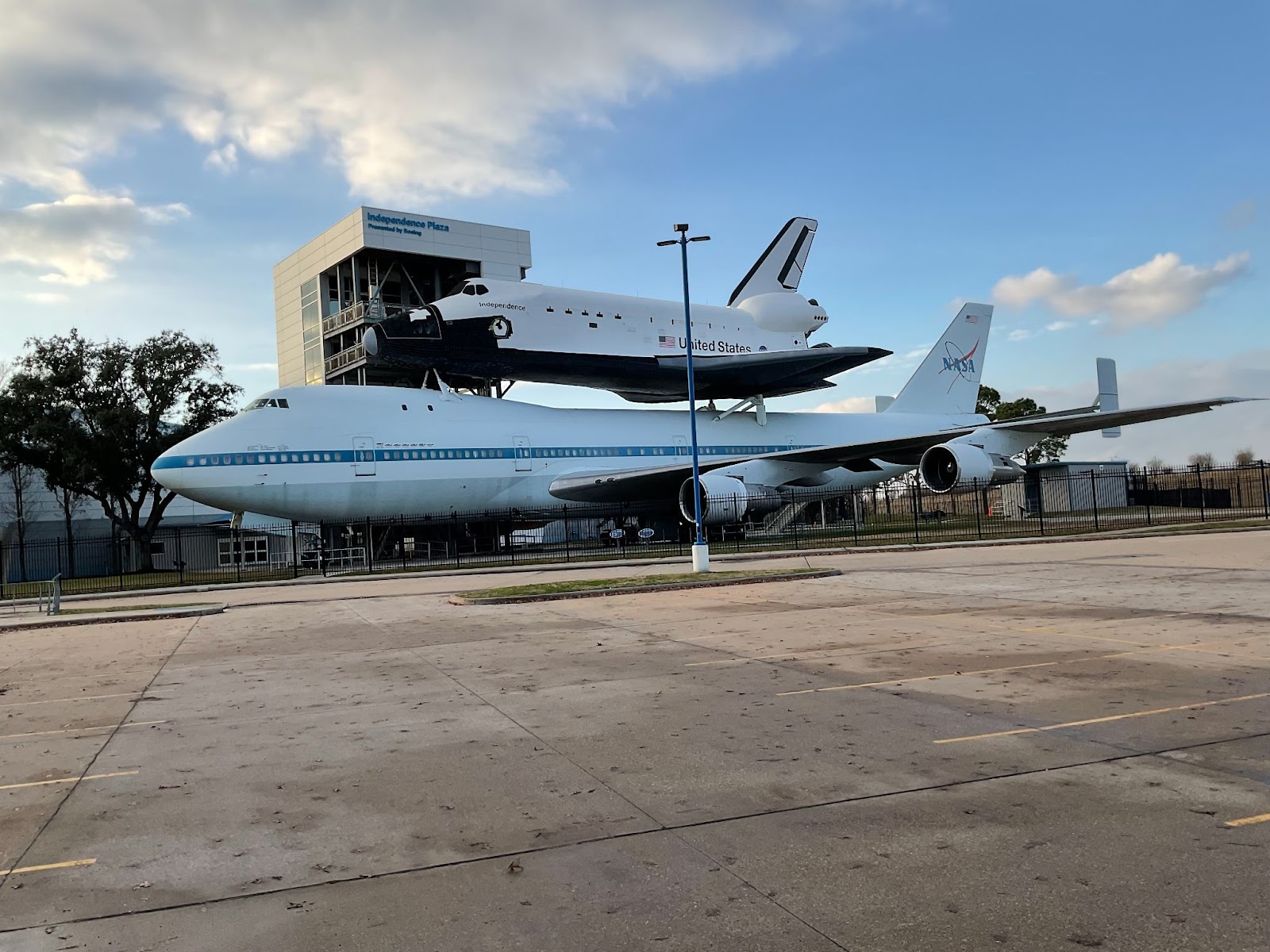
The space shuttle era followed the Apollo missions. It was a reusable spacecraft which took off strapped to a rocket, but came back into the earth’s atmosphere and landed like an airplane. Sometimes the landing happened in California when the weather in Kennedy Space Center was not favorable. In which case, it had to be ferried back to Florida for the next take off. A 747 Jumbo Jet was used for the purpose. The history of the concept and the design are well illustrated through a real sized exhibit shown in the picture below.
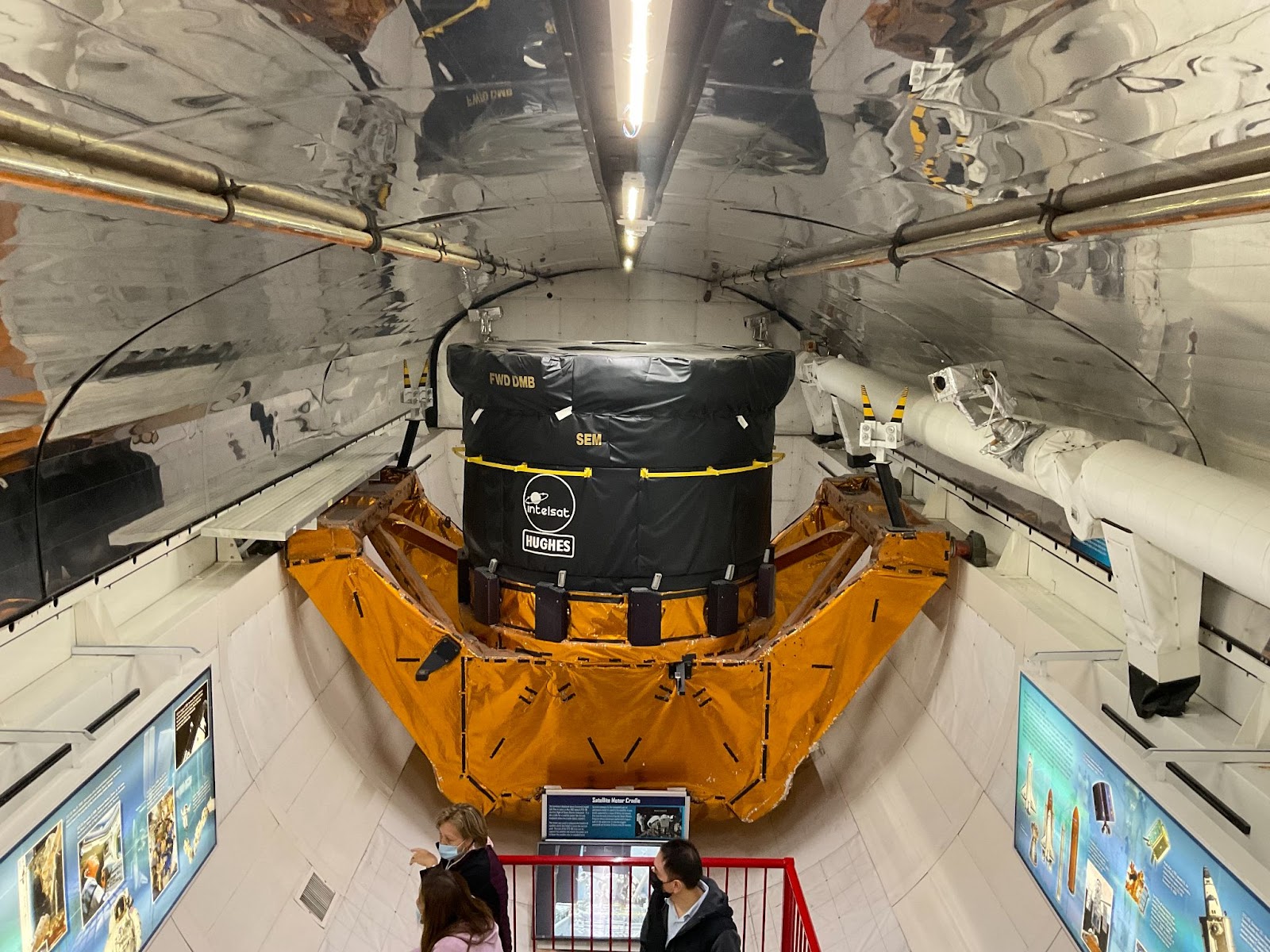
Visitors can climb into the 747 as well as the space shuttle on top of it. Given below is the picture of the cargo bay of the space shuttle. The Hubble telescope flew in this bay before it was released into space.
Most of the day was well spent in visiting the various exhibits. It is certainly a feast for the brain and the eyes, and be able to relive the historical moments of the space age.
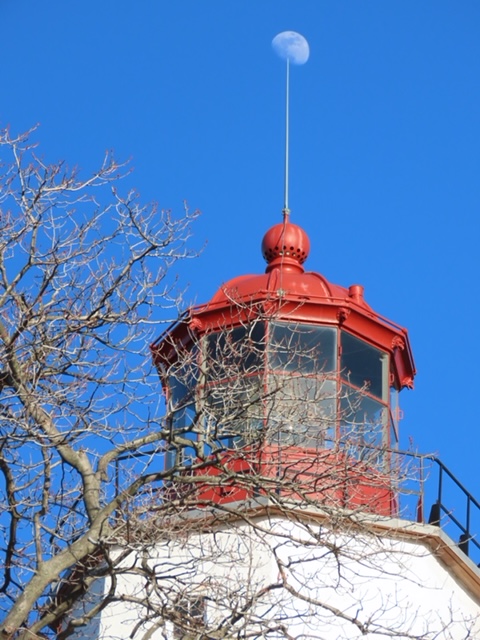
“Lighting the way” – Having some fun with the moon at the end of a fun day. The Sandy Hook Lighthouse is the oldest lighthouse in America (since the original Boston Light was burned down during the American Revolution.)
I enjoyed playing the game of place the moon in a fun position and was able to capture it atop the lighthouse.
📷: iPhone 13 ~ 2/11/22
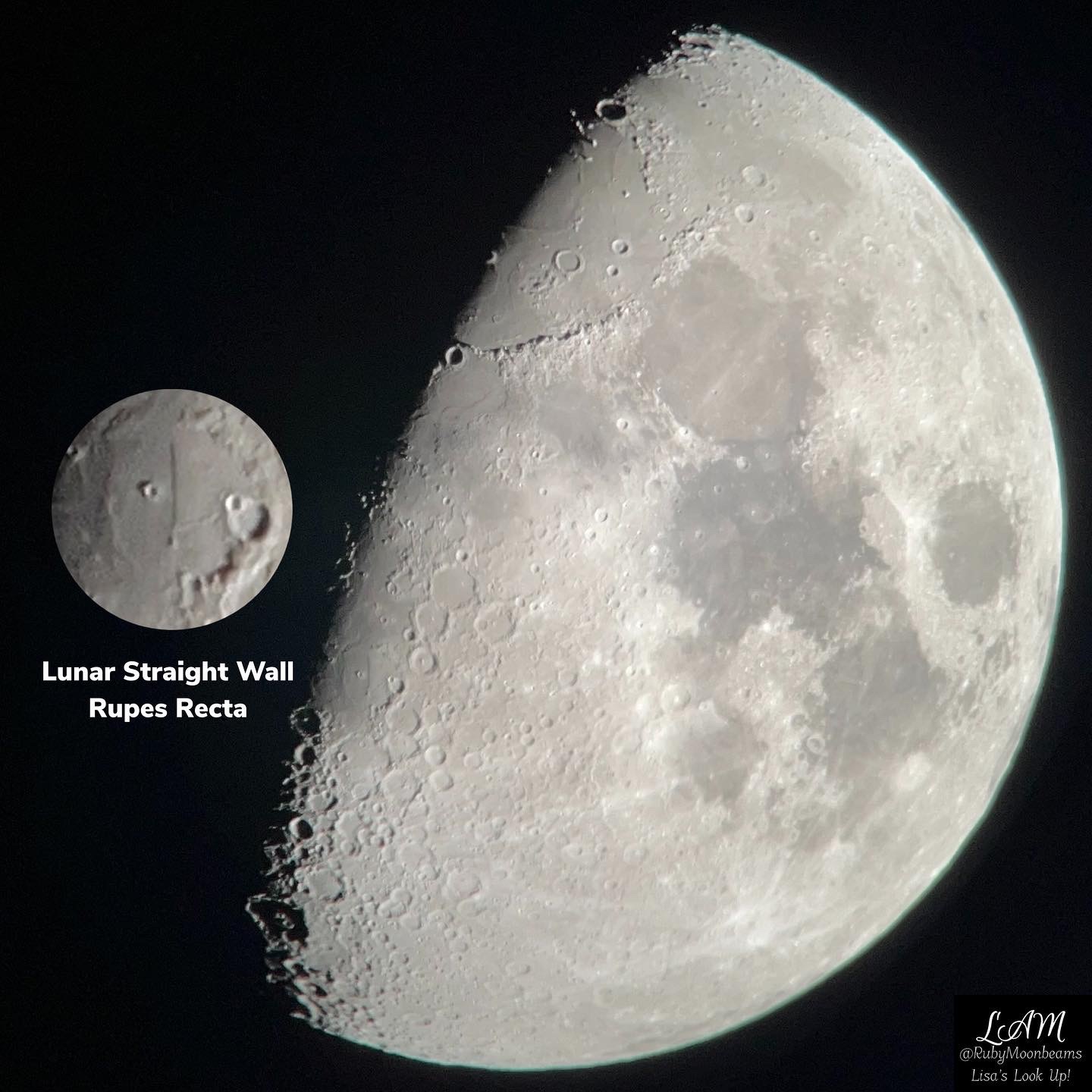
Waxing Gibbous Moon
February 9, 2022 – The day after First Quarter is always a fun time to look for the Straight Wall (Rupes Recta) as highlighted here.
IPhone 13 through Celestron NexStar Evolution 8- 40 mm eyepiece
Sunspots and Prominences 2/9/22
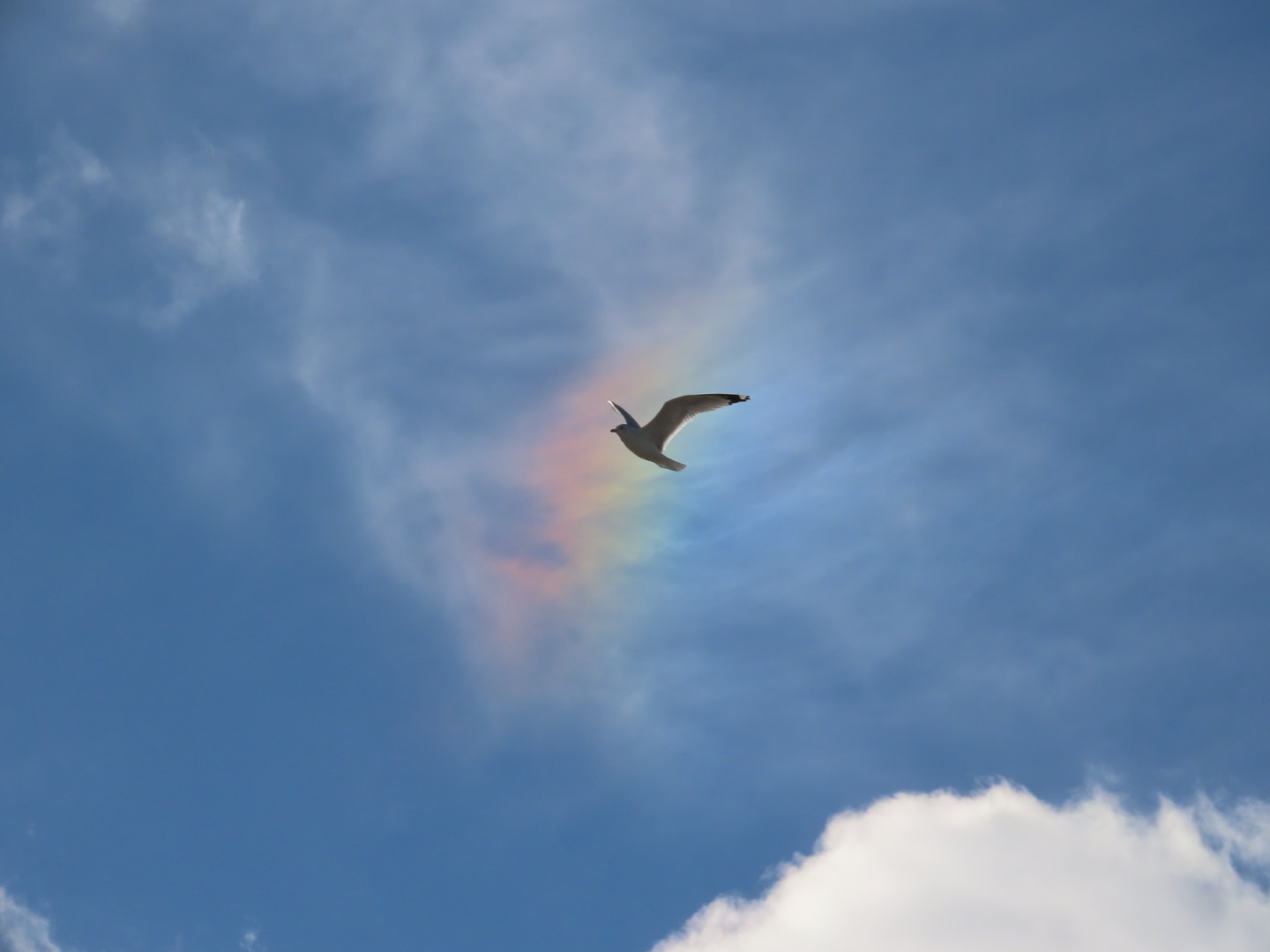
Sundog and a gull
A Ring-billed Gull flies through a sundog on Sunday at the Keyport waterfront Feb 7.
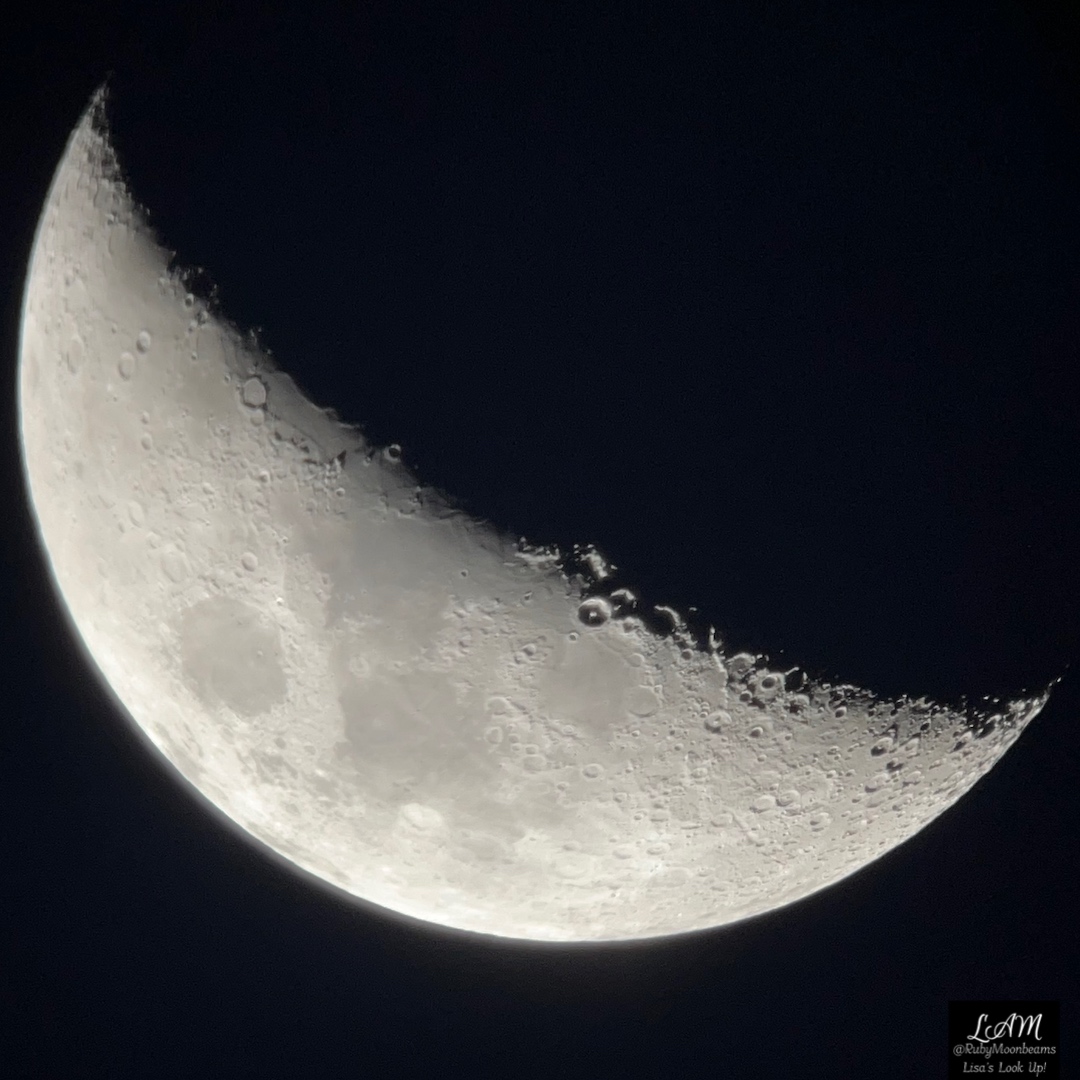
Waxing Crescent moon –
February 6, 2022 – 34%. I love these days around the first quarter. So many features revealed including Theophilus, Cyrillus and Catharina.
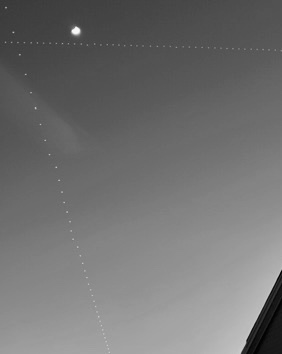
ISS Pass under the moon
February 6, 2022 5:46 PM EST
Equipment: iPhone 11 on a tripod
Processing: extracted from video; cropped for composition, converted to black and white for effect and resized in GIMP
Using the iOS app, “ISS Spotter,” I was able to determine when the ISS would be passing over our house. Visibility began from the Northwest at 5:45 PM traveling to Southeast. This gave me time to set up in my front yard, knowing it would pass horizontally over our home and under the moon. As I was capturing video, an airplane can be seen traveling vertically, which made for an intersection when stacked. 53 images were extracted from video and stacked in Starry Sky Stacker for iOS. I then cropped the image so that the pitch of the roof made for an interesting composition.
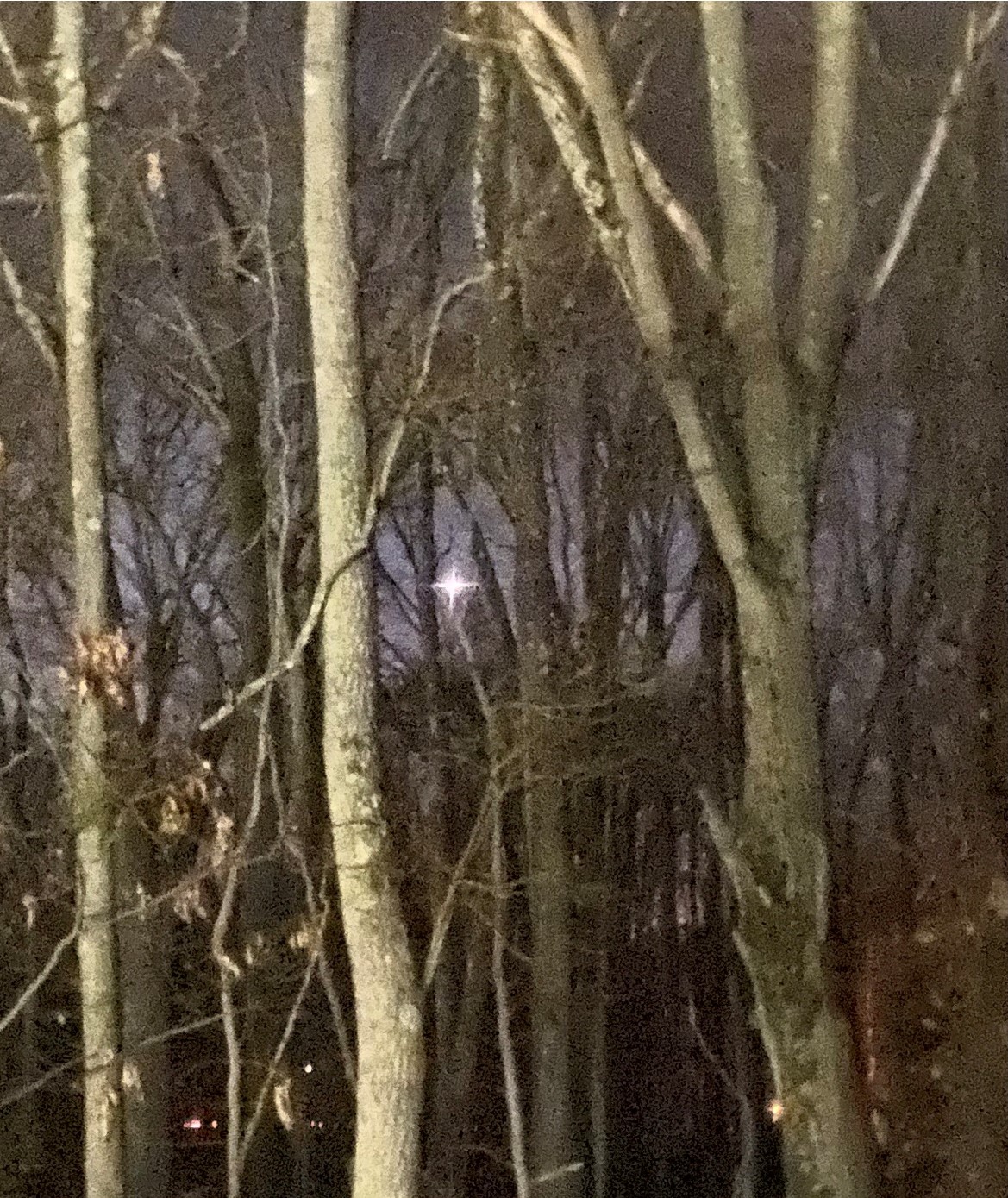
Planet Venus is greeting me every morning, weather permitting. To make sure that I don’t miss her brilliant presence, I leave the window blinds up and ready for the morning ritual. These two pictures were taken on February 10, 2022 between 5:40 and 6:30 A.M.
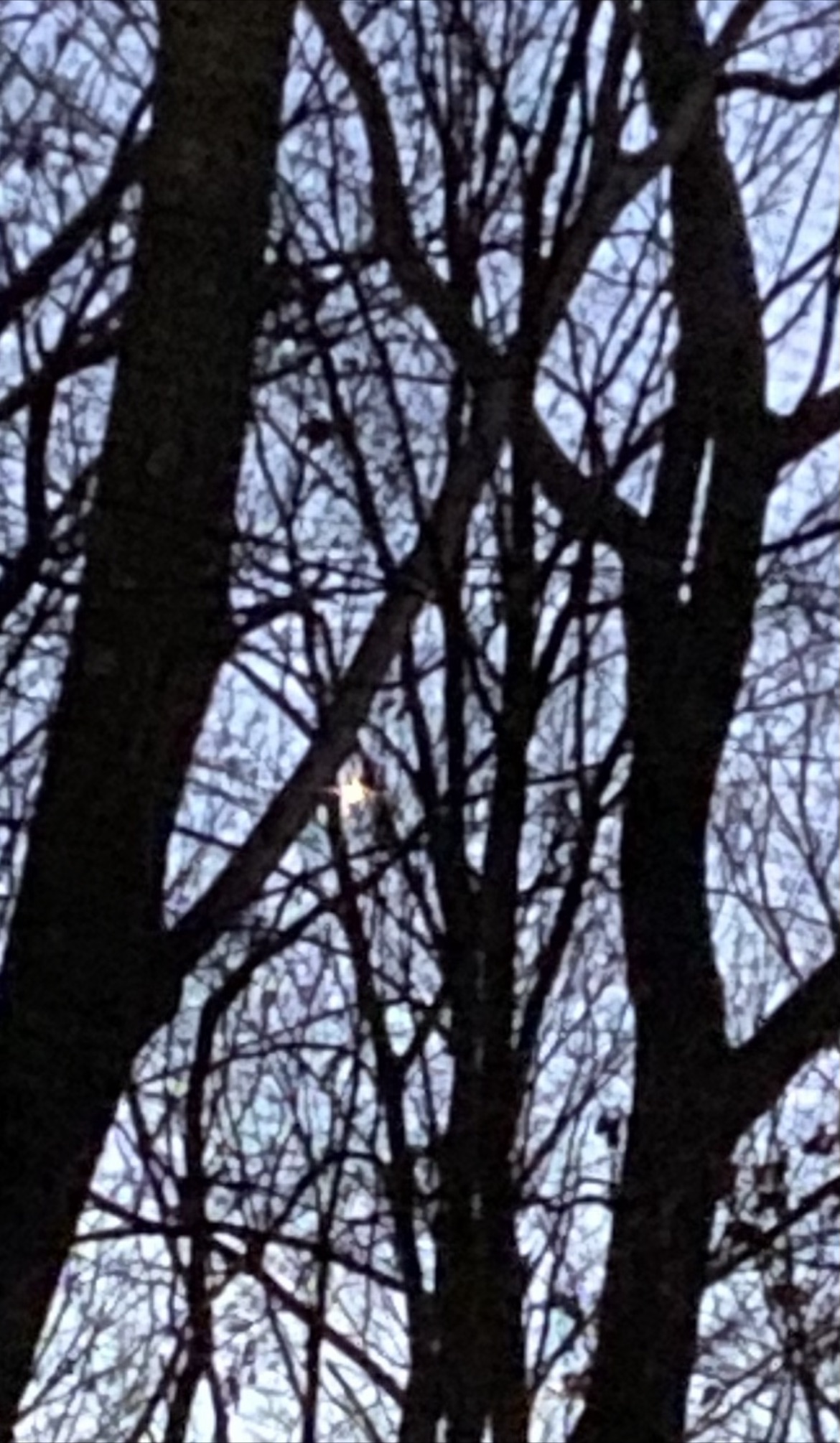
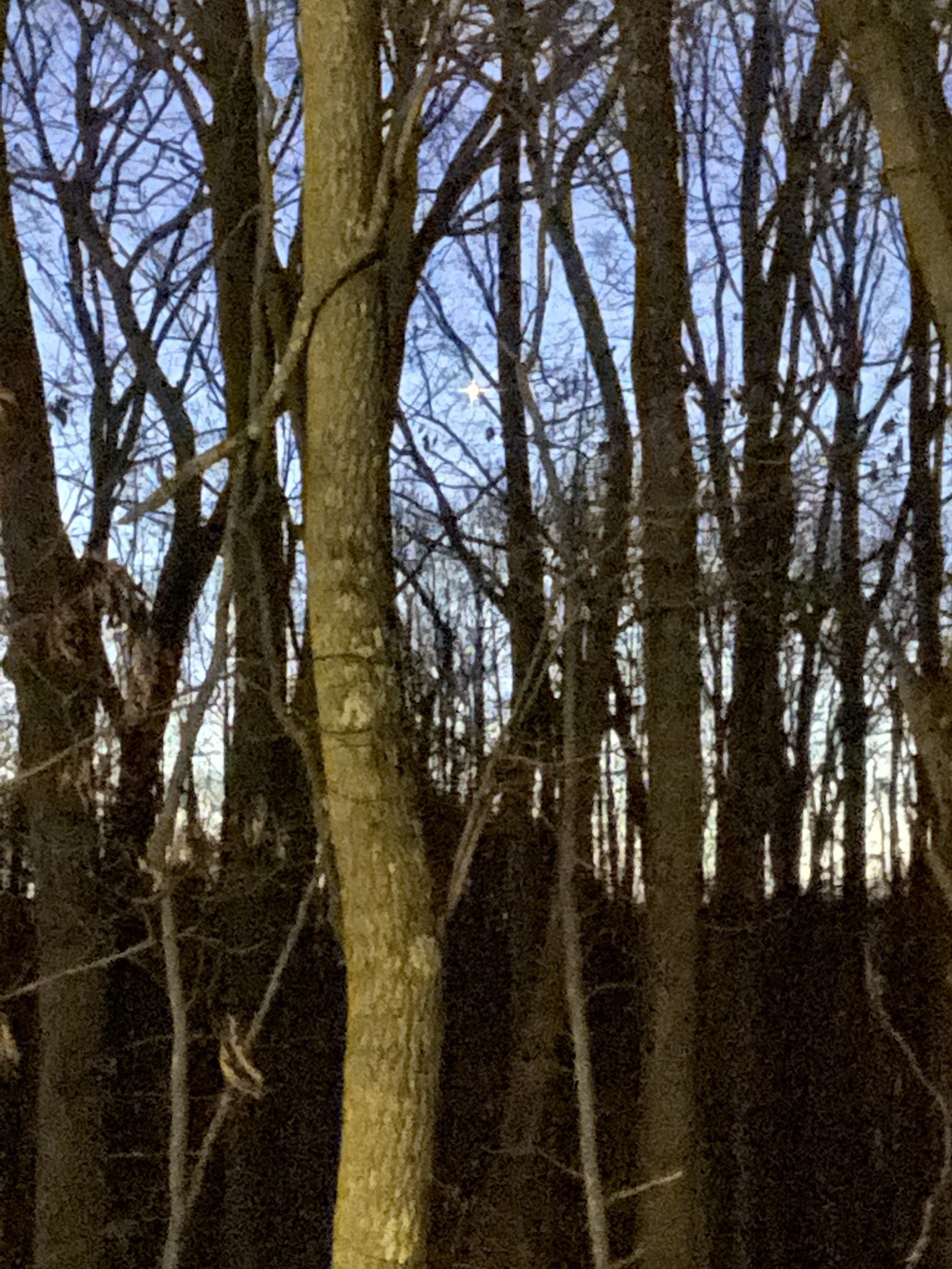
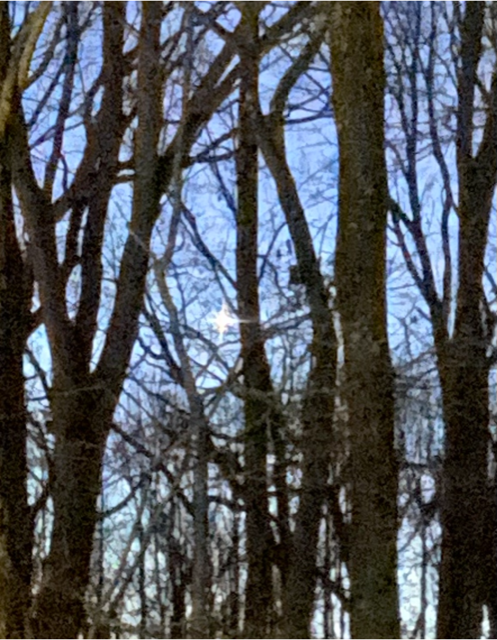
Bare trees during the winter months are permitting me to view the planet Venus. It’s the only time of the year I can wake up to her breathtaking brilliance. These two pictures below were taken on February 23 around 6:30 A.M. from my home in Princeton, NJ.
Iris: Student-built robot rover on track to explore the Moon William “Red” Whittaker may not be a household name, but he should be. The robotics professor has been leading the development of a tiny wheeled robot called Iris, which could become the first uncrewed rover sent by the US to explore the Moon…more
-NYT
Astronomers Find a New Asteroid Sharing Earth’s Orbit Astronomers have discovered a captive asteroid shadowing Earth in its orbit. The asteroid, known as 2020 XL5, is only the second of its type ever seen, shepherded by Earth’s gravity into an orbit that is locked in synchrony with our planet’s…more
-WP
The launch of NASA’s massive SLS moon rocket is delayed again. The much-anticipated rollout of NASA’s moon rocket and capsule to the launchpad at the Kennedy Space Center in Florida for a fueling test will be delayed for another few weeks, the space agency said Wednesday. But after years of setbacks and cost overruns…more
-BBC
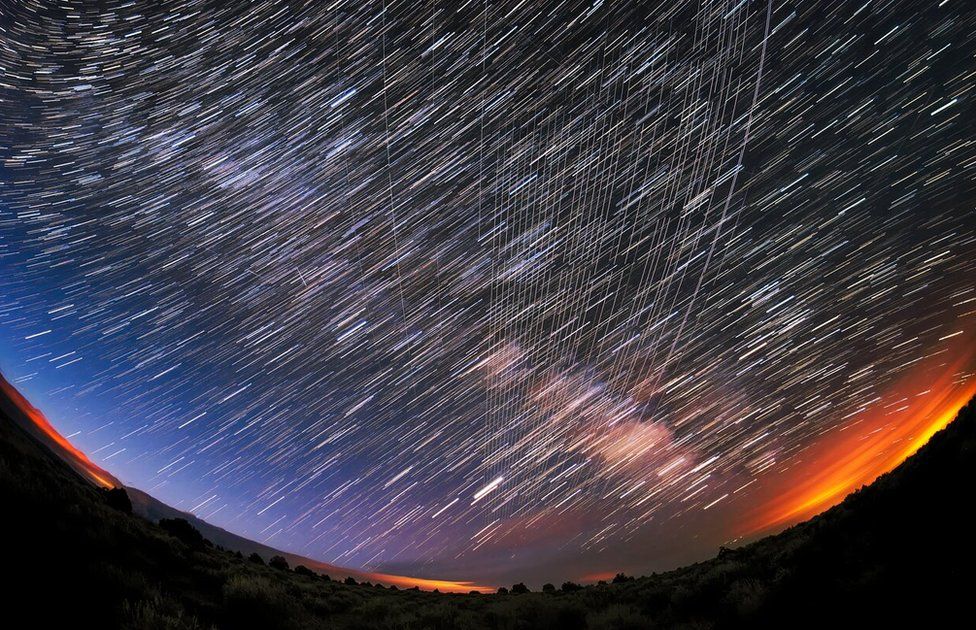
Astronomers stand up to satellite mega-constellations Astronomy is finally putting up a co-ordinated front to defend its interests as thousands of satellites are placed in the sky. Huge networks of spacecraft are being launched that are making it harder to get a clear view of the cosmos…more
-NYT
The First Quadruple Asteroid: Astronomers Spot a Space Rock With 3 Moons Astronomers had already spotted two other rocks orbiting the asteroid known as 130 Elektra, and think more quadruple systems are out there. We already knew the asteroid 130 Elektra was special. Astronomers previously discovered it had two moons, making it a rare triple asteroid system…more
-sNYT
Solar Storm Destroys 40 New SpaceX Satellites in Orbit The geomagnetic incident resulted in the Starlink transmitters drifting back into Earth’s atmosphere, where they will burn up, potentially costing the company about $100 million. Over the past three years, SpaceX has deployed thousands of satellites into low-Earth orbit as part of its business to beam high-speed internet service from space…more
-BBC
James Webb telescope begins to focus its ‘big eye’ Astronomers intend to use the $10bn observatory and its remarkable 6.5m-wide primary mirror to capture events that occurred just a couple of hundred million years after the Big Bang. They want to see the very first stars to light up the Universe…more
– BBC
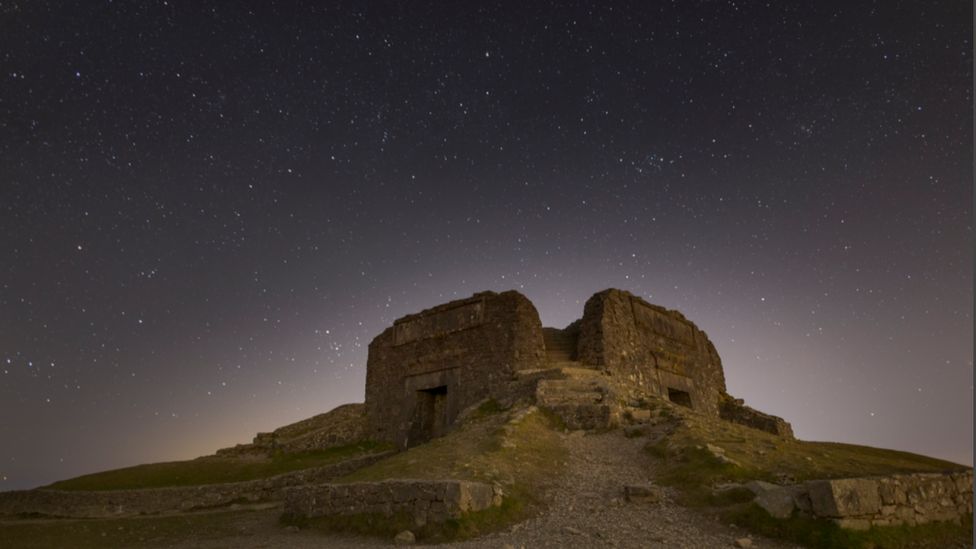
Dark sky: Could Wales soon be home to four zones? A swathe of the north-east Wales uplands could soon be recognised as a hotspot for gazing at the stars. The Clwydian Range and Dee Valley Area of Outstanding Natural Beauty (AONB) plans to submit a bid for global recognition as a dark sky zone…more
-NYT
Beneath a Blanket of Stars It isn’t as easy as it once was to find a dazzling night sky. In search of the Milky Way, our writer headed to Utah, which has the densest concentration of designated Dark Sky places in the world. Roughly 99 percent of the people living in the United States and Europe see only a dim approximation of stars in the night sky, nothing close to the bright firmament…more
On with the Show. As we move into mid-winter it gets harder to do astronomy outside. Better to curl up with a good book or click the link to a seminar for your astronomy experience this month. At the AAAP meeting on Feb 8 we offer a Princeton University guest speaker, Dr. Christopher Spalding, Postdoctoral Fellow in the Dept of Astrophysical Sciences. For info about the talk and the Zoom link see the section below from Program Chair Victor Davis.
Last month’s session with Dr Robert Williams of STScI was one of the best attended (61) since we’ve been Zooming. If you missed that meeting or other recent astrovideo live sessions, see the AAAP You Tube channel (link below). Thanks to Victor Davis, Dave Skitt and Ira Polans for recordings and editing. https://www.youtube.com/channel/UCiJvXfK9DGCmGwiKK_Q6ieg.
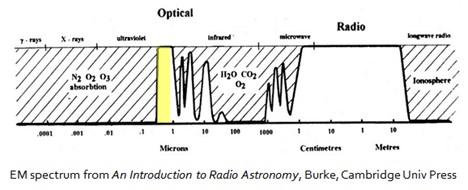
Visualizing Astronomy. What would it be like to see in the infrared? This question arises as we look forward to the commissioning of the James Webb Telescope, which unlike Hubble and most other telescopes was designed to see in the infrared and not the visible spectrum. So why can’t we see outside the visible range (Figure below, electromagnetic spectrum with visible wavelengths in yellow)? This is a circular question that shows that our perception of the universe has been completely shaped by the wavelengths we can see.
The development of sight in animals is a deep topic in evolutionary biology, and in astronomy the limit of eyesight has an obvious major role. As early as 1604 the Renaissance astronomer Johannes Kepler recognized this. His treatise Astronomiae Pars Optica, explores the properties of light and in line drawings the structures of the eye of several animal species are depicted. Two main reasons can be deduced for the limited spectral range of our eyes. Firstly, the earth’s atmosphere absorbs most of the radiation outside this range (Figure above, cross-hatched areas).
This opacity to radiation is due to fundamental properties of atoms and molecules in the gaseous state in the atmosphere and is essential for earth’s hospitality to life. Water vapor strongly absorbs much of the infrared band, which is why infrared astronomy largely relies on orbiting telescopes, hopefully including the Webb. The second major reason is that the molecular biochemistry of photoreception depends on chromophore-dependent biochemical processes which have been fine-tuned over the millennia to absorb light in the 400-700nm range of the spectrum only. A photoreceptor that could detect outside this range was unlikely to be assembled from the proteins and accessory pigments available in evolution. Such a photoreceptor would need a quite different molecular structure beyond the scope of molecules evolving in the history of life. Our perception of the cosmos has earthly underpinnings only now being loosened by the advances of science and engineering.
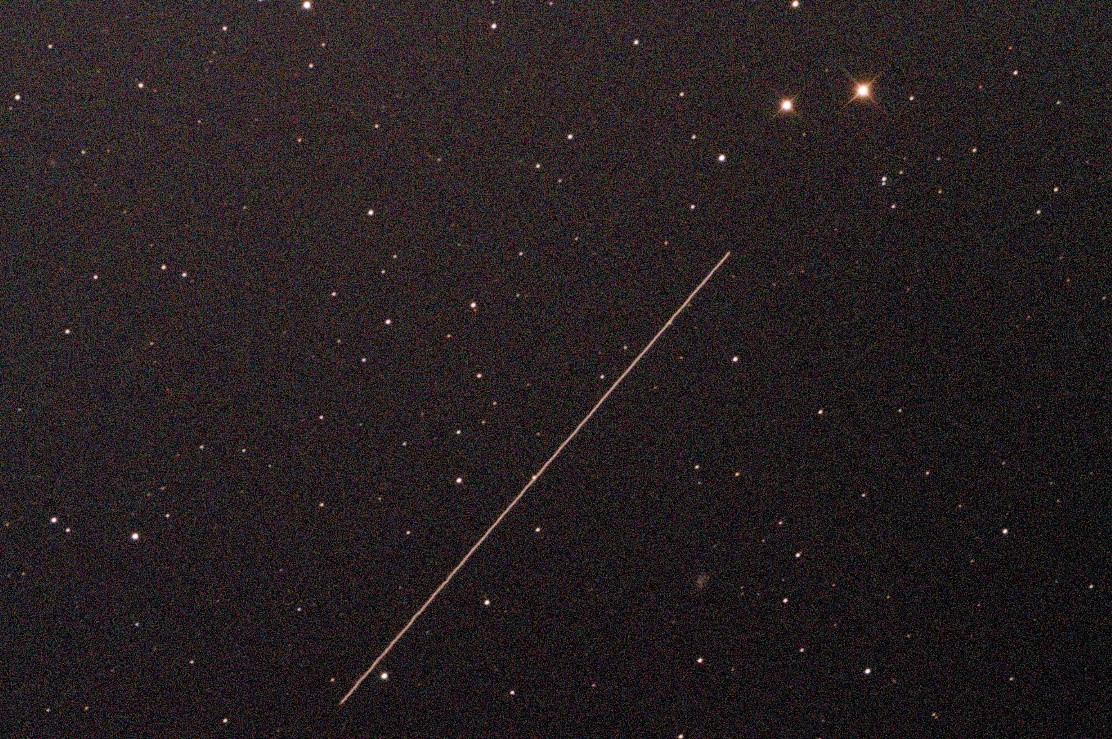
Speed of an Asteroid. At the meeting last month I tossed out an astro challenge for members with telescopes to observe a celestial object that few people ever see. The challenge was to observe, and for extra credit take images, of the near-earth Asteroid 7482 1994 PC1 on or about the day of its closest approach to earth, ~6pm Jan 18. It would be dim (magnitude ~10.3) but potentially observable from central NJ for only a couple of hours after twilight that night. I have heard that several AAAP members succeeded in the challenge. Here I offer my own observations and a calculation of the speed of the asteroid based on the data collected, illustrating what amateur astronomers can do with today’s equipment.
The original 1994 discovery of this asteroid by R.H. McNaught in Sidings Springs Australia is written up in The Minor Planet Bulletin (vol 24, no.4, Oct-Dec 1997), accessible by internet search. A little over 1 km in diameter, asteroid 7482 is one of about 1600 Apollo objects whose elliptical earth-crossing orbits make them top candidates for a possible collision in the future. In this case, with an orbital period of 1.65 years, one of its close approaches to earth happened on Jan 18, 2022. Predicted to come within 0.013 AU (1.2 million miles) of the earth, 7482 sped by at a distance only slightly greater than the Webb Telescope orbital distance!
The days leading up to the event were cloudy, but amazingly the clouds over New Jersey dispersed around sunset on Jan 18. With the near full moon rising at 5:40pm, observers had to work swiftly to catch the asteroid between twilight ending and full moon rising. The astroimage below shows the path of the asteroid captured in a 10 min exposure with my 12.5” reflector telescope. The brightest star in this image is 8.8 magnitude, the asteroid 10.3. The speed can be better appreciated in an MP4 movie (click icon under the image below). In the movie below, 58 frames of 12 seconds were combined for a total elapsed time of 11.6 minutes. The asteroid blazed across the sky!
Asteroid 7482 1994 PC1 at close approach on Jan 18, 6:15pm. Image from central NJ using 12.5” telescope and ASI071 camera. The 10 min exposure with tracking on stars reveals the movement of the asteroid as a streak. Click on the icon below for video. Astrophotos by RAParker.
Just how fast is “blazed across the sky”? With the tools of the modern amateur astronomer, we ought to be able to solve this. I measured the distance in pixels movement in the image above using trigonometry (Pythagoras theorem) and used it to calculate angular velocity in radians per minute. Then I used the formula for angular speed ω = θ/t (where ω is angular speed, θ is angle of rotation in radians, t is time); the known scale of the optical system (0.46 arcsec per pixel);and the formula to convert angular to linear velocity: v = r ω. From the data and these formulae I calculated the approximate speed of the asteroid to be 42,500 miles per hour. According to earthsky.org, professional astronomers calculated the speed at 43750 mile per hour, so my error was less than 3%. To give some perspective, the moon in its orbit speeds along at 2288 miles/hr. The asteroid flew by the earth at almost 19 times the speed of the moon!
A little over two years from now, on April 8, 2024 there will be a total solar eclipse that will cross most of North America. While New Jersey will not be within the “path of totality” those in the following cities will see much of the sun’s light blocked out, to the following percentages.
Trenton 89.1%
Newark 90.1%
New York City 89.9%
Cities that will be within the path and, thus will be a witness to the total eclipse include Cleveland, Ohio, Erie, Pennsylvania, Niagara Falls, New York, Buffalo, New York and Rochester, New York. The latter is the closest to Princeton at roughly 340 miles, a five hour, fourteen minute drive. I believe all of these cities have airline access.
While this eclipse is a long way off and many of us have more pressing astronomical and otherwise important things by which we can concern ourselves, I am proposing, that the AAAP start to work on a “field trip” to the Solar Eclipse. So any AAAP member interested in joining the Second AAAP Solar Eclipse Excursion, should send me your contact information and I will start to forward relevant trip information as it is gathered. Send an email to assist.director@princetonastronomy.org. Once an observing location is selected, based on anticipated weather patterns, accessibility, lodging and local astronomy contacts, we can get down to the logistics of the trip.
The February, 2022 meeting of the AAAP will take place (virtually) on Tuesday, February 8th at 7:30 PM. (See How to Join the February Meeting below for details). This meeting is open to AAAP members and the general public. Participants will be able to log in to the meeting as early as 7:00 pm to chat informally with others who log in early. We will not be using the “waiting room;” participants will enter the meeting as soon as they log in. However, you will enter the meeting space with your microphone muted. This will help to remedy some of the background noise we experienced during some previous meetings. Please be aware you must unmute yourself to be heard by other participants.
For the Q&A session, you may ask your question using Zoom’s chat feature or you may unmute yourself and ask your question directly to the speaker. To address background noise issues, we are going to follow the rules in the table below regarding audio. If you are not speaking, please remember to mute yourself. You are encouraged, but not required, to turn your video on.
Meeting Event
Participant Can Speak?
Participant Can Self-Unmute?
Pre-meeting informal chatting
Start All on Mute
Yes
Director Rex’s General Remarks
Yes
Yes
Program Chair Victor’s Speaker Introduction
Yes
Yes
Speaker Presentation
No
No
Q&A Session
Start All on Mute
Yes
5-minute bio break
Yes
Yes
Journal Club presentation by Surabhi Agarwal
Start All on Mute
No
Business Meeting
Start All on Mute
Yes
Director’s closing remarks/Informal chatting
No
No
Only the Business part of the meeting will be locked.
Featured Speaker: Dr. Christopher Spalding, 51 Pegasi b Postdoctoral Fellow in Princeton University’s Department of Astrophysical Sciences. (christopher.spalding@princeton.edu)
Upside-down, Inside-out Solar Systems The planets of our Solar System follow orbits that resemble concentric circles, with the Sun spinning in the same direction as the planets orbit. This “clockwork” picture filled textbooks and research papers alike for centuries. But the past decade of exploring exoplanets has revealed a puzzle: Many of them seem to orbit “backwards”–opposite to the spin direction of their host stars. How could this be? Moreover, these worlds usually exist 10 times closer to their stars than Mercury does to the Sun. Clearly, something very different led to the creation of these “upside-down, inside-out” systems as compared to our Solar System. In this talk, Dr. Spalding describes the weird and wonderful properties of these alien worlds and discusses what they are teaching us about the origin of our own planet Earth.
Christopher Spalding earned his BA and MSci degrees from Cambridge University with first class honors, and his PhD in Planetary Science from Caltech. He has won numerous honors and awards, including the Ray Duncombe Prize for Dynamical Astronomy, a NASA Earth and Space Science Fellowship (NESSF) Graduate Fellowship in Earth and Planetary Science, a 51 Pegasi b Postdoctoral Fellowship, and most recently, and closer to home, a Lyman Spitzer Jr. Postdoctoral Fellowship. Dr. Spalding’s primary research seeks to understand planet formation by way of simple theoretical descriptions of planetary dynamics. He enjoys applying simplified mathematical methods to extract important lessons from problems spanning planetary system formation and architectures, Earth’s long-term habitability, extinction dynamics, and more. He’s active in science education and outreach as a teacher, guest lecturer, and colloquium organizer.
51 Pegasi b is the first planet discovered orbiting a Sun-like star, discovered in October 1995. This gas giant is about half the mass but half again larger than Jupiter, and orbits its star in 4 days. It fits the description “hot Jupiter” typical of the first exoplanets, which were discovered using radial velocity measurements of their host stars. The 51 Pegasi b Fellowship “provides an opportunity for promising recent doctoral scientists to conduct novel theoretical, experimental, or observational research in planetary astronomy.”
AAAP webcast: This month’s AAAP meeting, beginning with Rex’s opening remarks and ending at the beginning of the business meeting, will be webcast live on YouTube and recorded for subsequent public access on AAAP’s YouTube channel. Be aware that your interactions during this segment, including questions to our guest speaker, may be recorded for posterity.
This session will be recorded and saved on YouTube. Send me an email at program@princetonastronomy.org if you have any concerns.
Using Zoom: While we are social distancing, the AAAP Board has chosen to use Zoom for our meetings, based our belief that many members have already have used Zoom and its ease of learning. One of its great features is you can choose whether you want to install the software on your computer or use it within your browser.
How to Join the February Meeting:For the meeting, we are going to follow a simple two-step process:
Please make sure you have Zoom installed on your computer. You do not need a Zoom account or need to create one to join the meeting. Nor are you required to use a webcam.
Following the post-presentation bio-break, Surabhi Agarwal will describe her experiences as a citizen advocate for remedying light pollution. Inspired by Rex’s community activism against light pollution, Surabhi will report on her efforts to fight light pollution in her own community, and encourage the rest of us to do the same.
We hope to make these short presentations a regular feature of our monthly meetings. We’d like to know what members are doing or what members are thinking about in the broad range of topics encompassed by astronomy. A brief ten-minute (or so) presentation is a good way to introduce yourself and the topics you care about to other club members. If you are interested in presenting a topic of interest, please contact either director@princetonastronomy.org or program@princetonastronomy.org.
A look ahead at future guest speakers:
March 8, 2022
Rosanne Di Stefano, of the Center for Astrophysics/Harvard and Smithsonian, led a team who used the Chandra X-ray observatory to search for brightness dips in X-ray binaries. They may have detected a transiting exoplanet in the spiral galaxy M51. To date, all exoplanet candidates (4,000+ and counting) have been discovered within 3,000 light-years of Earth. An exoplanet in M51, 28 million light-years away, would be thousands of times farther away than those in the Milky Way.
April 12, 2022
Paul Daniels, FRAS, an active participant in the Royal Astronomical Society’s Megaconstellation Working Group, will discuss the serious threats to professional and amateur astronomy posed by launching thousands (potentially 100K+) of reflective objects into low Earth orbit.
May 10, 2022
TBA
June 14, 2022
Bill Murray, AAAP Outreach Chair and astronomer at the New Jersey State Museum will once again (following a Covid hiatus) give club members a private sky tour at the museum’s planetarium. He’ll show off the refurbished planetarium’s state-of-the-art Digital Sky 2 8K projection system. This is an opportunity to put aside Zooming and commiserate with astro-buddies in the real world.
Thanks to Bill Thomas, Ira Polans, and Dave Skitt for their valuable advice and assistance.
As always, your comments and suggestions are gratefully accepted.
The meeting was convened on Zoom by Director Dr. Rex Parker at 1930 with the agenda for the evening.
At 1945 Program Chair Victor Davis introduced featured speaker Dr. Robert Williams who presented “Observing Galaxy Formation with the Hubble Space Telescope” from his home. His limited internet bandwidth restricted us to his voice, gave us some dropout issues, and Victor had to run a copy of his slide pack. Among lots of other interesting information, he too modestly described how he had risked his job as director of the Space Telescope Science Institute to point Hubble at an empty patch of sky for 400 orbits. In doing so he captured the momentous, game-changing Hubble Deep Field image. We broke for five minutes at 2101, then reconvened for a briefing on the James Webb Space Telescope and questions.
We transitioned directly to the business meeting at 2125, the Unjournal Club Presentation by member Surabhi Agarwal having been postponed to next month.
Rex briefed us on details about approaching Apollo Asteroid 7482 / Minor Planet 1994PC1, then challenged members to observe and capture images of it on or around its closest distance of 0.013 AU on January 18. Share your experience on Discord and in an article for the Sidereal Times. He encouraged us to watch the Netflix movie “Don’t Look Up” about an Earth-impacting asteroid for “extra credit.”
Rex presented an overview of the AAAP Discord Server, a restricted social media platform launched last month, noting that 45 members had signed on so far. He made an appeal for two or three members to step up to serve as monitors.
Rex announced that he had placed his first order at the AAAP Online Merchandise Shop, and some discussion followed.
Observatory Co Chair Dave Skitt announced that water has been turned off and the toilet winterized in the Observatory. It is not closed to use, but manual flushing, where you bring your own water and then use antifreeze, is now required. Check with Dave for the correct procedure before you go.
Rex reported that the January 7 Astrovideo Live Winter Zoom Session included views from the telescope cameras of members Bill Murray, Rich Sherman, and himself, while Dave and Jen Skitt fired up the C-14 in the Observatory. Members with camera capability are encouraged to join in and contribute to future sessions planned for February 4 and March 4. Other members are invited to enjoy the views and discussions from the warmth and comfort of your own home, as some 15 had done during this session.
Member Tim Gong shared that he has been engaged in photometry and agreed to offer an Unjournal Club Presentation about his effort at the March meeting.
Member Lee Sandberg was encouraged to inquire about the use of the auditorium at the Institute for Advanced Studies while Peyton Hall is denied to us due to both Covid and impending campus construction.
Member Surabhi Agarwal reminded us that 2022 is the Diamond (60th) anniversary of the AAAP. A suggestion was made that a logo be created for this event, and she offered to submit one for consideration. The logo could be applied to various merchandise items.
Discussion about the mechanics of posting images and files on Discord wound down and the meeting was adjourned promptly at 2200.
Between Zoom and the live YouTube feed, approximately 66 people attended the speaker’s presentation. The business meeting began a bit later than usual but 35 were still connected halfway through. Since the beginning of December, 11 new members have joined, bringing our total membership to 191.












 Amateur Astronomers Association of Princeton