Minutes of the May 9, 2023, AAAP Members General Meeting

by Gene Allen, Secretary

The meeting was convened in Peyton Hall and on Zoom by Director Rex Parker at 1935. Following a brief introduction and presentation of an agenda, Program Chair Victor Davis introduced Speaker Alain Maury, an international citizen and professional astronomer currently visiting the US. His topic was The Hunt for Near Earth Asteroids. From the dawn of the space age when only 20 Near Earth Asteroids were known, advancements in technology have enabled the count to exceed 30,000 by 2022. Mr. Maury described that progress and his long and still ongoing participation in the effort. His impressive accomplishments are detailed on the website that also describes his lodge and observatory in San Pedro de Atacama, Chile, just a few miles north of ALMA. https://www.spaceobs.com/en/Alain-Maury-s-Blog/Who-am-I

There were 31 attending in person and 33 on Zoom.

After questions and a brief break, the business meeting resumed at 2116 with only 17 still connected online and 20 in the auditorium. Contributions by members other than the elected officers were acknowledged.

               Surabhi Agarwal, longtime Webmaster and newsletter Editor

               Debbie Mayes, enthusiastic promoter recently named Promotions Chair

               Mike DeMario, astrophotography advocate recently named Astroimaging Chair

               Rich Sherman, singlehandedly established AAAP Merchandise

               Ira Polans, former Chair and continuing Program Committee contributor plus network coordinator

The AAAP Membership Roster had been updated that day to show 201 current members, meaning that the required 15% quorum amounts to 30. Nominations Chair Lee Sandberg reported that no further nominations had been received. A motion was made and seconded to accept the slate of incumbent officers.

Director: Rex Parker

Assistant Director: Larry Kane

Treasurer: Michael Mitrano

Secretary: Gene Allen

Program Chair: Victor Davis

Observatory Co-Chairs: Jen & Dave Skitt

Outreach Chair: Bill Murray

There were 17 members present in the auditorium and all voted in favor. Online another 9 votes in favor were received with no dissentions. The total, however, was only 26. John Church had given his proxy in favor and that made 27, still short of making it a valid election. It’s rather shameful that not even 15% can show up for an annual election.

The loaner telescopes are still not ready to loan out.

The eclipse travel group meeting came up with a weak consensus of a group willing to travel to Texas and another that might coordinate to some location in the middle of the country. Assistant Director Larry Kane is coordinating research and participation.

Ten minute Unjournal Presentations by members are still invited.

Outreach Chair Bill Murray will be following a star show at the NJ State Museum Planetarium with a convoy to Simpson Observatory on May 12 and 19, weather permitting.

The June meeting talk will be about Arecibo and held at the NJ State Museum Planetarium at 205 W State St in Trenton. A live star show will be included.

A wide field telescope field of view to compliment the C14 is being assembled. It currently consists of a SkyWatcher Evo 50 scope and a ZWO ASI585MC astronomical camera. The four Board members present in the auditorium approved spending up to $1,000 to complete that project.

Observatory Co-Chair Dave Skitt offered an update on the other projects at the Observatory.

  • We are still seeking someone to coordinate and oversee professional installation of new carpet.
  • Opening the observatory is planned to observe the occultation of Jupiter by the Moon at dawn on May 17
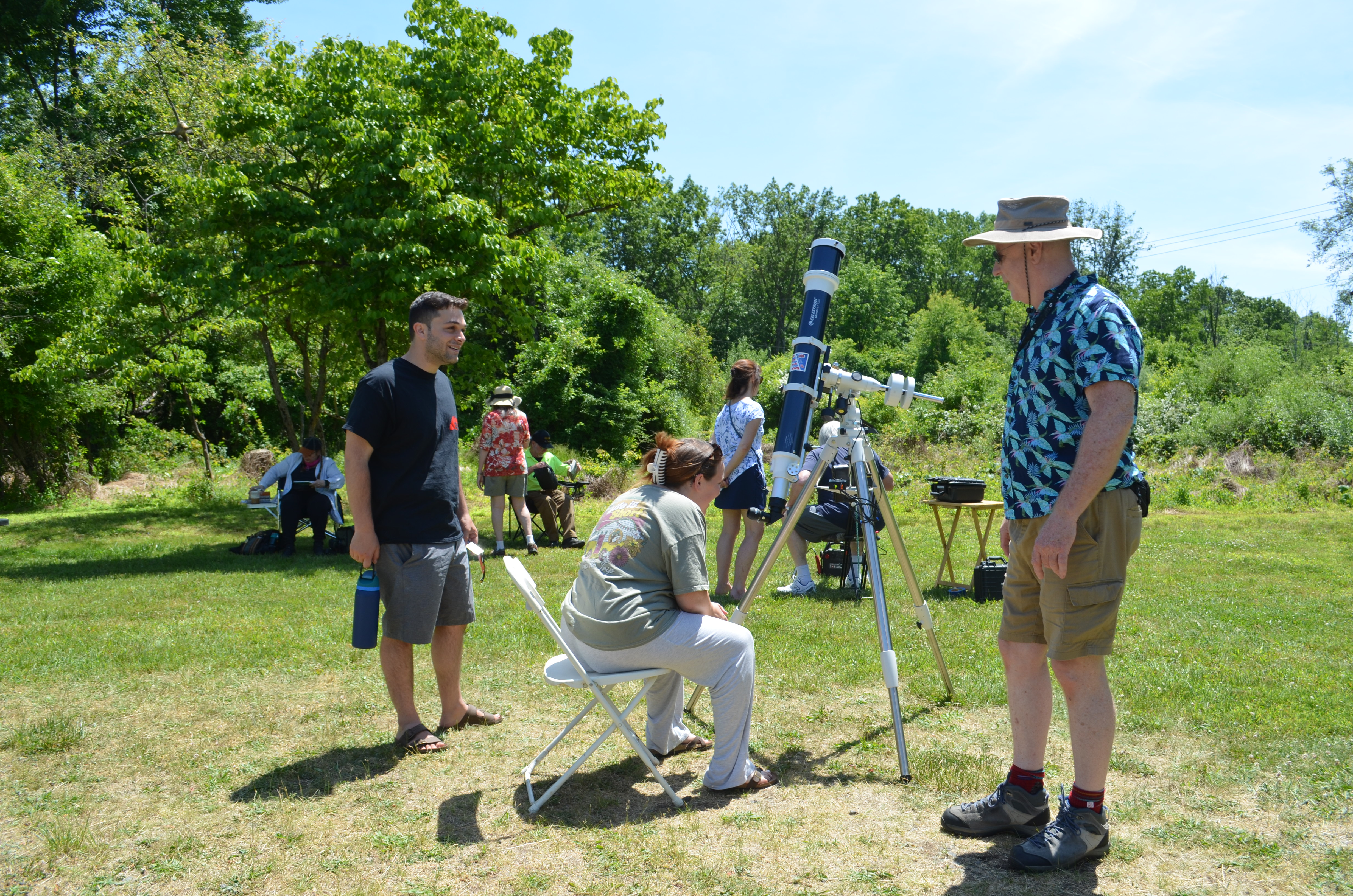
  • While the Nature Center post in the state park is currently vacant, the traditional solar viewing event held there over Memorial Day weekend is being planned as an AAAP event. Members able to help answer questions and manage visitors or who can bring a properly filtered solar scope are encouraged to be in contact with Dave.
  • A bear has been sighted near the park. Heads up!

The fate of the Holmdel Horn is still undetermined.

Monitor the increasing Sun activity for possible auroras reaching down into our area.

The meeting was adjourned at 2159.
Posted in June 2023, Sidereal Times | Tagged , , | Leave a comment

New Summer AAAP Merchandise

by Rich Sherman, Merchandise Chair

We are happy to announce that we have added a second merchandise vendor.  This new site offers a wide range of primarily non-apparel items—from bags and magnets, to towels and cups, and lots of stuff in between.  The website is:  https://aaap-next-gen-store.printify.me/products.  The password is: SiderealTimes.

Note that we now have TWO vendors to meet all your AAAP gear needs on our website.  Just click on the “Membership” tab and select “Merchandise.”  or click here AAAP Shopping

Why do we have two vendors?  One is apparel:  https://www.logosoftwear.com/shareandsell/?store=AAAP1962. The new vendor is primarily non-apparel:   https://aaap-next-gen-store.printify.me/products.  The password for both is:  SiderealTimes.  If you have any questions or need a custom order, send an email Rich Sherman at merchandise@princetonastronomy.org.

Posted in June 2023, Sidereal Times | Tagged , | Leave a comment

From the Observatory Chair

By David Skitt

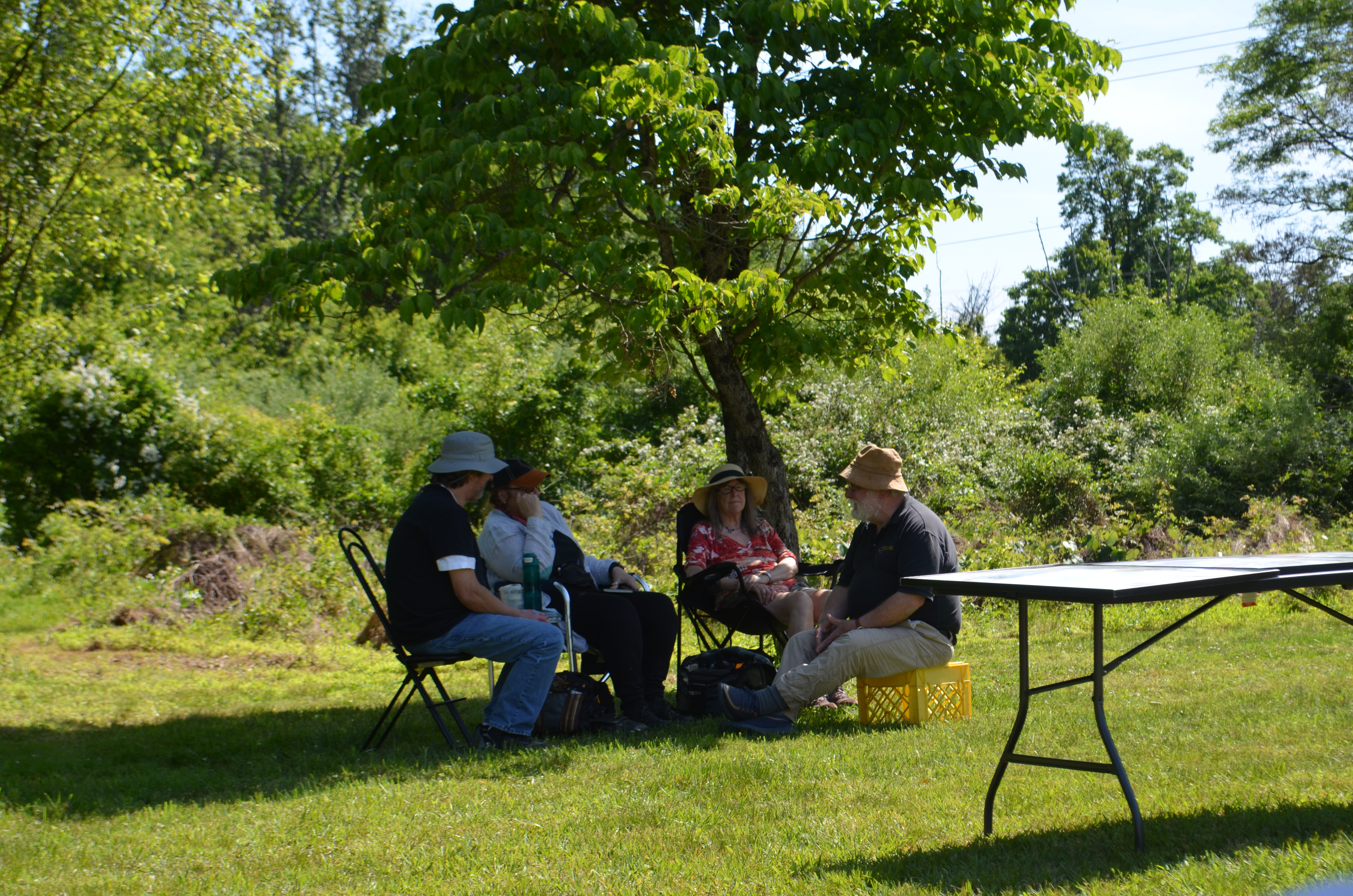
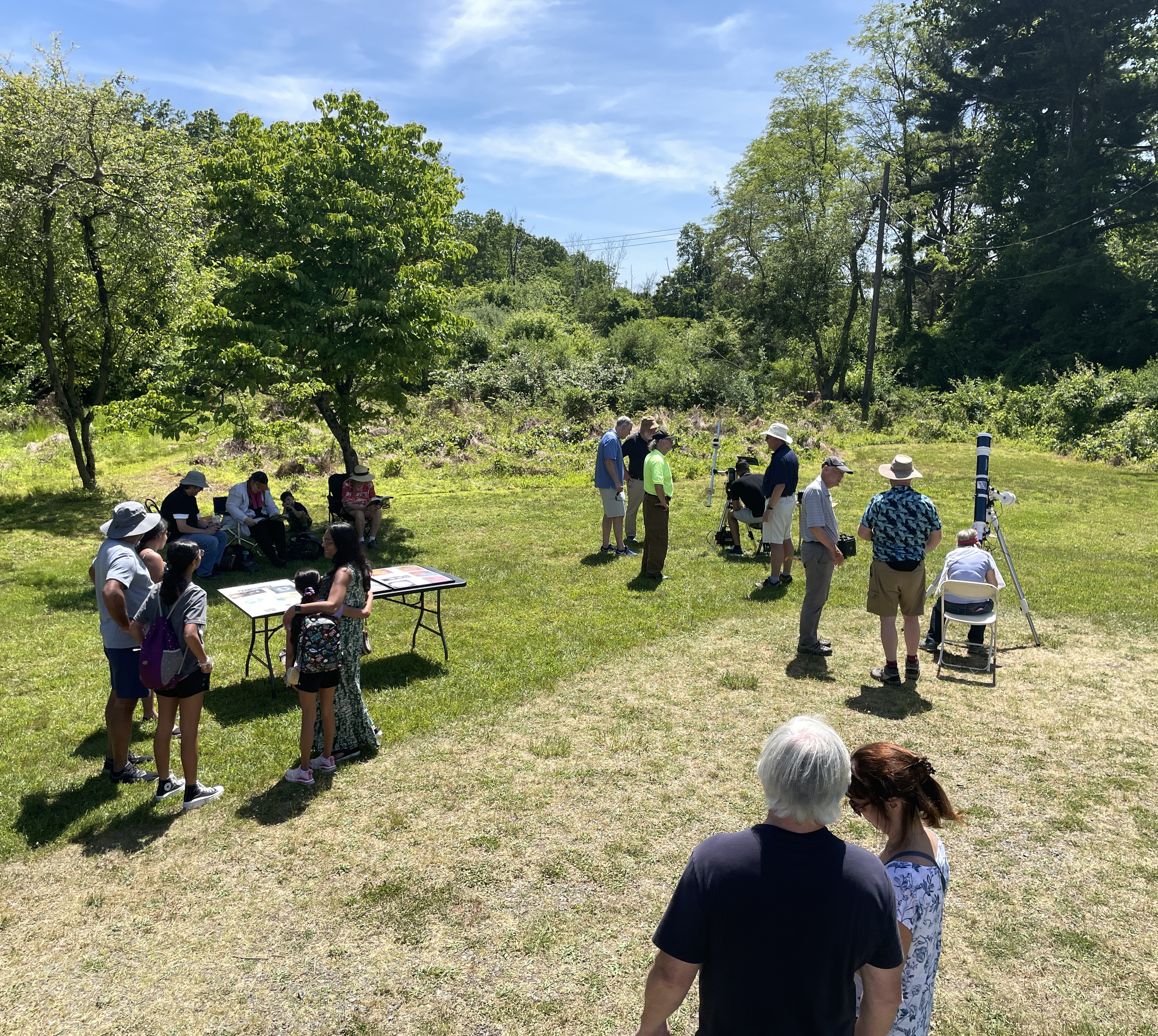
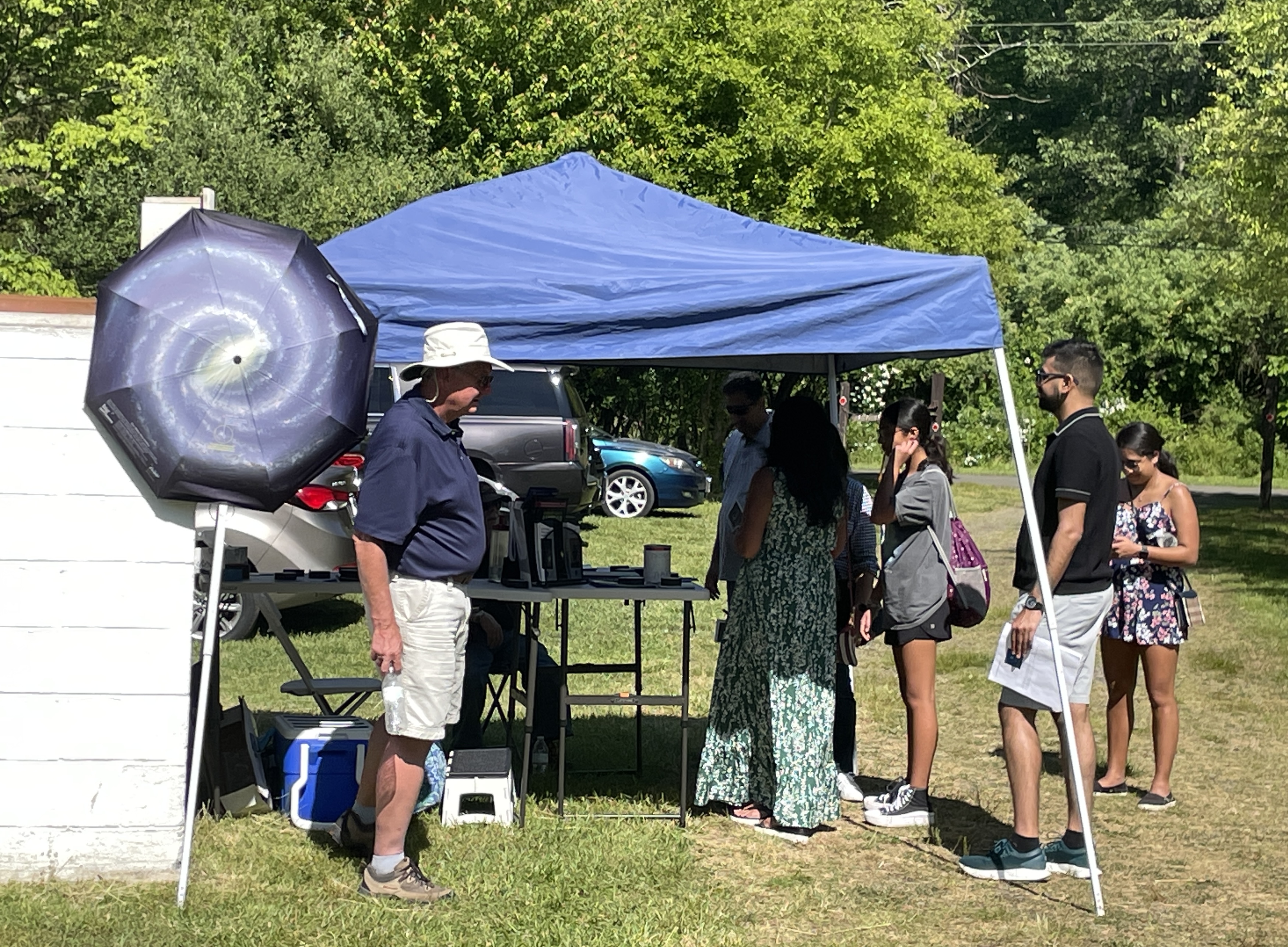
The Solar Observing Memorial Day Weekend event on Saturday, May 27th, held at AAAP’s Observatory in Washington Crossing State Park was awesome! We had 10 volunteers/keyholders.  Not sure of the breakdown of members in attendance versus general public but we had at least 60 +/- people wander through.  Some said they follow us on SM or our website and that’s how they heard about it.  Some came because we talked about it Friday night.  There was a park musket firing demo at 2 pm which probably added some passers-by.  I gave some flyers to the visitors center around 12:20; there was no one manning the main entrance kiosk or I would have given them some.  I’ve been told the park entrance fees have been waived until the state budget is finalized.  One of the park park volunteers at the VC came by for a look.

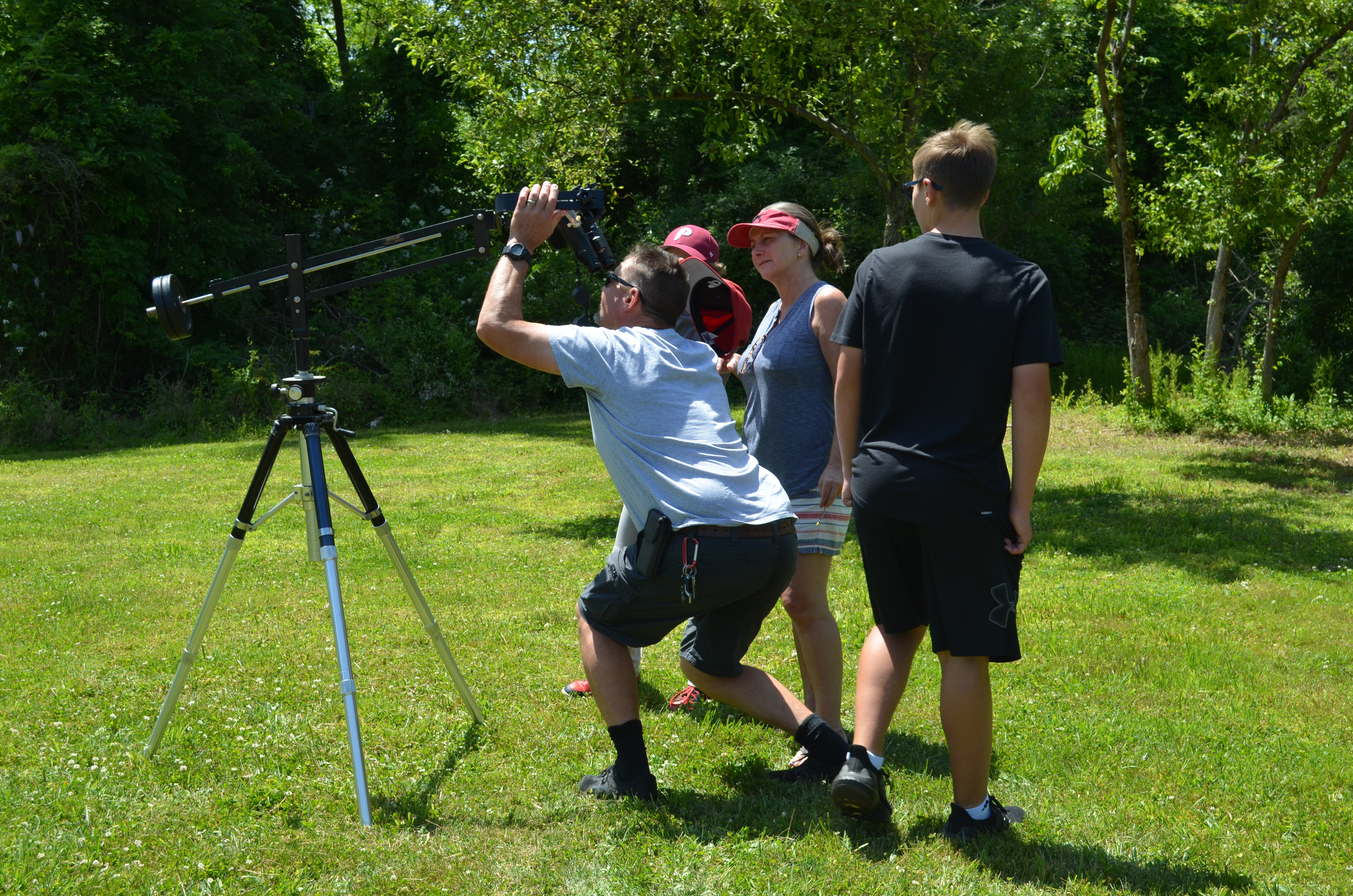
We had two, dual setups with whitelight/hydrogen alpha filtered scopes, one single HA scope, three single whitelight scopes and one binocular/whitelight setup.  Inside the obs’y we had two whitelight visual scopes and were using the two cameras with whitelight filters. Plenty of options for the viewers.

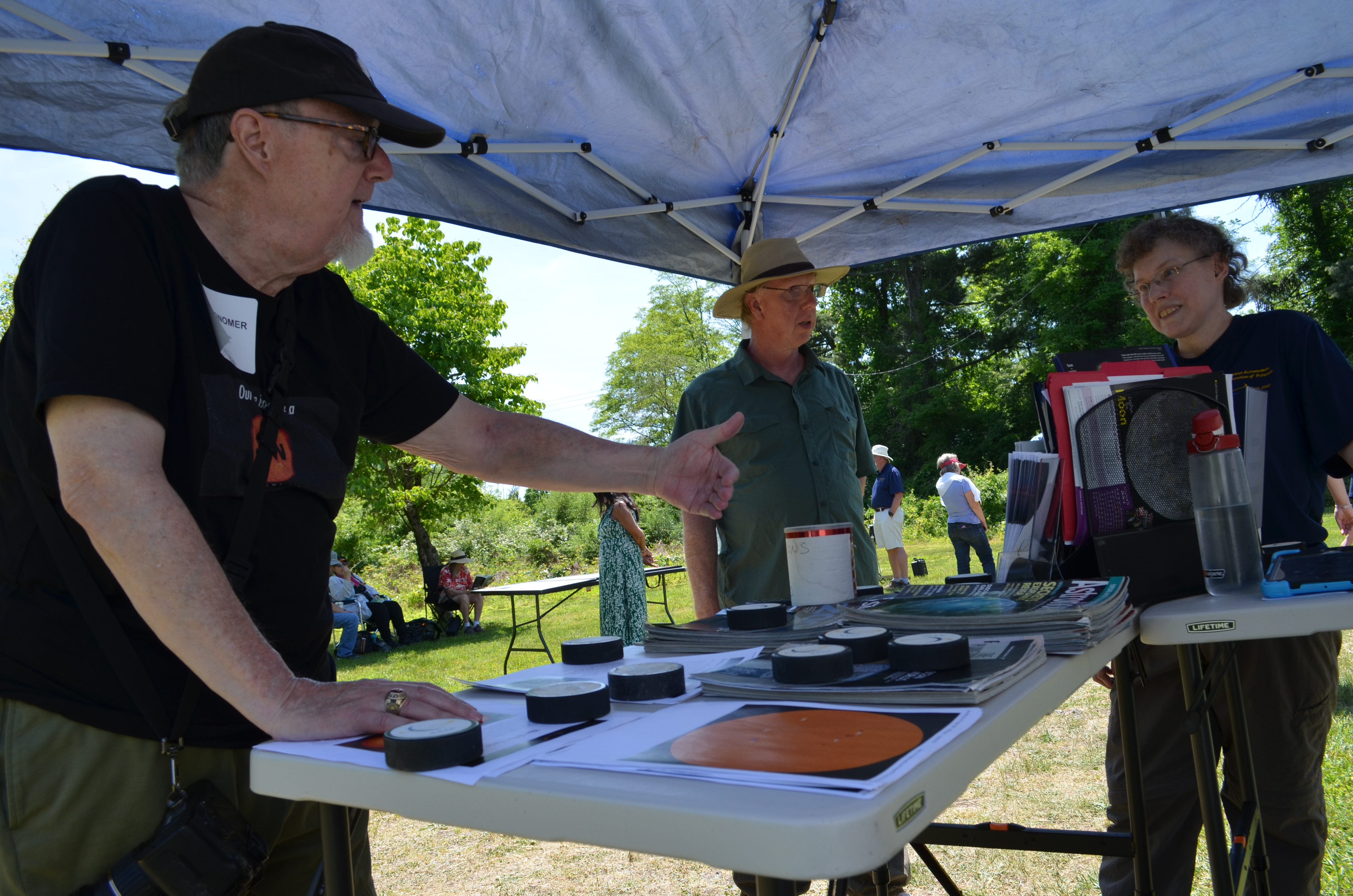
I took some pictures as did Jen, Larry Kane and John Miller. 

Jen, John M. John H. and Larry manned the literature table under a canopy I brought.  The donation can attracted $109.  On Friday night, a friend of one (maybe several) of our members donated a used Celestron 114mm GT newtonian scope (yes, one of the bird-jones designs).  It needs some collimation but seems to track OK.   Tom and I will have a go at it sometime.

All in all it was fun and informative weekend at the Observatory.

Posted in June 2023, May 2023, Sidereal Times | Tagged , | Leave a comment

Safe Solar Viewer – The “Scope On A Stick”

by Tom Swords

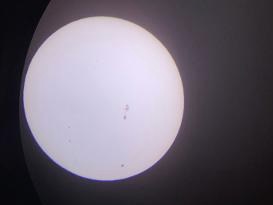
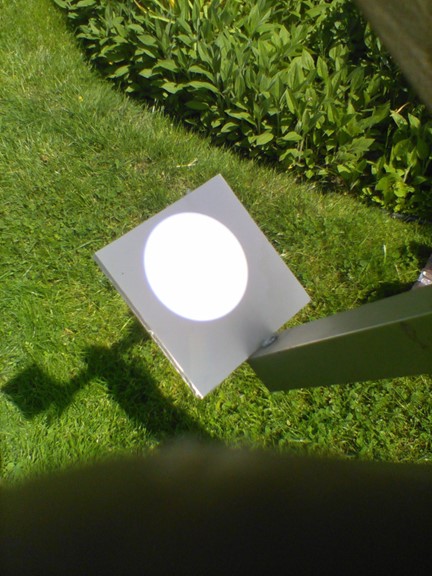
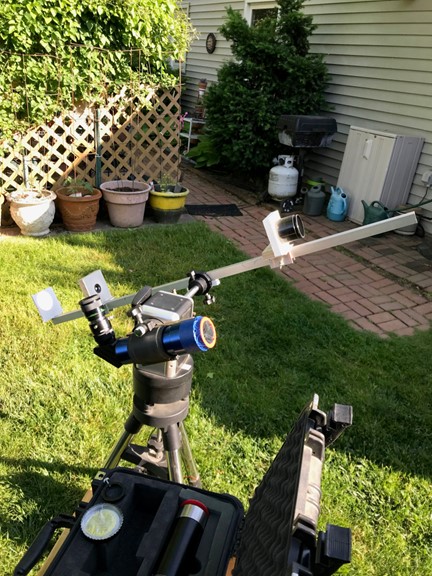
At the 2023 AAAP solar event on Memorial weekend, I employed my “Scope on a Stick” solar viewer. It allows one or more viewers to easily and safely see the solar disk in white light cast onto a white screen.

I constructed the instrument using the instructions located here: http://richardsont.people.cofc.edu/safe_solar_folder/index.html

Here is the link to Surplus Shed. They have the lens kits.
https://www.surplusshed.com/search.php?search=safe+solar+viewer

The device can be hand held or mounted to a manual or guided mount with the appropriate hardware. There are alternative construction materials and designs in the instruction guide. The guide is being updated for the 2024 solar eclipse. See the link above for the instructions for details.

The instructions explain the different optical components and how to employ them. It makes for a great “hands on” project to see how the optical components work together.

I took the basic design and modified it for durability. I used aluminum square tubing, aluminum angle and wood that I had on hand.

I was fortunate to have a 60mm achromatic lens for my construction in place of the singlet objective that came with the kit. The singlet lens provided with the kit from Surplus Shed had worked just fine. I simply desired a larger image.

The instrument will provide for safe viewing of the solar eclipse in 2024.

This was an interesting project and I am quite pleased that it works as well as it does!

Posted in June 2023, Sidereal Times | Tagged , , | Leave a comment

From The Digital Desk of New Member Joseph Matthews

by Joe Matthews

Joseph_Matthews

After thinking about joining  AAAP for about 5 years, I finally made my decision on December 31, 2022.  I have been interested in Astronomy since reading Issac Asimov’s 1968 book, “The Universe from Flat Earth to Quasar’s”.  I wanted to go to University after High School but finances were tight, so I enlisted in the US Navy.  While stationed at Pearl Harbor circa 1975-1977, I enjoyed a few astronomy classes at the University of Hawaii.  My favorite course was given by, if I recall his name correctly, Dr. William Hickox, our textbook was by Shipman “Black Holes Quasars & the Universe”.
After enlistment, life got in the way and I worked various jobs finally working in Information Technology mainly as a Network Engineer and retired in 2019.  In retirement, I have renewed the goal of my youth and have been self-studying Astronomy, spending time on GalaxyZoo, observing and devoting a lot of time to Astrophotography.

Posted in June 2023, Sidereal Times | Tagged | Leave a comment

Black holes, Entropy, and information

by S. Prasad Ganti

In the century following Albert Einstein’s General theory of relativity, the term “Black holes” entered our lexicon. In addition to a greater understanding, Black holes have been confirmed via indirect means and also photographed in the last few ears. Greater understanding resulted from relating Black holes to a thermodynamic concept called Entropy, and also relating to information theory or quantum computing. 

Albert Einstein did not come up with the idea of Black holes. It came up as a solution to the equations of Einstein’s General theory of relativity. Solved by a German Physicist Karl Schwarzschild. A Black hole is a very compact and dense, a few miles to a few hundred miles in diameter and weighing millions of solar masses, an object which sucks in all the matter in its vicinity. It warps space and time to a great extent that the time literally stops at the singularity within the Black hole. Super massive Black holes are at the center of all galaxies including our own Milky way. Our Black hole is known as Sagittarius A*. It probably started off as a graveyard of a massive star or a huge lump of coalescing gas, heavier than 1.4 solar masses which is known as Chandrasekhar limit. It probably grew by sucking in matter in its neighborhood. Like a corporation growing using the mergers and acquisitions route.   

It was presumed that the Black holes live forever and accumulate matter as they go along. Steven Hawking found that Black holes do emit radiation. They are not at absolute zero cold temperatures. The temperature of a Black hole is inversely proportional to its mass. Heavier Black holes are colder while lighter ones are hotter. As per laws of Physics, any object which is hotter than absolute zero, known as a black body, produces radiation. This radiation is known as Hawking radiation. The formula for the temperature of a Black hole is engraved on the floor of Westminster Abbey where Hawking is buried. The following link points to details and picture of the formula:

https://www.westminster-abbey.org/abbey-commemorations/commemorations/stephen-hawking

As the Black holes “evaporate”, they become lighter and hotter and more radiation they emit. Becoming hotter and shrinking in size until they disappear. But they accumulate mass as well and become heavy. This dynamics plays out over billions of years, closer to the age of the Universe. Entropy is a pretty abstract concept. I struggled with understanding it for several years. I don’t pretend to understand it fully. Basically, it is a measure of disorder in a system. Things being scattered around a house or molecules being in different energy levels in a closed surrounding etc. It also involves the number of combinations in which things can be arranged, like a deck of cards. Thermodynamics is an area which deals with energy associated with heat. Two of the three laws of Thermodynamics are relevant to our discussion. One is the familiar law that energy is conserved – neither created nor destroyed but just converted from one form to another. 

The second law states that the overall entropy in the Universe keeps increasing over time. The Universe started with zero Entropy and will keep increasing with its age. Rudolph Clausius, the Physicist who came up with the idea of Entropy,  summarized by saying “the energy of the world is constant, the entropy strives for a maximum”. Entropy is what prevents heat from flowing from cold to hot or for time to go back into the past, although neither of them would violate the principle of energy conservation. The famous equation quantifying Entropy is engraved on the tomb of Ludwig Boltzmann, the Austrian Physicist. The picture below, courtesy Wikipedia, has his bust with the formula on the top of his tombstone. 

The Black holes do have entropy by the virtue of having a temperature. Neither the entropy nor the temperature of a Black hole are zero. Information is represented as bits in computers. The number of bits required to store information is closely related to the Boltzman equation for Entropy. Information does share something with Entropy.

The basis for Hawking radiation is the generation of a virtual pair of submicroscopic particles close to the Event horizon. Event horizon is the point of no return for matter falling into a Black hole. Quantum mechanics tells us that these particles are “entangled”, which means that by studying one particle we can predict what the other particle would look like. For example, their spins are interrelated even after they leave their origin and travel vast distances. Even if one of the particles falls into the Black hole and another escapes in the form of Hawking radiation. 

In normal circumstances such virtual pairs are created and destroyed all the time contributing to the vacuum energy of space. Such “entangled” particles near the Event horizon of the Black hole ensure that the information on matter which gets sucked into a Black hole is not lost, as was perceived earlier. It is stored in the Hawking radiation which emanates from the Black hole. In the book “Einstein’s shadow’”, Seth Fletcher writes “The idea that all the information about the interior of a black hole is engraved on a surface just outside the event horizon is called the holographic principle. Entanglement holds no matter how much distance separates the two particles-even if they are separated by the event horizon of  a black hole. Entanglement plays an important factor in black hole evaporation. In quantum theory, a vacuum is never entirely empty. Spontaneous creation and annihilation of pairs of virtual particles. Near the event horizon, gravity rips a pair of virtual particles, one could fall into the black hole and other could escape. The escaping one becomes a real particle of Hawking radiation”. 

The recent book titled  “Black Holes” by Brian Cox and Jeff Forshaw  summarizes thus “Entangled systems have a rich structure that encodes information in the correlations across the system. The information is lost if the entanglements are broken”. The behavior of particles at quantum levels is the basis of modern day Quantum computing. Entanglement is one of the key features which is exploited by the Quantum computers.  

The notion that the Black holes and Quantum computers share commonality is an interesting one. Cross pollination of ideas not just to understand the abstract, but put to use to the benefit of humanity.   

Posted in June 2023, Sidereal Times | Tagged , | Leave a comment

Snippets

compiled by Arlene & David Kaplan

-NYT

It’s the End of a World as We Know It Astronomers have witnessed a star gobbling up a planet, offering the first direct glimpse of a gnarly process called planetary engulfment that most likely awaits Earth in the deep future. Scientists serendipitously spotted a gas planet — like Jupiter but possibly larger…more

-NYT

This Is Not an Extraterrestrial Signal. This Is Just a Test. In the 1997 movie “Contact,” Jodie Foster plays an astronomer, Ellie Arroway, who detects an alien radio signal from outer space. Eventually the fictional Dr. Arroway goes on a trip through hyperspace to commune with an alien presence appearing in the form of her dead father…more

-NYT

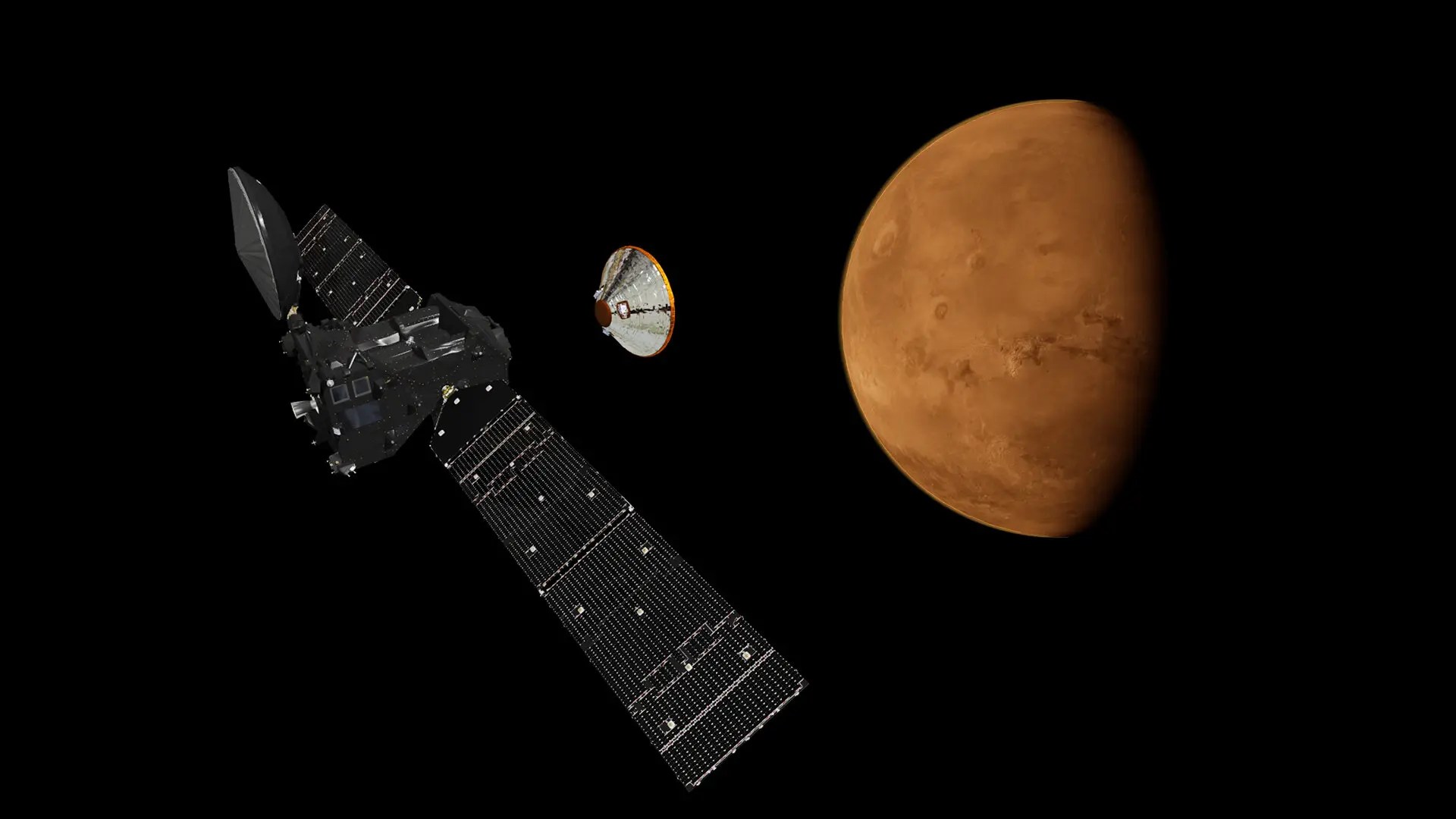
The United Arab Emirates Is Heading for the Asteroid Belt Building off the success of its Hope spacecraft, which is still circling and studying Mars, the United Arab Emirates announced on Monday plans for an ambitious follow-up mission: a grand tour of the asteroid belt…more

Comet Tempel

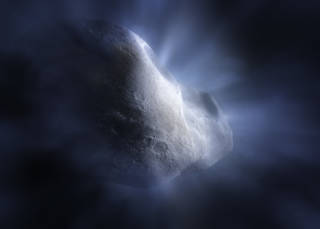
NASA’s Webb Finds Water, and a New Mystery, in Rare Main Belt Comet NASA’s James Webb Space Telescope has enabled another long-sought scientific breakthrough, this time for solar system scientists studying the origins of Earth’s abundant water. Using Webb’s NIRSpec (Near-Infrared Spectrograph) instrument, astronomers have confirmed gas – specifically water vapor…more

-NASA

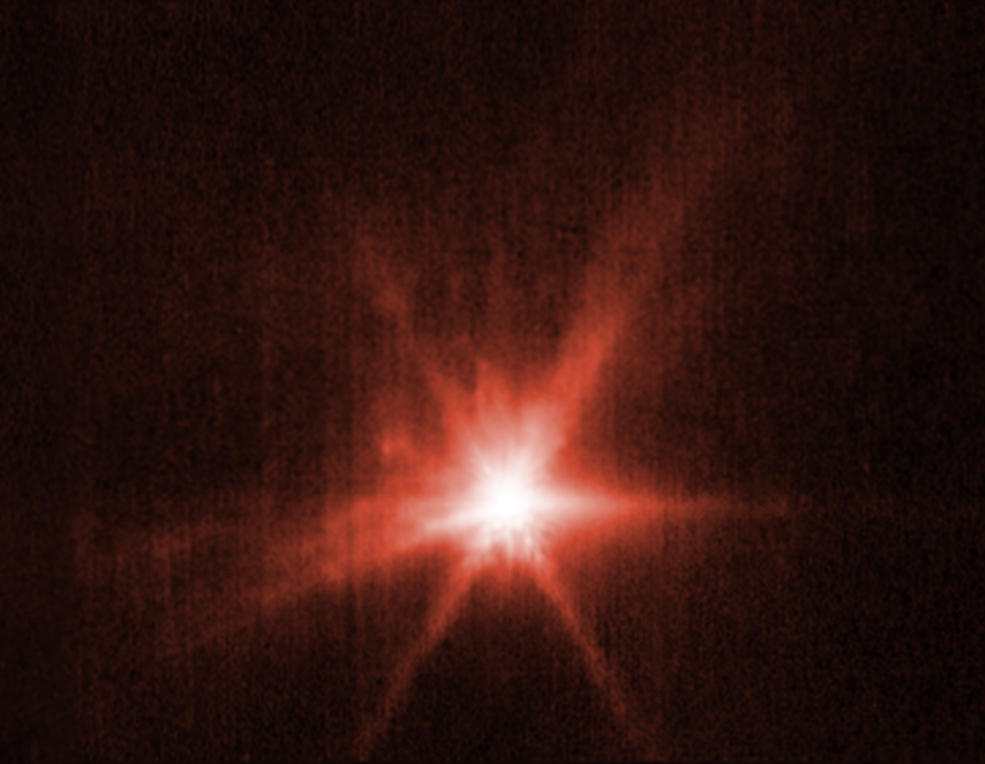
Webb, DART Missions Win AIAA 2023 Premier Awards The American Institute of Aeronautics and Astronautics (AIAA) honored NASA’s James Webb Space Telescope and Double Asteroid Redirection Test (DART) missions and contractors as three of the 2023 recipients of its most prestigious awards, the AIAA Premier Awards. The awards recognize the individuals in aerospace AIAA deems as most influential and inspiring…more

-NYT

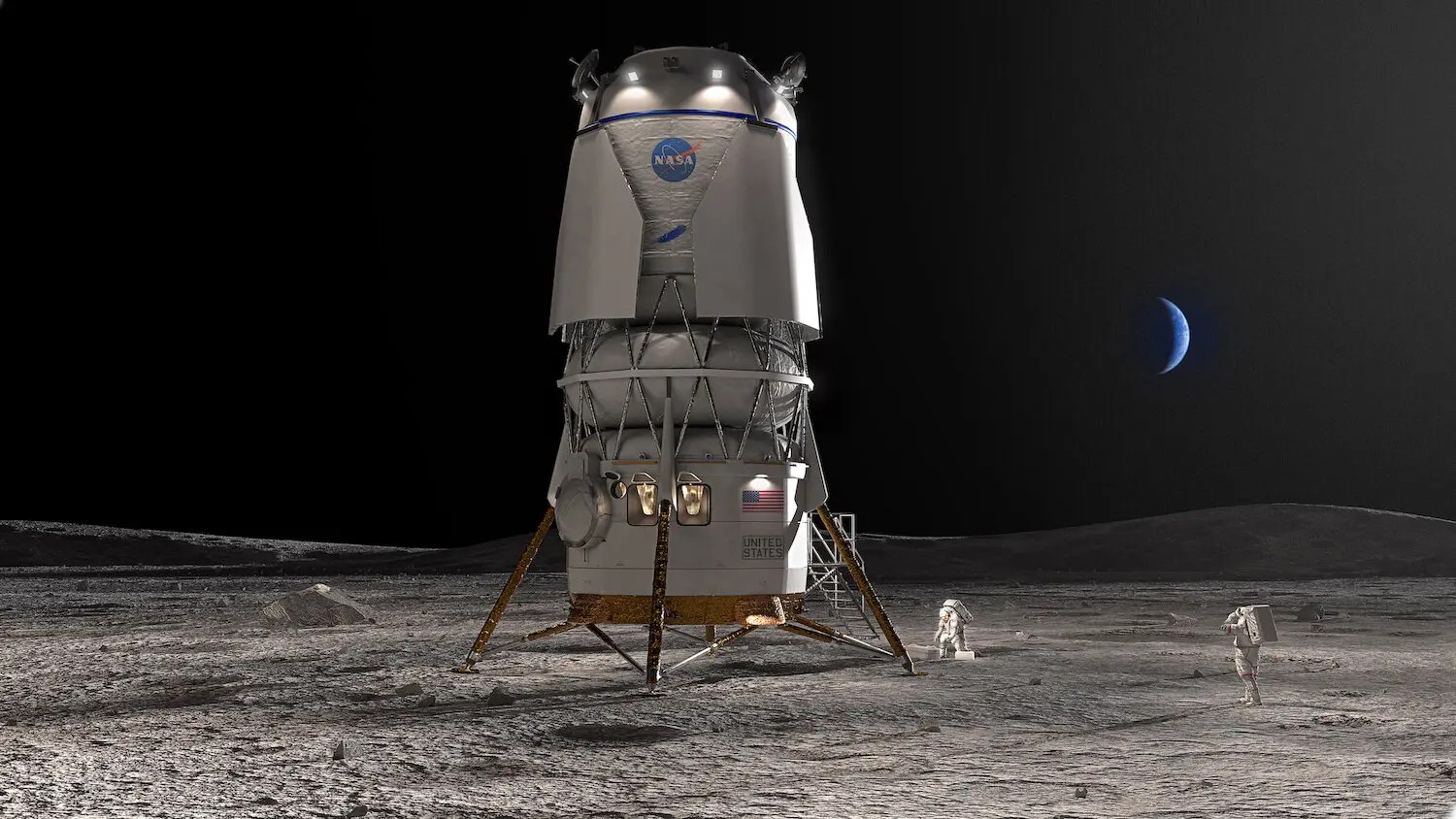
NASA Picks Blue Origin’s Blue Moon Lander for Artemis V Mission On their second try, Jeff Bezos and his rocket company have won a contract to take NASA astronauts to the moon. NASA announced on Friday that it had awarded a contract to Mr. Bezos’ company, Blue Origin, to provide a lunar lander for a moon mission that is scheduled to launch in 2029…more

-BBC

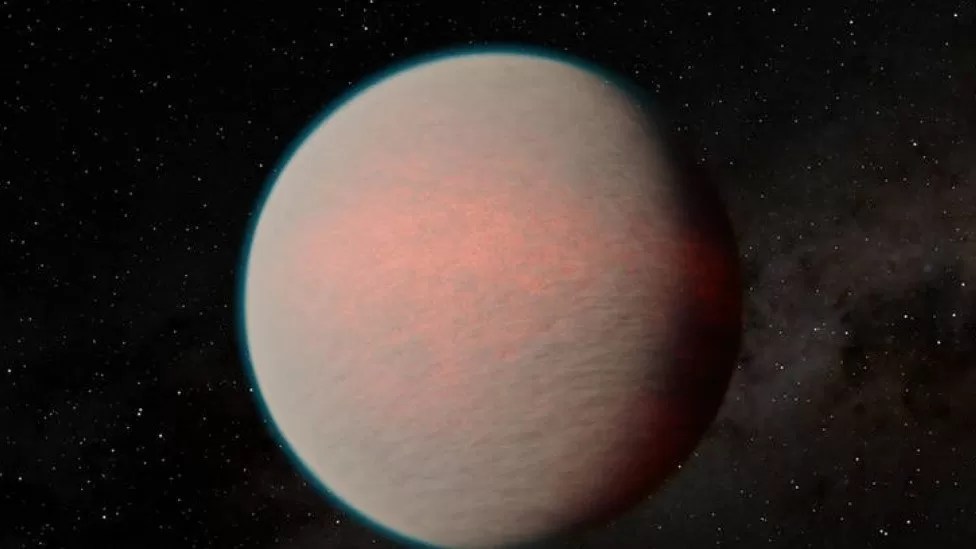
Scientist makes alien weather forecast for distant planet A scientist’s “alien weather forecast” for a distant planet has helped a NASA-coordinated team gain a new understanding of it. Dr Michael Roman, from the University of Leicester, made the observations about the atmospheric conditions on the planet GJ 1214b, which was discovered in 2009…more

-Nature

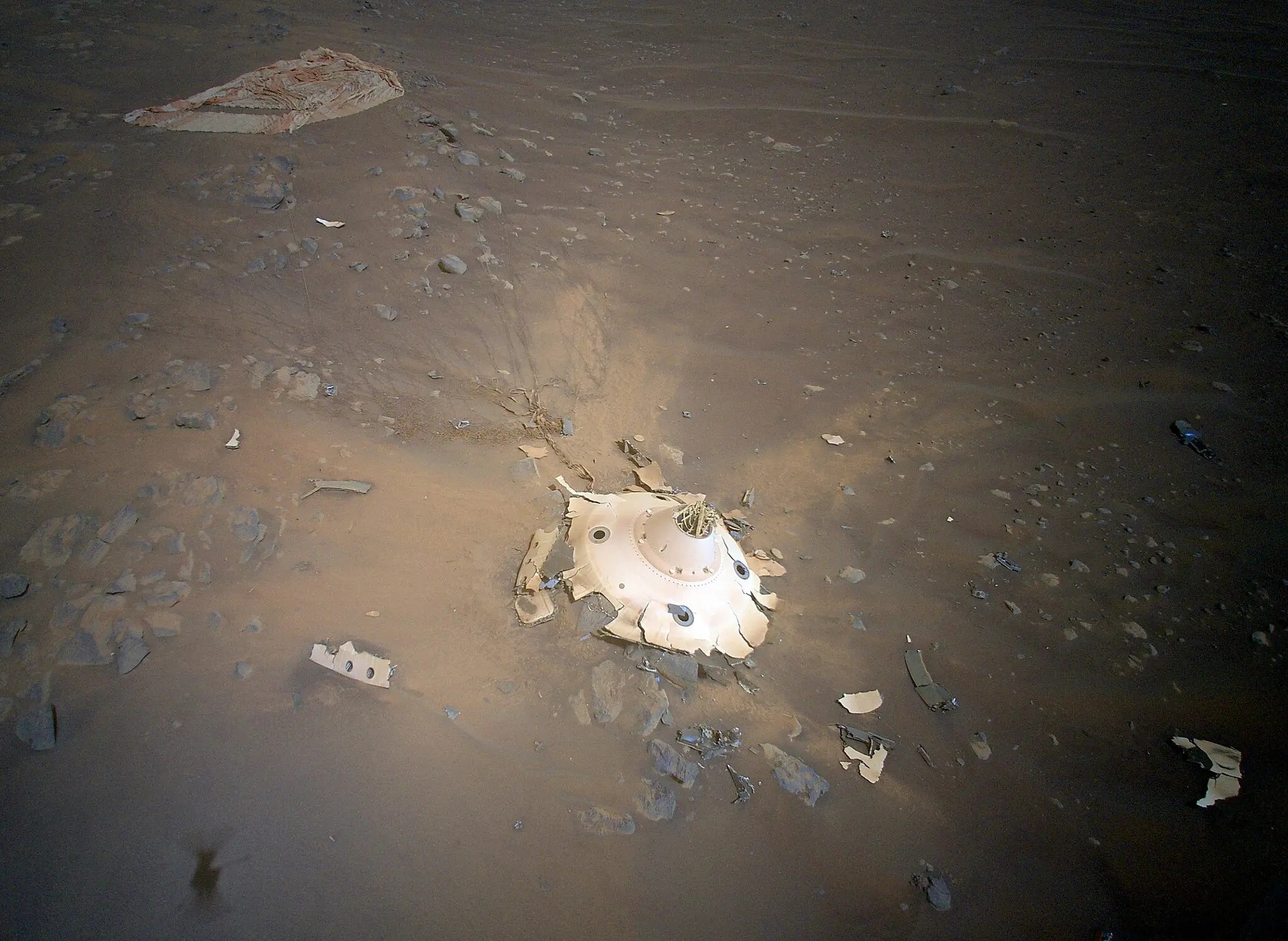
NASA Sees ‘Otherworldly’ Wreckage on Mars With Ingenuity Helicopter The object resembles a flying saucer that crashed on Mars. And indeed it is. But it doesn’t belong to aliens. Instead, the wreckage is the work of NASA, a component called a backshell that detached during the landing of the Perseverance rover on the surface of the red planet in February 2021….more

-BBC

James Webb telescope: Icy moon Enceladus spews massive water plume Astronomers have detected a huge plume of water vapour spurting out into space from Enceladus, an icy moon of Saturn. The 504km-wide (313 miles) moon is well known for its geysers, but this is a particularly big one. The water stream spans some…more

-BBC

Welsh space firm devises ‘shuttlecock’ heatshield A Welsh space start-up has developed a novel heatshield to enable it to re-use satellites brought back to Earth. It’s a large flexible sheet that can be folded tightly for launch but then spring out like a shuttlecock to protect a spacecraft when it returns. Cardiff-based Space Forge…more

-BBC

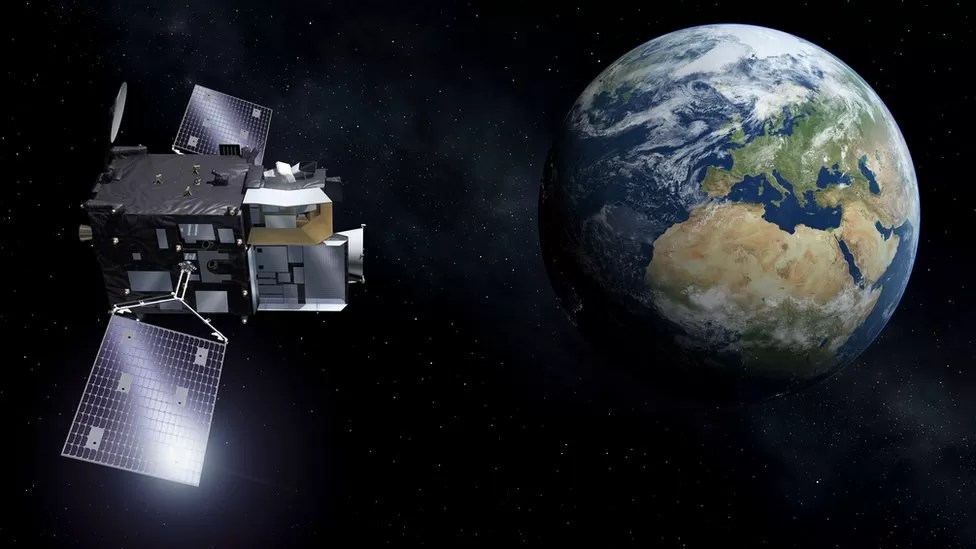
Meteosat-12: Europe’s new weather satellite takes first photos The first images from Europe’s new weather satellite, Meteosat-12, have just been released. The spacecraft, which sits 36,000km above the equator, was launched in December and is currently in a testing phase that will last most of this year…more

-NASA

NASA’s Webb Space Telescope Peers Behind Bars A delicate tracery of dust and bright star clusters threads across this image from the James Webb Space Telescope. The bright tendrils of gas and stars belong to the barred spiral galaxy NGC 5068, whose bright central bar is visible in the upper left of this image – a composite from two of Webb’s instruments…more

Posted in June 2023, Sidereal Times | Tagged , | Leave a comment

From The Director

by Rex Parker, PhD director@princetonastronomers.org

May 9 Meeting – Election of Officers.  Through our 60-year history we have elected officers (the Board of Trustees) for new 1-year terms at the May meeting as provided in the by-laws.  Nominations committee chair Lee Sandberg has reported that each of the current officers is willing to serve again, forming a slate for the election.  The 7 candidates for the Board positions are Rex Parker (Director), Larry Kane (Assistant Director), Michael Mitrano (Treasurer), Gene Allen (secretary), Victor Davis (Program Chair), Dave Skitt (Observatory Chair), and Bill Murray (Outreach Chair).  For your information, the constitution, by-laws, and position descriptions are on the website https://www.princetonastronomy.org/club_by_laws.html

After the Break.  The tradition each month is for a member to give an Unjournal Club, a ~10 minute excursion into astro thoughts and activities, to begin the second half of the meeting.  I call upon you to consider doing an Unjournal Club presentation to help the club as well as yourself get a little more involved in the flow of astronomy in AAAP.  You can use PowerPoint slides, JPEG’s, astro-images, travel pictures, book reviews — your imagination is the limit (note:  no need to bring a laptop computer, simply bring a USB memory stick).  To get onto the schedule for an upcoming meeting, please contact me or the program chair.

Insects Share a Big Problem with Astronomers.  Excess night lighting is as damaging to small flying creatures as it is for astronomers.  As the stars fade from view we are blinded from seeing ourselves in relation to the cosmos, losing our perspective — just as moths are trapped in the glare of lamps.  Entomologists are reporting that the decline of insect populations around the world is related to excess outdoor lighting at night.  Why are insects drawn to light to their demise?  This question becomes highly relevant amid recent increases in light pollution and the decline of insect populations, which threatens to crash entire ecosystems for which insects are an essential major component.

The underlying biological mechanism for nocturnal insects’ attraction and rapid flying around flames and lamps, often to their demise, has been difficult to determine.  The 3-D tracking of small moving objects in low light is technically difficult (a challenge well-shared by astro-imagers), and necessary tools did not exist before.  Previous theories include lunar navigation, escaping towards light as if it were a “gap” in the foliage, and blinding of sensitive eyes.  All flying animals need a reliable way to determine orientation to the external world, especially with reference to the direction of gravity.  Throughout insects long evolutionary history, the sky has been the brightest part of the visual field, making it a robust indicator of “up”. This is true also at night, especially at short wavelengths. 

A new report (posted April 12, 2023) on BioRxiv, the preprint server for biology, provides novel insight to how this happens (Fabian et al., Why flying insects gather at artificial light | bioRxiv).  This paper caught my eye upon return from a nature tour of Costa Rica – the authors’ field studies were conducted at Monteverde in Costa Rica.  Fabian and colleagues used high-speed (500 fps) and high-resolution imaging in the field and lab to study the kinematics of insect flights around artificial light. They show that artificial point light source induces abnormal flight behavior in insects.  But contrary to expectations of attraction, insects do not steer directly toward the light. Rather, they turn their backsides toward the light and fly perpendicular to the light source. They consistently fly orthogonal to the light source. Under natural sky light this dorsal tilting maintains proper flight attitude and control. But near artificial lamps, the dorsal light response causes steering around the light and traps the insect in endless loops.  

The authors conclude that the dorsal tilting causes the erratic flight paths of insects near lights, providing the most plausible model for why flying insects gather and become entrapped at artificial lights.  They suggest that light entrapment of insects at a local scale is due to a corruption of the insect’s attitude control rather than navigation.  Bright nearby lights disrupt this mechanism and cause unintentional course alterations in insect flight.  Reducing bright, unshielded, and upward facing lights will mitigate the impact on flying insects, simultaneously helping restore the sky to our own eyes and telescopes.

Posted in May 2023, Sidereal Times | Tagged , | Leave a comment

From the Program Chair

By Victor Davis

Welcome to Peyton Hall
The May, 2023 meeting of the AAAP will take place IN PERSON on Tuesday, May 9th at 7:30 PM. As usual, the meeting is open to AAAP members and the public.

Options for Attending the April Meeting
You may choose to attend the meeting in person or participate via Zoom or YouTube as we’ve been doing for the past few years. (See How to Participate below for details). This evening’s guest speaker is Alain Maury, discoverer of asteroids and operator and tour guide of a visual observatory in the pristine skies of Chile. He and his wife will join us for a “Meet the Speaker” dinner at La Mezzaluna restaurant in Princeton’s Palmer Square, then join us in Peyton Hall for his presentation “The Hunt for Near Earth Asteroids.” 

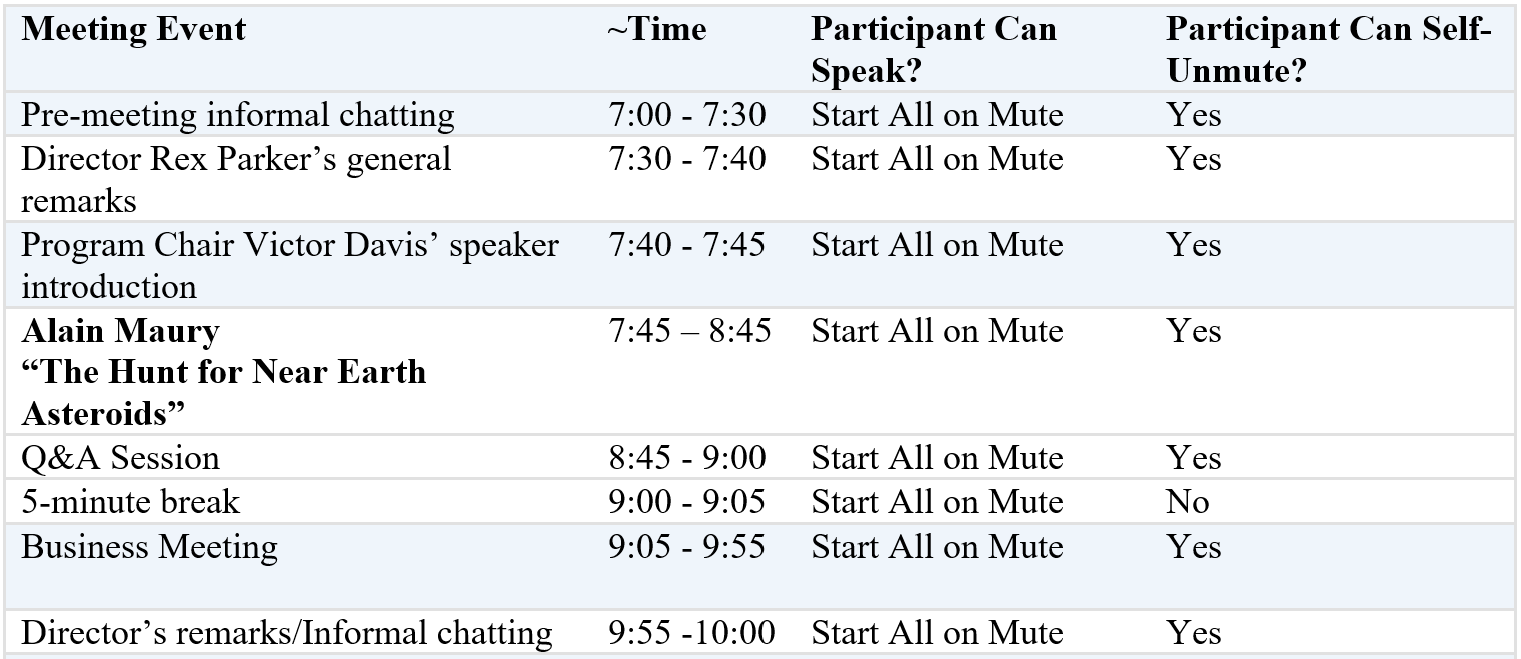
Here’s the anticipated agenda for May’s monthly meeting of the AAAP:

(Times are approximate)

Getting to Peyton Hall
The parking lots across the street (Ivy Lane) from Peyton Hall are now construction sites, unavailable for parking. We’ve been advised by the administration of the astrophysics department that we should park in the new enclosed parking garage off Fitzrandolph street and walk around the stadium and athletic fields. Here’s a map of the campus and walking routes from the parking garage to Peyton Hall. The map shows the recently completed East Garage. Not shown is an access road Sweet Gum that connects from Faculty Road to an entrance at the lower left corner of the garage. Stadium Road connects from Fitzrandolph Road to another entrance at the opposite corner (and higher level) of the garage. It’s about a 10-15 minute walk from the parking garage to Peyton Hall.


Alain_Maury

Featured Speaker: Alain Maury
Asteroid Discoverer and Observatory Operator and Guide
amaury2020@spaceobs.com

The Hunt for Near Earth Asteroids
Astronomers, admittedly not reputed for their robust sense of humor, sometimes joke that the world would be a very different place if the dinosaurs had in place a space program sixty-five million years ago. The dinosaurs’ demise, along with seventy percent of all species of life on Earth, plus more recent harbingers such as Comet Shoemaker-Levy 9 at Jupiter a few decades ago, motivated several apocalyptic (and abysmally bad) movies and an interest in discovering and characterizing Near Earth Asteroids (NEAs). Astronomers believe that with enough lead-time, perhaps measured in decades or centuries, potentially catastrophic impacts could be avoided by nudging dangerous objects away from Earth-intersecting trajectories. At the dawn of the space age, 20 Near Earth Asteroids were known; in 1980, the number reached 50. In 2000 we reached 1000 known NEAs. In 2022, we passed the 30000 mark, and counting… Mr. Maury will describe his own experience of how this revolution occurred, and why discovering more and smaller near earth asteroids is important.

Alain Maury
Alain Maury started as an amateur astronomer. The first asteroid he observed with his 3-inch telescope convinced him that asteroids were the most boring things in the sky. He later changed opinion, discovered his first Near Earth Asteroid (NEA) in 1983 and has followed the field ever since. He has worked in several observatories (Observatoire de la Côte d’Azur, Palomar Mountain Observatory, European Southern Observatory). In 2003 he left the professional world to open a touristic observatory in Chile’s Atacama desert. SPACE (San Pedro de Atacama Celestial Explorations) receives about 15,000 tourists per year who can discover the beauty of the universe through several large telescopes. The largest has an aperture of 45 inches. This activity allows him to finance his own research with a group of friends. The MAP project (Maury, Attard, Parrott) is the 4th most successful asteroid search program in the world, after the 3 largest, NASA financed programs.

For much more detail about the accomplishments of this fascinating astronomer, see his blog at https://www.spaceobs.com/en/Alain-Maury-s-Blog/Who-am-I

Thanks to Gene Allen for suggesting and following up with this month’s guest speaker.

This Month’s “Meet the Speaker” Dinner……will take place at La Mezzaluna restaurant.
25 Witherspoon Street (in Palmer Square) Princeton, NJ.
(609) 688-8515

La Mezzaluna is an Italian restaurant that features outdoor dining under a canopy. We’ll be honoring recent guest speakers John Church and Ira Polans as well as Mr. Maury. Please take note of the new location. Our club’s reservation is for 5:45 pm Tuesday, May 9th.

 Please contact me to reserve a spot if you’re planning to attend.

AAAP webcast:  This month’s AAAP meeting, beginning with Rex’s opening remarks and ending at the beginning of the business meeting, will be webcast live on YouTube and recorded for subsequent public access on AAAP’s YouTube channel. Be aware that your interactions during this segment, including questions to our guest speaker, may be recorded for posterity.

Join YouTube Live to listen to the speaker Ira Polans using the link below –

Logo-with-play

YouTubeAAAP May Meeting, Alain Maury, An astronomer and discoverer of comets and asteroids

This session will be recorded and saved on YouTube. Send me an email at program@princetonastronomy.org if you have any concerns.

Using Zoom: While we are social distancing, the AAAP Board has chosen to use Zoom for our meetings, based on our belief that many members have already used Zoom and have found it easy to use. One of its great features is you can choose whether you want to install the software on your computer or use it within your browser.

NOTE: The Zoom site has many training videos. If you’re unsure how Zoom works you might want to view the videos on how to join a meeting or how to check your computer’s audio and video before the meeting.

How to Participate:

  • Please make sure you have Zoom installed on your computer. You do not need a Zoom account or to create one to join the meeting. Nor are you required to use a webcam.
  • Please see below for the link to the meeting, or visit our website.

Join Zoom Meeting Link,   Meeting ID: 860 9778 5664  Passcode: 726729

There is no “Unjournal Club” presentation scheduled this month. As you may know, guest speakers receive a baseball cap with the AAAP logo embroidered upon it as a “thank you” for making a presentation to us. We’re expanding the hat giveaway to members who contribute an “Unjournal Club” presentation to encourage participation.

We hope to make these short presentations a regular feature of our monthly meetings. We’d like to know what members are doing or what members are thinking about in the broad range of topics encompassed by astronomy. A brief ten-minute (or so) presentation is a good way to introduce yourself and the topics you care about to other club members. If you are interested in presenting a topic of interest, please contact either director@princetonastronomy.org or program@princetonastronomy.org.

A look ahead at future guest speakers:

June 13, 2023
Bill Murray, AAAP’s Outreach Director and staffer at NJ State Museum planetarium Bill will give his traditional planetarium show at the New Jersey State Museum in Trenton.
Summer Hiatus
Later this fall
Gary Rendsburg, Distinguished Professor of Jewish Studies and History at Rutgers Prof. Rendsburg will talk about “The Jewish Calendar,” with emphasis on its astronomical connections to lunar months, intercalated month to adjust to the solar year, festival days, and new moon observances.

As always, members’ comments and suggestions are gratefully accepted and much appreciated.

Posted in May 2023, Sidereal Times | Tagged , , | Leave a comment