
Since we will not be opening the observatory for the eclipse event, this is a possible way to experience it from wherever you are.
Interactive map tracing the line of totality.
Since we will not be opening the observatory for the eclipse event, this is a possible way to experience it from wherever you are.
Interactive map tracing the line of totality.
by Gene Allen, Secretary
Minutes of the February Meeting
Due to the closing of the University in anticipation of snow, the meeting was convened on Zoom by Director Rex Parker at 1930. Following a brief opening introduction, Program Chair Victor Davis introduced speaker Dr. David Helfand, who gave us a presentation based on his book, The Universal Timekeepers: Reconstructing History Atom by Atom. Sadly, the intended book signing was denied to us, but his book is available online and at Labyrinth Books in Princeton. A ten minute question session ended at 2100 and was followed by a five minute break. Signed in on Zoom were 59.
The business meeting opened at 2105.
***********IMPORTANTCHANGES***************************************************
Due to most of the AAAP leadership traveling for the April 8 eclipse, it was decided that:
● The 2024 observatory season will be delayed for two weeks. The first Public Night will be on April 19.
● There will be no hosted, live eclipse event at the observatory. Folks will be referred to online coverage.
● The April meeting is cancelled.
Obscuration in the Princeton area will be 85-90%, still dramatically different from totality. Glasses or filters will be needed throughout the event.
***********************************************************************************
Member Bob Vanderbie shared some astrophotos.
Member Nick Mellis pitched an in-person Virtual Moon event at the Unitarian Universalist Church at Washington Crossing on February 17 at 1300. He introduced Manny Pimenta, CEO and Founder of the Virtual Moon experience, who will be attending the event and added details about his project. Three sets of virtual reality goggles will be available at the event to enable a virtual walk on the Moon, exploring Apollo landing sites or whatever. If you have VR goggles you can experience it at home from < https://virtualmoon.space/ > .
Outreach Chair Bill Murray attended the Winter Star Party, organized by the Southern Cross Astronomical Society on Big Pine Key from February 5-11. Sky conditions are typically Bortle 3, SQM 21.76, but this year it was unpleasantly cold and much too windy. Limited accommodations are rustic but three meals are provided and a food truck is available all night. Bill showed many astrophotos that were captured with his little Seestar S50, which did better in the conditions this year than his three bigger imaging rigs. < https://www.scas.org/winter-star-party/ >
Rex presented images and video of Jupiter and issued a Jupiter Video Challenge to capture moon shadows crossing the planet. He reminded us that his Lunar South Pole Challenge is still unanswered.
Member John Chase shared a photo of Jupiter’s Great Red Spot that he captured on film when the Hastings was being stored in his garage.
A scope that was recently donated was sold for $450. The loaner scopes we already have are not being adequately utilized and storage is a critical issue. Discussion ensued about our need for a storage shed and that revived the extremely onerous requirements of the state because of our park location. The possibility of installing a structure small enough to not count as a building was suggested. Observatory Co-Chair Dave Skitt proposed acquiring a steel shipping container that might be installed on a bed of gravel. Astroimaging Chair Mike DeMario suggested that we might consider enclosing the piers to gain simple and inexpensive additional space.
Astroimaging Chair Mike DeMario reported that the New Website Design Team has updated the website requirements. He explained that the new website would be built alongside the existing one, and only when we were satisfied with it would it be swapped over.
Outreach Chair Bill Murray thanked Members Bob Vanderbie, Prashant Joshi, and Gene Allen for taking scopes to the stargazing outreach event at the Plainsboro Reserve on February 9. Special thanks go to new Member Cody Pedersen who added his astronomical knowledge and enthusiasm and greatly helped hosting nearly a hundred people. Cars kept coming in all evening, and it was good that closing was scheduled for 2100.
Observatory Co-Chair Dave Skitt reported that the top of a pine tree had broken off on its own, improving our southern horizon a bit. A draft version of the Keyholder Roster and Schedule has been distributed and bears some changes from last year. While we will not be holding any formal eclipse event, we do have something like 250 eclipse glasses that could be handed out in the soccer fields if some members were interested in doing that.
The meeting was adjourned at 2222.
Membership currently numbers 206, with 9 having joined in 2024. There have been 17 renewals 5 have allowed their membership to expire, giving us a 77% retention rate.
by Gene Allen, Secretary
Minutes of the January Board of Directors Meeting
The meeting was convened at 1934 on Zoom by Director Rex Parker with the agenda for the evening. All other board officers were present: Assistant Director Larry Kane, Treasurer Michael Mitrano, Program Chair Victor Davis, Observatory Co-Chairs Dave & Jennifer Skitt, Outreach Chair Bill Murray, and Secretary Gene Allen. Other leaders in attendance were Editor Surabhi Agarwal, Promotions Chair Debbie Mayes, member Bob Vanderbie, and former Program Chair Ira Polans.
Impending Reverse Snowbirding Brings Changes for Rex Parker
In order to be closer to family for part of the year he will be residing in Indiana from before Thanksgiving through February and will be unable to attend the December, January, and February meetings in person. Ongoing health challenges make Larry Kane unable to commit to standing in for those meetings. He will complete this term and not seek reelection. Graciously, Bob Vanderbie has agreed to stand for election to Assistant Director.
New Ideas and Energy Contributed by Bob Vanderbie
He suggests that members audit classes and proposes seeking greater involvement of Princeton University students and faculty. Debbie asked about seeking permission to post meeting flyers in Peyton, and Bob responded that he expects more student interest in observing opportunities than in attending meetings. The Astrophysics Department will be moving to a new building with more than twice the space of Peyton and it will have an adjacent grassy area. He suggests that members bring scopes for student observing sessions, perhaps in conjunction with the Astrophysics Social held every Friday.
Meeting Configuration Discussion
Consensus continues to favor hybrid meetings that include in-person as well as virtual attendance. The point was made that we need a deeper tech team to provide backup capability. More people need to be able to host Zoom, operate the A/V hardware in Peyton, stream and record the meeting on YouTube, and edit recordings. This is not due to any existing deficiencies, just an effort to avoid complications.
The April 9th Meeting is Cancelled
Given that many, even most of the AAAP leadership will be traveling for the April 8th eclipse the Board formally voted to cancel the meeting scheduled for April 9. It was also decided that no opening of the observatory or other outreach effort would be made to host the public for the eclipse. Instead, on our website we will post links to reputable live streaming sites.
Eclipse Accommodations Are Being Offered by Surabhi Agarwal
She has prepaid rooms in the Dallas area for 12 people for April 6-10 and for 7 for April 5-10. Members can contact her to sublet the rooms.
General Financial Condition Reported by Michael Mitrano
Michael announced the AAAP balance as “something like $25,000.” He noted that we had been concerned about the cost of the major repair needed at the observatory, but it had been completely funded by additional donations and had no impact on the treasury. He also pointed out that our lease on the observatory site in Washington Crossing State Park is on year 37 of our first lease with a 20 year extension. There is no provision for another extension and although we do not anticipate any reason for the state to refuse us, it is possible that regulations have changed and will not permit it. He will begin inquiries about another extension but suggests that we consider possible relocation. In the discussion that ensued, dedication to the history of the site was reported. While it would require a major expenditure of effort and capital, another site could well offer us better access, parking, and storage. No action was decided.
Revisions to Our Trifold Brochure Are Being Finalized by Debbie Mayes
She distributed the latest version to the Board before the meeting and asked that any corrections or additions be submitted promptly so that the design can be finalized and sent for printing.
New Website Requirements and Recommendations Shared by Debbie Mayes
She distributed the team document to the Board before the meeting for their information. Surabhi confessed that she had not had any time to work with the team and still had a major software installation impending. She committed to looking into the team’s recommendations and providing the team with the server credentials so they could explore what is already available there. Rex and Surabhi invited Gene to join the team, who will now be awaiting Surabhi’s review. Ira again reported that NSN invites organizations to use their website which offers considerable functionality for little effort.
Outreach Update and Changes for Bill Murray
Bill reported that the January 22 event was a success because of Ira’s presentation, but the observing session was clouded out. Since he will be attending the Winter Star Party in the Keys, the February 9th observing event at the Plainsboro Reserve will be coordinated by Bob. It still needs more telescopes. Gene will be coordinating the April 24th daytime observing event at the school in Sergeantsville. He has Tom Swords and Victor bringing solar scopes and Debbie contributing brochures, enthusiasm, and crowd control.
He also reported that he will be retiring from the planetarium on July 1, 2024. The June meeting at the planetarium is secure for this year but perhaps not thereafter. For the first time in 40 years the AAAP will have no primary contact with the planetarium. He intends to spend summers and early fall in Massachusetts.
Observatory Update by Dave Skitt
He reported that carpet is still on the agenda. The need for additional storage for loaner scopes, other scopes, and supplies is becoming increasingly urgent. In the hope of avoiding similar complications to those experienced in dealing with the state over the observatory repairs, he is proposing acquiring an 8’ x 20’ shipping container for $1200-$200 and installing it on a bed of gravel. Below some certain size, a construction does not qualify as a building. The discussion which followed was inconclusive.
The meeting was adjourned at 2150.
by Michael DiMario
 Title: Under Alien Skies: A Sightseer’s Guide to the Universe
Author: Philip Plait, PhD
Publisher: W. W. Norton & Company, New York, NY
Publication Date: 2023
Total Pages: 336
How many of us have read tour guides taking us to far off places with descriptions so detailed that you wish you were immediately there resulting in planning and booking your travels. The book Under Alien Skies: A Sightseer’s Guide to the Universe is such a book for touring our solar system, the Milky Way, and grand deep sky objects. The author and astronomer, Dr Philip Plait who has worked on the Hubble Space Telescope Team analyzing data specifically on the Space Telescope Imaging Spectrograph, also known as The Bad Astronomer, is an advocate of NASA’s public outreach. He has written for and appeared in several science documentaries.
Plait brings the reader from the couch comfort of Earth to the Moon, onto Mars, the asteroids, Saturn, Pluto, and objects outside of our solar system exiting into a Black Hole to be unnoticeably spaghettified. The author uses the latest scientific data to translate what it would be like to walk or “shuffle” about the surface of the Moon coursing through the sunlit moonscape into the dark regions and shadows with exacting detail of the issues of moon dust. Plait continues the adventure of the astro tourist onto Mars to watch the blue sunsets, two moons fill the sky, and then to sail past the rings of Saturn. The astro tourist may wish to skim through the various atmospheric layers of Saturn and may contemplate landing to find that its surface is gaseous with an eventual hard surface of metallic hydrogen. Beneath the metallic hydrogen will eventually be a rocky core followed by extreme temperatures exceeding the surface of the Sun.
Another fascinating place Plait brings the astro tourist to is a planet caught in a binary star system such as Star Wars’ Tatooine and the experience to live on such a planet of which a third of all stars may be in a binary system. The remaining stars are in a more complex arrangement such as Mizar which is a four-star system. The Earth’s single star is actually atypical.
For anyone that wonders what it would be like to travel and experience destinations of the solar system and beyond, Under Alien Skies: A Sightseer’s Guide to the Universe is an enjoyable read.
The author includes a “Further Reading” section for even more detail on the destinations that are reviewed to further enrich your travel plans.
by Michael DiMario, AAAP Astroimaging Chair
The astroimaging section of this month’s Sidereal Times displays eleven remarkable images from the AAAP membership. The images presented in this edition represent a disparate set of telescopes and imaging configurations captured from locations in our very light polluted skies of New Jersey and the darker regions of Florida. The eleven images comprise several emission nebulas, a total lunar eclipse of 2023, a current sunspot event, two images of M33 the Triangulum Galaxy taken from locations of New Jersey and Florida with different astroimaging configurations, and several images with multiple targets such as the Horsehead Nebula with two adjacent nebulas, and an image of the Spider and Fly Nebulas.
Image descriptions are edited or authored by Michael DiMario unless noted.
Image capture data are by the imager.
Lisa Fanning
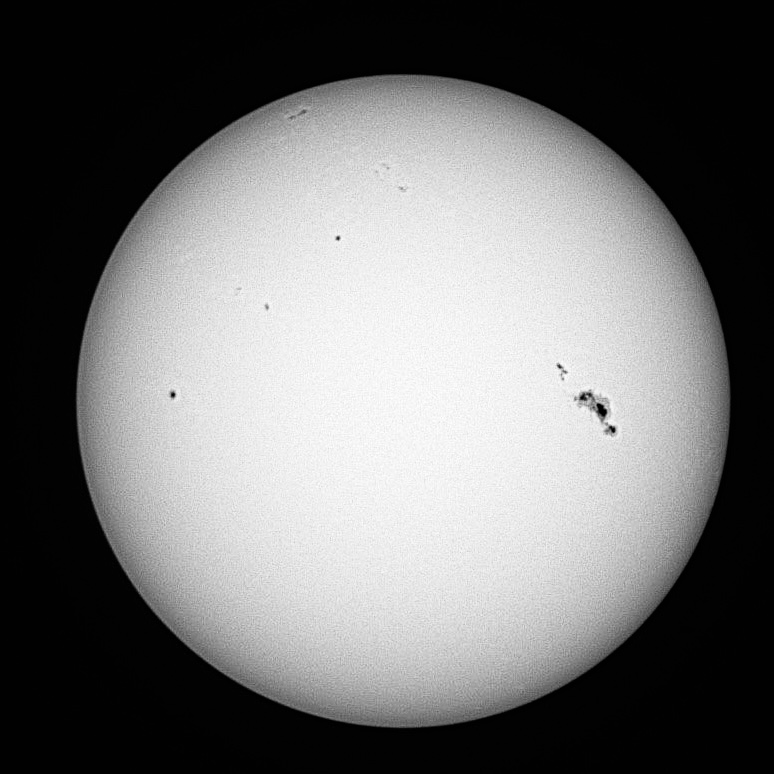
Solar image acquired 02/26/2024 at 2:54 PM ET; location Morganville, NJ. Telescope Dwarf II and Dwarf II Lab processing of 101 stacked images.
Spaceweather.com states: “AR3590 is now the largest sunspot of Solar Cycle 25. For comparison, it is now 60% as large (by surface area) as the great sunspot that caused the Carrington Event in Sept. 1859. Even a 60%-intensity Carrington Event occurring today could cause problems for satellites, power grids, and internet connectivity. That’s why forecasters are carefully watching this sunspot.”
Rich Sherman

IC417 The Spider Nebula (center) and NGC 1931The Fly Nebula (upper right) emission nebulas imaged 12/18/2023 with ASI2600MC Pro camera using the Antlia Triband Filter on a Sky-Watcher Esprit ED APO 100mm f/5.5 refractor; Integration of 25×2 min frames at -10 C, Bin 1, at unity gain; Processed with CCD Stack, Topaz De Noise, and Lightroom.
The IC417 and NGC 1931 emission nebulas known as The Spider and The Fly nebulas are located about 10,000 and 7,000 ly from Earth respectively. The nebulas are located in the Auriga constellation comprised of massive clouds and gas providing stellar nurseries. The Spider nebula is about 100 ly across while the Fly nebula has been described as a mini-Orion nebula as it displays similar characteristics.
Purnendu Gupta
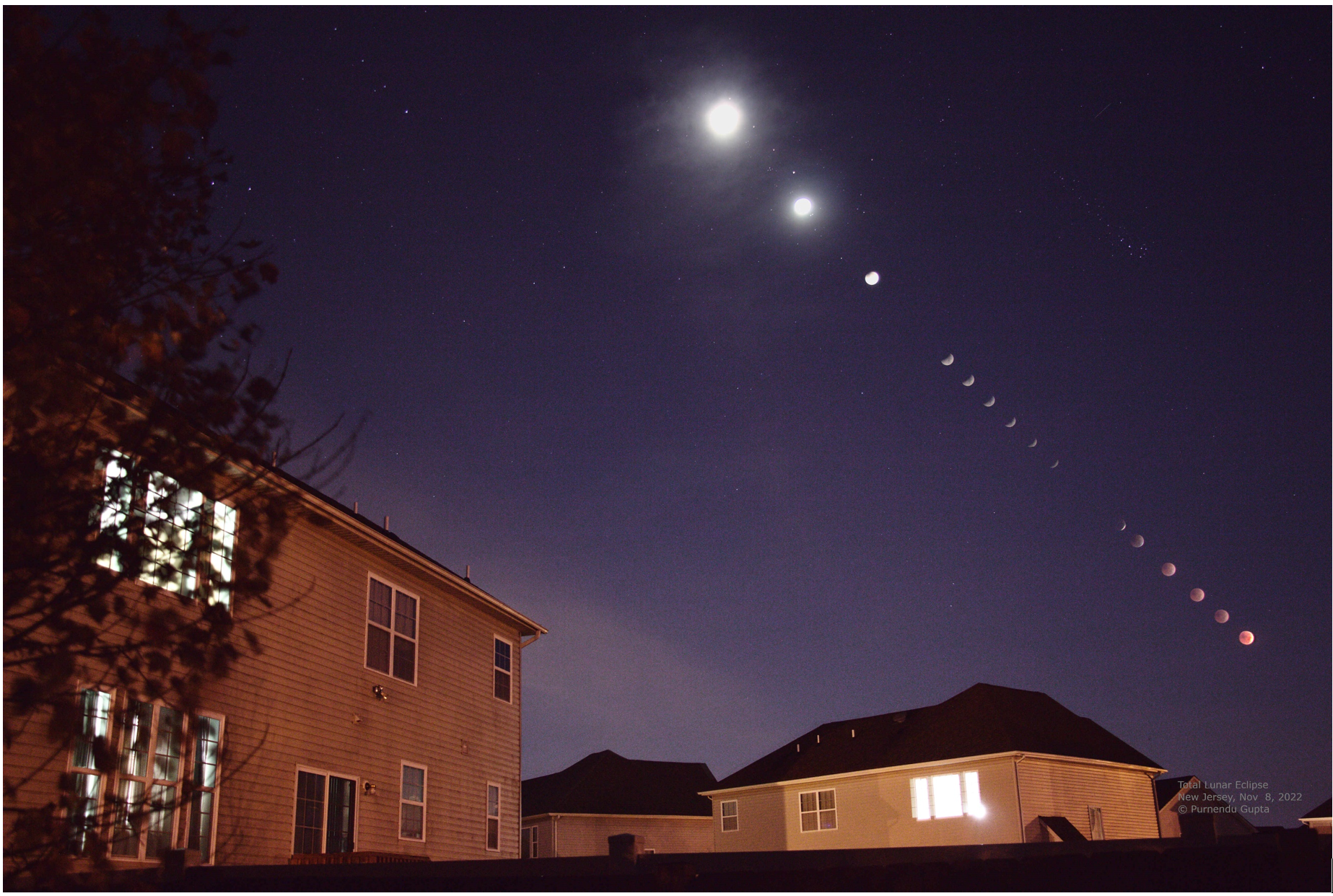
In the Earth’s shadow, a total lunar eclipse as seen on 11/08/2023 from my backyard. It’s a strange transformation to see the Moon, in a span of 2 hours, go from a brilliant full disc, to a smoldering ashen orb lurking among the stars. It doesn’t look as red by naked eye, but certainly looks more ominous. This image is a composite of 15 images taken with a DSLR on a tripod.
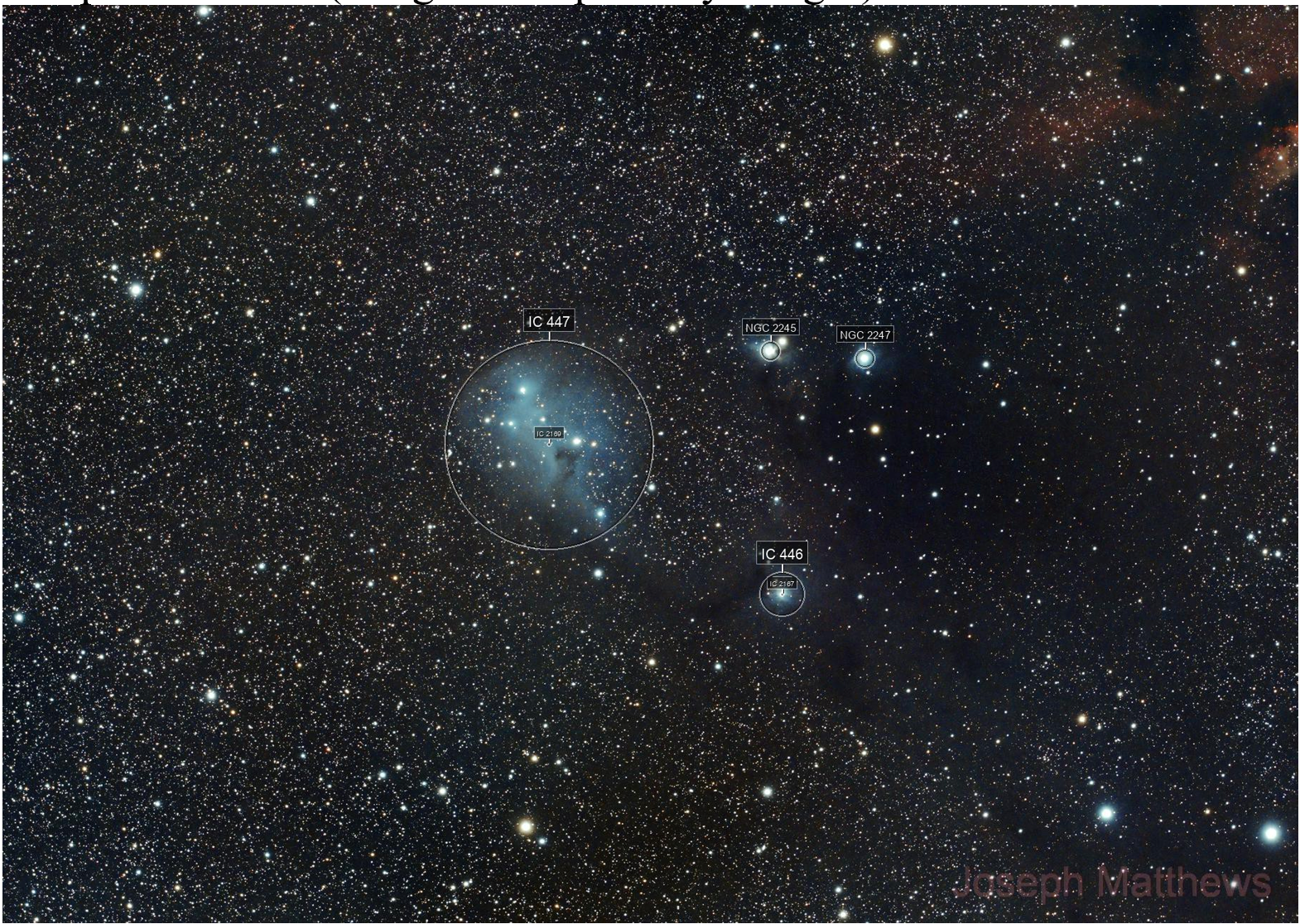
On 12/11/2023, this image of the collective IC2169, IC447, IC2169, and IC2167 located in the Monoceros constellation was taken in 26 mph wind gusts. It is not as popular as its neighbors the Cone Nebula and the Christmas Tree Cluster. It is full of dark nebula (LDN1605 LDN1606 and LDN1607) and the blue reflection nebulas scattered about the area. It is approximately 2,500 ly from Earth. Image integration of 30×300 sec frames using an Optolong L-Pro filter.
Joseph Matthews
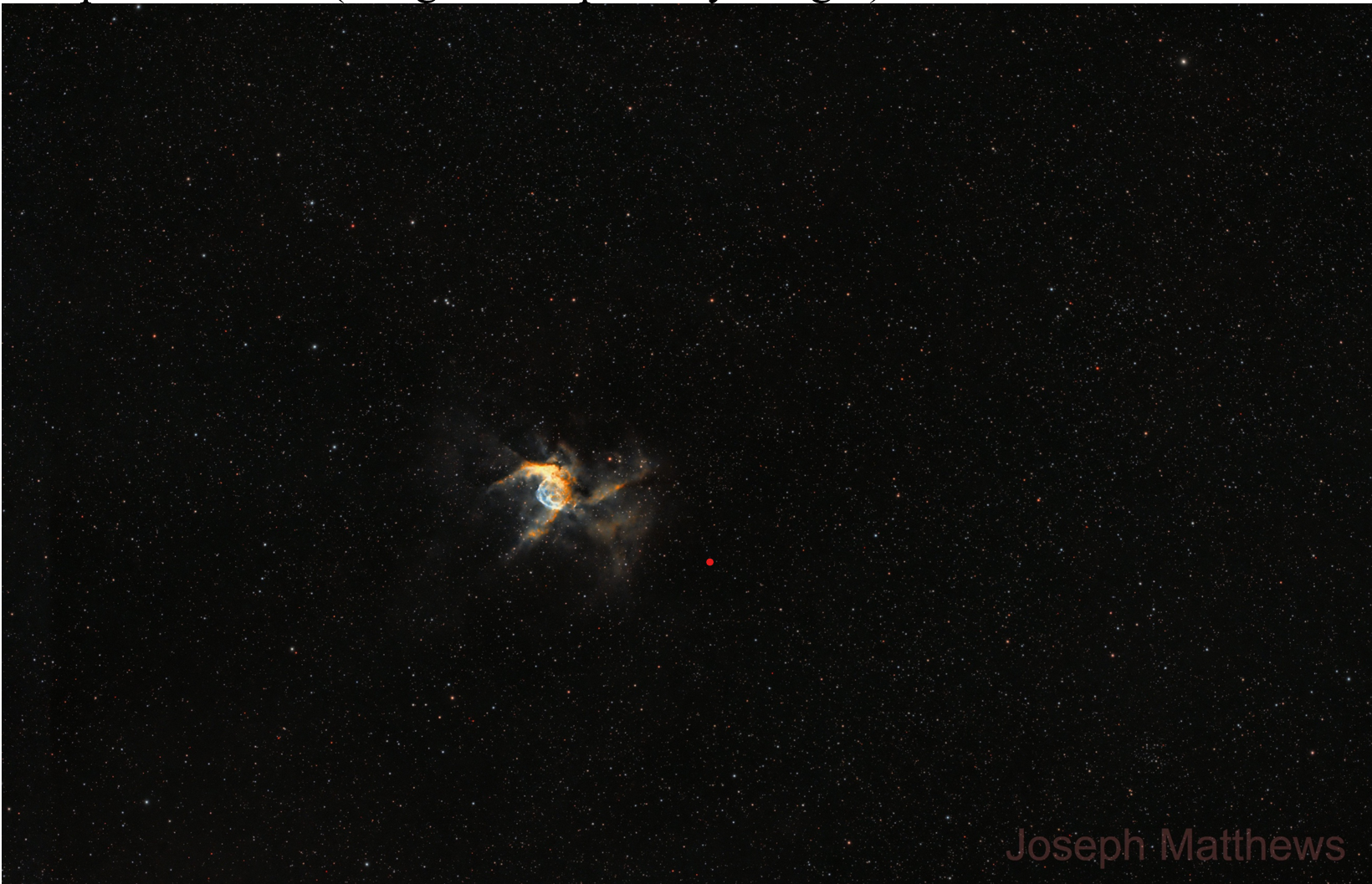
This image is Joseph Matthews’ first of NGC 2359 or known as Thor’s Helmut captured at 1 am on 12/01/2023. This emission nebula is in the constellation Canus Major. The nebula is approximately 3,670 pc or 12,000 ly from Earth and is 30 ly in size. The central star is the Wolf-Rayet star WR7, an extremely hot star thought to be in a brief pre-supernova stage of evolution. Thor’s Helmut image integration of 17×300 sec frames using a L-Ultimate filter.
Bill Murray Rich Sherman
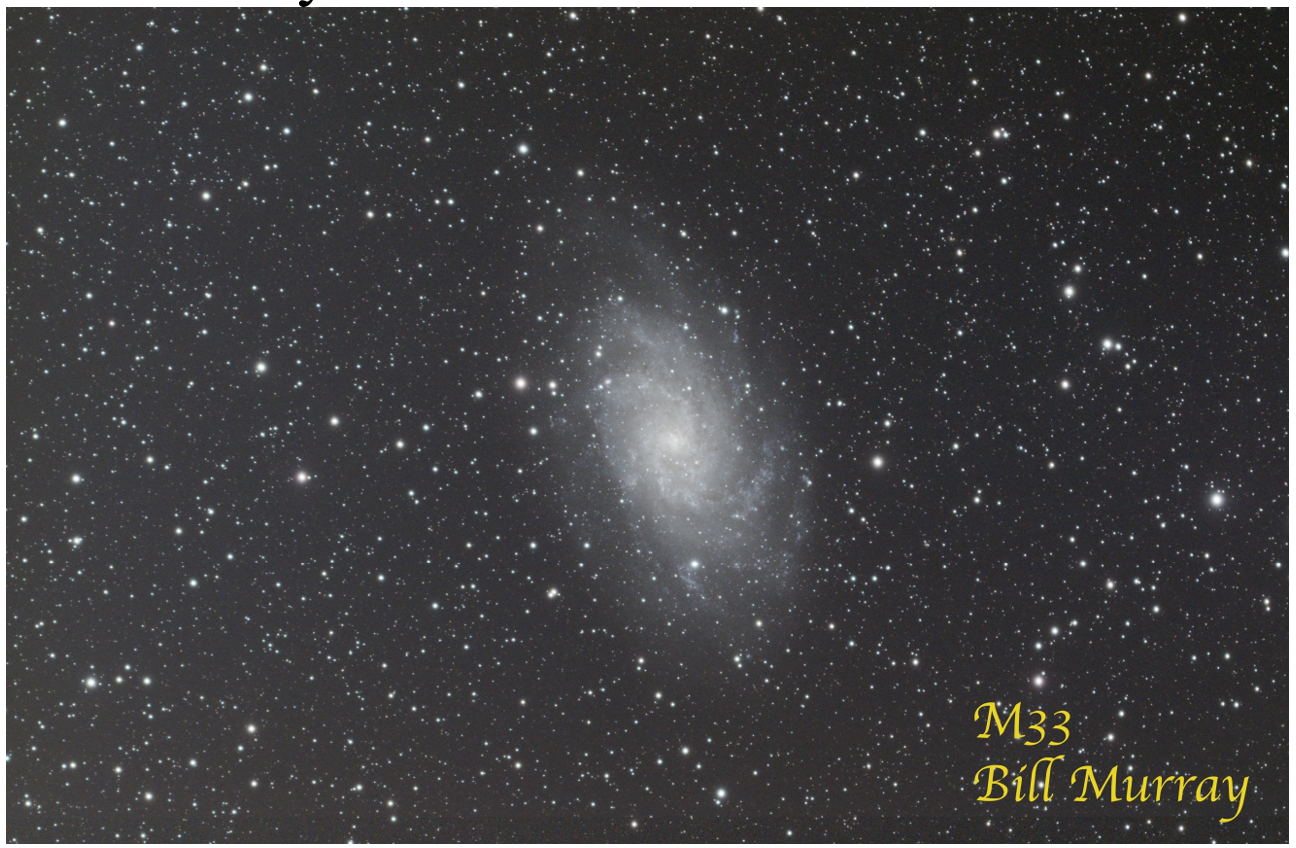
M33 image was captured using a ASI183MC Pro camera on a William Optics Redcat 51 with an integration of 5 to 6 hours.
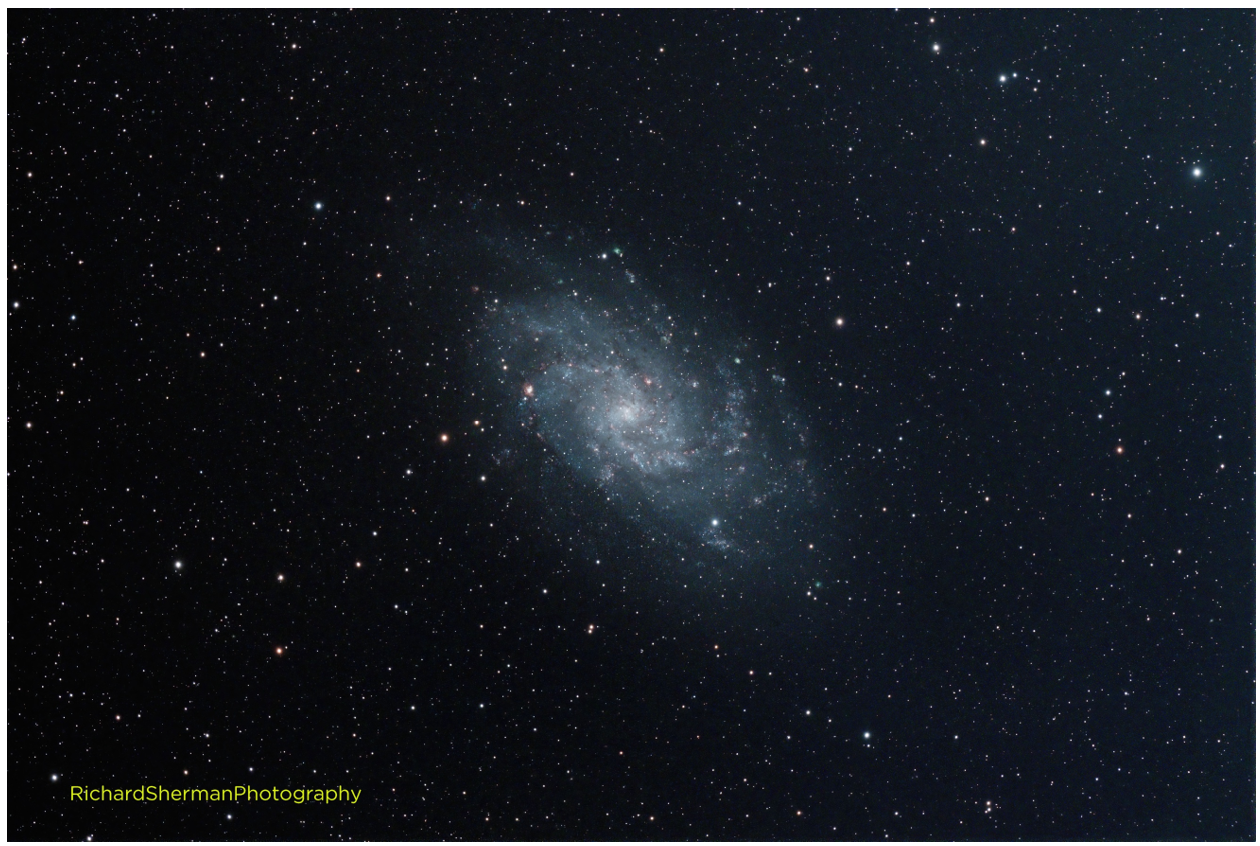
M33 image captured 02/02/2024 with ASI2600MC Pro camera using the Antlia Triband filter on a Sky-Watcher Esprit ED APO 100mm f/5.5 refractor. Image integration of 35×2 min frames at -10C, Bin 1, unity gain; Processed in CCD Stack and Topaz DeNoise and Adobe Lightroom.
These two images of M33 the Triangulum Galaxy, or referred to as the Pinwheel Galaxy, is a spiral galaxy about 2.38 to 3.07 million ly from Earth in the constellation Triangulum first cataloged by Charles Messier August 1764 at an apparent magnitude 5.7. M33 is 61,100 ly in diameter making it the third largest member of the Local Group of galaxies with Andromeda Galaxy as the largest followed by our own Milky Way Galaxy. The galaxy contains about 40 billion stars, which is much less than the Milky Way with 400 billion stars and the Andromeda Galaxy with 1 trillion stars.
Robert Vanderbei
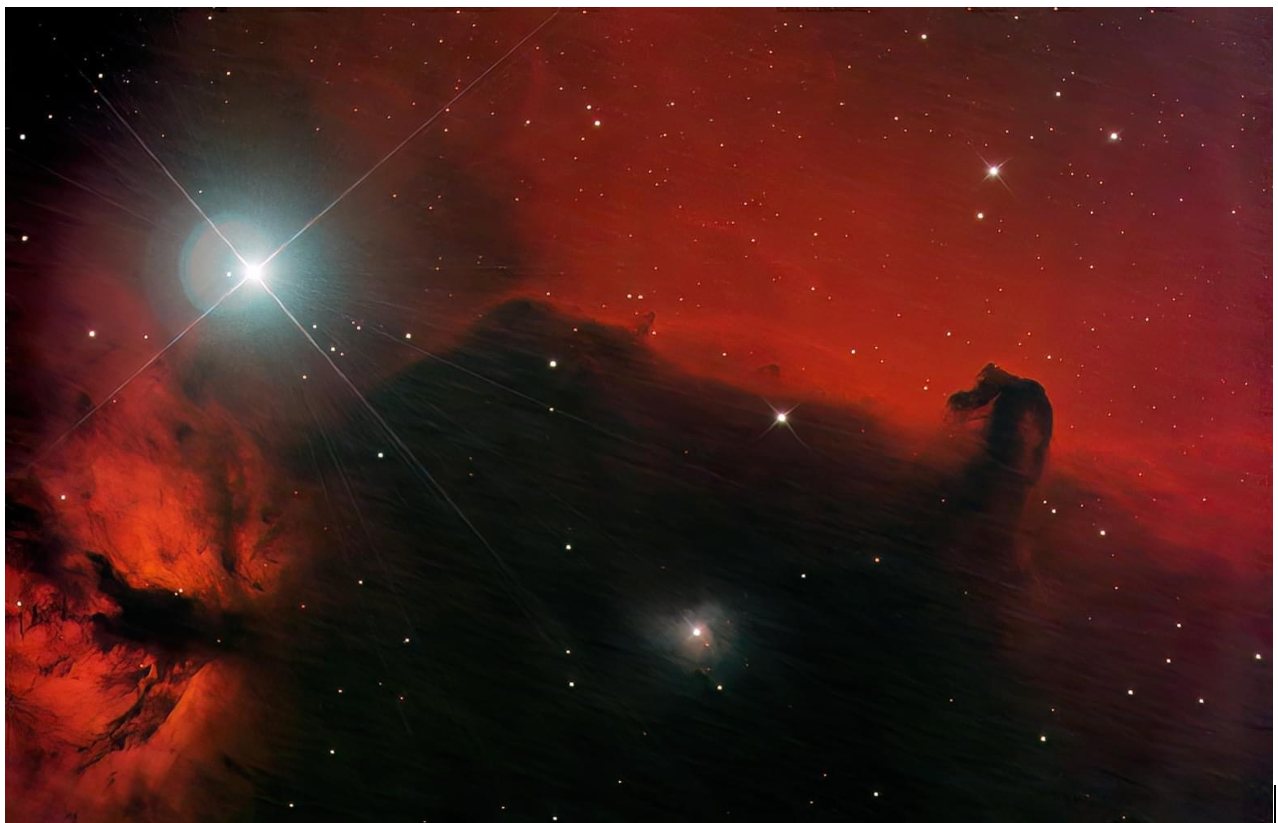
IC 434, also known as the Horsehead Dark Nebula, and NGC 2024, also known as the Flame Nebula, imaged 02/05/2023 with a ASI2400MC Pro and L-eXtreme filter using a 10” Ritchey-Chretien f/9 telescope. Images were processed using SharpCap with exposure of 102 min in 30 sec frames.
The Horsehead nebula, located in the Orion constellation, is about 422 pc from Earth. It is part of the Orion molecular cloud complex where star formation is taking place. The reflection nebula NGC 2023 is located in the lower left and is about 400 pc from our planet and is one of the largest in our sky at 10×10 arcminutes. The Flame Nebula, NGC 2024, located on far left in the image is 1,500 ly away. At the center of the Flame Nebula is a cluster of 800 newly formed stars of which 86% of them have circumstellar disks whereby planets may form.
Rich Sherman
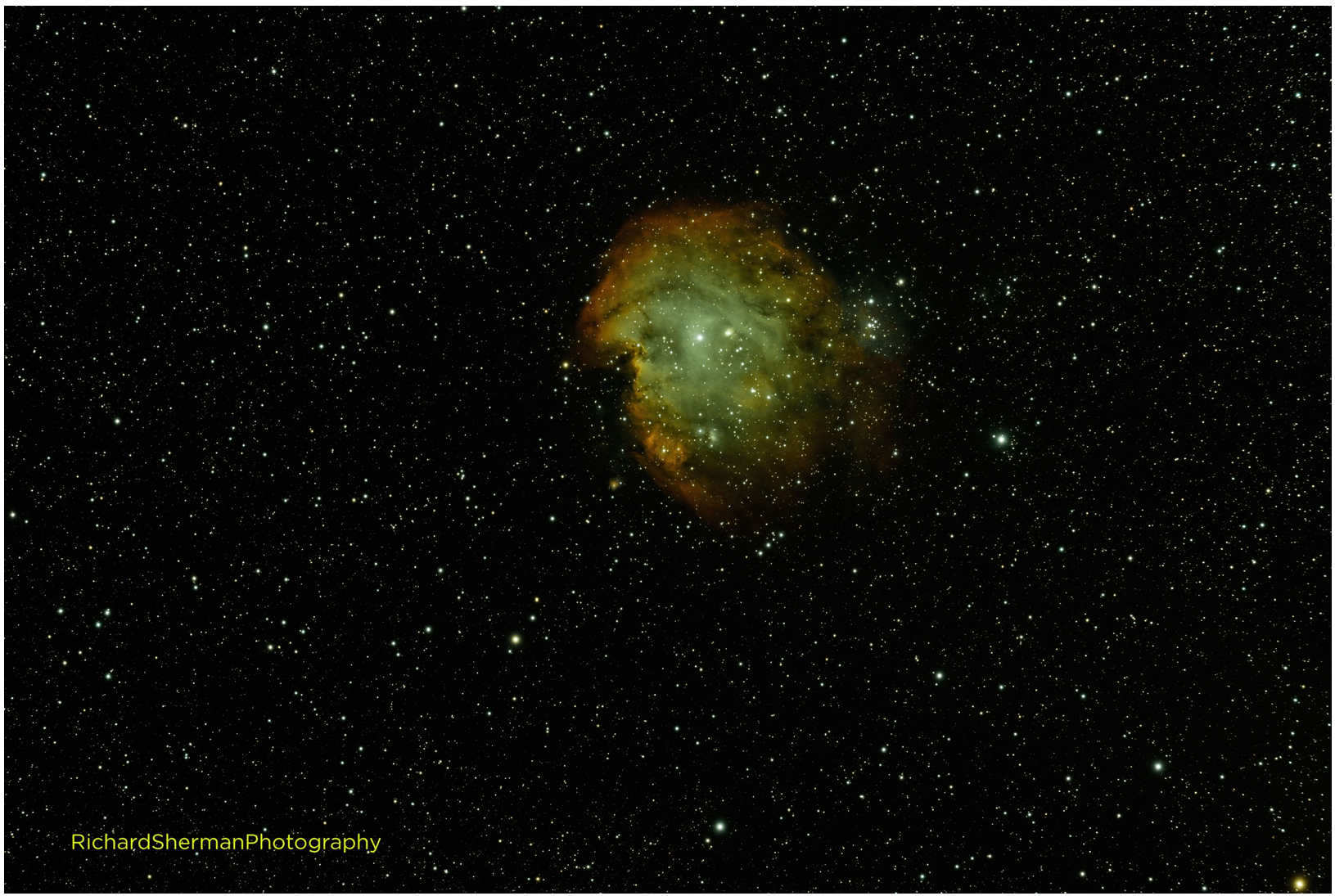
NGC 2174 – Monkey Head Nebula image captured 02/02/2023 with ASI2600MC Pro camera using the Antlia Triband filter on a Sky-Watcher Esprit ED APO 100mm f/5.5 refractor. Image integration of 35×2 min frames at -10C, Bin 1, unity gain; Processed in CCD Stack and Topaz DeNoise and Adobe Lightroom.
The Monkey Head Nebula, an emission nebula, is located in the Orion constellation and is about 6,400 ly from Earth. The stars at the center of this nebula generate stella winds coupled with high energy radiation resulting in the nebula transforming into complex dynamic shapes.

IC 2177, the Seagull Nebula, is 3,800 ly from Earth and was imaged 02/07/2024 with a ASI2600MC Pro camera and Antlia Triband filter atop a Sky-Watcher Esprit ED APO 100mm f/5.5 refractor. Image integration is 36×2 min frames at -10 C, Bin 1, at unity gain; Processed in CCD Stack, Topaz DeNoise, and Adobe Lightroom.
The Seagull Nebula lies between constellations Monoceros and Canis Major. NGC 2327 is located in IC 2177 and is known as the Seagull’s Head.

NGC 1365 “The Great Barred Spiral Galaxy” located 74,000,000 ly from Earth was imaged 02/07/2024 with a ASI2600MC Pro camera and Antlia Triband filter atop a Sky-Watcher Esprit ED APO 100mm f/5.5 refractor. Image integration is 36×2 min frames at -10 C, Bin 1, at unity gain; Processed in CCD Stack, Topaz DeNoise, and Adobe Lightroom.
NGC 1365 is a double-barred spiral galaxy 300,000 ly across in the Formax constellation. At the center of this large double-barred galaxy, there exists a supermassive black hole with a mass of about 2 million solar masses and rotates at nearly the speed of light.
by David A. Ackerman
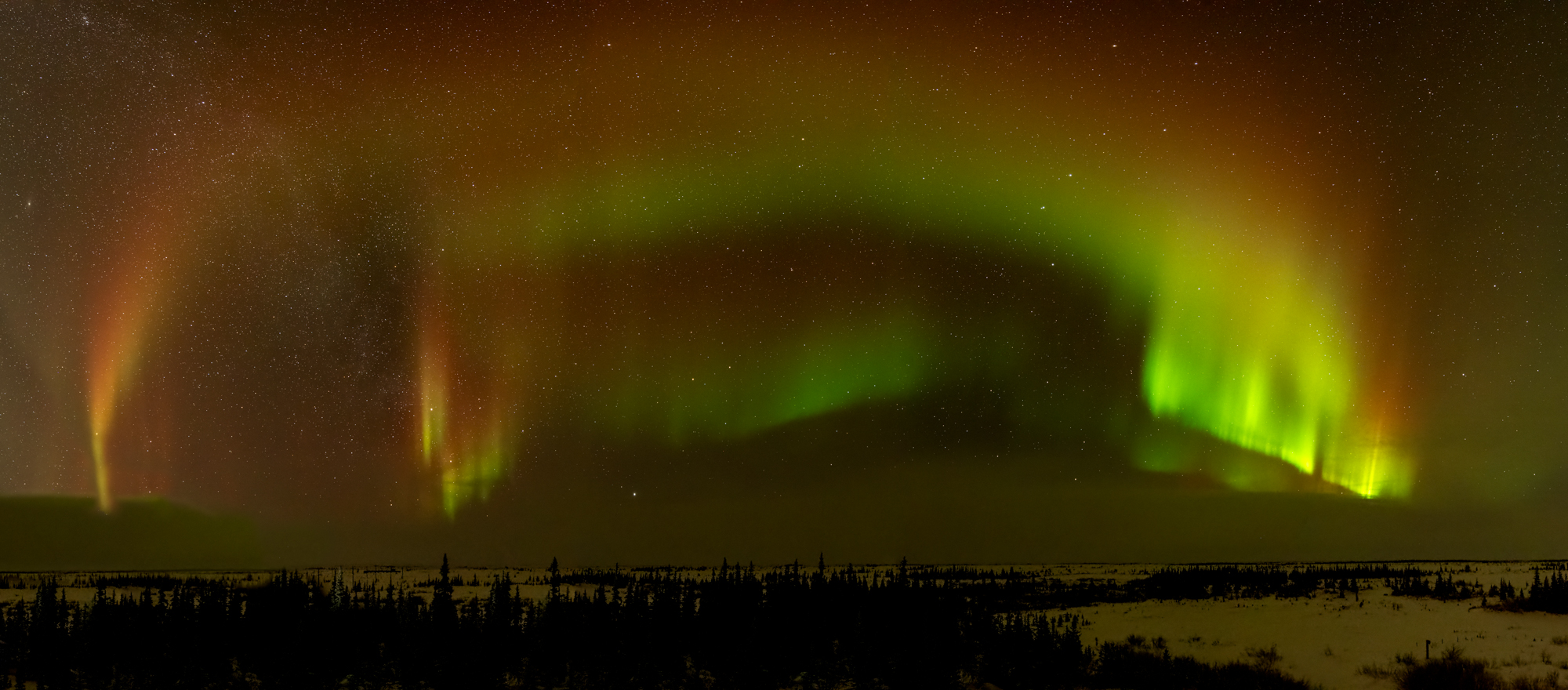
A wide field image of the Aurora Borealis viewed from within the Auroral oval, looking north, photographed from Churchill, MB, latitude 59N, temperature a balmy -20F. Nikon DSLR with 14mm lens, 5s exposure, ISO 3200 (thank you NoiseXTerminator).
The Auroral Oval is a ring-shaped region encircling the polar regions. It is a prime location for observing auroras due to its high geomagnetic activity. Churchill, Manitoba in Northern Canada falls within the Auroral Oval.
by S. Prasad Ganti
A recent article in the journal “Nature” intrigued me. It stated that the accelerated expansion of the Universe, attributed to dark energy currently, could be happening due to merger with other Universes. A very thought provoking idea indeed, although very difficult to prove. It made me think and come up with my 2 cents.
Our Universe was born from a super giant explosion called “The Big Bang”. From a very humble beginning a small dense and hot dot grew rapidly – a phenomenon called “inflation”. It led to the Universe we know today. The expansion still continues. This expansion pales in comparison with the initial inflation which expanded the space twenty orders of magnitude (10 followed by 20 zeroes) in a very tiny fraction of a second. Given below is the picture from Wikipedia depicting the growth of our universe since the big bang. The vertical rise to the left is the period of rapid inflation.
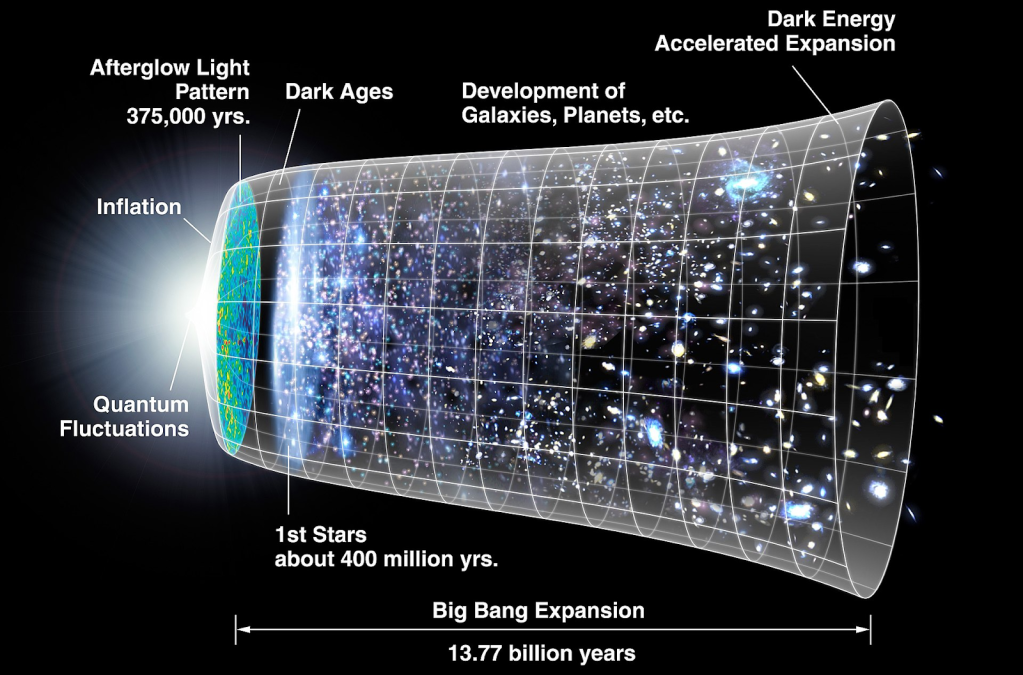 The current expansion which is accelerating (right portion of the picture) is supposed to be caused by Dark energy. Also known as the energy of the vacuum, wherein virtual particles come into existence and get annihilated, not much is known about it, There has been no light shed on the “dark” yet. In the middle of such a situation comes in an explanation based on Multiverses or Multiple Universes. While the Multiverse is only a mathematical theory, it is also being used to explain what happened before the Big Bang. Very well explained in the book “Before the Big Bang” by Laura Mersini-Houghton. It is posited that multiple Universes float in a higher dimension. Universes are born and not everyone of them matures to become one like ours.
Given this background, it is not much of a stretch to say that we are absorbing other Universes from higher dimensions. In fact it is being said that we did absorb a lot of other Universes during the initial inflation phase. Collisions and mergers amongst astronomical objects are very common in our Universe too. Black holes merge into other black holes, neutron stars merge into black holes and also into other neutron stars. Galaxies merge too. In fact, our neighboring Andromeda galaxy is on a collision path with our Milky Way galaxy to happen in about two million years. After the merger, things will settle down into a bigger merged galaxy. Our galaxy, in effect, would be expanded to more than double its size.
Multiverse may sound like science fiction. But then about a century ago, our Universe was just confined to our galaxy, Edwin Hubble made a shattering discovery that a nebula in the Orion belt called Andromeda is a separate galaxy and is about 2 million light years away. Since then a lot of galaxies have been found and the span of our Universe and its age and history were discovered as well. A century from now, multiple universes may be in the same state as multiple galaxies are today. And another dimension would have been added to our lexicon.
For now, the question is how to find evidence. Most of the evidence in astronomy is indirect. It is only remote measurements anyway. Analyzing the spectrum of the radiation coming in, to infer what elements or molecules have emitted that radiation. And to look at pictures and infer the properties of the object. After all, no human being has gone beyond our moon and none of our spacecraft has ventured beyond the confines of our solar system.
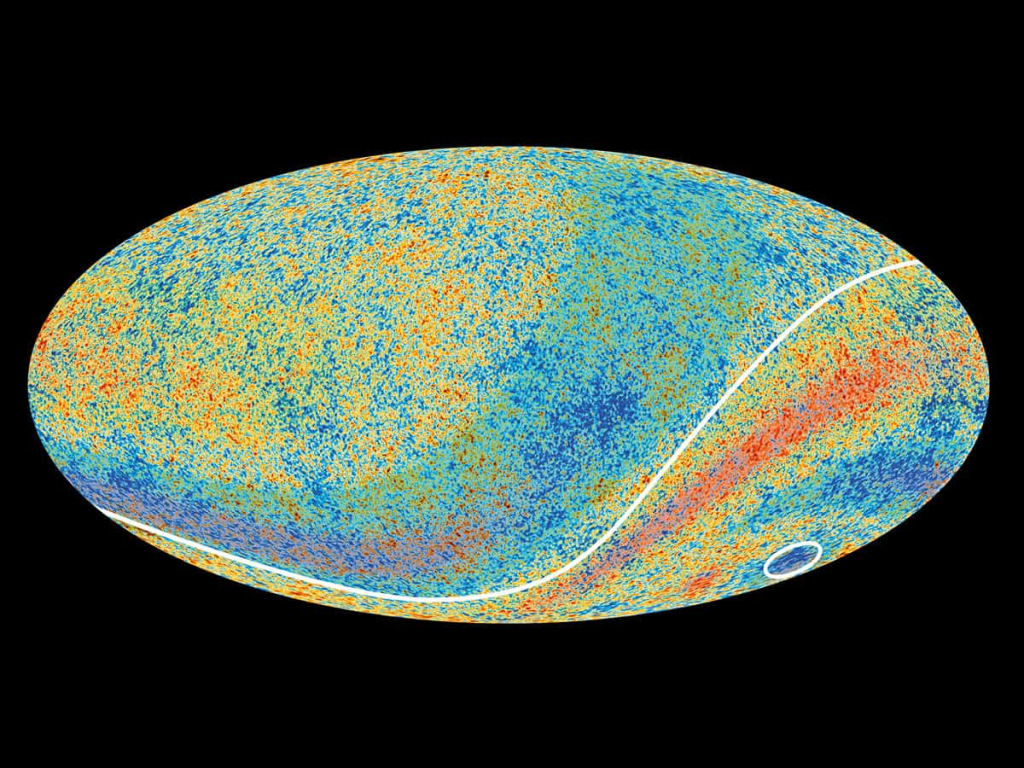 Studying the pattern of CMB (Cosmic Microwave Background) radiation can give us some clues. Like the book “Before the Big Bang” mentioned that a patch of the pattern in CMB was possibly related to interaction with our neighboring Universes (picture shown below has a circled patch in the right lower corner, by the Planck satellite, courtesy Physics World). There could be other hidden messages in the CMB patterns. CMB could tell us about possible mergers with other Universes. I am letting my imagination fly here. Someday we might find out there is no dark matter at all. The gravitational effects we see may be due to the tug of our neighboring Universe ! Both the “darks’ ‘ which are not well understood – dark energy and dark matter may be due to a common cause of the multiverse.
CMB detectors will become more granular in the future. And AI (Artificial Intelligence) may come to the fore to detect patterns that our minds cannot imagine. Hoping it would be a groundbreaking discovery.
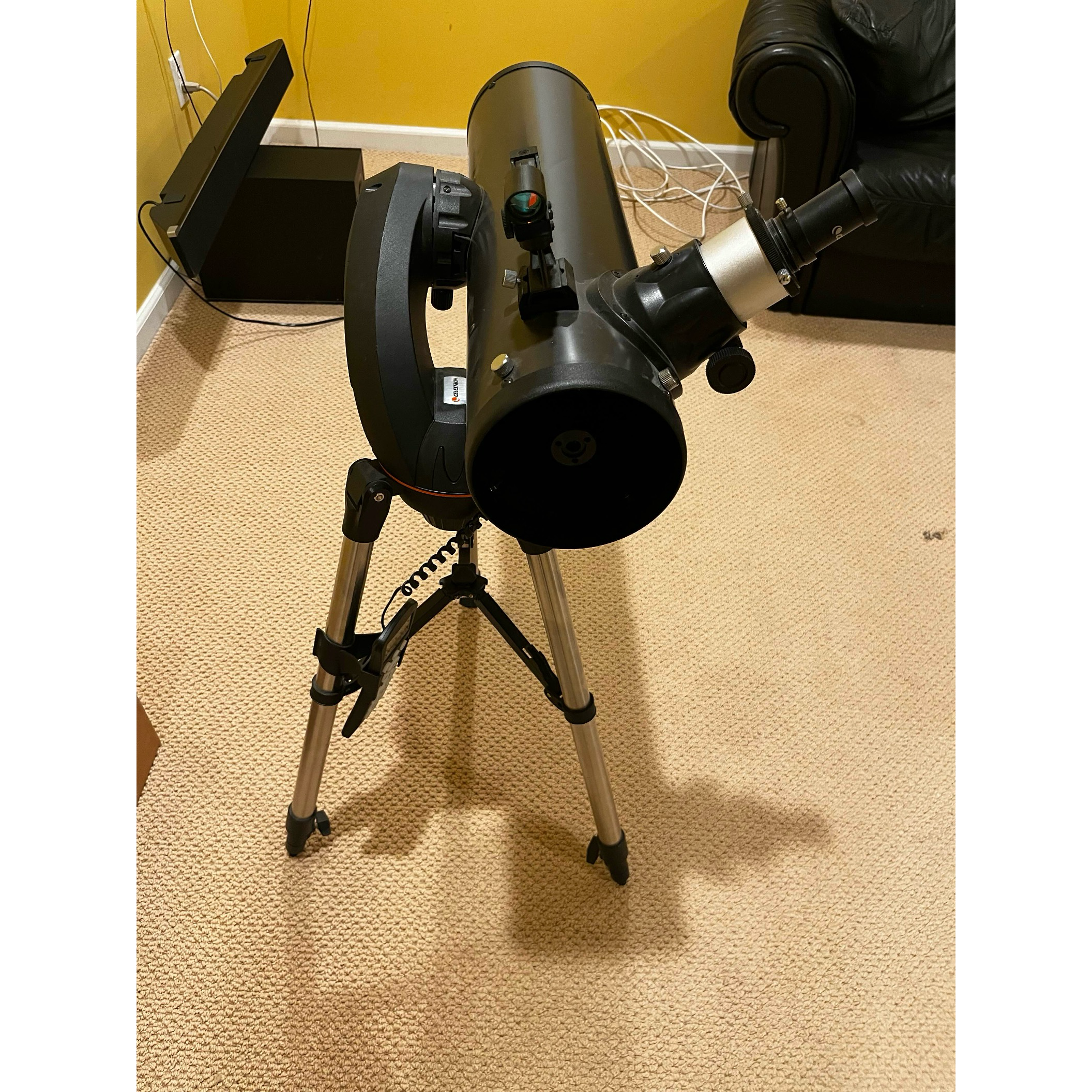
Rarely Used. Celestron Nexstar 130LTS Telescope for $500 or any reasonable offer. Email David at davem1960@comcast.net with an offer.

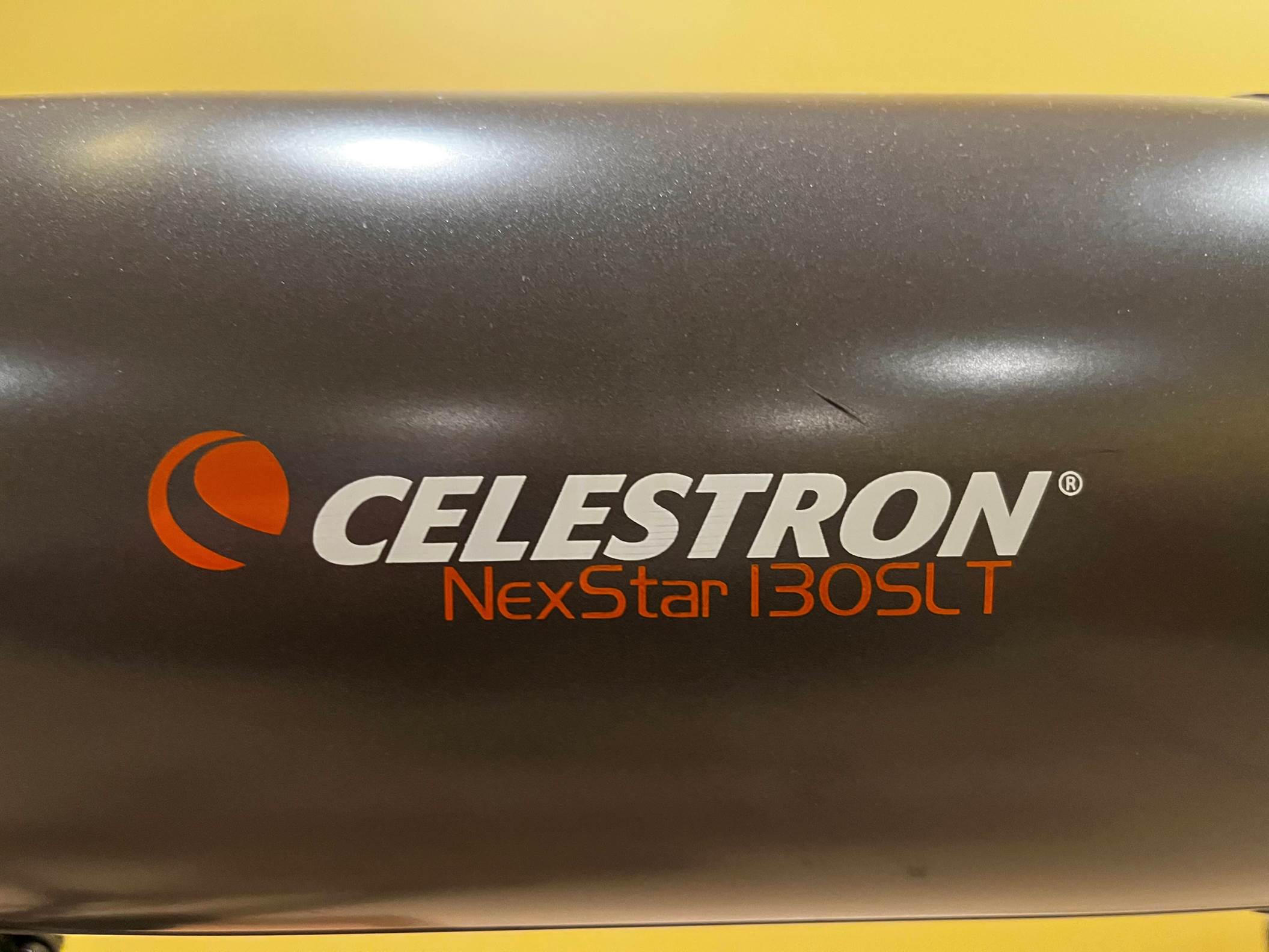
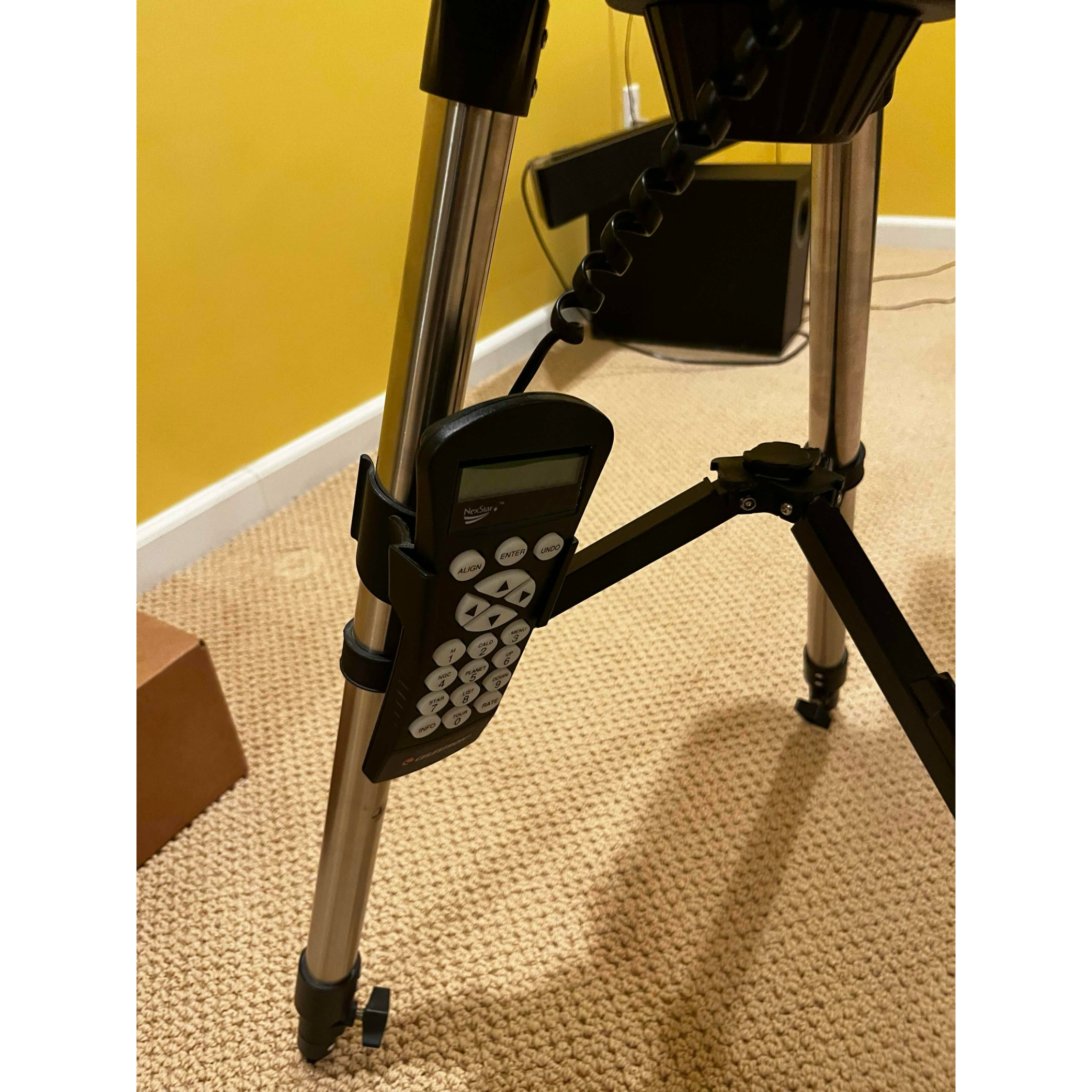
compiled by Arlene & David Kaplan
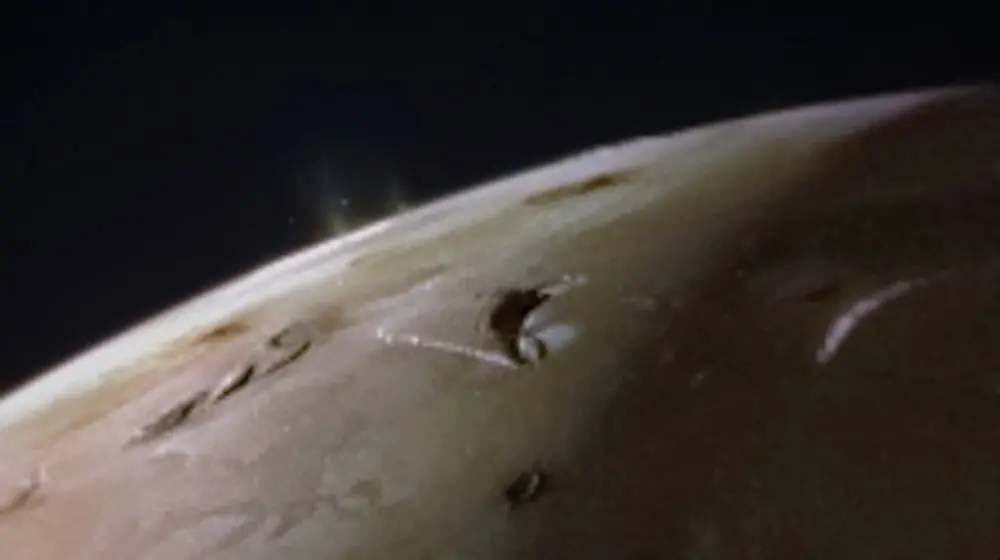
NASA Spots Signs of Twin Volcanic Plumes on Jupiter’s Moon Io On Saturday, NASA’s Juno orbiter got a second close-up with Io, Jupiter’s third-largest moon and the most volcanic world of our solar system. The Juno spacecraft, which arrived at the gas giant in 2016, is on an extended mission to explore Jupiter’s rings and moons. Its latest flyby, which complemented the mission’s first close approach on Dec. 30…more
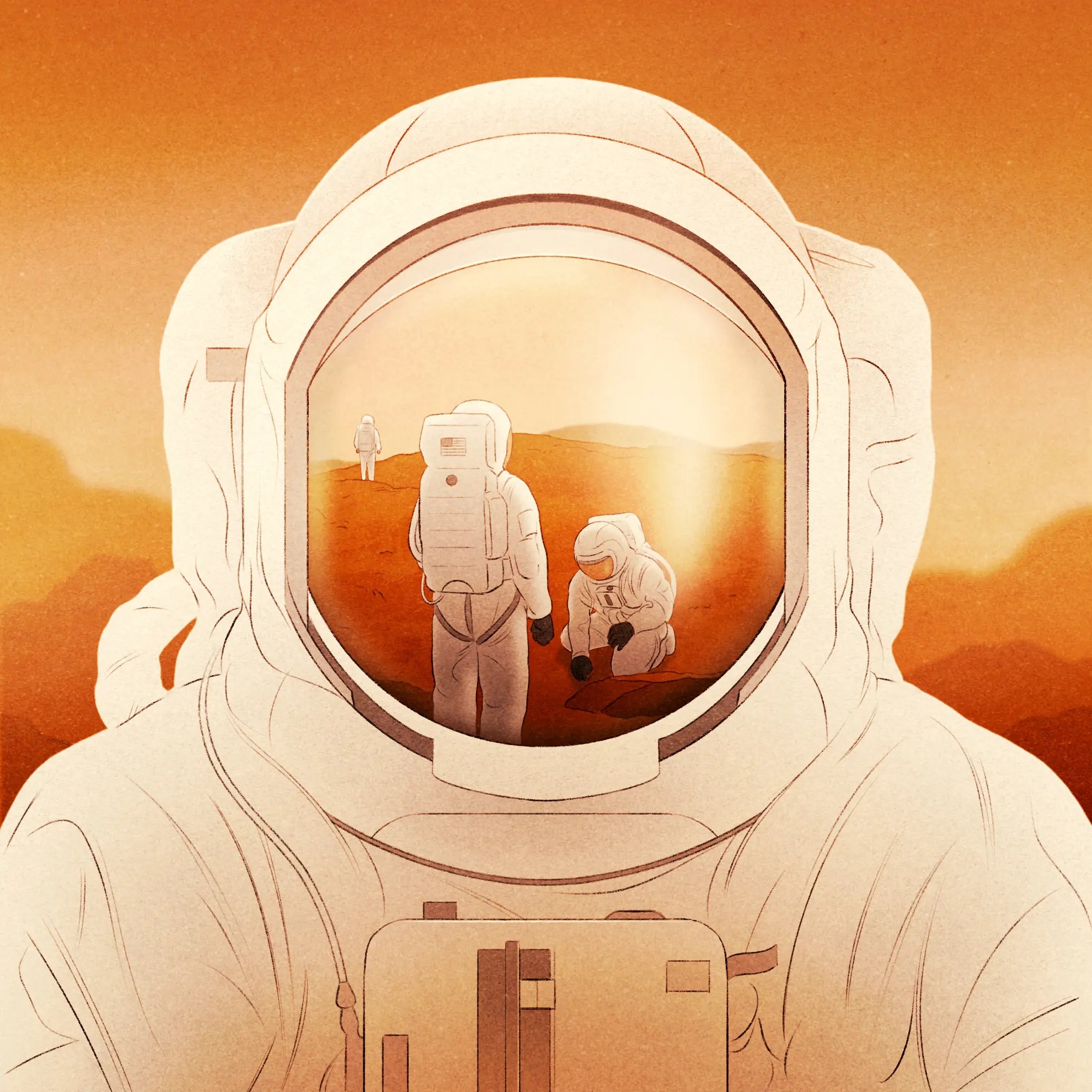
Can Humans Endure the Psychological Torment of Mars? Alyssa Shannon was on her morning commute from Oakland to Sacramento, where she worked as an advanced-practice nurse at the university hospital, when NASA called to tell her that she had been selected for a Mars mission. She screamed and pulled off the highway. As soon as she hung up, she called her partner, an information-security…more
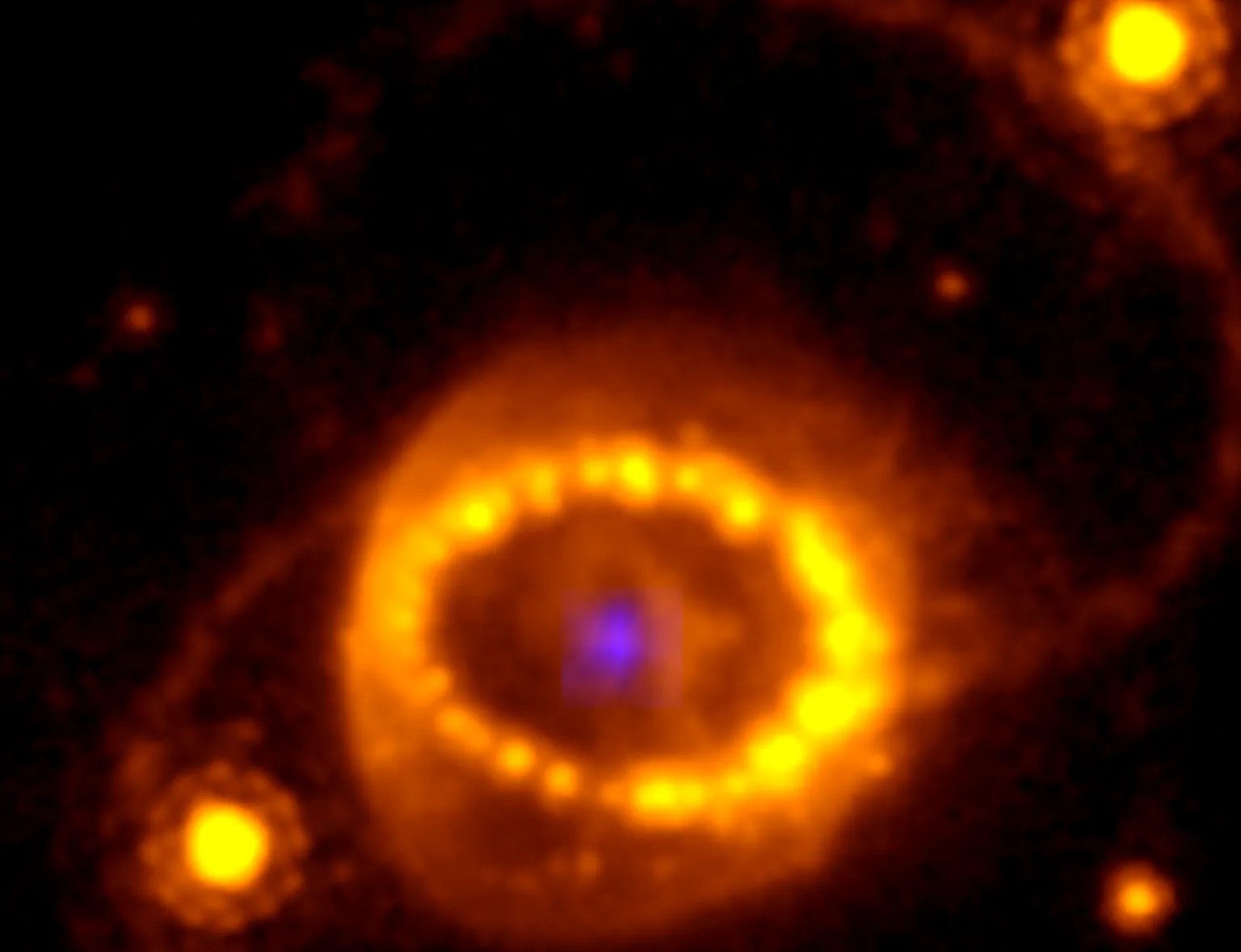
Supernova: Astronomers crack cosmic ‘murder mystery’ Scientists say they have solved the mystery of what lies at the heart of a celebrated cosmic explosion. In February 1987, a star was seen exploding in a nearby galaxy. It was visible from Earth for months, shining with the power of 100 million suns. There was so much debris, even the most powerful telescopes could not confirm what remained at its heart…more
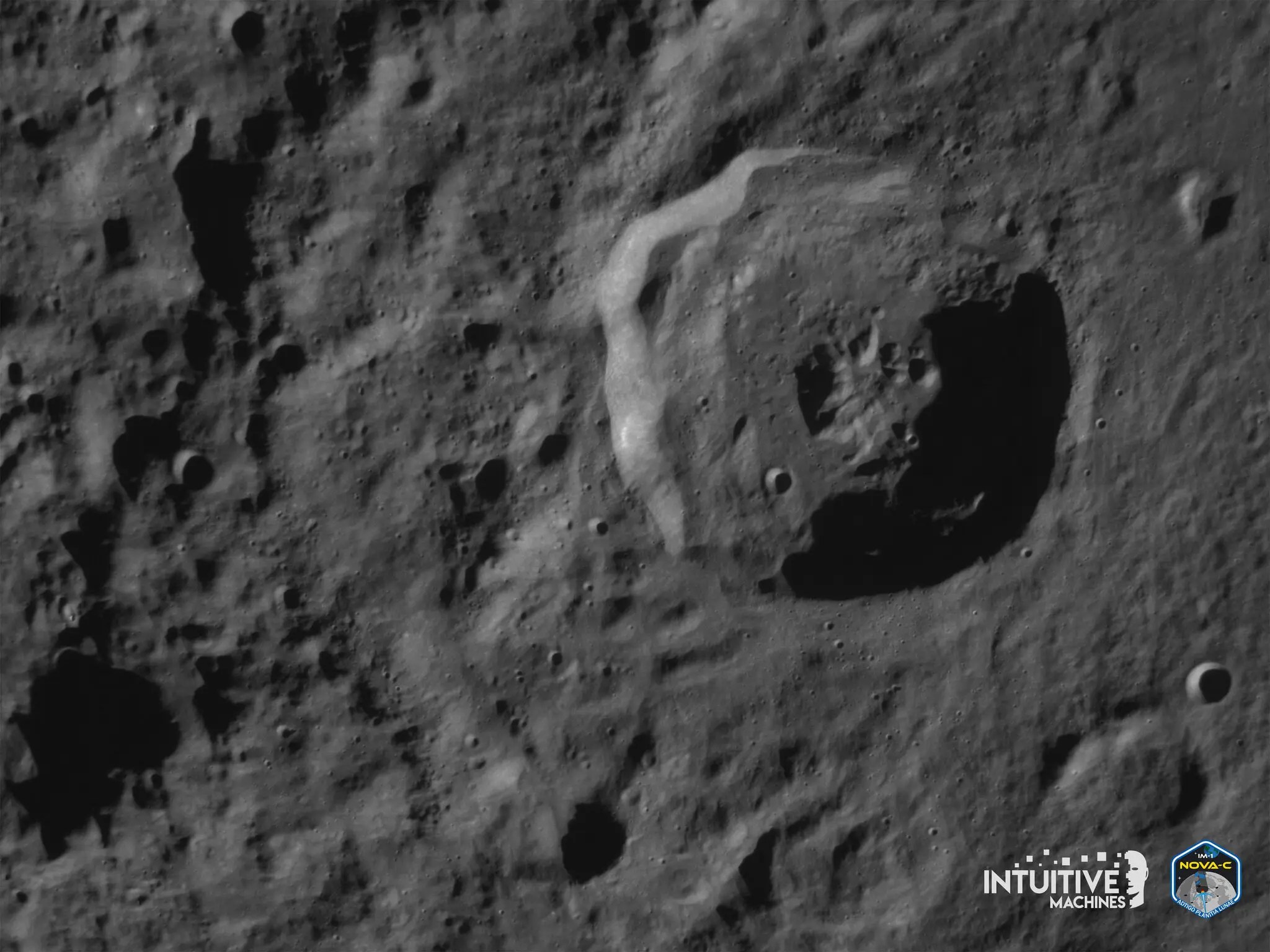
A U.S.-Built Spacecraft Lands on the Moon for the First Time Since 1972 For the first time in a half-century, an American-built spacecraft has landed on the moon. The robotic lander was the first U.S. vehicle on the moon since Apollo 17 in 1972, the closing chapter in humanity’s astonishing achievement of sending people to the moon and bringing them all back alive…more
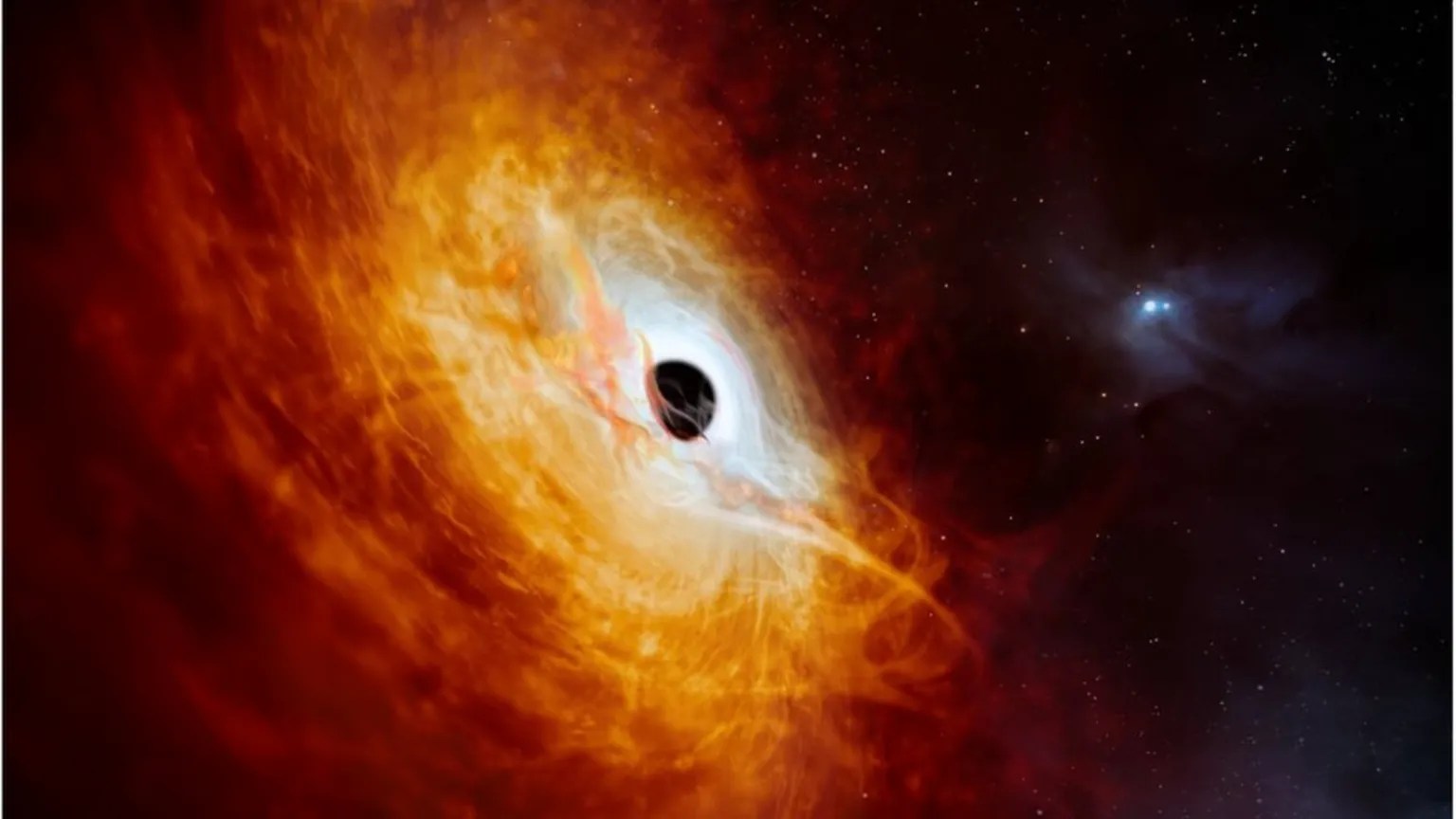
Brightest and hungriest black hole ever detected The most luminous object ever detected has been spied in the distant Universe. It’s a quasar – the bright core of a galaxy that is powered by a gargantuan black hole some 17 billion times the mass of our Sun. Known as J0529-4351, the object’s power was confirmed in observations by the Very Large Telescope in Chile…more

Fragments of Asteroid With Mystery Origin Are Found Outside Berlin Scientists have found pieces of a meteorite that fell near Berlin just after midnight on Jan. 21. It is a rare find, from an asteroid that was identified just before it entered Earth’s atmosphere. Only a handful of such events in the recent past have allowed astronomers…more
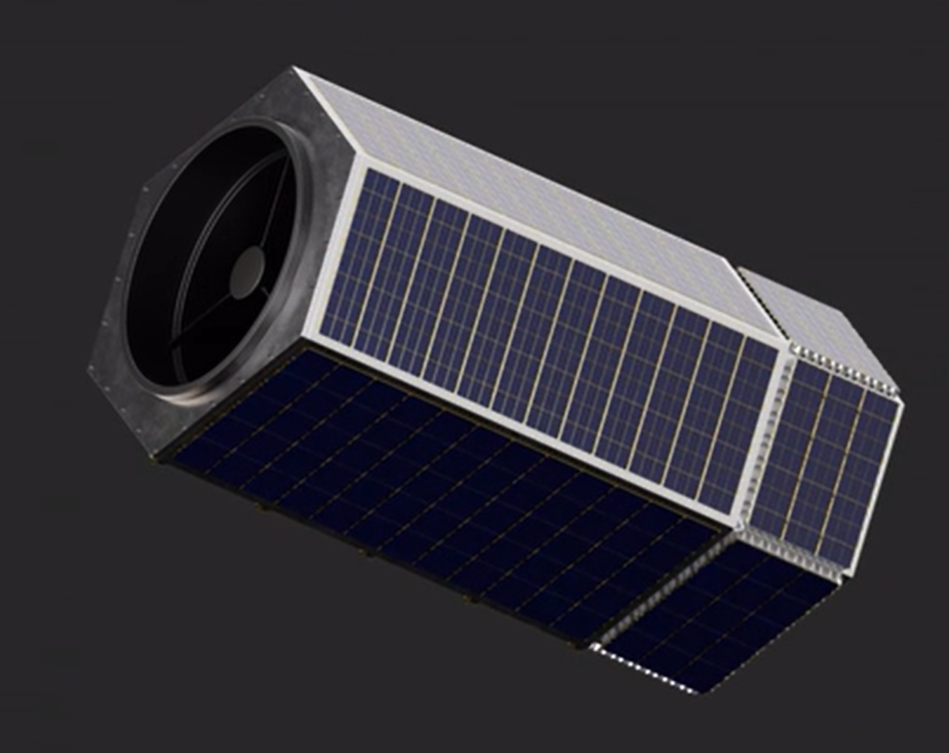
When Eyes in the Sky Start Looking Right at You For decades, privacy experts have been wary of snooping from space. They feared satellites powerful enough to zoom in on individuals, capturing close-ups that might differentiate adults from children or suited sunbathers from those in a state of nature…more
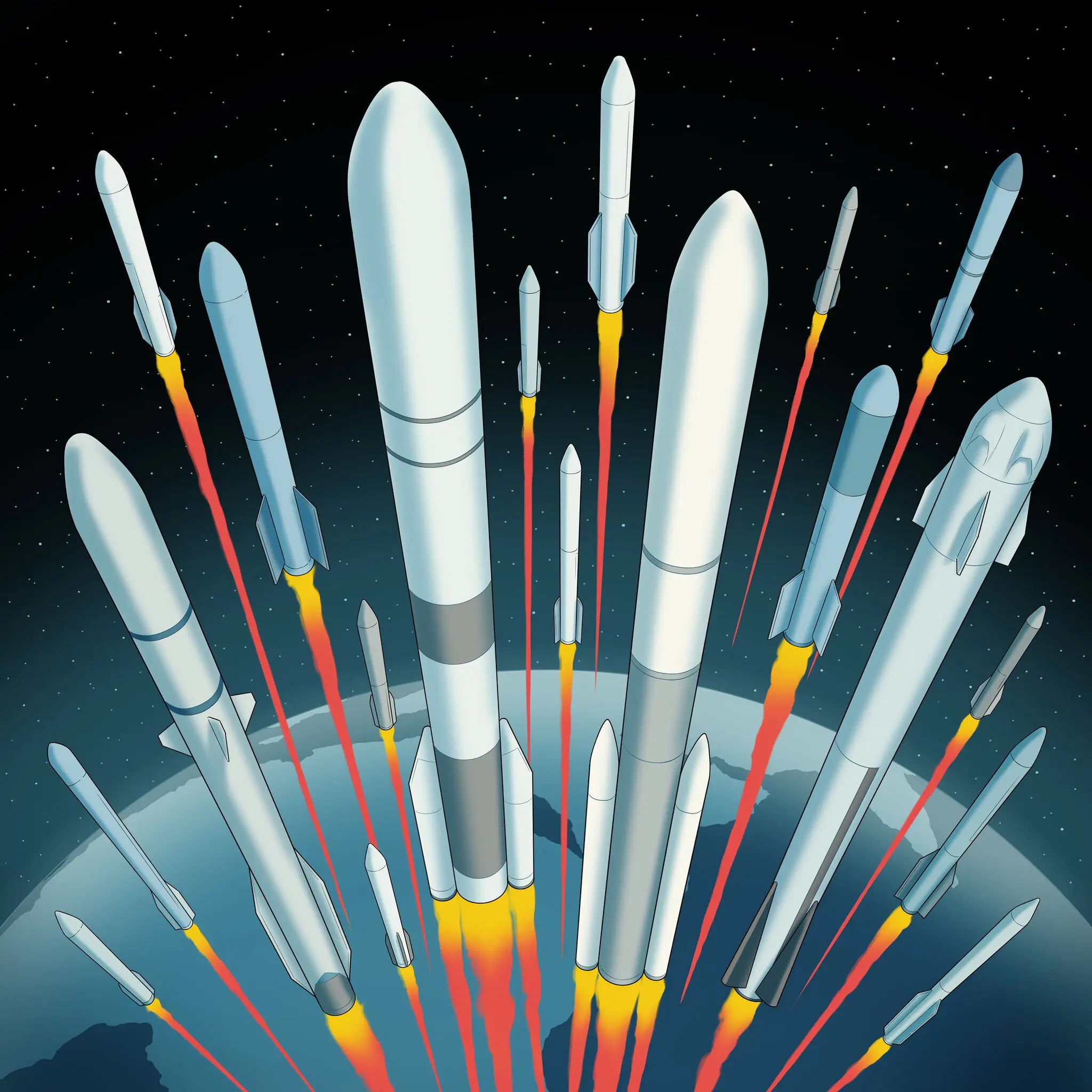
The New Space Race Is Causing New Pollution Problems Earth’s stratosphere has never seen the amounts of emissions and waste from rockets and satellites that a booming space economy will leave behind. The high-altitude chase started over Cape Canaveral on Feb. 17, 2023, when a SpaceX Falcon 9 rocket launched…more
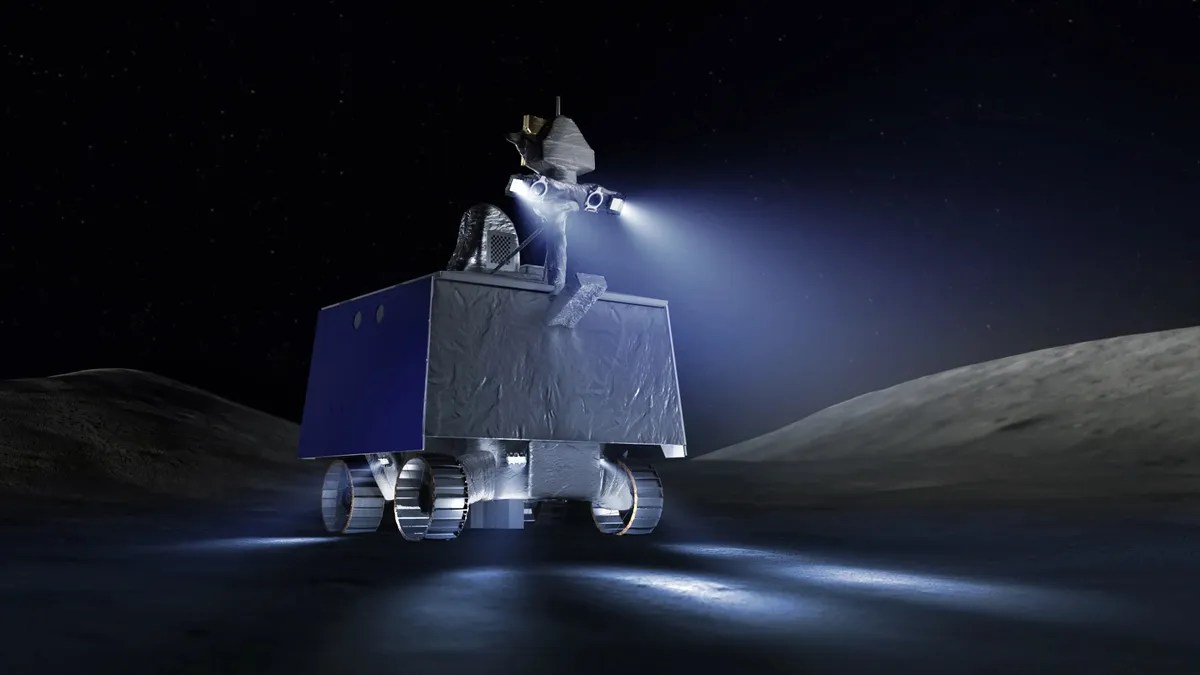
NASA’s ice-hunting VIPER moon rover getting ready to slither to the launch pad NASA’s next moon rover is one step closer to starting its lunar mission. The rolling robot, known as VIPER (“Volatiles Investigating Polar Exploration Rover”), is set to launch toward the moon later this year. And it just notched a milestone along that path…more
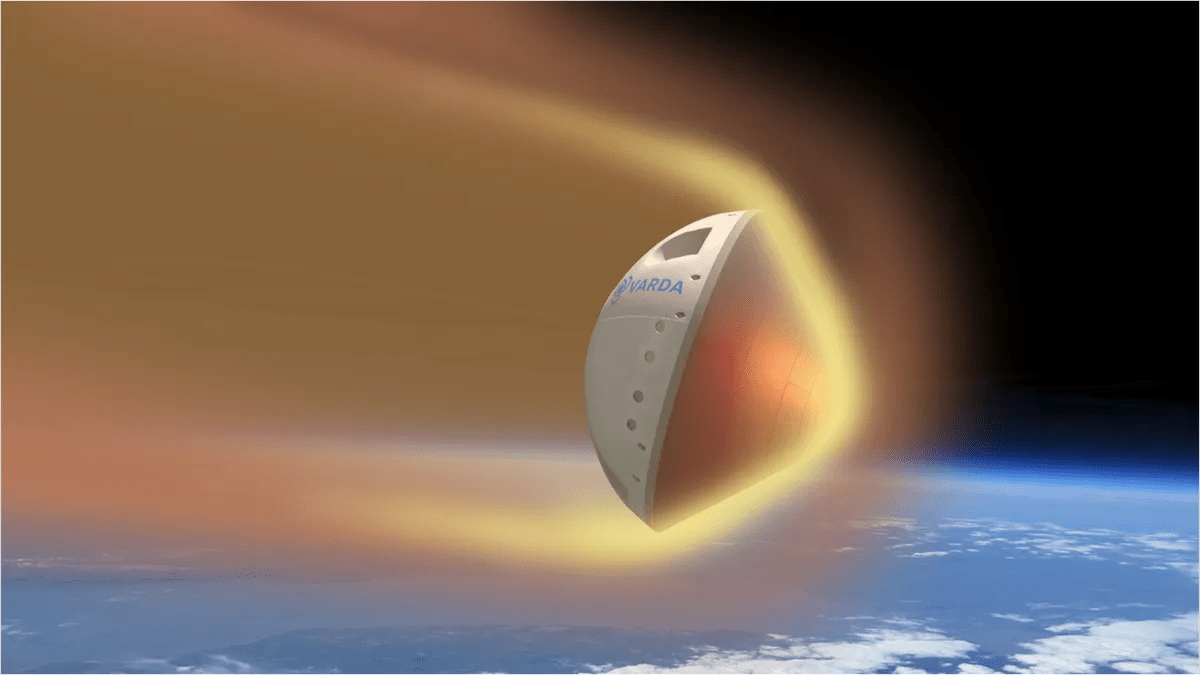
Private Varda Space capsule returns to Earth with space-grown antiviral drug aboard A California startup’s first in-space manufacturing effort is in the books. The capsule from Varda Space Industries‘ W-1 mission landed in northern Utah this afternoon (Feb. 21), bringing down to Earth crystals of an antiviral drug that were grown in orbit. The success makes Varda just the third company to recover an intact spacecraft from orbit…more

 Amateur Astronomers Association of Princeton