October 2010 Meeting Minutes

by Larry Kane, Secretary

The meeting was called to order by Director Ludy D’Angelo.

The Director presented observatory keys to our new key-holders, David Zahler and Victor Davis, in recognition of their completing observatory training.

Rex Parker gave a report on the device he used at StarQuest, to measure the sky “darkness.”  His measurements indicated that the sky in Hope, NJ was one full magnitude darker than at Washington Crossing.

Outreach: Member David Letcher has assumed the responsibilities of Outreach Coordinator.  He announced that we have two events scheduled.  The first, this coming Saturday is two troops of boy scouts at our W/C observatory.  The other, some time in November is a two night event in Pemberton, NJ and was requested by member Dee Bosch.  Dee noted that member and co-editor of the Sidereal Times, Michael Wright, has helped her to get her school’s telescope to work correctly.

Secretary Larry Kane stated that corrections to errors on the roster are being finalized.

Program Chair John Church noted that the next speaker for our Tuesday lecture series in Jerry Lodriguss.  He is a professional sports photographer for the Philadelphia Inquirer and noted astro-photographer.  Jerry has written several books on astro-photography.  John proceeded to highlight the speakers for the remainder of the season.

Treasurer’s report: The Treasurer’s report appears in another section of the Sidereal Times.

Observatory Co-chair Gene Ramsey reported that he has found some good information on repairing the observatory’s refractor mount.  Members Rex Parker and John Church offered to help Gene find articles that will assist the repairs.  Member and Assistant Director Jeff Bernardis gave Gene some material on security systems that might replace the present observatory system. Developing a new set of directions and a new map to the observatory were discussed.  Gene asked that a work party of members be assembled for the following Saturday to clear brush and brambles and do some painting.  It was noted that we need to complete the drainage work.  Member Saul Moroz asked if an “air chair” could be purchased for the observatory.  Member Brian Van Liew suggested that some of the hollows around the building be filled in thus creating more even space to set up telescopes.

Sidereal Times: The deadline for the November issue is October 29.

Larry Kane, Secretary
Posted in November 2010, Sidereal Times | Tagged | Leave a comment

Gas Giant Dreams

by Rex Parker

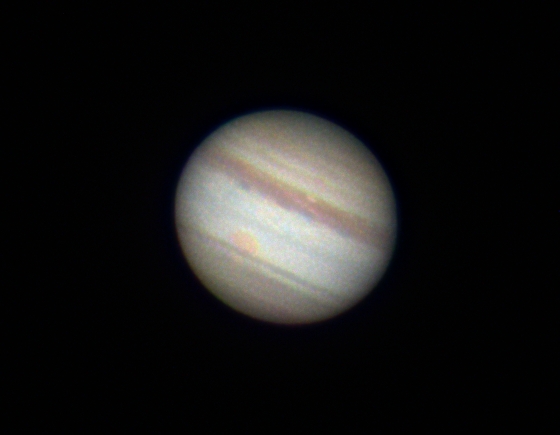
Several nights before and after the recent opposition of Jupiter were great for telescope observing and imaging the gas giant.  I was able to get some decent images from my backyard astro-imaging setup just before Labor Day when I could afford to be sleep-deprived while on vacation from work.

Jupiter

The image above was taken with a CCD camera (SBIG ST10XME with CFW8/RGB filters) and my 5-inch, f8 Takahashi FS128 refractor with 5X Barlow.  This arrangement yielded f/40 and approx. 5000 mm FL.  Even while using a ~700X 500 pixel subframe at 0.1-0.5 sec per image, it took many hours to acquire the hundreds of individual L,R,G,B frames to find the best “seeing” images to put the LRGB composite together.  In a way I guess this turned out to be an advantage since I had to stay out much later than I would have otherwise, and Jupiter reached transit at nearly 4 AM with me still taking frames.   The best frames were selected using a subroutine which grades sharpness (from CCDOps). Then they were assembled using MaximDL from single ~0.2 sec exposures for each RGB filter and 60% L (luminance) and combined for the LRGB composite.  The S/N was high enough to not need to stack sub-frames.

When I finally did get to sleep I dreamed of life on the gas giant. (Anyone else read the sci-fi novel, The Algebraist by Ian M Banks?)

Posted in November 2010, Sidereal Times | Tagged , , | Leave a comment

Orion Launch Abort System Stops in Philadelphia

by Ken Kremer

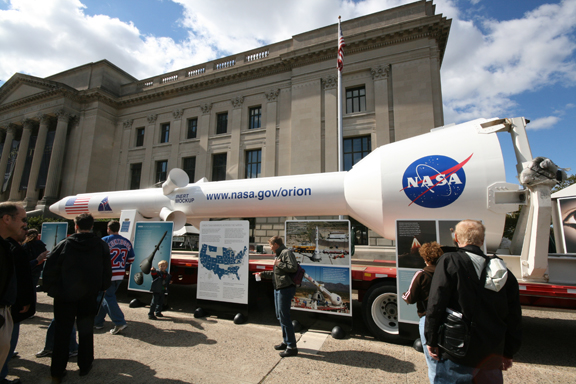
A full scale mock-up of the Orion Launch Abort System (LAS) is hitting the road for a cross country trek of several museums and science centers.  The public can see the LAS spacecraft hardware up close and personal and learn about the Orion crew vehicle and abort system.  I visited the LAS in Philadelphia, PA where it was on display at the Franklin Institute Science Museum during the weekend of Oct 16 & 17, 2010.

It is a rather startling and rare sight to behold the 45-ft. long rocket assembly mock up sitting pretty on a long flatbed tractor trailer outside the steps of the architecturally grand museum in the midst of the bustle of a major American city with cars driving by.  The spacecraft hardware was far too large to bring inside the museum.

The impressive rocket display and information panels were popular with kids and adults passing by. The outdoor display was accompanied by an exhibition booth inside the museum atrium which was manned by engineers from Orion’s prime contractor Lockheed Martin and sub contractor ATK to explain Orion spacecraft operations.

Orion is NASA’s next generation manned spacecraft and is designed to eventually replace the Space Shuttle. The shuttle will be retired sometime in 2011.  The first Orion orbital test flight – dubbed OFT-1 – is set for 2013.

The LAS is designed to immediately pull the Orion crew module away from the launch vehicle during an emergency on the pad or during the climb to orbit and save astronaut’s lives.

Known as the LAS pathfinder, the mock up is traveling the roadways from the U.S. Army’s White Sands Missile Range in New Mexico to NASA’s Kennedy Space Center (KSC) in Florida.  At KSC, it will undergo future pathfinding operations for investigation with the Orion crew exploration vehicle to prepare for the OFT-1 flight.

Between New Mexico and Florida, the LAS is making several public stops.  The next stop was in Hampton, Va on Oct. 23 for the 2010 EarthFest at Sandy Bottom Nature Park near the NASA Langley Research Center.

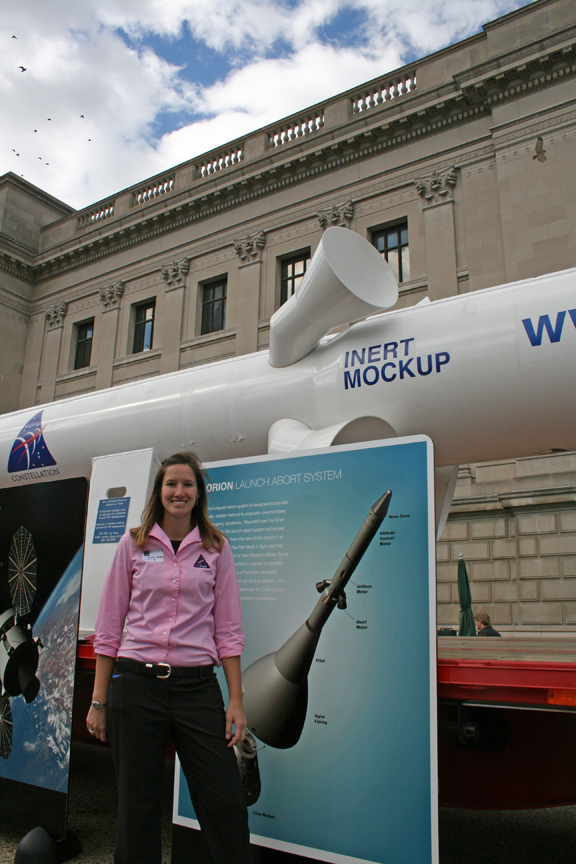
“This LAS pathfinder was used by ground crews to practice lifting and stacking operations at the launch pad to help prepare for handling the actual flight hardware used in the flawless Pad Abort 1 (PA-1) test flight,” Heather McKay told me. McKay is a propulsion engineer for Lockheed Martin in Denver.  “The LAS is the highest thrust and fastest acceleration abort system ever tested. This is the only abort system of its kind in the world and it’s state of the art.  It is equipped with three types of solid rocket motors. The innovative abort system will significantly improve astronaut safety for future human space flight.”

The PA-1 test took place on May 6, 2010 at the U.S. Army’s White Sands Missile Range near Las Cruces, N.M. During the test, the system fired the abort motor thrusting the crew module mock-up off the pad, reaching a speed of about 445 mph in three seconds. PA-1 Test Flight YouTube Video.  See more pictures here.

At this moment in late October, I am now at the Kennedy Space Center for STS-133. The LAS has arrived and I will report further next month.

Photo Credit: Ken Kremer Orion Launch Abort System (LAS) on display at the front entrance of the Franklin Institute Science Museum in Philadelphia, PA during the weekend of Oct. 16 & 17, 2010.   The abort motor (center nozzles) generates 500,000 pounds of thrust to accelerate the Orion from 0 to 445 MPH in under 3 seconds in case of an emergency.

Philadelphia City Skyline and NASA’s Orion LASPhoto Credit: Ken Kremer Philadelphia City Skyline and NASA’s Orion LAS on 16 Oct. 2010.

Photo Credit: Ken Kremer Passersby enjoy the Orion LAS on display at the Franklin Institute Science Museum, Philadelphia, PA on Oct. 16/17.  The LAS performed a flawless test flight during Pad Abort 1 test on May 6, 2010.

Photo Credit: Ken Kremer Lockheed Martin propulsion engineer Heather McKay explains operation of the abort motor she helped develop and which activates in milliseconds to save astronauts lives in case of an emergency abort.  The abort motor was built by ATK in Utah.

Please contact me for more info or science outreach presentations at kremerken@yahoo.com or via my website.

Posted in November 2010, Sidereal Times | Tagged , , | Leave a comment

SnippeTs

Planets

NASA’s Kepler spacecraft has discovered the first confirmed planetary system with more than one planet crossing in front of, or transiting, the same star.  The transit signatures of two distinct planets were seen in the data for the sun-like star designated Kepler-9. The planets were named Kepler-9b and 9c. The discovery incorporates seven months of observations of more than 156,000 stars as part of an ongoing search for Earth-sized planets outside our solar system.

Scientists refined the estimates of the masses of the planets using observations from the W.M. Keck Observatory in Hawaii. The observations show Kepler-9b is the larger of the two planets, and both have masses similar to but less than Saturn. Kepler-9b lies closest to the star with an orbit of about 19 days, while Kepler-9c has an orbit of about 38 days. By observing several transits by each planet over the seven months of data, the time between successive transits could be analyzed.

The full article may be found at http://www.nasa.gov/mission_pages/kepler/news/two_planet_orbit.html

Technology

NASA and the Spaceward Foundation awarded a prize of $900,000 to LaserMotive LLC of Seattle, Washington for their winning performance in the Power Beaming Challenge competition held on Nov. 4th through 6th at the NASA Dryden Flight Research Center. The Spaceward Foundation of Mountain View, CA manages this competition for NASA’s Centennial Challenges Program.

The Power Beaming Challenge is a demonstration of wireless power transmission in which teams build and demonstrate systems to beam energy from the ground to a robotic device that climbs a vertical cable. To compete, teams must integrate a complex set of technical skills for optical beam forming, electro-mechanical beam tracking, photovoltaic beam conversion, power capture electronics, and mechanical drive. To win a prize, the climber must reach the top of the cable at a height of one kilometer. Teams that can reach the top share in the prize purse of $2,000,000 based on their vertical speed and payload mass. LaserMotive’s average speed on their best of several successful climbs was 3.9 meters per second and by exceeding the average speed of 2 meters per second and being the only team to reach the top, they claimed the entire $900,000 prize for that level. Teams had to exceed an average speed of 5 meters per second to qualify for a share of the remaining prize purse of $1,100,000. That amount will remain available for the next Power Beaming competition.

The full article may be found at http://www.nasa.gov/offices/oct/early_stage_innovation/centennial_challenges/cc_pb_feature_11_10_09.html

Historical Moments

75 Years Ago

July 2, 1935: The Air Defense Research Committee in the United Kingdom heard the first report on radio direction finding (RDF, later called RADAR). The historic development quickly transformed British air defenses in preparation for war.

65 Years Ago

July 13, 1945: An armed forces circular announced the activation of the White Sands Proving Ground. Later known as White Sands Missile Range, the facility was the largest over-land test installation in the western hemisphere and remains the largest today.

60 Years Ago

July 24, 1950: General Electric Co., in cooperation with NASA’s Jet Propulsion Laboratory of Pasadena, Calif. launched the Bumper #8 rocket. It was the first rocket launched from the recently established Long Range Proving Ground at NASA’s Kennedy Space Center, Fla. The purpose of the mission was to test methods of stage separation while a rocket is performing a near-horizontal flight.

50 Years Ago

July 1, 1960: NASA launched the first complete Scout launch vehicle fired from Wallops Flight Facility at Wallops Island, Va. (part of NASA’s Goddard Space Flight Center in Greenbelt, Md.). The rocket quickly became a workhorse in orbiting scientific payloads because Scout’s four-stage booster could place a heavy satellite into orbit.

Credit: NASA Science

Posted in November 2010, Sidereal Times | Tagged | Leave a comment

StarQuest 2010

Observers Prepare Their Scopes

Observers Prepare Their Scopes

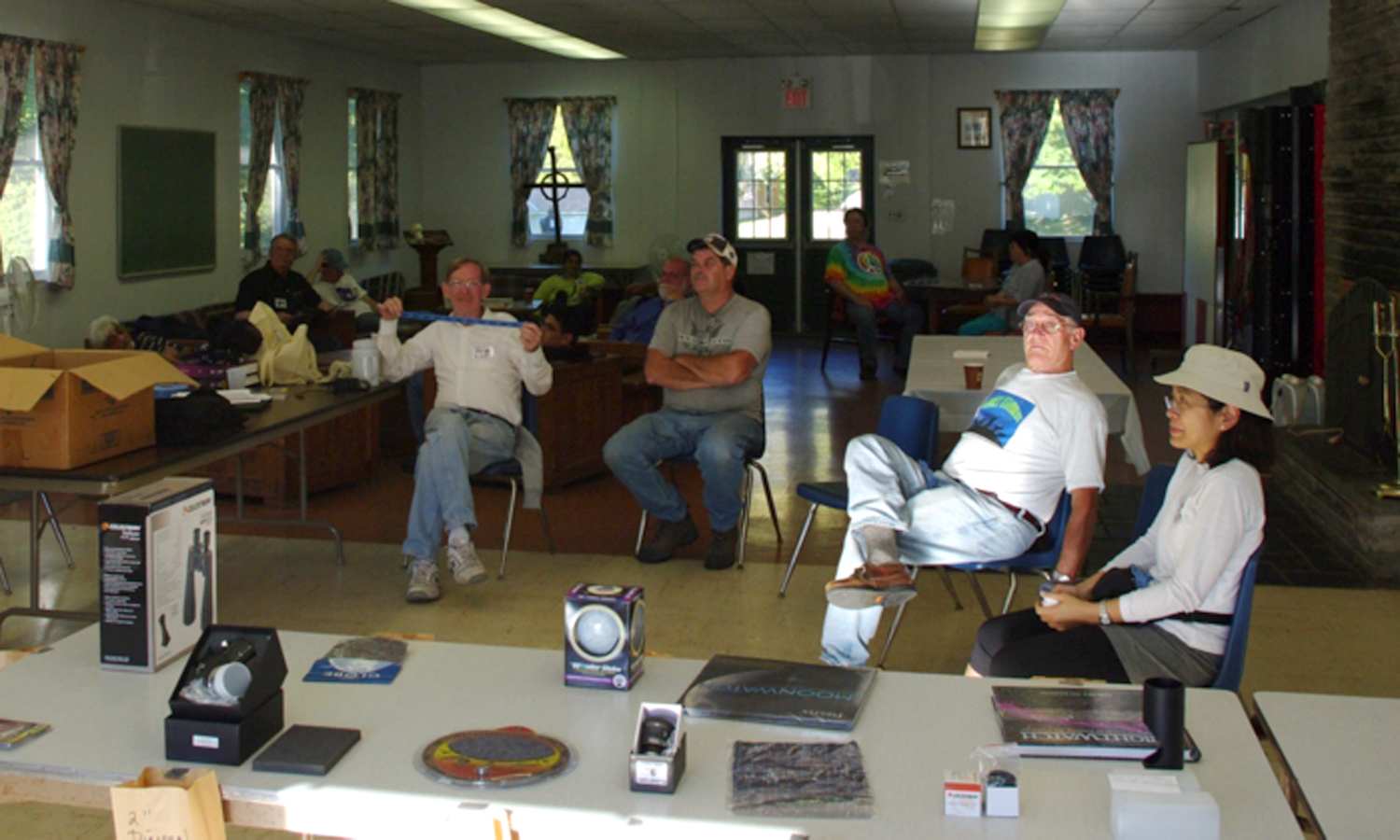
Waiting Patiently for the Raffle to Begin

Waiting Patiently for the Raffle to Begin

Checking out AAAP’s Reflector at the UACNJ Observatory at Jenny Jump State Park.

Checking out AAAP’s Reflector at the UACNJ Observatory at Jenny Jump State Park.

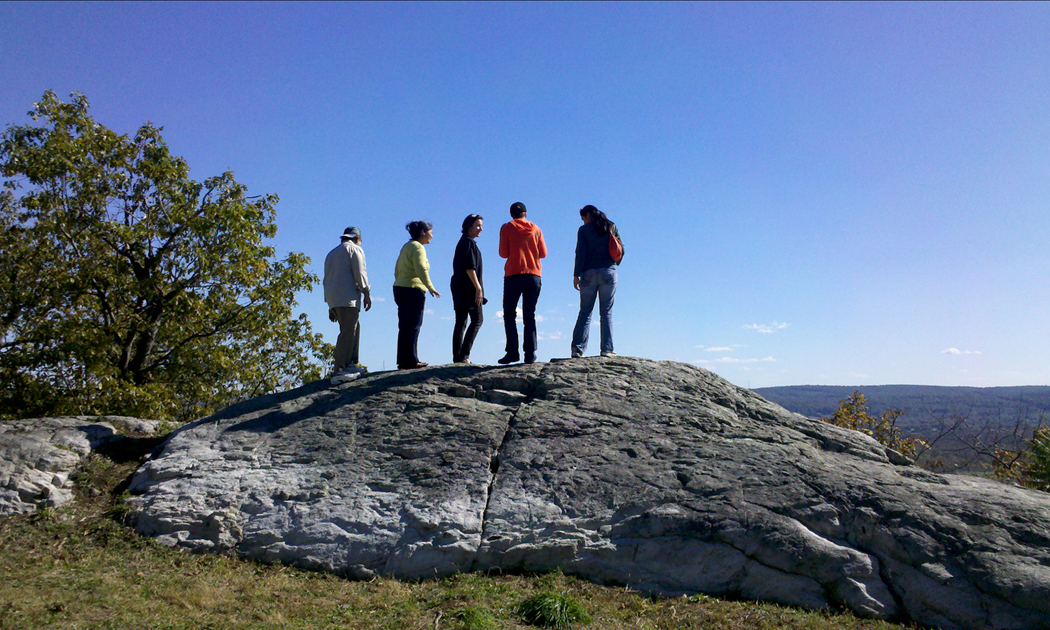
Doing the Jenny Jump

Doing the Jenny Jump


Posted in November 2010, Sidereal Times | Tagged | Leave a comment