Sidereal Times Blog: 2011 in Review

The WordPress.com stats helper monkeys prepared a 2011 annual report for this blog.

Here’s an excerpt:

A San Francisco cable car holds 60 people. This blog was viewed about 2,400 times in 2011. If it were a cable car, it would take about 40 trips to carry that many people.

Click here to see the complete report.

Posted in January 2012 | Tagged | Leave a comment

From the Director

by Ludovico D’Angelo, Director AAAP

I hope you are all noticing that there is no snow on the ground, and the weather has been very mild for November and so far in December. Enjoy it. Get outside. Breathe the fresh night air. Look at Orion rising, Jupiter high in the sky and Venus with the setting Sun.

StarQuest, for those who attended, was a great success.

Starquest Site

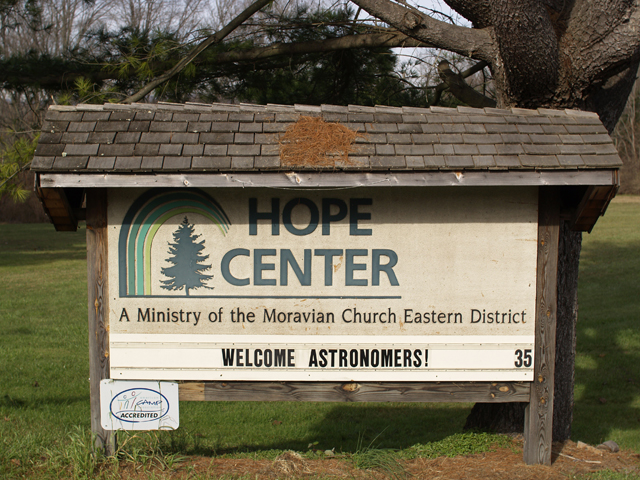
Hope Center, Starquest site. Photo credit: Michael Wright

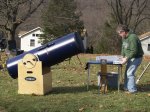
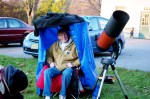
The night of Friday, November 18th was very clear, and many deep sky objects were seen. Bill Murray had his large Dob there and was picking objects out of the sky for all to see. Newcomer, Chandra, struggled with his first-time set up in the dark, but we got him on track. Gene Ramsey set up his homemade personal observing tent and was very comfortable. Michael Wright and his wife Lynn enjoyed the night sky through his modified ETX 90. John Masters, Henry Kugel, John Giles, Saul Moroz were also in attendance.

It was cold (down to the mid 20’s), but the lodge kept us warm. The coffee and hot chocolate was flowing. The Milky Way was present; not bad for New Jersey. Unfortunately, the next night was not so good and everyone left after dinner since there was no sky to see, unless you could see through the clouds. But before everyone left Saturday evening, there was the day. During the day there was Solar observing, a trip to Jenny Jump, a great astrophotography talk given by Robert Vanderbei, and great food and conversation.

I read today that the Voyager spacecraft are still going strong, which is a huge human achievement when you think about it. Launched in the late 1970’s, they continue their journey into interstellar space. See http://voyager.jpl.nasa.gov/where/index.html for more information. It is fascinating.

Our next meeting is December 13th at 8 p.m. The speaker will be Dr. Gaspar Bakos. He will present a talk entitled ‘Hunting for Transiting Extrasolar Planets’

See you all on the 13th at 8PM in Peyton Hall!

Posted in December 2011, Sidereal Times | Tagged , , , | 1 Comment

From the Program Chair

by Ken Levy, Program Chair

Many thanks to AAAP’s Dr. Ken Kremer for last month’s lecture ‘What’s Beyond for NASA”. Ken attended the launch of The Mars Science Laboratory (aka Curiosity) at the Kennedy Space Center on November 26th. The 2,000 pound rover is scheduled to land on Mars in August 2012.

Dr. Ken Kremer.  Photo credit: Ken Levy

Dr. Ken Kremer. Photo credit: Ken Levy

On Tuesday December 10th we’re proud to present Princeton’s Dr. Gaspar Bakos, speaking on ‘Hunting for Transiting Extrasolar Planets’. Dr. Bakos is Assistant Professor in the Princeton Astrophysical Sciences Department and has just returned from work in Chile.

Dr. Bakos is the Principal Investigator for the Hungarian Automated Telescope Network (HATNet), six 110-mm diameter, wide-field, fully-automated telescopes designed to detect and characterize extrasolar planets, and to find and study bright variable stars. The network is maintained by the Harvard-Smithsonian Center for Astrophysics with primary stations at the Fred Lawrence Whipple Observatory of the Smithsonian Astrophysical Observatory and the Sub-millimeter Array site atop Mauna Kea, Hawaii. Dr. Bakos is also the PI for the related HAT-South network of telescopes installed in Chile, Australia and Namibia, the first truly global network of identical telescopes allowing for round-the-clock monitoring of the sky.

Dr. Gaspar Bakos. Source: National Geographic Hungary, 2009 July

Dr. Gaspar Bakos. Source: National Geographic Hungary, 2009 July

Data from HATNet have enabled the discovery of roughly a quarter of the more than 100 known exoplanets which transit their parent stars. Observations of transiting exoplanets yield precise measures of the mass and radius of the planet, placing important constraints on the planet’s internal structure. The HATNet planets have masses ranging from the mass of Neptune (only 5% of the mass of Jupiter) to roughly seven times the mass of Jupiter. Several HATNet planets are the first of their kind, including two of the first four transiting Neptune-mass planets and the first multi-planet systems with a transiting inner planet.

Dr. Bakos was awarded the 2011 Newton Lacy Pierce prize of the American Astronomical Society “for outstanding achievement, over the past five years, in observational astronomical research based on measurements of radiation from an astronomical object.” This prize is given to a distinguished astronomer younger than 36 years of age in the year designated for the award.

Dr. Bakos obtained his MSc in 2000 at the Eotvos Lorand University in Budapest. After receiving his PhD from ELTE in 2004, he was a Hubble Postdoctoral Fellow until 2007 and a National Science Foundation Postdoctoral Fellow until 2010.

There will be a “Meet the Speaker” dinner, 6:00 pm before the meeting at the Triumph Brewery. To insure a place at the table, please email me at kenetics@me.com by Friday, Dec. 9th for a reservation. We look forward to seeing you in December!

Posted in December 2011, Sidereal Times | Tagged , , , , , | Leave a comment

From the Outreach Chair

by David Letcher, Outreach Chair

Many thanks go out to Jeff Bernardis and Mike Moreken and yours truly for giving a lively star party at the Newell Elementary School in Allentown, NJ on Friday evening, November 18th. Although it was a chilly night, the sky was reasonably clear but somewhat full of airplanes waiting to land somewhere. We were able to show many children and their parents the sights of Jupiter, the Pleaides, and the Great Nebula in Orion. We also received a donation from the school parents organization.

I’ll keep you all posted when our next few star parties get scheduled. In the meantime, I wish you all a pleasant holiday season!

Clear Skies!

Posted in December 2011, Sidereal Times | Tagged , , | Leave a comment

November 8, 2011 AAAP Meeting

by Larry Kane, Secretary

The meeting was called to order by Director Ludy D’Angelo

  • Observatory Report: During the last storm, a power surge caused some damage to the circuit breaker box in the observatory. Director D’Angelo suggested that we wait until the power company can check their lines and determine where the problem is, and inform us when power can be returned to the observatory. A suggestion was made to get the approval of the membership to hire an electrician to replace the box and any other damaged parts, once the power can be restored. The Director recommended that we have at least two quotes from electricians. Treasurer Mitrano raised the issue that the State must treat the well that supplies water to the observatory. A discussion was held on gaining access to a compressor that could be used to blow out and clean the lines that supply the water. It was also pointed out that we would need a power supply for the compressor, depending on its type. According to the UACNJ, our observatory at Jenny Jump will require insurance coverage up to the limits set by the State, as of January 1. It was thought that any additional coverage would not cost that much
  • Web Site: The website was updated a week ago.
  • Secretary: One new membership application was received but the new member’s information was not on the member roster. Secretary Kane announced that he sent the updated roster with the new member’s information to the webmaster. Secretary Kane also stated that he sent another message to the membership requesting those who have not paid their current dues, to do so.
  • Sidereal Times: Co-editor Michael Wright announced the continued help provided by co-editor Surabhi Agarwal in getting out the last issue. The next deadline for submittals is December 2nd.
  • Outreach Report: The group has been invited to do a star party in Allentown on November 18th.
  • StarQuest: There is a thousand dollars in prizes to be given away. It appears that people are waiting for the weather forecast before committing to attend. The meeting was adjourned by Director D’Angelo.
Posted in December 2011, Sidereal Times | Tagged , , , , | 1 Comment

Treasurer’s Report

by Michael Mitrano, Treasurer

Membership has increased by 10 to 64 since my last report, as past members renew and new ones join. Setting aside StarQuest, we currently have a year-to-date surplus of about $2,200. The upcoming insurance payment (about $1,200) and needed electrical repairs to the observatory will reduce that, but I am confident that we will remain in the black for the fiscal year as membership continues to grow.

If all participant payments and event expenses are in, then StarQuest 2011 in its second attempt will have a surplus of exactly $3. The rescheduled event had total revenue from registrations plus the raffle of about $1,100 versus $1,700-$1,900 in recent years. Expenses this year were down about 10% from those earlier years. In my opinion, the AAAP’s financial strength at this point does not require StarQuest to produce a surplus.

Our cumulative surplus is about $23,000.

Posted in December 2011, Sidereal Times | Tagged , | Leave a comment

StarQuest, Pictures

November 18, 2011

Posted in December 2011, Sidereal Times | Tagged , , | Leave a comment

First Light with Stellar Spectroscopy

by Rex Parker

Spectroscopy has always been an interesting and appealing branch of optics and chemistry ever since I made my first diffraction grating spectroscope for a junior-high science fair project. Of course spectroscopy has many scientific applications today, especially in fields like biochemistry and biophysics that occupy my day-time hours. So for a few years I’ve been looking for an affordable spectroscope for amateur astronomy, but I was not that impressed with the readily available Rainbow Optics star spectroscope for visual application with telescopes. Then I came upon the Paton Hawksley Star Analyser 100, designed for amateur astronomical spectroscopy using CCD or DLSR cameras with telescopes. The first order spectrum of this 100 line/mm blazed diffraction grating, mounted in a standard 1.25-inch filter cell, is dispersed to just the right dimensions for small CCD chips if it is positioned correctly in the telescope light path.

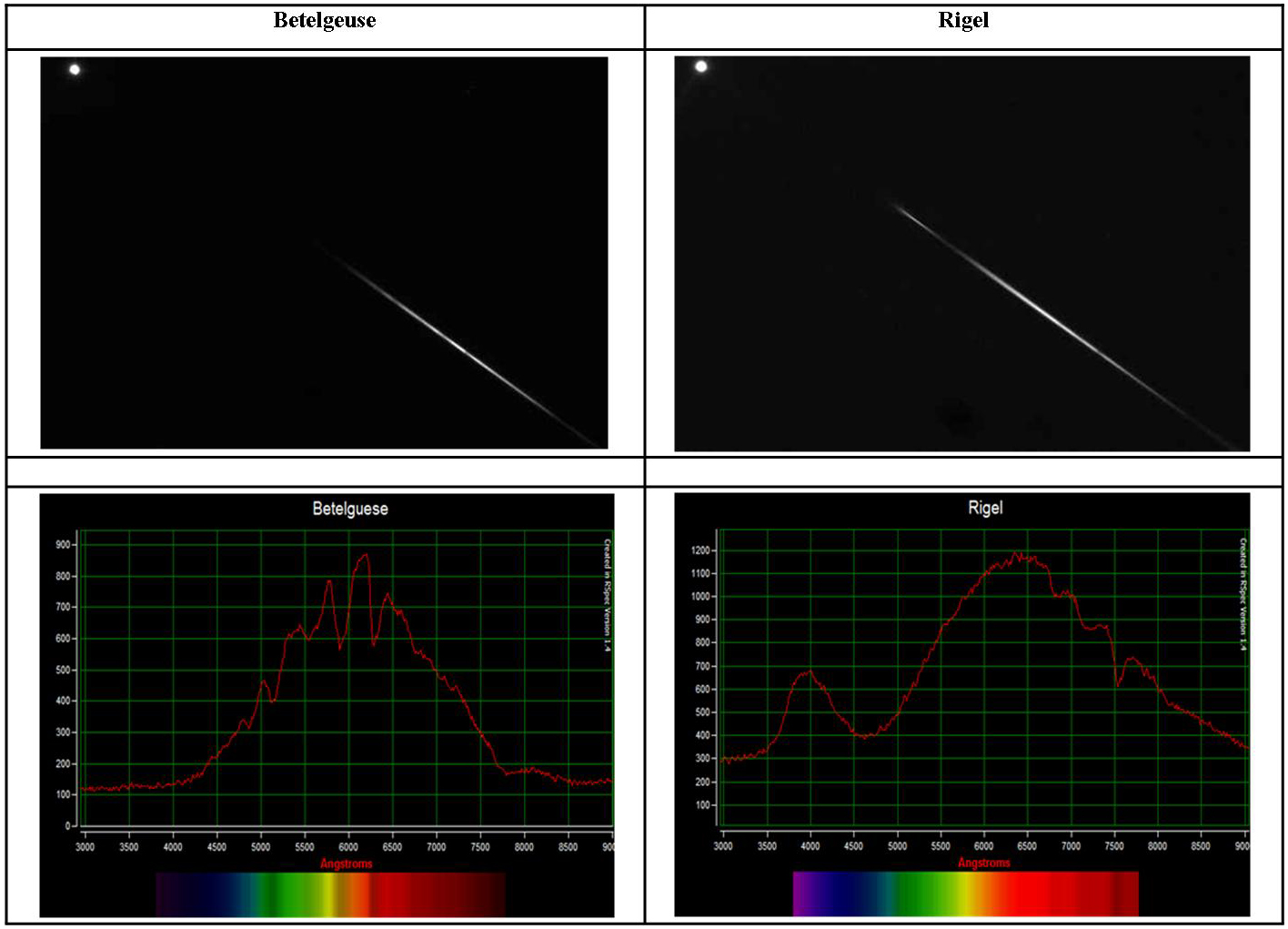
I recently acquired the new SBIG ST-i camera to use as external guide camera with my ST10-XME for narrow-band filter and RGB imaging of deep sky objects. The lightweight ST-I monochrome CCD camera (about the size and weight of a 30-mm Plossl eyepiece!) seemed a good match for the Star Analyzer 100. So a couple weeks ago I gave my new equipment first light using my 3-inch Tak refractor. What better comparison to make in this situation than the spectra of two contrasting giant stars of winter significance – Betelgeuse the red supergiant, and Rigel the blue supergiant, both in Orion. Included in my setup is the specialized spectroscopy software program, RSpec, which helps to display the absorption lines in the spectra and calibrate using known stars spectra files. RSpec also has a nifty color synthesizer to give a color spectrum based on the monochrome CCD image readout, after proper calibration. The data below, however, have not yet been corrected for CCD wavelength-dependent sensitivity response. That will come later on the learning curve. As you can see by comparing the blue vs red regions of the spectra for these two super giants, there is a large difference in intensity (energy) and absorption bands indicating differences in composition and temperature, which is consistent with their positions in the Hertzsprung-Russel diagram for luminosity/temperature correlation.

If you’re interested in getting involved in stellar or deep sky spectroscopy, please catch me at an upcoming AAAP meeting, where we can chat about equipment, software, and interpretation!

BR

CCD spectroscopy images and calibrated spectral data for Betelgeuse (left) and Rigel (right).

Posted in December 2011, Sidereal Times | Tagged , , , | Leave a comment

NASA’s Curiosity Mars Rover Blasts Off in Search of Signs of Life

by Dr. Ken Kremer

Curiosity, humankind’s latest quest to find out if we are alone in the universe, soared skyward on Nov. 26 atop a towering inferno. Curiosity is NASA’s newest and biggest robotic surveyor specifically tasked to hunt for the ingredients of life on Mars.
Atlas V

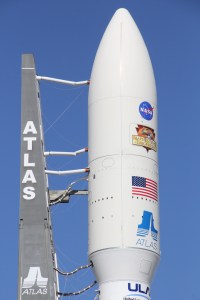
NASA’s Curiosity Mars rover is encapsulated inside the 5 meter payload fairing and loaded atop the Atlas V rocket at Pad 41. Credit: Ken Kremer

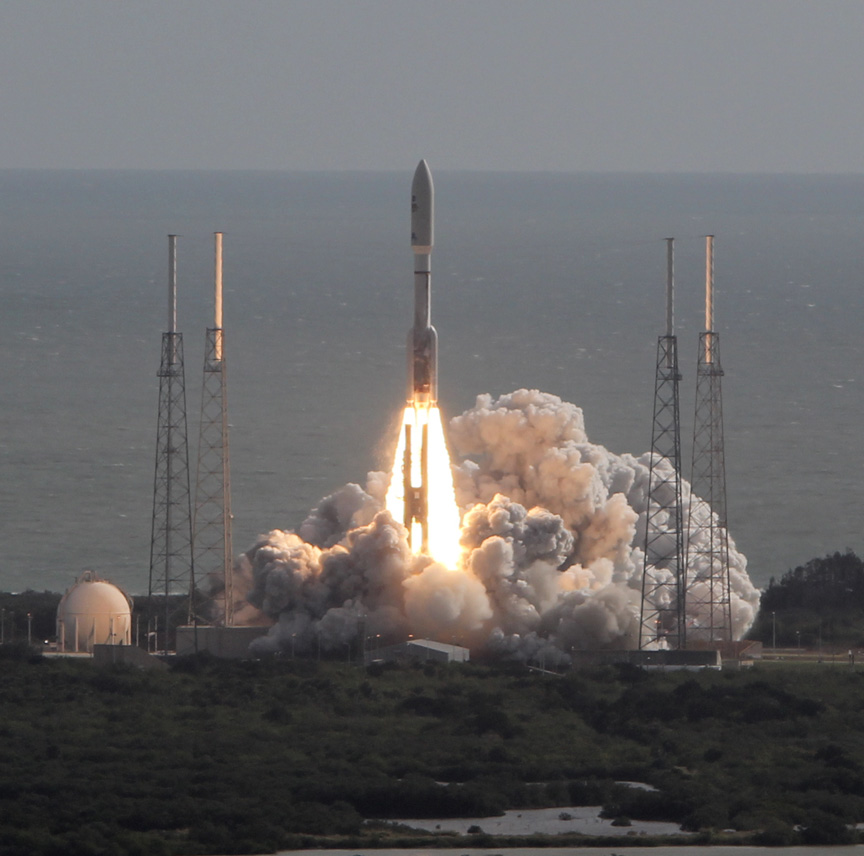
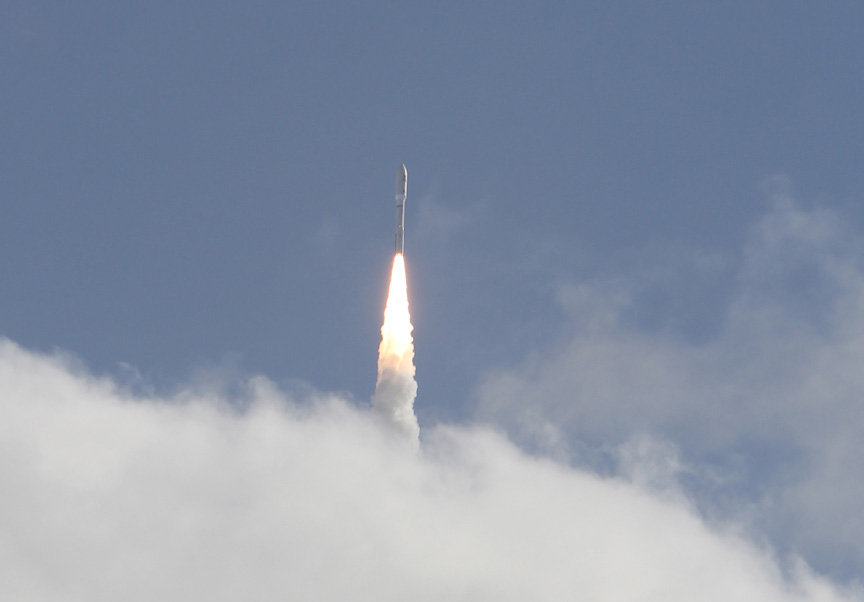
Curiosity zoomed to the heavens with a pulse pounding blastoff mounted atop a United Launch Alliance Atlas V rocket at 10:02 a.m. EST from Space Launch Complex 41 on Cape Canaveral Air Force Station in Florida. The 197-ft tall, Atlas booster’s powerful liquid and solid fueled engines ignited precisely on time with a flash and thunderous roar that grew more intense as the expanding plume of smoke and fire trailed behind the rapidly ascending rockets tail. It was a spectacular sky show for the throngs of spectators who journeyed from across the globe to witness the liftoff of the $2.5 billion Curiosity Mars Science Lab (MSL) rover.

Atlas V with Curiosity

Atlas V rocket and Curiosity rover poised at Space Launch Complex 41 at Cape Canaveral, Florida. Credit: Ken Kremer


The engines powered the accelerating climb to space and propelled the booster away from the US East Coast as it majestically arced over in between broken layers of clouds. The Centaur second stage success-fully fired twice and placed the probe on an Earth escape trajectory at 22,500 MPH and lofted the space-craft out of Earth orbit into a 352-million-mile journey to Mars.

“Our spacecraft is in excellent health and it’s on its way to Mars,” said Pete Theisinger, Mars Science Laboratory Project Manager from the Jet Propulsion Laboratory in California at the briefing. “The launch vehicle has given us a first rate injection into our trajectory and we’re in cruise mode.”

Atlas V Rocket 1

Curiosity rover soars to Mars atop an Atlas V rocket on Nov. 26 at 10:02 a.m. EST from Cape Canaveral, Florida. Credit: Ken Kremer (kenkremer.com)


Curiosity’s noble goal is to meticulously gather and sift through Martian soil and rock in pursuit of organic molecules, and clay and sulfate minerals that may preserve evidence of habitats and that could support the genesis of Martian microbial life forms, past or present. The car sized rover is the most ambitious, important and far reaching science probe ever sent to the Red Planet.

“Science fiction is now science fact,” said Doug McCuistion, director of the Mars Exploration Program at NASA Headquarters at the post launch briefing for reporters at KSC. “We’re flying to Mars. We’ll get it on the ground… and see what we find.” “Ecstatic – NASA is Ecstatic. MSL is enormous, the equivalent of three missions frankly.”
Blastoff 1

Curiosity blasts off for Mars on Nov. 26 from Florida. The car-sized rover has 10 science instruments designed to search for signs of life. Credit: Ken Kremer


Curiosity is a 2000-pound behemoth. She is nearly twice the size and five times heavier than Spirit and Opportunity, NASA’s prior set of twin Martian robots. Curiosity is equipped with a powerful 165-pound array of 10 state-of-the-art science instruments weighing 15 times more than its predecessor’s science payloads. A drill and scoop located at the end of the robotic arm will gather soil and powdered samples of rock interiors, then sieve and parcel out these samples into analytical laboratory instruments inside the rover. A laser will zap rocks to determine elemental composition.
blastoff 2

Curiosity rover bound for Mars punches through Florida clouds. Credit: Ken Kremer


“We are ready to go for landing on the surface of Mars, and we couldn’t be happier,” said John Grotzinger, Mars Science Laboratory Project Scientist from the California Institute of Technology at the briefing. “I think this mission will be a great one. It is an important next step in NASA’s overall goal to address the issue of life in the universe.”
NASA is using an unprecedented, rocket-powered, precision descent system to guide Curiosity to a pinpoint touchdown inside the Gale Crater landing site, with all six wheels deployed. Gale Crater is 96 miles wide. It is dominated by layered terrain and an enormous mountain rising three miles above the crater floor which exhibits exposures of minerals that may have preserved evidence of ancient or extant Martian life.

“I hope we have more work than the scientists can actually handle. I expect them all to be overrun with data that they’ve never seen before. It will be like sitting at the bottom of the Grand Canyon,” said McCuistion.

“Our mission is about looking for ancient habitable environments – a time on Mars which is very different from the conditions on Mars today. The promise of Mars Science Laboratory, assuming that all things behave nominally, is we can deliver to you a history of formerly, potentially habitable environments on Mars,” Grotzinger said.

Mars

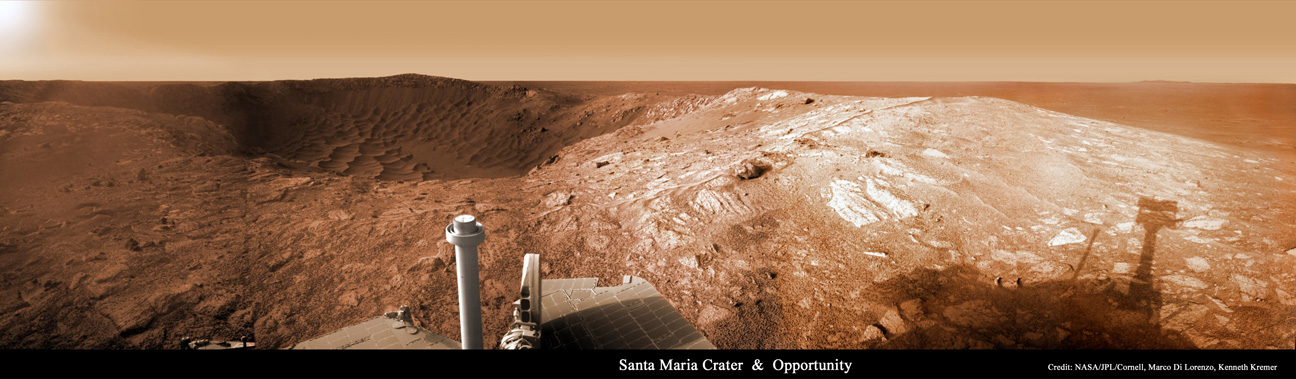
Opportunity at Santa Mars Crater, January 2011, Sol 2476. Credit: NASA/JPL/Cornell/Marco Di Lorenzo/Kenneth Kremer


The liftoff was the culmination of 10 years of effort by the more than 250 science team members and thousands more spread across the United States and NASA’s international partners including Canada, Germany, Russia, Spain and France.

Check Ken’s Curiosity Mars rover features online at Universe Today:
Curiosity Mars Rover Launch Gallery – Photos and Videos
Curiosity Majestically Blasts off on ‘Mars Trek’ to ascertain ‘Are We Alone?
Mars Trek – Curiosity Poised to Search for Signs of Life
Curiosity Rover ‘Locked and Loaded’ for Quantum Leap in Pursuit of Martian Microbial Life
Science Rich Gale Crater and NASA’s Curiosity Mars Rover in Glorious 3-D – Touchdown in a Habitable Zone
Curiosity Powered Up for Martian Voyage on Nov. 26 – Exclusive Message from Chief Engineer Rob Manning

Astronomy Outreach by Ken Kremer
Rittenhouse Astronomical Association (RAS), Franklin Institute, Philadelphia, PA, Jan. 11, Wed , 8 PM, “8 Years of Mars Rovers — Mars and Vesta in 3 D”.
Website: http://www.rittenhouseastronomicalsociety.org/

New Jersey Astronomical Association NJAA- Vorhees State Park: High Bridge, NJ, March 24, Sat., 8 PM “Atlantis, the End of America’s Shuttle Program and What’s Beyond for NASA”. Website: http://www.njaa.org/

Ken Kremer:  Spaceflight magazine & Universe Today
Ken has a selection of his Shuttle photos and Mars mosaics for sale as postcards and frameable prints.

Please contact Ken for more info or science outreach presentations:
Email: kremerken@yahoo.com   website:  www.kenkremer.com
http://www.universetoday.com/author/ken-kremer/

Posted in December 2011, Sidereal Times | Tagged , , , | 1 Comment