NASA’s GRAIL Lunar Mapping Twins Achieve New Year’s Orbits

by Dr. Ken Kremer

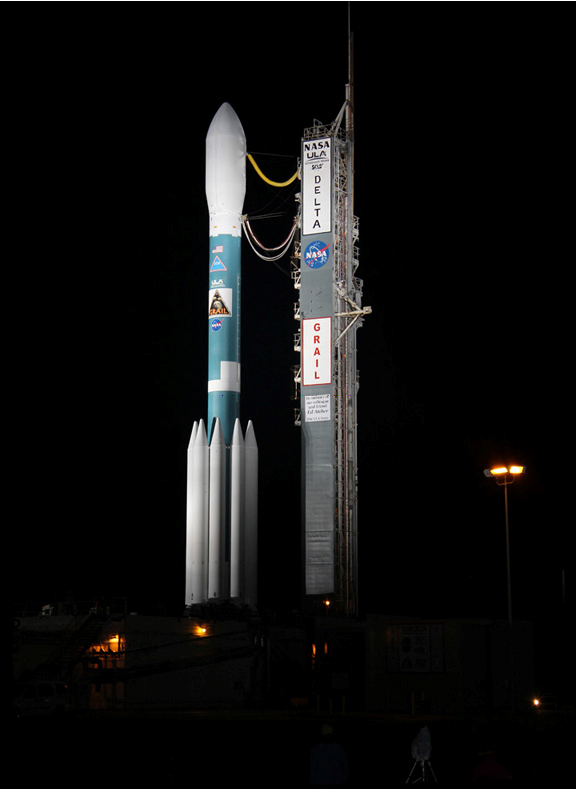
GRAIL probes mounted atop Delta II rocket at Cape Canaveral.

GRAIL probes mounted atop Delta II rocket at Cape Canaveral. Credit: Ken Kremer

Next time you look at the moon consider this: Two new moons recently reached orbit. NASA is ringing in the New Year with a double dose of champagne toasts celebrating the back-to-back insertions into lunar orbit of two tiny probes that seek to unravel the hidden mysteries lurking deep inside the moon and figure out how the inner solar system formed eons ago.

NASA’s GRAIL-B spacecraft ignited her main braking rockets precisely as planned on New Year’s Day to go into orbit around the Moon, chasing behind GRAIL-A, which arrived on New Year’s Eve.

“Now we have them both in orbit. What a great feeling!!!!” NASA manager Jim Green told me just minutes after the thruster firing was over. Green is NASA’s Director of Planetary Science and witnessed the events inside Mission Control at the Jet Propulsion Laboratory (JPL) in Pasadena, Ca. “It’s the best New Year’s ever!!”

The lunar arrivals of GRAIL-A and GRAIL-B capped a perfect year for NASA’s planetary science research. “2011 began the Year of the Solar System, which is a Mars year (~670 Earth days long)… and includes Grail B insertion, Dawn leaving Vesta this summer … And the landing of MSL!” Green said.
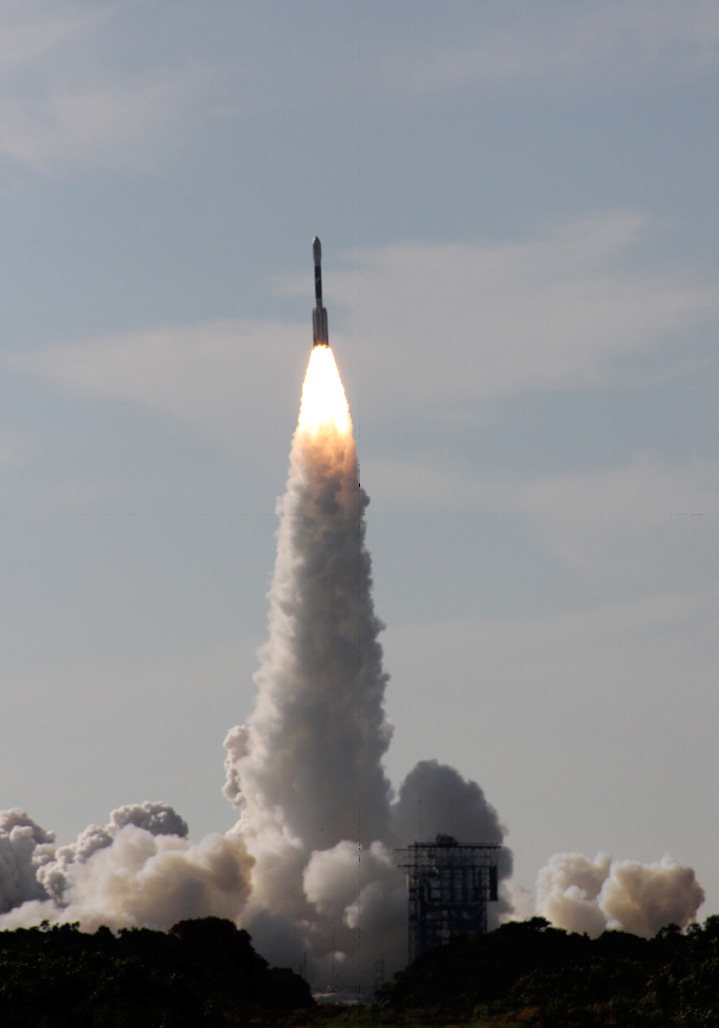
GRAIL A and B rocket to the moon atop a Delta II heavy booster on Sept. 10.

GRAIL A and B rocket to the moon atop a Delta II heavy booster on Sept. 10. Credit: Ken Kremer


After years of hard work, GRAIL principal investigator Maria Zuber of MIT told me that she was very relieved soon after hearing the good news at JPL Mission Control. “Since GRAIL was originally selected, I’ve believed this day would come,” Zuber said. “But it’s difficult to convey just how relieved I am right now. Time for the Science Team to start their engines!”

The hydrazine-fueled main thrusters placed the spacecraft duo into near-polar, highly elliptical orbits. Over the next two months, engineers will trim the orbits of both spacecraft to a near-polar, near-circular, formation-flying orientation. Their altitudes will be lowered to about 34 miles, and the orbital periods trimmed from their initial 11.5-hour duration to about two hours. The science phase begins in March 2012. For 82 days, the mirror-image GRAIL-A and GRAIL-B probes will be flying in tandem with an average separation of about 200 kilometers as the moon rotates beneath.

“GRAIL is a journey to the center of the moon,” Zuber explains. “It will use exceedingly precise measurements of gravity to reveal what the inside of the moon is like.” As one satellite follows the other in the same orbit, they will perform range-rate measurements to measure the changing distance between each other to within 1 micron, the width of a red blood cell, using a Ka-band instrument. When the first satellite goes over a higher mass concentration or higher gravity, it will speed up slightly, which will increase the distance. Then as the second satellite goes over, that distance will close again. The data returned will be translated into gravitational field maps of the moon that will help unravel information about the makeup of the moons mysterious core. GRAIL will map the gravity field 100 to 1000 times better than ever before.

Ebb & Flow achieve Lunar Orbit on New Year’s Weekend 2012.

Ebb & Flow achieve Lunar Orbit on New Year’s Weekend 2012. Credit: Ken Kremer

The GRAIL twins blasted off from Florida atop a Delta II booster on September 10, 2011. “Ebb” & “Flow” – are the dynamic duo’s new official names. A classroom of America’s youth from a Bozeman, Montana elementary school submitted the stellar winning entry in NASA’s nationwide student essay contest to rename the twin probes.

Ebb & Flow achieved Lunar orbit on New Year’s Weekend 2012. NASA’s twin GRAIL-A & GRAIL-B spacecraft are orbiting the Moon in this astrophoto taken on Jan. 2, 2012.

                
Check Ken’s GRAIL features online at Universe Today:
2011: Top Stories from the Best Year Ever for NASA Planetary Science!
Two new Moons join the Moon – GRAIL Twins Achieve New Year’s Orbits
America’s Youth Christen NASA’s Twin New Lunar Craft – Ebb & Flow
Astronomy Outreach by Ken Kremer
Rockland Astronomy Club RAC, Rockland Community College, Suffern, NY, Mar 16, 8 PM, “NASA’s Year of the Solar System: Mars, Moon, Mercury, Vesta, Jupiter, Comets and Beyond (plus 3-D”). Website: http://www.rocklandastronomy.com/

New Jersey Astronomical Association NJAA- Vorhees State Park: High Bridge, NJ, March 24, Sat., 8 PM “Atlantis, the End of America’s Shuttle Program and What’s Beyond for NASA”. Website: http://www.njaa.org/

Ken Kremer:  Spaceflight magazine & Universe Today
Ken has a selection of his Shuttle photos and Mars mosaics for sale as postcards and frameable prints.

Please contact Ken for more info or science outreach presentations:
Email: kremerken@yahoo.com   website:  www.kenkremer.com
http://www.universetoday.com/author/ken-kremer/
Posted in February 2012, Sidereal Times | Tagged , , , | Leave a comment

Snippets

Closest Type Ia supernova in decades solves a cosmic mystery
Published: Wednesday, December 14, 2011 – 15:33 in Astronomy & Space

Type Ia supernovae (SN Ia’s) are the extraordinarily bright and remarkably similar “standard candles” astronomers use to measure cosmic growth, a technique that in 1998 led to the discovery of dark energy — and 13 years later to a Nobel Prize, “for the discovery of the accelerating expansion of the universe.” The light from thousands of SN Ia’s has been studied, but until now their physics — how they detonate and what the star systems that produce them actually look like before they explode — has been educated guesswork……On August 24 of last year, searching data as it poured into DOE’s National Energy Research Scientific Computing Center (NERSC) from an automated telescope on Palomar Mountain in California, Nugent spotted a remarkable object. It was shortly confirmed as a Type Ia supernova in the Pinwheel Galaxy, some 21 million light-years distant. That’s unusually close by cosmic standards, and the nearest SN Ia since 1986; it was subsequently given the official name SN 2011fe.

For the full story go to – Cosmic Mystery

Some nearby young stars may be much older than previously thought
Published: Wednesday, December 21, 2011 – 15:37 in Astronomy & Space

Low in the south in the summer sky shines the constellation Scorpius and the bright, red supergiant star Antares. Many of the brightest stars in Scorpius, and hundreds of its fainter stars, are among the youngest stars found near Earth, and a new analysis of them may result in a rethinking of both their ages and the ages of other groups of stars. New research by astrophysicists from the University of Rochester focused on stars in the north part of the constellation, known as Upper Scorpius, which is a part of the Scorpius-Centaurus OB association, one of our best studied groups of young stars and a benchmark sample for investigating the early lives of stars and the evolution of their planet-spawning disks. The Upper Scorpius stellar group lies roughly 470 light years from Earth.

While those stars have been thought to be just five million years old, the team concludes that those stars are actually more than twice as old, at 11 million years of age. The findings are surprising given Upper Scorpius’s status as one of the best-studied samples of young stars in the sky.

For the full story go to – Stars may be much older than previously thought

Scientists discover a Saturn-like ring system eclipsing a sun-like star
Published: Wednesday, January 11, 2012 – 14:35 in Astronomy & Space

A team of astrophysicists from the University of Rochester and Europe has discovered a ring system in the constellation Centaurus that invites comparisons to Saturn. The scientists, led by Assistant Professor of Physics and Astronomy Eric Mamajek of Rochester and the Cerro Tololo Inter-American Observatory, used data from the international SuperWASP (Wide Angle Search for Planets) and All Sky Automated Survey (ASAS) project to study the light curves of young Sun-like stars in the Scorpius-Centaurus association — the nearest region of recent massive star formation to the Sun.

The basic concept of the research is straightforward. Imagine yourself sitting in a park on a sunny afternoon and a softball passes between you and the sun. The intensity of light from the sun would appear to weaken for just a moment. Then a bird then flies by, causing the intensity of the sunlight to again weaken — more or less than it did for the baseball, depending on the size of the bird and how long it took to pass. That’s the principle that allowed the researchers to discover a cosmic ring system.

The complete article may be found at A saturn ring system eclipsing a sun star

Posted in February 2012, Sidereal Times | Tagged , , , | Leave a comment

From the Director

by Ludovico D’Angelo, Director AAA

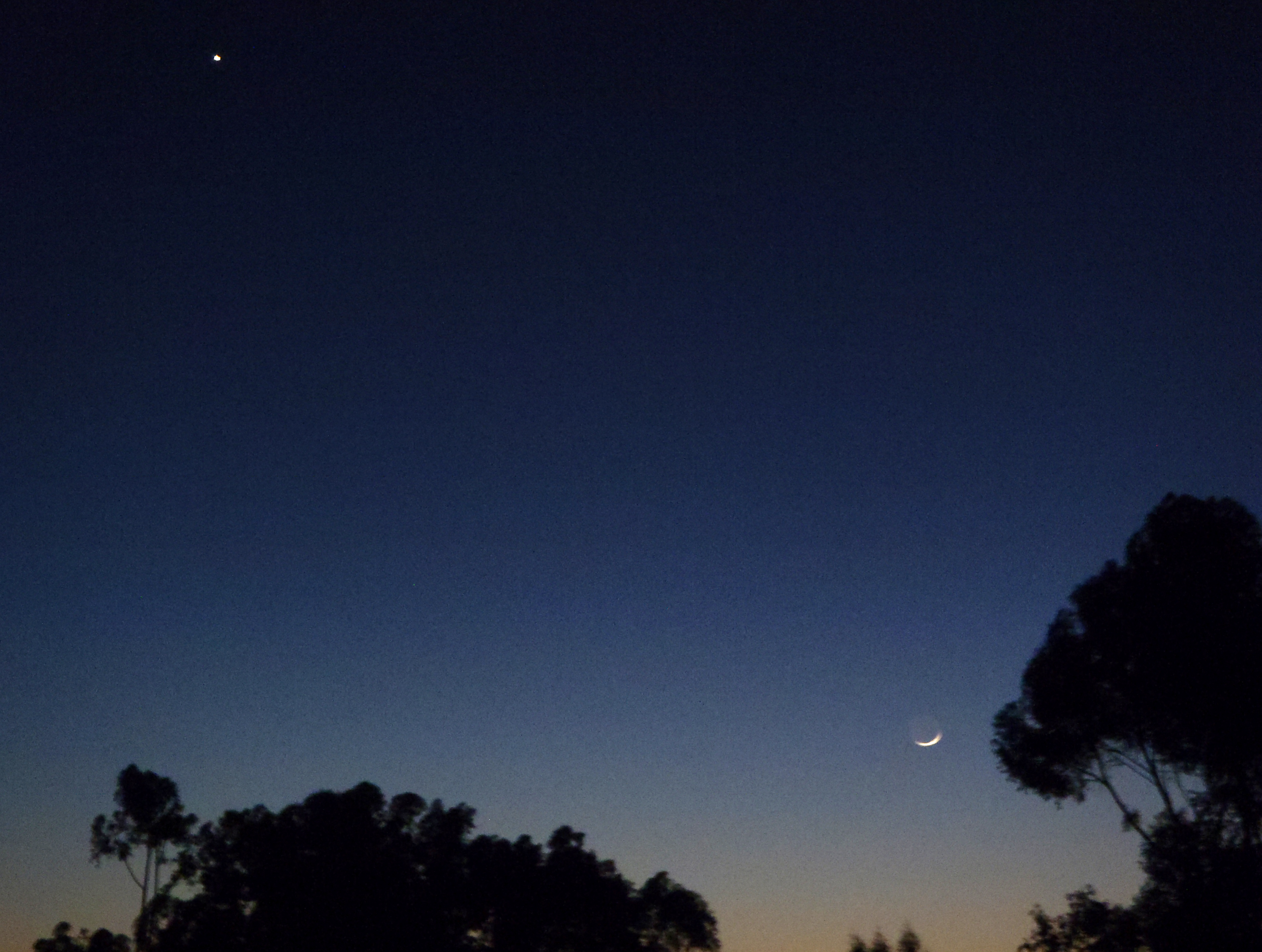
Moon looking up at Venus in San Diego, California. Captured by Ludy D'Angelo

Moon looking up at Venus in San Diego, California. Captured by Ludy D'Angelo

Greetings from sunny California. Hope every one is having, or had a great holiday season. We started our vacation by arriving in San Diego and I am writing this currently in Oakhurst. This week I have been enjoying the Moon and Venus in the early evening. The sky here is amazingly clear. If you locate yourself above the city lights (i.e., on a mountain), one can have some very nice views of the night sky. In California, this tends not to be a problem in many places. Many towns and cities are positioned low in the valleys, so mountain tops are easily accessible.  Also, it is mostly dry, which contributes to the very good seeing. I have been enjoying looking up every night.

Posted in January 2012, Sidereal Times | Tagged , , | Leave a comment

From the Program Chair

Submitted by Michael Wright for Ken Levy, Program Chair

Shara2011

Michael Shara. Source: American Museum of Natural History

Last month Dr. Gaspar Bakos of Princeton’s Astrophysical Sciences Department gave a fascinating and entertaining talk on his discovery of transiting extrasolar planets with the globe-spanning Hungarian Automated Telescope Network.

AAAP’s first meeting of 2012 will be on Tuesday, January 10. Our speaker will be Michael Shara, adjunct professor at Columbia University and curator in the Physical Sciences division at American Museum of Natural History, who will discuss how novae and type Ia supernovae are connected.

As usual the meeting will be at 8:00 p.m. in Peyton Hall, 4 Ivy Lane on the Princeton University Campus.

Posted in January 2012, Sidereal Times | Tagged , , , | Leave a comment

December 13, 2011 AAAP Meeting

Submitted by Michael Wright for Larry Kane, Secretary

The meeting was called to order by Assistant Director Jeff Bernardis.

  • Sidereal Times: Co-Editor Michael Wright announced that the deadline for the January issue is December 28, 2011.
  • Outreach: Chair David Letcher requested volunteers for the next outreach event, which is a science fair at Hopewell Elementary School on March 16, 2012.
  • Finance: Treasurer Michael Mitrano said that the club’s finances are sound.
  • Observatory: Jeff Bernardis announced that electricity has been restored to the observatory so key-holder training and observing can resume. The cause of the power outage was a wire that was pulled down by wet snow and vines during the Halloween snow storm. JCP&L will remove vines from the power lines. Gene Ramsey showed the severely corroded breaker box that was recently replaced by an electrician for the cost of parts. Paying the electrician a stipend was discussed.
     
    The water and soil pipes have been winterized. Gene Ramsey and John Church checked the computer and the C14 mount and both were working fine. Also, James McHenry tested and replaced a faulty circuit breaker. The quartz heater should not be used until the electrical system is checked. There was a long discussion about possible upgrades to the observatory’s electrical system. The consensus was that the club should have an electrician inspect the system and recommend upgrades. A permit maybe required for the completed emergency repairs and future updates to the electrical system. Jeff Bernardis will discuss hiring an electrician with Director D’Angelo. In the meantime, Gene Ramsey will check and consolidate the various powers strips in the computer room if possible.

    Jeff Bernardis and John Church agreed to meet at the observatory on December 18, 2011 to remove the old alarm system and activate the new one. Directions for turning the system on and off will be provided to keyholders.

    Gene Ramsey said that park rangers and township police may stop and question members in the park. Keyholders and members are allowed to be in the park after dark. There is list of keyholders on the bulletin board in the observatory if needed.

    Rex Parker reminded that ice or snow on the roof will prevent it from opening. If any resistance is felt when rolling the roof back, stop and check the roof to avoid damaging the crank mechanism. Gene Ramsey reminded that the park does not plow the access road so members should be cautious about going to the observatory when there is snow on the ground.

Posted in January 2012, Sidereal Times | Tagged , , | Leave a comment

From the Outreach Chair

by David Letcher, Outreach Chair

Greetings everyone. I hope your holiday season is going well. Have you noticed the days are getting longer?

Our next star party will be held on Friday, March 16, 2012 at the Hopewell Elementary Science Fair. This fair starts at 5 pm and ends at 8 pm. If you can attend, let me know. My email is letcher@tcnj.edu.

Bring your scope if you have one but you can still help out if you don’t have a scope by showing the children the early spring constellations that are out that night.

I’ll also be sending an email to our membership in the near future.

Happy New Year!

Posted in January 2012, Sidereal Times | Tagged , , | Leave a comment

Poet’s Corner

Submitted by David Kaplan

                                                            CANIS MAJOR

                                                            The great Overdog,
                                                            That heavenly beast
                                                            With a star in one eye,
                                                            Gives a leap in the east.

                                                            He dances upright
                                                            All the way to the west,
                                                            And never once drops
                                                            On his forefeet to rest.

                                                            I’m a poor underdog,
                                                            But tonight I will bark
                                                            With the great Overdog
                                                            That romps through the dark.

                                                            –Robert Frost, 1928

Canis-Major

Canis-Major. Source: Linda Hall Library of Science and Engineering.

Posted in January 2012, Sidereal Times | Tagged , , | Leave a comment

Snippets

Some Nearby Young Stars May Be Much Older Than Previously Thought
Published: Wednesday, December 21, 2011 – 15:37 in Astronomy & Space

Low in the south in the summer sky shines the constellation Scorpius and the bright, red super giant star Antares. Many of the brightest stars in Scorpius, and hundreds of its fainter stars, are among the youngest stars found near Earth, and a new analysis of them may result in a rethinking of both their ages and the ages of other groups of stars. New research by astrophysicists from the University of Rochester focused on stars in the north part of the constellation, known as Upper Scorpius, which is a part of the Scorpius-Centaurus OB association, one of our best studied groups of young stars and a benchmark sample for investigating the early lives of stars and the evolution of their planet-spawning disks. The Upper Scorpius stellar group lies roughly 470 light years from Earth.

The complete article may be found at http://esciencenews.com/articles/2011/1/21/some.nearby.young.stars.may.be.much.older.previously.thought

NASA’s Fermi Shows That Tycho’s Star Shines In Gamma Rays
Published: Tuesday, December 13, 2011 – 17:37 in Astronomy & Space

In early November 1572, observers on Earth witnessed the appearance of a “new star” in the constellation Cassiopeia, an event now recognized as the brightest naked-eye supernova in more than 400 years. It’s often called “Tycho’s supernova” after the great Danish astronomer Tycho Brahe, who gained renown for his extensive study of the object. Now, years of data collected by NASA’s Fermi Gamma-Ray Space Telescope reveal that the shattered star’s remains shine in high-energy gamma rays. The detection gives astronomers another clue in understanding the origin of cosmic rays, subatomic particles — mainly protons — that move through space at nearly the speed of light. Exactly where and how these particles attain such incredible energies has been a long-standing mystery because charged particles speeding through the galaxy are easily deflected by interstellar magnetic fields. This makes it impossible to track cosmic rays back to their sources.

The complete article may be found at http://esciencenews.com/articles/2011/12/13/nasas.fermi.shows.tychos.star.shines.gamma.rays

Astronomers Look To Neighboring Galaxy For Star Formation Insight
Published: Wednesday, November 30, 2011 – 15:35 in Astronomy & Space

An international team of astronomers has mapped in detail the star-birthing regions of the nearest star-forming galaxy to our own, a step toward understanding the conditions surrounding star creation. Led by University of Illinois astronomy professor Tony Wong, the researchers published their findings in the December issue of the Astrophysical Journal Supplement Series.

The Large Magellanic Cloud (LMC) is a popular galaxy among astronomers both for its nearness to our Milky Way and for the spectacular view it provides, a big-picture vista impossible to capture of our own galaxy.

The complete article may be found at http://esciencenews.com/articles/2011/11/30/astronomers.look.neighboring.galaxy.star.formation.insight

Strange New ‘Species’ Of Ultra-Red Galaxy Discovered
Published: Thursday, December 1, 2011 – 14:38 in Astronomy & Space

In the distant reaches of the universe, almost 13 billion light-years from Earth, a strange species of galaxy lay hidden. Cloaked in dust and dimmed by the intervening distance, even the Hubble Space Telescope couldn’t spy it. It took the revealing power of NASA’s Spitzer Space Telescope to uncover not one, but four remarkably red galaxies. And while astronomers can describe the members of this new “species,” they can’t explain what makes them so ruddy. “We’ve had to go to extremes to get the models to match our observations,” said Jiasheng Huang of the Harvard-Smithsonian Center for Astrophysics (CfA). Huang is lead author on the paper announcing the find, which was published online by the Astrophysical Journal.

Spitzer succeeded where Hubble failed because Spitzer is sensitive to infrared light — light so red that it lies beyond the visible part of the spectrum. The newfound galaxies are more than 60 times brighter in the infrared than they are at the reddest colors Hubble can detect.

The complete article may be found at http://esciencenews.com/articles/2011/12/01/strange.new.species.ultra.red.galaxy.discovered

Posted in January 2012, Sidereal Times | Tagged , , , , , , , , , , | Leave a comment

Opportunity Finds Powerful Evidence for Ancient Liquid Water on Mars

by Dr. Ken Kremer

NASA’s long lived Opportunity rover has discovered the most scientifically compelling evidence yet for the flow of liquid water on ancient Mars. The startling revelation comes in the form of a bright vein of the mineral gypsum located at the foothills of an enormous crater named Endeavour, where the intrepid robot was recently traversing in November 2011.

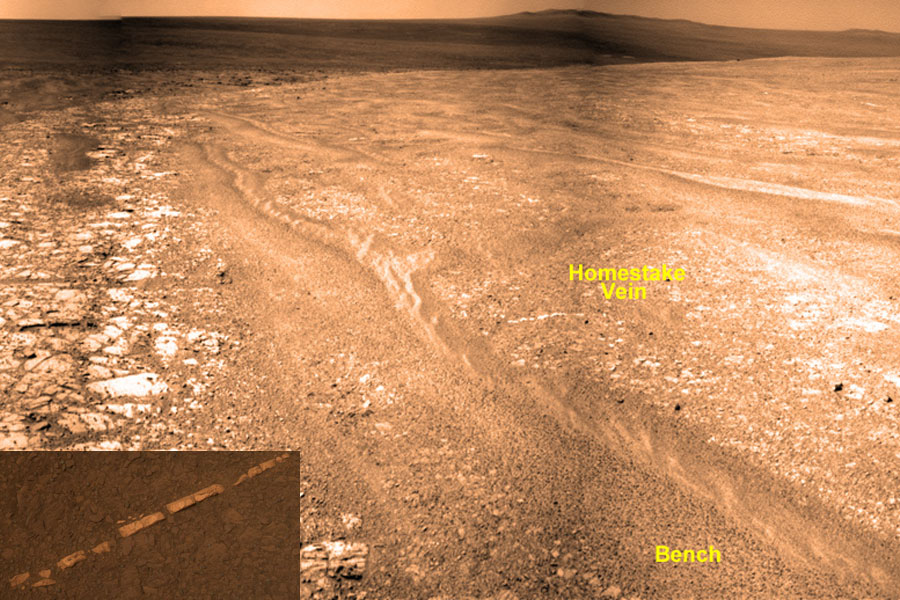
The light-toned vein is named “Homestake” and was found as the rover was driving northwards along the western edge of a ridge dubbed ‘Cape York’ – which is a low lying segment of the eroded rim of Endeavour Crater. Opportunity was scouting out a “Winter Haven” location to spend the approaching Martian winter.

Researchers announced the finding on Dec. 7 at the annual meeting of the American Geophysical Union (AGU) in San Francisco.

“This gypsum vein is the single most powerful piece of evidence for liquid water at Mars that has been discovered by the Opportunity rover,” said Prof Steve Squyres of Cornell University, Ithaca, N.Y., Principal Investigator for Opportunity.

Opportunity arrived at the rim of the 14 mile (22 kilometer) wide Endeavour Crater in mid-August 2011 following an epic three year trek across treacherous dune fields from her prior investigative target at the ½ mile wide Victoria Crater – a feat once thought unimaginable. All told, Opportunity has driven more than 34 km ( 21 mi) since landing on the Red Planet way back in 2004 for a mere 90 sol mission.

The light-toned vein is apparently composed of the mineral gypsum and was deposited as a result of precipitation from percolating pools of liquid water which flowed on the surface of ancient Mars, billions of years ago. Liquid water is an essential prerequisite for life as we know it.

The panoramic mosaic below right illustrating the exact spot which also was published by Astronomy Picture of the Day (APOD) on 12 Dec 2011. It was created by Ken Kremer and Marco Di Lorenzo.
APOD link: http://apod.nasa.gov/apod/ap111212.html

An Unusual Vein of Deposited Rock on Mars

An Unusual Vein of Deposited Rock on Mars. Credit: NASA/JPL/Cornell/Marco Di Lorenzo/Kenneth Kremer


The team believes the gypsum vein is the dihydrate of calcium sulfate; CaSO4•2H2O. On Earth, gypsum is used for making drywall and plaster of Paris.

“This tells a slam-dunk story that water flowed through underground fractures in the rock,” said Squyres.

The ‘Homestake’ vein is about 1 centimeter wide and 40 to 50 centimeters long. Veins are a geologic indication of the past flow of liquid water. The evidence for flowing liquid water at Endeavour crater is even more powerful than the silica deposits found by Spirit around the Home Plate volcanic feature at Gusev Crater a few years ago.

Learn all about Mars and Asteroid Vesta in 3 D at my Jan. 11 lecture at the Franklin Institute in Philadelphia at 8 PM.

Mars

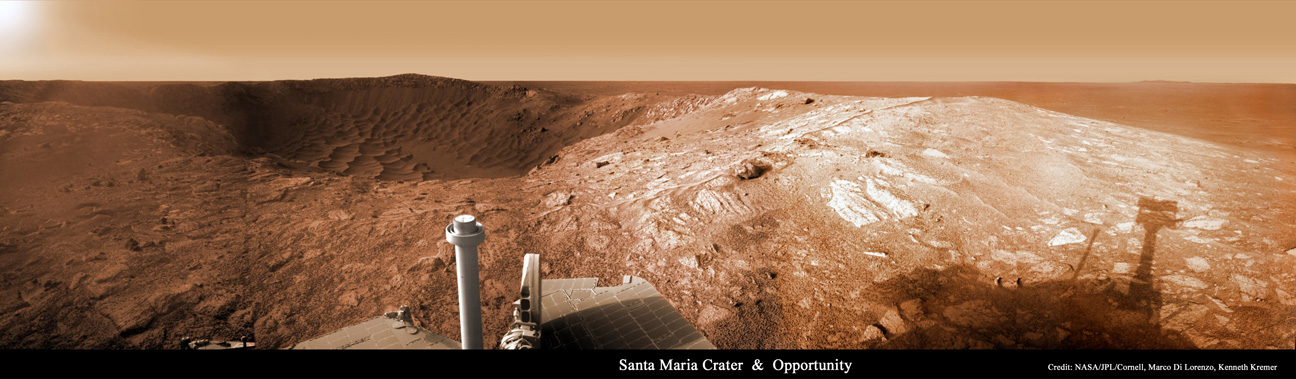
Opportunity at Santa Mars Crater, January 2011, Sol 2476. Credit: NASA/JPL/Cornell/Marco Di Lorenzo/Kenneth Kremer

Opportunity discovered water related mineral vein at Endeavour Crater in November 2011. The Homestake vein is composed of gypsum, or calcium sulfate dehydrate and indicates the ancient flow of liquid water on Mars. This panoramic mosaic illustrates the exact spot of the vein discovery. It was published on APOD on 12 Dec 2011.

Ken’s mosaic creation of “Opportunity at Santa Maria Crater” on Mars was selected as one of the 100 best space images of 2011 by Astronomy magazine for their November 2011 Special Photo Issue – see p. 34-35. Opportunity was celebrating 7 Years on Mars.
APOD link: http://apod.nasa.gov/apod/ap110129.html

Read more about Opportunity, Curiosity and NASA’s 2011 Highlights in Ken Kremer’s features online at Universe Today:

http://www.universetoday.com/92166/2011-top-stories-from-the-best-year-ever-for-nasa-planetary-science/
http://www.universetoday.com/91603/opportunity-discovers-most-powerful-evidence-yet-for-martian-liquid-water/
http://www.universetoday.com/91959/curiosity-starts-first-science-on-mars-sojurn-how-lethal-is-space-radiation-to-lifes-survival/

Astronomy Outreach by Ken Kremer
Rittenhouse Astronomical Association (RAS), Franklin Institute, Philadelphia, PA, Jan. 11, Wed , 8 PM, “8 Years of Mars Rovers — Mars and Vesta in 3 D”.
Website: http://www.rittenhouseastronomicalsociety.org/

New Jersey Astronomical Association NJAA- Vorhees State Park: High Bridge, NJ, March 24, Sat., 8 PM “Atlantis, the End of America’s Shuttle Program and What’s Beyond for NASA”. Website: http://www.njaa.org/

Ken Kremer:  Spaceflight magazine & Universe Today
Ken has a selection of his Shuttle photos and Mars mosaics for sale as postcards and frameable prints.

Please contact Ken for more info or science outreach presentations:
Email: kremerken@yahoo.com   website:  www.kenkremer.com
http://www.universetoday.com/author/ken-kremer/

Posted in January 2012, Sidereal Times | Tagged , , , | Leave a comment