
by Abhinav Sukla, co-editor
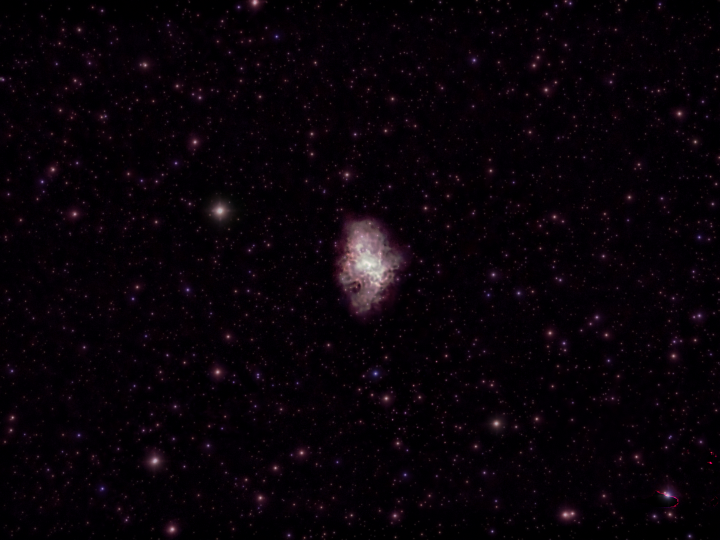
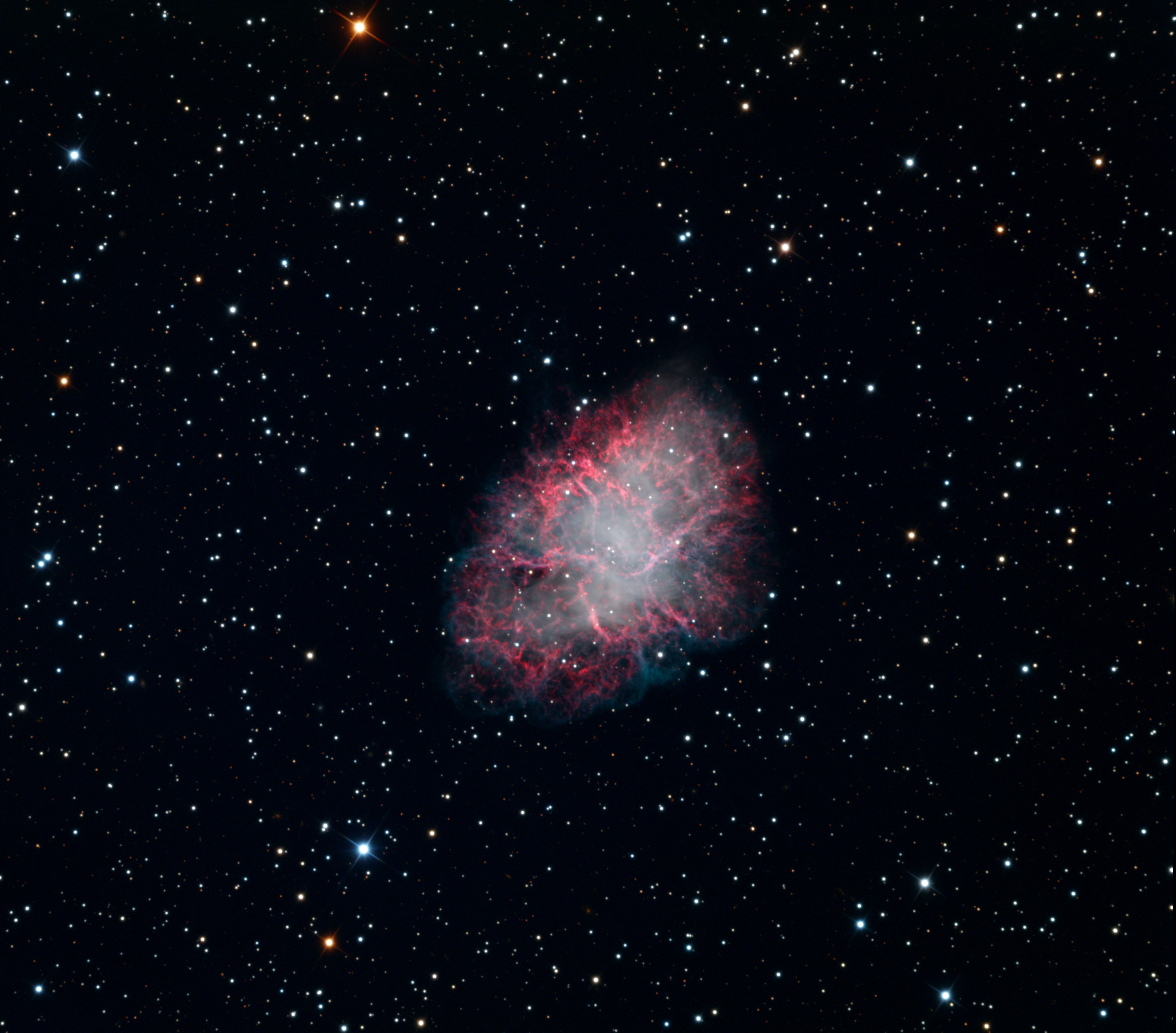
Neutron stars are the dense remnants of massive stars that underwent supernova explosions. When a star goes supernova, it collapses in on itself as it no longer has any materials inside of it to fuse. Normally, the nuclear fusion occurring inside of a star releases energy. As the star fuses heavier and heavier elements, however, it comes to a point where fusion no longer produces any energy.
Iron is the heaviest element that can be produced via fusion in a star’s core, as its fusion does not release energy but instead consumes it. This leads to the creation of an iron core. Due to this lack of fusion, the star has no interior force to push back against the powerful inward force of its own gravity and collapses. A neutron star is formed when the iron core collapses under gravity, and the protons and electrons combine to form neutrons. This phenomenon is what gives neutron stars their names. The rest of the star’s matter bounces off of this ball after collapsing, leading to a massive outward shockwave that gives supernovae their explosive reputation.
The remaining compressed iron ball becomes a neutron star, which can have masses over thrice that of our sun, while only being about 20 kilometers across. Neutron stars are some of the most extreme objects in the universe. The compression of the original star’s magnetic field decreases the area through which the magnetic field lines have to pass drastically, proportionally increasing the magnetic field of neutron stars to about 10^8 Tesla, which is 2 trillion times that of Earth’s. Due to the massively shrunk radii of neutron stars, the conservation of angular momentum results in their spinning extremely fast, sometimes hundreds of times every second, as the rotational speed increases as the radius decreases.
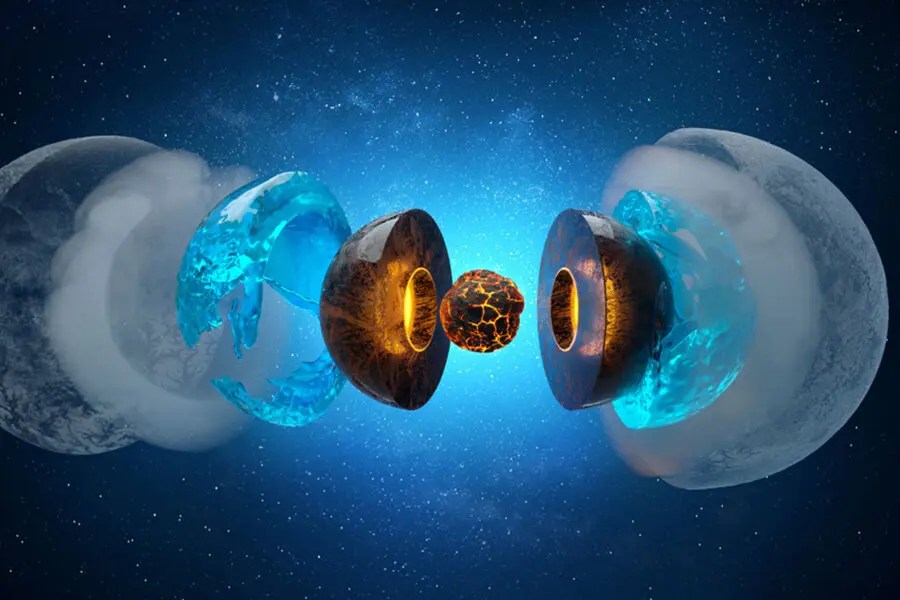
All of this matter packed into a miniscule, superheated, and highly magnetized space results in completely unique conditions. I will be discussing the different layers of matter in a neutron star and what each of them look like.
Outer Crust
Despite being the most “tame” out of all of the layers, the outer crust is still extremely hot and densely packed. Magnetars, which are neutron stars with even more powerful magnetic fields than normal, can have surface temperatures of over 10 billion degrees celsius when newly formed. In this layer iron nuclei are still intact, but the electrons have been stripped away in a process known as electron degeneracy and float between the nuclei.
Inner Crust
As the force of gravity gets stronger, more and more electrons and protons merge to neutrons, and the iron nuclei are even more densely packed. The nuclei are pushed so close together in the deeper parts of the crust that they begin to deform against each other and merge, creating large, misshapen shapes with thousands or millions of neutrons. Just one cubic centimeter of this highly dense matter weighs around 100 million tons, which is equivalent to around 25000 Empire State buildings!
Core
The true make up of the core of a neutron star is an elusive question that is one of astrophysics’ greatest mysteries. One of the most prominent theories is the existence of a quark-gluon plasma. Quarks are the elementary particles that make up protons and neutrons. They are essentially the tiniest building blocks in the universe. Gluons are elementary particles that carry the strong force, a force that holds quarks together. The astounding strength of gravity deep in the core of a neutron star is believed to overcome the strong force, creating a sea of quarks and gluons that are tightly packed together. Strange quarks are a flavor of quark that could make up an exotic matter called strange matter. Normally, these quarks are unstable, but in the high pressure cores of neutron stars, where up, down, and strange quarks might freely interconvert, it’s possible that strange quarks are dominant.
Why Is This Important?
When neutron stars collide, the masses of neutrons re-arrange themselves into different structures, some of which are only possible to create in the unique conditions inside neutron stars. It is possible that these collisions are the reason behind most heavy metals today. The universe as we know it would not be the same without these stars and the extraordinary environments they create.










 Amateur Astronomers Association of Princeton