AAAP at Communiversity 2014

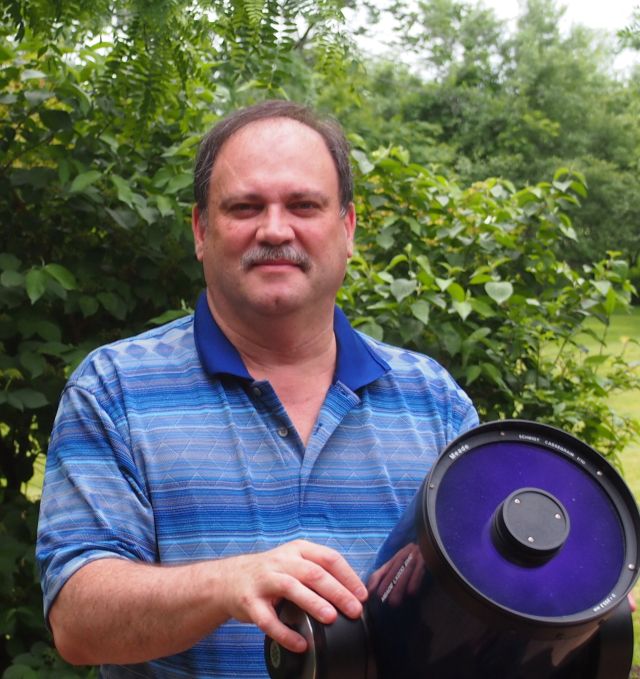
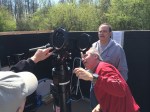
IMG_0021

Photo credit: Kate Otto

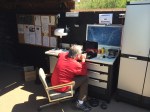
IMG_1158

Photo credit: Mary Hays

AAAP’s participation in Communiversity on April 27, 2014 was a success due to Larry Kane, John Giles, Pat & Mary Hayes, Kate Otto, Bill Murray and John Miller who helped at the club booth.  They dazzled visitors with views of the Sun through the club’s telescopes.

Posted in June 2014 | Tagged | Leave a comment

Chandra

Subrahmanyan Chandrasekhar (Public Domain Image)

Subrahmanyan Chandrasekhar (Public Domain Image)

by S. Prasad Ganti

The name Chandra brings two things to the minds of those who are inclined towards astrophysics and cosmology. One is the Chandrasekhar limit, which is equivalent to 1.4 times the mass of the Sun. Stars weighing more than the limit die a different death than those weighing less. Two is an X-ray space telescope named in his honor.

Subrahmanyan Chandrasekhar came from an illustrious family going back three generations, which was steeped in science and mathematics in British-colonized India. Chandra’s uncle was the great CV Raman who won the Nobel Prize in Physics in the early twentieth century for his “Raman Effect”. The family benefited from the English education system put together by the British Governor General Lord William Bentinck and Thomas Macaulay in the early 1800s. Though the British rule was widely criticized, a small minority of Indians benefited from this system, which was mainly created by the colonial power to turn out civil servants for the administration.

Chandra was very studious and precocious as a child. He took keen interest in mathematics and physics in his school and college days. Chandra published a paper that caught the attention of William Fowler of Cambridge University. Fowler helped Chandra to get a scholarship to study at Cambridge in the 1930s. On the voyage to England, Chandra came up with some ideas relating to what later became known as the “Chandrasekhar limit”. In those days, scientists knew that stars are born and eventually die, like all species do. They speculated that all stars end up as white dwarfs after they burn their fuel away. A white dwarf is a smoldering remains of a dead star. Chandra came up with the concept that not all stars end up the same way. Stars heavier than 1.4 times the weight of our own Sun end up as supernovae and eventually as neutron stars. Some really massive ones end up as black holes.

This concept was strongly opposed by Arthur Eddington who conducted a famous experiment in 1919 during a solar eclipse to prove Albert Einstein’s General theory of relativity. This opposition did not discourage Chandra but being a novice he could not stand up to Eddington. Paul Dirac and William Fowler were Chandra’s mentors at Cambridge where he got his PhD in 1933. Eddington and Fowler were his thesis examiners.

Chandra joined the University of Chicago as an Assistant Professor at its Yerkes Observatory in Williams Bay, Wisconsin. He remained in the US for rest of his life and became an American citizen. In Chicago, Chandra worked with the likes of Enrico Fermi and John Von Neumann. He got lot of praise from his colleagues and his students for his lasting contribution to the field of astrophysics. He became a Fellow of Royal Society of Britain in 1944. He was also the editor of Astrophysical Journal from 1955 to 1971 during which time the journal gained national stature.

Finally in 1983, history vindicated this great man. The idea for which Eddington reviled him, led to a Nobel Prize in physics, which he shared with his guru William Fowler. The Chandrasekhar limit like the Raman effect became part of physics vocabulary forever. More details on Chandra’s life and achievements can be found in the biography Chandra by Kameshwar Wali.

Posted in June 2014 | Tagged , | Leave a comment

From the Director

By Jeff Bernardis, Director

It’s hard to believe that we are already at the end of the club year.  It seems like just yesterday that we were celebrating our 50th anniversary over at the IAS.

Jeff Bernardis

Jeff Bernardis

We are now entering into my favorite part of the year – the public viewing season over at Washington Crossing.  Last year I think we had a fantastic year both in terms of very few rain/cloud days, and in the number of attendees.  I hope we have a repeat of all of that his year.

Even though this is a fun part of the year for me, I can’t overlook the fact that this ends my tenure as Director.  I have been honored to be the director to bring us into our 2nd 50 years.  It has not been without its challenges, and there are still things that need to be resolved, but nevertheless it was a rewarding experience.

I look forward to what Rex will get done during his tenure.  When I first joined the club, Rex was the Director.  I liked the direction the club was moving in at the time, and I’m sure I will have the same feelings next year.

I cannot leave this post without thanking my board; as I said last year, one of the reasons I decided to accept the nomination for Director was because of the strong people on the slate with me.

  • Michael Wright has been a steady influence in his secretary position. I always felt that the information provided by him was timely and accurate, and he represented the club well when dealing with others. Although he too is stepping down from his post, he will remain in a prominent position as co-editor of the Sidereal Times. He will also manage the word-press site. Mike also volunteered to coordinate Starquest this year.
  • Michael Mitrano has become synonymous with Treasurer to me.       With him in his position, I have never had to worry about anything financial with the club. I’m glad to see him continue in this position; I know everything is in good hands.
  • Kate Otto continues to fill our schedule with interesting speakers. It’s a job I don’t feel I’d be good at, but which she makes look easy.       Again, I think the club will be well-served as she returns in the same position.
  • Larry Kane is a long-time member of the club who stepped up to the AD role this past year. Larry has taken the initiative to help improve our relationship with Washington Crossing Park by helping to form the “Friends of” group. This is extremely important to us since, of course, our observatory is housed there. He too is returning in the same role next year.

At the risk of overlooking someone, I should also thank those who are in other prominent roles in the club for their contributions:

  • Dave Letcher continues to serve as our outreach coordinator,
  • Gene Ramsey, and now Dave and Jen Skitt, for their roles in managing the observatory
  • Surabhi Agarwal for her work as co-editor of the ST, and
  • John Miller for his work as webmaster.
Posted in May 2014, Sidereal Times | Tagged , | 1 Comment

The Dark Side Of The Universe

by Surabhi Agarwal

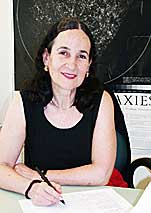
Neta A Bahcall. Credit: Princeton University

Neta A Bahcall. Credit: Princeton University

What is the Universe made of? Observations suggest surprising results: not only most of the matter in the Universe is dark and unconventional but, more surprisingly, the major component of the Universe may be in the form of ‘dark energy’ — a form of energy that opposes the pull of gravity and causes the expansion of the universe to accelerate. By combining observations of large-scale structure, distant supernovae, and the cosmic microwave background, we find evidence for a Universe that has only 5% ‘normal’ baryonic matter, 20% non-baryonic dark matter, and 75% ‘dark energy’. The observations suggest a Universe that is lightweight, with only 25% of the critical mass-density needed to halt the Universal expansion, and a geometry that is flat with no space curvature.

Neta A. Bahcall, the Eugene Higgins Professor of Astrophysics and the Director of the Undergraduate Program in Astrophysics at Princeton University will discuss her observations on the Dark Side of the Universe and their implications on Tuesday May 13th 2014. Bahcall is a member of the National Academy of Sciences, Distinguished Research Chair at the Perimeter Institute for Theoretical Physics, past Vice-President and Councilor of the American Astronomical Society, Century Lecturer of the AAS, and Chair and member of various NASA, NSF, and Congressional committees.

Bahcall has won numerous awards during her distinguished career. Some of the most recent ones are:
•The Cecilia Payne-Gasposkin Prize, Harvard University (2013)
•Distinguished Research Chair, Perimeter Institute for Theoretical Physics, Ontario, Canada (2009 -2013 )
•Frontiers of Astronomy Lecturer, CWRU (2009)
•Evnin Lecturer, Princeton University (2008)
•Honorary Degree, Doctor of Science, The Ohio State University (2006)

She has penned hundreds of research papers. Some of her latest ones are:
•“SDSSIII Photometric Quasar Clustering: Probing the Initial Conditions of the Universe Using the Largest Volume” (S. Ho et al), JCAP (2013)
•“On the Determination of Cluster Masses: Lensing versus SZ/Xray Mass” (N. Bahcall and Allison Hume), in preparation (2013)
•“Supermassive Black Holes in Quasars” (N. Bahcall, M. DiDonato, M. Medeiros), in preparation (2013)
•“Tracing Dark Matter and Baryons in the Universe”, (N. Bahcall and B. Cook), in preparation (2013)
•“Baryon Acoustic Oscillations Using Clusters of Galaxies” (N.Bahcall, H.Yesuf, P.Bode), in preparation (2013)

See you on Tuesday, May 13th at 8:00 p.m. in Peyton Hall, 4 Ivy Lane, Princeton. The lecture will be followed by a business meeting.

Posted in May 2014, Sidereal Times | Tagged , , , , | Leave a comment

Treasurer’s Report

by Michael Mitrano, Treasurer

New memberships and continued renewals have brought the AAAP member count to 97 for the fiscal year to date.  Dues income, however, is slightly below the level of a year ago.

Monthly expenses continue to be very modest and our surplus for the year to date is nearly $3 thousand.

On a cumulative basis, the AAAP’s surplus is approaching $25 thousand.

Posted in May 2014, Sidereal Times | Tagged , | Leave a comment

News Flash!!

by John A. Church

Here is a news flash, hot off the wires!

On Saturday April 26, Rex Parker, Jeff Bernardis, Dave Skitt and the writer successfully replaced the existing Paramount mount on the Hasting-Byrne refractor at Washington Crossing with the GoTo version which had been stored in the observatory for some time.  The replacement went perfectly and there were no mechanical issues at all. Balance in all orientations is very good.

The electronics were successfully fired up and all the systems worked well after a little tweaking of the motherboard to get the main IC seated correctly.  The button battery that works the clock turned out to be discharged, but this is an easy replacement.

We were all pleased at how smoothly the two servo motors slewed the long OTA at varying speeds, ramping up and down very nicely.  We had previously tested the mount’s performance with a heavy wooden mockup which simulated the moments of inertia of the actual telescope about both axes, so we knew that it would likely work very well when actually installed, and it did.

Keyholders will need to undergo some training with this new system. The operating manual will be circulated by email for easy reference. In the meantime, the mount can still be used in manual mode.

We anticipate that the rest of the transition will go smoothly, and we will soon be enjoying the benefits of computer control with this fine old instrument.  I like to think that its 1880-era makers would be very pleased to know that it has been upgraded this way.  It is now ready for even more generations of delighted users to enjoy the sharp and contrasty wide field views of an excellent 6-inch refractor.

Posted in May 2014, Sidereal Times | Tagged , , | Leave a comment

Minutes of April 8, 2014 AAAP Meeting

By Michael Wright, Secretary

Director Jeff Bernardis opened the meeting. He awarded new keyholder Lee Sandburg with his key. Jeff introduced the nominations committee, Jim McHenry and John Giles. Jim announced the following slate of candidates for the 2014-15 Board of Trustees:

• Director – Rex Parker
• Assist. Director – Larry Kane
• Treasurer – Michael Mitrano
• Secretary – Jim Poinsett
• Program Chair – Kate Otto

Prof. Jeremiah Ostriker of Princeton Astrophysics stopped by the meeting to leave his new book and to offer to speak before the club.

Program Chair Kate Otto introduced the three speakers for the evening: members Ken Kremer, Gene Ramsey and Robert Vanderbei. Ken announced that a Cygnus cargo module will be launched from NASA’s Wallops Flight Facility in Virginia on the afternoon of May 6. Ken encouraged members to attend and offered to provide information on how best to view the launch. Gene demonstrated an iOS and Android planetarium app called Sky Safari that can be used to control a GoTo telescope. The app also contains encyclopedic information and stunning graphics of astronomical objects. Gene also demonstrated some observing tools that he designed and built such as solar finder, iPad holder and two different eyepiece trays. Robert Vanderbei first showed a video about his latest photography project: snowflake macrophotography. He then explained the techniques he uses to take astrophotographs from his driveway with various combinations of Ritchey-Chretien, Takahashi and Questar telescopes, and Canon DSLR and Starlight Express cameras.

Larry Kane announced that the club has been invited to participate in Communiversity, which will be held on April 27, 2014 in Princeton. Volunteers are needed to bring solar scopes and staff the club’s table.

After a short break, Jeff convened the business meeting. He thanked the Board of Trustee nominees for volunteering to serve. Elections will be at the May meeting as required by the by-laws.

Washington Crossing Park Association – Trustee Larry Kane announced that WCPA is holding a clean-up in the park on April 27, which is the same day as Communiversity. Volunteers are needed.

Simpson Observatory – Gene Ramsey reported that the water is on and some repairs were made so the observatory is ready for the public. Unfortunately, the first Friday was rained out. Access procedures were discussed. Anyone arriving before dark can use the dirt road that passes by the campsites to reach Brick Yard Road and the observatory. Anyone arriving after dark must park at the soccer fields and walk in. Anyone parked at the observatory after dark must leave via Brick Yard Road. The consensus was that the current situation is unacceptable for several reasons discussed at previous meetings. Gene volunteered to contact the park administration again to try and persuade them to allow visitors to enter and leave after dark via the dirt road. He will request that they fill the potholes.

Outreach Report – Dave Letcher announced that the club has been invited to participate in Super Science Saturday on May 3 from 9:00 a.m. to 5:00 p.m. at the NJ State Museum. Volunteers are needed to bring solar scopes and staff the club’s table. We have been invited to participate at an event at Stuart Country Day School in the summer. He will suggest that they move the observing to the fall so that it can start earlier in the evening.

Program Chair’s Report – Kate Otto said she appreciated recent flood of speaker ideas from members. Neta Bahcall of Princeton Astrophysics will speak in May. The June meeting will be at the planetarium at the NJ State Museum in Trenton. A speaker from NASA has been arranged for November with assistance from Ken Kremer.

Refractor Mount – It was agreed that a work party will be held on April 26 to install the new Gemini mount under the refractor. At the same time, the new C14 will be set up on a tripod for star testing, potentially that evening.

New Observatory Donation – Jeff contacted the potential buyer for the dome who said that he is interested but cannot take the dome immediately. He suggested that the club not wait for him.

Astronomical Calendar – Bill Murray reported that there will be a total lunar eclipse in the early morning of April 15.

Observatory Plans – Michael Wright announced that he scanned and copied the original observatory plans that John Church had in his archive. Anyone who would like the electronic files can email Mike, and he will provide a link to download them from Google Drive.

Jeff adjourned the meeting.

Posted in May 2014, Sidereal Times | Tagged , | Leave a comment

Snippets

compiled by Surabhi Agarwal

Hubble view: A hungry starburst galaxy
Source: NASA; Published: Friday, May 2, 2014 in Science Daily

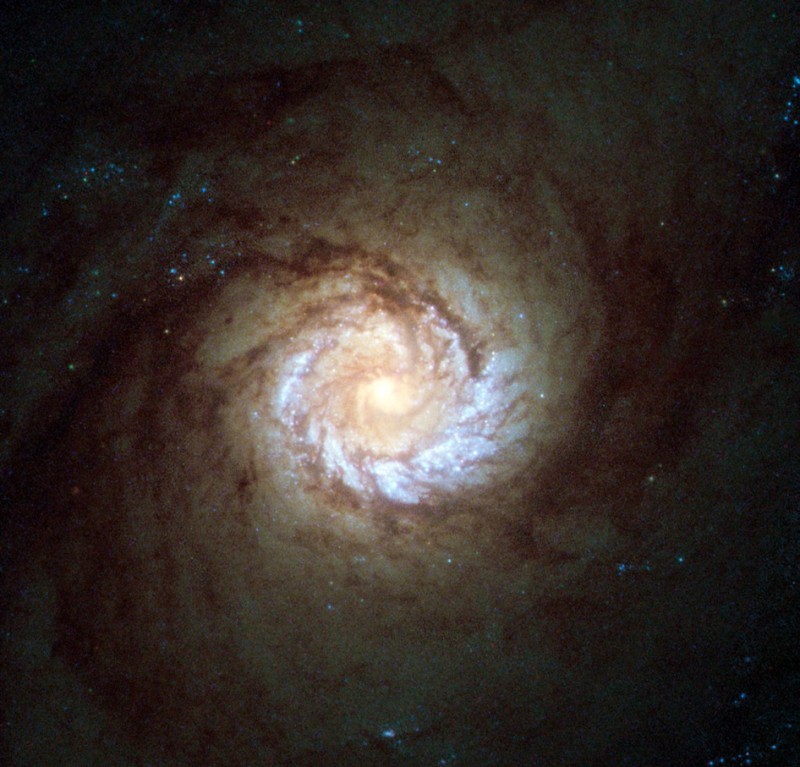
Messier 61. Credit: NASA

Messier 61. Credit: NASA

A new Hubble picture is the sharpest ever image of the core of spiral galaxy Messier 61. Taken using the High Resolution Channel of Hubble’s Advanced Camera for Surveys, the central part of the galaxy is shown in striking detail. Also known as NGC 4303, this galaxy is roughly 100,000 light-years across, comparable in size to our galaxy, the Milky Way. Both Messier 61 and our home galaxy belong to a group of galaxies known as the Virgo Supercluster in the constellation of Virgo (The Virgin) — a group of galaxy clusters containing up to 2,000 spiral and elliptical galaxies in total.

For the complete article go to: A hungry starburst galaxy

Nearby galaxy is a ‘fossil’ from the early universe
Source: Carnegie Institution; Published: Thursday, May 1, 2014 in Science Daily

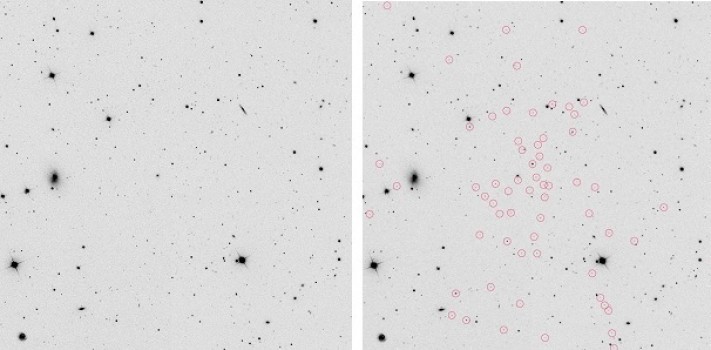
On the left, Segue 1 (note that you can't see the galaxy); on the right, the stars that are part of Segue 1 are circled.

On the left, Segue 1 (note that you can’t see the galaxy); on the right, the stars that are part of Segue 1 are circled. Credit: Marla Geha Yale University

Scientists analyzed the chemical elements in the faintest known galaxy, called Segue 1, and determined that it is effectively a fossil galaxy left over from the early universe. Stars form from gas clouds and their composition mirrors the chemical composition of the galactic gas from which they were born.

The complete article may be found at: Nearby galaxy is a ‘fossil’

First ever gravitationally lensed Type Ia supernovae discovered
Source: Space Telescope Science Institute (STScI); Published: Thursday, May 1, 2014 in Science Daily

 Fireworks of cataclysmic stellar explosions outshining entire galaxies of stars. Credit: NASA

Fireworks of cataclysmic stellar explosions outshining entire galaxies of stars. Credit: NASA

Astronomers have discovered three distant exploding stars that have been magnified by the immense gravity of foreground galaxy clusters, which act like ‘cosmic lenses.’ These supernovae are the first of their type ever to be observed magnified in this way and they offer astronomers a powerful tool to check the prescription of these massive lenses.

Massive clusters of galaxies act as “gravitational lenses” because their powerful gravity bends light passing through them. This lensing phenomenon makes faraway objects behind the clusters appear bigger and brighter — objects that might otherwise be too faint to see, even with the largest telescopes.

For the full article go to: Type Ia supernovae discovered

Traces of recent water on Mars: Liquid water on Mars as recently as 200,000 years ago
Source: University of Gothenburg; Published: Friday, April 25, 2014 in Science Daily

Debris flows. Credit: NASA/JPL/UofA for HiRISE

Debris flows. Credit: NASA/JPL/UofA for HiRISE

New research has shown that there was liquid water on Mars as recently as 200,000 years ago. The southern hemisphere of Mars is home to a crater that contains very well-preserved gullies and debris flow deposits. The geomorphological attributes of these landforms provide evidence that they were formed by the action of liquid water in geologically recent time.

For the full story go to: Traces of recent water on Mars

Posted in May 2014, Sidereal Times | Tagged , , | Leave a comment

Constants of our Universe

by Prasad Ganti

Life on Earth came into existence because of some favorable factors. Earth is located in our solar system at the right distance from the Sun where we get the light and heat for the sustenance of life, where water exists in liquid form and the atmosphere is thick enough to protect us from radiation and trap heat to keep us warm. It is thin enough so as not to crush us.

Unlike other planets like Venus that has a thick atmosphere of carbon dioxide and traps so much heat that it is a runaway greenhouse. On the other hand, Mars has almost no atmosphere. It is pretty cold and frigid. The outer planets from Jupiter onwards do not have any land or solid surface worth talking about. They are just gaseous giants where it is difficult for life to imagine.

No other planet in our solar system is conducive for the existence of life barring Mars or some satellites like Europa (of Jupiter) or Titan (of Saturn). In effect, the Earth is supposed to be in a Goldilocks zone in our solar system. When we look for alien life elsewhere, these considerations come into the picture. Now let us expand this concept to the level of our Universe.

There are some fundamental constants of our Universe that make it what it is. Other Universes may have different values for these constants, which could make them different than ours. These constants are described in the book called “Just Six Numbers” by Martin Rees. We will talk about some important ones of those constants.

Gravity is one of the four fundamental forces which operates at a macro level across the Universe. Then we have the strong nuclear force which works at the micro level. At the outset one might get a feeling that Gravity is very strong indeed. In a way it is. It sculpts the stars, keeps the planets in orbit, keeps the solar systems within Galaxies and so on. It is also the basis of the universal monsters called Black holes. It can bend and fold the fabric of space. It can cause time to pass by very slowly or speed up like the press of a fast forward button.

And since the nuclear force operates at such a micro level, we do not feel it. It keeps the protons and neutrons bound together to the nucleus, which is no mean feat. But it would be surprising for us to know that the ratio of the nuclear force to gravitational force is a number called “N” whose value is 10**36 (10 raised to the power of 36 or 10 followed by 36 zeroes). We see that the Gravity pales in comparison to the Nuclear force. But the impact of the nuclear force diminishes very rapidly with distance. And gravity comes into force when huge masses are involved.

What happens if this number N is any different from what it is? If this number is any smaller, the Universe would be much smaller because Gravity would crush anything as large. The stellar lifetimes would be much shorter. Conditions for complex evolution of life would be less favorable. Life forms, as we know it, need very long timelines to appear and evolve. On the other hand, a weaker gravity may not help in the creation of structures like stars of galaxies. Again chances of life appearing would be slim.

Like our Earth in our solar system, our Universe also seems to be in a Goldilocks zone where the constants are very favorable for life to exist for someone to write this article and for someone else to read it! Are there other Universes with different ratio of gravity to nuclear force? We have 3 spatial and 1 time dimension. Are there other Universes with different number of dimensions? We keep learning more as observations are made using more sophisticated instruments and more complex theories are conceived.

Posted in May 2014, Sidereal Times | Tagged | Leave a comment