
by Robert Vanderbei
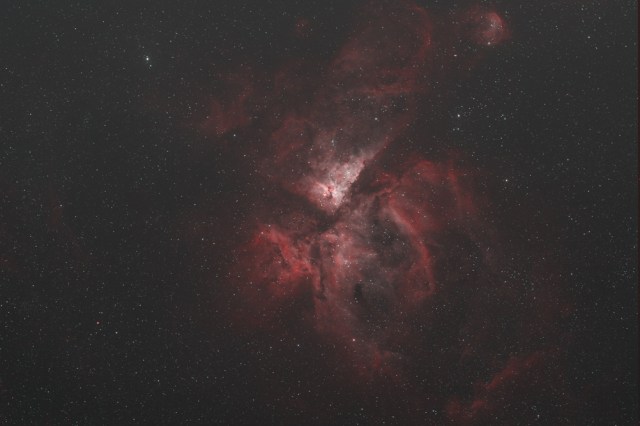
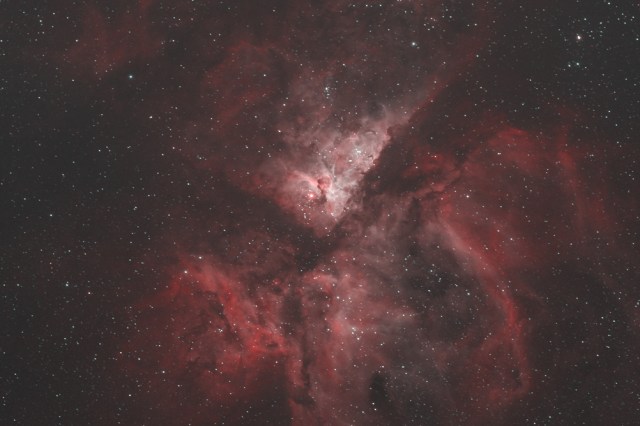
Two images of Eta Carinae taken on February 7, 2016. SBIG Universal on Takahashi FSQ-104D H-alpha = 40 min, OIII = 6 min Two-minute unguided exposures. Richardson-Lucy deconvolution, Gaussian blur, Log.
by Robert Vanderbei
Two images of Eta Carinae taken on February 7, 2016. SBIG Universal on Takahashi FSQ-104D H-alpha = 40 min, OIII = 6 min Two-minute unguided exposures. Richardson-Lucy deconvolution, Gaussian blur, Log.
Compiled by David Kaplan and Michael Wright
 China Telescope to Displace 9,000 Villagers in Hunt for Extraterrestrials
Thousands of villagers in Guizhou Province are being relocated to make room for a $184 million telescope to detect signs of alien life.
Exotic Cosmic Locales Available as Space Tourism Posters
Fourteen space travel posters of colorful, exotic cosmic settings are now available free for downloading and printing.
Stephen Hawking: ‘Things can get out of a black hole’
An illustrated version of Prof Stephen Hawking’s second Reith lecture, Black holes ain’t as black as they are painted. Prof Hawking examines scientific thinking about black holes and challenges the idea that all matter and information is destroyed irretrievably within them.
Madness and Genius
Cosmologist Janna Levin on the Vitalizing Power of Obsessiveness, from Newton to Einstein

Saturn’s Rings: Less than Meets the Eye?
A recent study from NASA’s Cassini mission proves that, in the mysterious and beautiful rings of Saturn, appearances can be deceiving.
Event Horizon Snapshot Due in 2017
A global network of nine radio telescopes is set to take the first ever picture of a black hole’s event horizon in 2017.
Why Can’t You Remember Your Future?
Physicist Paul Davies on The Puzzlement of Why We Experience Time as Linear
Wrapping Armchairs in Wire, and Other Childhood Attempts to Travel in Time
Whether we were influenced by C.S. Lewis or Doctor Who, many of us have distinct memories of fantasizing about time travel as kids.
Where NASA’s Rocket Countdown Came From
On December 1, 2014, NASA retired a historic piece of equipment at Kennedy Space Center in Florida. It wasn’t a rocket, or even a deep space nine-iron—it was the original countdown clock, an analog display the size of a titan’s wristwatch that stood across the river from the rocket launch site and stoically ticked off the seconds until blastoff.
Cosmic Solitude
Polish Nobel Laureate Wislawa Szymborska on How the Prospect of Being Alone in the Universe Can Make Us Better Stewards of Our Humanity
 New Animation Takes a Colorful Flight Over Ceres
A colorful new animation shows a simulated flight over the surface of dwarf planet Ceres, based on images from NASA’s Dawn spacecraft.
Ceres: Keeping Well-Guarded Secrets for 215 Years
In 1801, when an astronomer pointed his telescope at a seemingly star-like point of light, he probably had no idea a robotic emissary from Earth would one day be sent there.
James Webb: Hubble Successor Maintains Course
James Webb, the space telescope that will take over from Hubble, is reaching some key milestones in its preparation for launch in 2018.
by Ira Polans, Program Chair
The Amateur Astronomers Association of Princeton is pleased to announce that immediately before the regular February meeting we will show the film “Saving Hubble” in Peyton Hall. The film is 70 minutes long. The showing will begin promptly at 6:00 PM. Since this is close to the dinner hour, the club will provide a light meal (think pizza and beverages). For this reason, the meet-the speaker dinner is canceled for February. Please join us for the screening, or the regular lecture and club meeting at 7:30 PM.
by Rex Parker, Director
Upcoming events and ideas for AAAP members
A Rare Opportunity for AAAP Members ONLY
Night-sky refresher at the Planetarium – Yes, hands-on astronomy can be done right despite the light pollution that we all lament! AAAP is offering a “night sky refresher” opportunity for members wishing to better understand which deep sky objects are visible over the seasons, how to find and identify them, and how to more effectively show them to others. We’ll utilize the considerable strengths of the planetarium along with the expert knowledge of planetarium staffer and AAAP member Bill Murray. Depending on member participation, one or more dates are being arranged in the near future. We need your input, so please take this survey to help us determine best dates for the planetarium sessions. https://www.surveymonkey.com/r/VDM9QZT
Take Advantage of the New Celestron-14 to Add Photography to Your Observing Skills
Changing equipment at the Observatory – We’re anxious to unveil the new Celestron-14 telescope now installed at the observatory (see photos in this issue). The advantage of the new telescope is Fastar capability. Fastar is a design invented by Celestron where the secondary mirror is swapped for a special lens and camera mount to allow CCD imaging from the front end of the scope. This results in a very fast focal ratio (f/2.3) which gives a wide field and shorter exposure times for astrophotography, making the whole endeavor easier. We’ll be discussing how to take advantage of this, potentially acquiring a Fastar lens and an appropriate camera later this spring; you could also use your own camera. For a taste of what can be done in astrophotography, have a look at the website I recently developed to display my own deep sky images obtained right here in central New Jersey over the past year or two. (http://rexparkerpixels.com/)
The club’s original C-14 telescope had been at our observatory since the millennium turned, a source of pride to members and a wonder to thousands of visitors through the years. Fittingly, it was sold this month to the North Jersey Astronomy Group, a well-established astronomy club with connections to Montclair State University. With NJAG, the telescope will continue its productive life for New Jersey amateur astronomers and public outreach.
In Search of Something in the Sky?
Software tools for your consideration – Even experienced astronomers need better tools to figure out which celestial objects are visible or best positioned on any given date and time. A number of good software programs are available to help do this. Software Bisque’s TheSkyX is a truly outstanding planetarium and telescope control program that keyholders are familiar with, as TheSky v6 is currently in use at the observatory. Another program I would like to see more members using is SkyTools3, produced by Skyhound of Cloudcroft, NM. SkyTools has an extensive database and integrates the core tasks of observation planning, charting, real time observing, and logging into a single tool. No matter the level of expertise, this program lets you get more out of observing, minimizing time spent at the computer and maximizing time under the night sky. There are different levels and costs of the software available. Let me know if you’re already using this program. If you aren’t, I highly recommend you check it out on-line: http://www.skyhound.com/order.html
In the News
Ancient Babylonians figured Jupiter’s position through integral calculus. The current media fanfare about five planets in the early morning sky sets the stage for a remarkable archaeo-astronomy discovery which made the cover of Science this month (M. Ossendrijver, Science 351, issue 6272, Jan 29 2016). Dr Ossendrijver of Berlin’s Humboldt University, an astrophysicist turned historian, studied clay tablets from the 4th century BCE with weekly pilgrimages to the British Museum’s vast collection of Babylonian cuneiform tablets. A few tablets prescribed the drawing of trapezoidal figures along with a reference to Jupiter, which Babylonians favored as vehicle of their patron god Marduk. As described in the Science commentary on the paper, Ossendrijver received from a colleague photos of an uncatalogued tablet that seemed to depict some kind of astronomical calculation. Alone in his office a few months later, he realized the blurry photos showed inscriptions identical to the trapezoid inscriptions he’d been studying. He concluded that the trapezoid calculations were a tool for determining Jupiter’s displacement each day along the ecliptic over 60 days from when the planet first appears in the night sky before dawn. This is when Jupiter’s apparent motion slows due to the combination of its orbit and earth’s, so that a graph of apparent velocity vs time slopes downward and the area under the curve is a trapezoid. The area under the curve gives the distance Jupiter moved along the ecliptic during the 60 days. This was the true “Eureka!” moment for Dr Ossendrijver, as he realized the ancient Babylonian astronomer-scribes had used the basic calculus operation of the integral nearly two thousand years before Newton and Gottfried!
by Ira Polans, Program Chair

Filmmaker David Gaynes
The February meeting will be held on the 9th at 7:30 PM in Peyton Hall on the Princeton University campus. The talk will be by award-winning filmmaker David Gaynes regarding his documentary film “Saving Hubble”. For background on the film please see http://www.savinghubble.com/about/. Please note that the meeting will not be a showing of the film due to time restrictions. Rather David will share his experiences making the film.
Please refer to the UPDATE for details regarding a pre-meeting showing of the film.
“Saving Hubble” (2012) is David’s second feature length documentary and is a fresh and original telling of the Hubble Space Telescope story, exploring the cultural, political, and spiritual significance of Hubble in addition to the telescope’s scientific importance. Of specific interest to the film is the chapter in Hubble history that began in 2004 with the proposed (and ultimately unsuccessful) cancellation of the telescope. The film tracks Hubble’s fight for survival, documenting the unexpected and transformational grassroots movement that led to its eventual reinstatement and servicing by space shuttle astronauts in Spring 2009.
David Gaynes is an independent filmmaker whose work has been presented theatrically around the world. He recently completed his third feature length documentary, Next Year Jerusalem, which tells the story of eight frail elders who leave the comfort and security of their nursing home to make one final pilgrimage. Keeper of the Kohn (2005), his debut feature, is the story of an autistic man caring for a dying friend and won awards at film festivals across the country, was seen on public television and can be viewed on Hulu. David is an accomplished documentary cinematographer, having photographed the award-winning All Me: The Life and Times of Winfred Rembert (2011) among other films.
A trailer and additional information about the film are available at the Saving Hubble website: http://www.savinghubble.com.
Prior to the meeting, there will be a meet-the-speaker dinner at Winberies, Palmer Square in Princeton at 5:45PM. This is 15 minutes earlier than the usual start time. If you wish to attend please email program@princetonastronomy.org no later than noon on February 9.
The meet-the-speaker dinner is cancelled. Please refer to the UPDATE for details regarding a pre-meeting showing of the film.
by Michael Wright
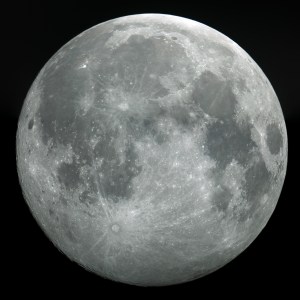
Blue Moon by Robert Vanderbei
The Internet has made delivering training courses easy for teachers and professors so that students and adult learners now have many options in addition to books for studying their chosen topic. This is true for astronomy too. Any amateur astronomer that would like to brush up on the hobby or deepen their knowledge has many options to do it in front of their computer or TV, or even in their car. Here’s a sampling.
CrashCourse – Astronomy – This collection of 46 videos produced and hosted by Phil Plait, author of the “Bad Astronomy” book and blog, is available on YouTube. These entry-level presentations cover everything that a beginner needs to get started in the hobby including naked eye observing, telescopes, the solar system, deep sky objects and cosmology. Thanks to John Miller for suggesting this video set.
Udemy – This astronomy for beginners course is presented by Professor Chris Impey of Steward Observatory at the University of Arizona. It is intended for beginners and anyone who wants to learn more about recent astronomical discoveries. Thanks to Prasad Ganti for recommending this course.

M42B by Brian Van Liew
Astronomy Cast – One can absorb a tremendous amount of knowledge by listening while commuting to work or school. With advent of podcasts, one can download a show on almost any topic to an MP3 player and listen in the car. Twenty minutes of commute time everyday adds up quickly, so before you know it, you’ve completed a semester-long course in astronomy.
Check out Astronomy Cast by Prof. Pamela Gay and Fraiser Cain. Pamela is an assistant research professor of Physics at Southern Illinois University Edwardsville. Fraiser Cain is the publisher of the Universe Today website.
As of 6/15/2015, 380 excellent podcasts are available on various astronomy topics. The solar system tour were my favorites (episodes 49 to 52, 55 to 57, 59 and 61 to 65). Topics include “The Fermi Paradox: Where Are All the Aliens?”, “Lagrange Points”, “Building a Career in Astronomy”, “How Amateurs Can Contribute to Astronomy” and “A Universe of Dark Energy.” Pick and choose the topics that interest you. Another podcast is available every week or two.
Great Courses offers adult learning courses made up of 30-min video lectures by prominent college professors. The course come on DVDs or streamed online to your computer or iPad. I have not take their astronomy courses, but those that I have taken on other topics are very well presented.

Spiral galaxy Messier 61. Credit: ESA/Hubble & NASA
If you are really ambitious and would like to earn a degree, Swinburne Astronomy Online (SAO) is a fully online postgraduate degree program in astronomy run by the Centre for Astrophysics & Supercomputing and the Department of Physics & Astronomy at Swinburne University of Technology in Australia. It concentrates on the fundamental concepts of and key issues in contemporary astronomy. According to its website, it is “designed for science educators and communicators, people working in astronomy related fields, amateur astronomers, and anyone with a love of astronomy.”
Submitted by David Kaplan
From: Spoon River Anthology (1915) by Edgar Lee Masters
Alfonso Churchill
They laughed at me as “Prof. Moon,”
As a boy in Spoon River, born with the thirst
Of knowing about the stars.
They jeered when I spoke of the lunar mountains,
And the thrilling heat and cold,
And the ebon valleys by silver peaks,
And Spica quadrillions of miles away,
And the littleness of man.
But now that my grave is honored, friends,
Let it not be because I taught
The lore of the stars in Knox College,
But rather for this: that through the stars
I preached the greatness of man,
Who is none the less a part of the scheme of things
For the distance of Spica or the Spiral Nebula;
Nor any the less a part of the question
Of what the drama means.
by David Kaplan
Carl Sandburg was once asked,
“How do you go about writing?”
He said, “I put one word in front
Of another.”
I, on the other hand, once asked
A Nobel Prize–winning astrophysicist,
“How is the orbit of a planet determined?”
He said, “Simple math!”
I wish I had the ability to be as glib
When it comes to finding the right word
To launch into the correct poetic orbit.
For me, writing a poem,
Is not as easy as putting one word
In front of another, and getting from the Earth
To the moon is beyond my comprehension.
Poetry requires, as in all things concise,
An extractor of unnecessary material.
A hand plane as sharp as a well-honed knife.
A set of whetted chisels of assorted sizes,
Sandpaper of finer and finer grit as in jeweler’s rouge.
And words that evoke
Deeper and deeper thought.
by Robert Vanderbei
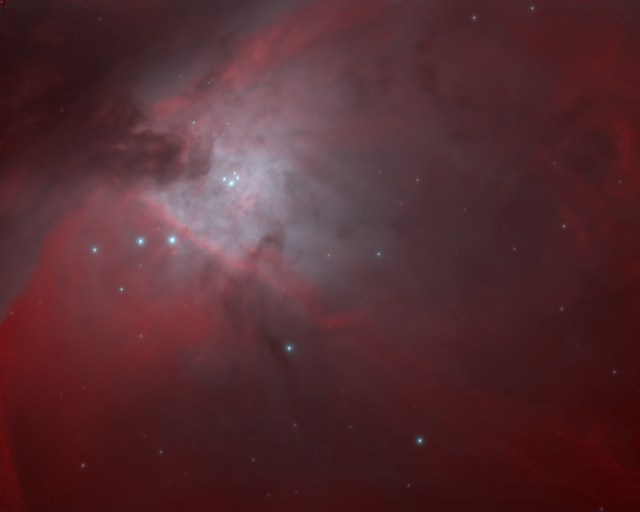
The Trapezium in M42
18:53 EST Jan 26, 2016.
Starlight Express Trius SX-694 on 10″ RCOS at f/9.
Ha = 28 mins, OIII = 42 mins, (unguided 15-second subexposures).
Richardson-Lucy deconv. Log stretch.

 Amateur Astronomers Association of Princeton