
by Jim Peck
I’ve had two recent encounters with the moon but not the usual visual ones where you can notice the phases but the gravitational ones where you can notice the tidal cycles.
I used to work at the American Littoral Society, which is a coastal conservation organization on Sandy Hook, where I was the Education Director. I taught kids about the coast and two of the topics were the tides and the Red Knot bird migration and how it is intimately tied to the mating cycle of horseshoe crabs.
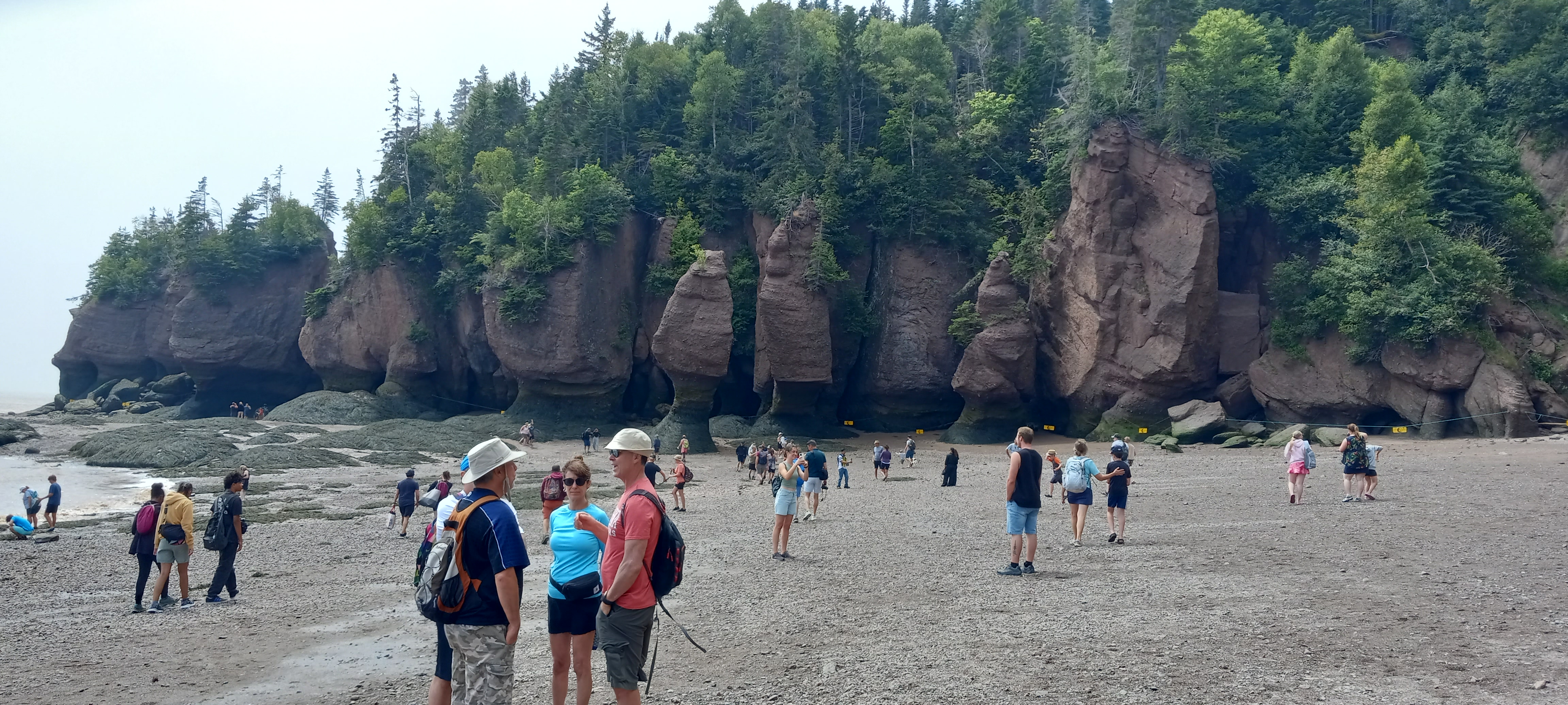
The world’s tidal cycles are very complicated and it has been on my bucket list to go the Bay of Fundy in Canada to see the world’s largest tidal shift (up to about 50 feet). I took my little travel trailer and spent 3 days on the coast of New Brunswick to see the highs and lows of the tide and to wander out on the coastal mud flats to see the shrimp that burrow down at low tide. Two of the best places I found to compare the tides were the St. Martins Sea Caves and Hopewell Rocks, also called Flowerpot Rocks because of the shape created by the erosion of the base of the sea stacks, as they are called. Most areas I visited didn’t allow walking on the mud flats as hoards of humans disturb the shrimp and the birds that feed on them.
The largest tides in the world are caused by two major factors, the first of which is the funnel effect. The bay is wider and deeper at the base than at the tip so as the 160 billion tons of water move into the bay it is forced into a tighter and shallower area and has no place to go but up. The other factor is the length of the bay. It is the perfect length to allow the tide to enter the bay, travel to the tip and back in about 12 hours and 26 minutes. This matches the time before the tidal cycle restarts so as one tide is just moving out the next one is moving in and they collide and amplify each other. This phenomenon is known as the seiche effect and acts like sloshing water in a bathtub.
The Delaware Bay is a prime spot for the spring mating of horseshoe crabs. Egg laying is at a peak at the highest of the high tides so at that time in May I traveled to Cape May to look around. This period matches exactly to when the Red Knot birds reach the bay during their annual migration. They fly non-stop from South America and land in New Jersey just as the horseshoe crabs are laying their eggs along the high tide line. They fill up on the protein rich eggs and gain enough weight and strength to continue northward to their breeding grounds.
I’d taught about this and worked for years on protecting the horseshoe crabs but had never actually gone to Cape May to see the crabs and birds. Well with some driving from beach to beach and with a little luck I did find a group of many hundreds of red knots feasting along the water’s edge. The beaches are roped off during this time of the year but most have a viewing area and I had the good fortune to be at one of them at the right time.
The moon’s tidal effects play a major role in the history of the earth’s development and life’s evolution and I feel good to have seen two of these up close.


 Amateur Astronomers Association of Princeton