
by Prasad Ganti
Our Sun holds our solar system together, including all the planets, the asteroid belt between Mars and Jupiter, and the Kuiper belt objects beyond all the known planets. The Sun’s influence is felt in terms of the radiation emitted, the solar wind, and its gravitational force. How far does its influence extend ?
As we go further away from the Sun, the planets are spaced further and further. The furthest planet Neptune is about 30 AU (Astronomical Units) from the Sun. 1 AU is the distance between the Sun and the Earth, about 93 million miles. AUs make us deal with small numbers to represent such astronomical distances. Beyond the known planets is the Kuiper belt, where Pluto and other objects live, is about 30-50 AU from the Sun.
The visible radiation emitted by the Sun becomes very pale in the Kuiper belt. Most of the Sun’s radiation is in the visible region of the electromagnetic spectrum. The Sun just looks like a bright star from such distances. It may not even be visible to the naked eye from elsewhere in our Milky way galaxy.
The Sun also emits charged particles called the solar wind. This wind is what disrupts the communication satellites and power grids on the Earth. Fortunately, the Earth’s magnetic field shields us from such wind. The solar wind travels further beyond the Kuiper belt. However it diminishes and slows down.
The place where the solar wind slows down considerably and begins to interact with the interstellar medium, or the space between the stars, is called the heliosheath. The first part of the heliosheath is called the termination shock, which is about 75-90 AU from the Sun. On the other side of Heliosheath is the Heliopause where the solar winds end and the interstellar winds take over. Heliopause is about 123 AU from the Sun. This is considered as the furthest point in our solar system.
Given below is the picture, courtesy Physics.org. The shape of the heliopause fluctuates and is influenced by a wind of interstellar gas which is caused by the Sun’s motion through space, as it orbits the center of our galaxy the Milky way. Hence the bow shape of Heliopause.
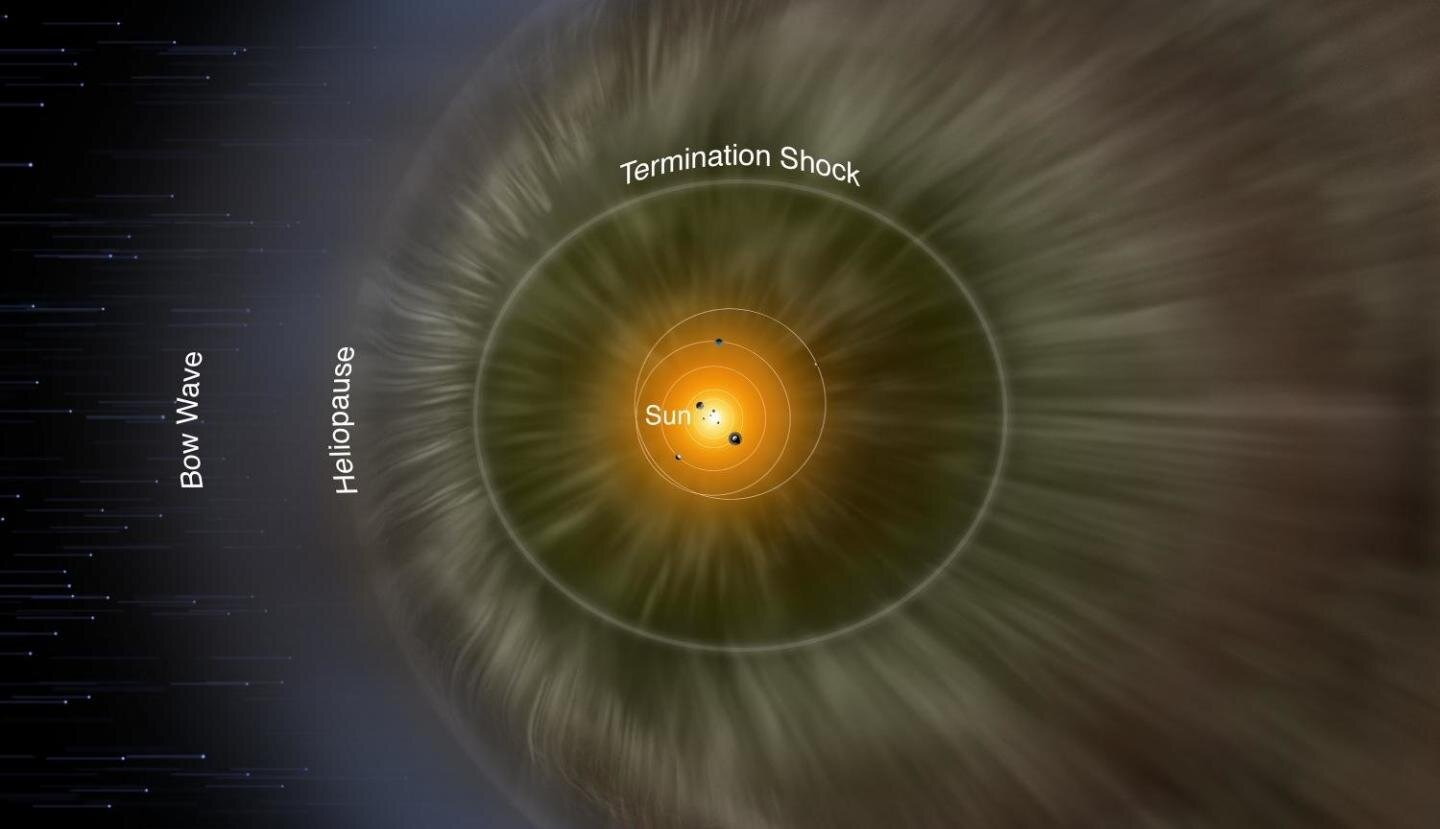
The NASA spacecraft Voyager 1 launched in 1977, crossed the termination shock in 2004. Its twin Voyager 2 did the same in 2007. Voyager 1 crossed the heliopause and entered interstellar space in 2012. Voyager did it in 2018. Another NASA spacecraft, New Horizons, which was launched earlier this century to explore the Kuiper belt object Pluto, is expected to cross the termination shock around 2030.
Beyond the Heliopause is the Oort cloud about 5000-100,000 AU from the Sun. It consists of icy objects. The Sun does exert some gravitation influence over these objects. But so do other nearby stars like Proxima Centauri. Our galaxy Milky way has some gravitational influence as well. Thus the Oort cloud can be considered to be outside of the Sun’s influence. Not within the City limits of the Sun, but a suburb!

 Amateur Astronomers Association of Princeton