
by Victor Davis, Program Chair
December Meeting
The December, 2024 meeting of the AAAP will take place in Peyton Hall on the campus of Princeton University on Tuesday, December 10th at 7:30 PM. As usual, the meeting is open to AAAP members and the public. Participants can join the meeting in-person at Peyton Hall or log in to the Zoom session as early as 7:00 pm to chat informally before the meeting begins. The evening’s guest speaker is Jessie Christiansen, Senior Scientist at NASA’s Exoplanet Science Institute, whose talk is entitled, “The Search for Earth 2.0: Why We Think It Exists, and How We’re Going to Find It.”
Options for Attending the Meeting
You may choose to attend the meeting in person or participate via Zoom or YouTube as we’ve been doing for the past few years. (See How to Participate below for details). Due to security concerns, if you log in before the host has set up internet connectivity in Peyton Hall, you may need to wait in the Waiting Room for a few minutes until the host is prepared to admit you into the meeting. You’ll need to unmute yourself to make comments or ask questions. It’s polite, though not required, for you to enable your camera so other participants can see you. A week or so after the meeting, the video of the lecture and Q&A will be posted on AAAP’s public YouTube channel.
The traditional “meet the speaker” dinner will be held at Winberie’s Restaurant & Bar, One Palmer Square, Princeton, NJ. Reservation is for 5:45 pm. Please advise the Program Chair if you plan to attend.
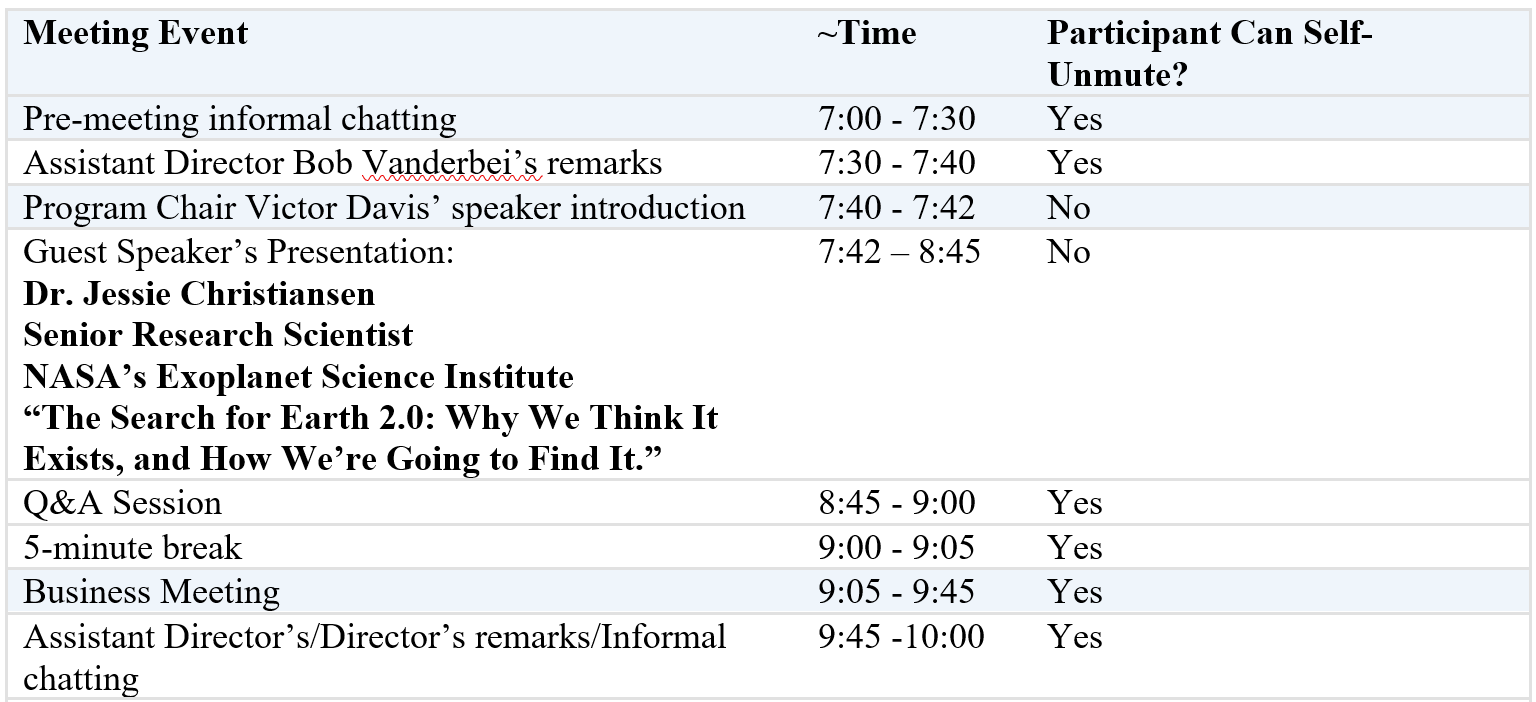
Here’s the anticipated agenda for December, 2024’s monthly meeting of the AAAP:
Getting to Peyton Hall
The parking lots across the street (Ivy Lane) from Peyton Hall are now construction sites, unavailable for parking. We’ve been advised by the administration of the astrophysics department that we should park in the new enclosed parking garage off Fitzrandolph street and walk around the stadium and athletic fields. Here’s a map of the campus and walking routes from the parking garage to Peyton Hall. The map shows the recently completed East Garage. Not shown is an access road Sweet Gum that connects from Faculty Road to an entrance at the lower left corner of the garage. Stadium Road connects from Fitzrandolph Road to another entrance at the opposite corner (and higher level) of the garage. It’s about a 10-15 minute walk from the parking garage to Peyton Hall.


Featured Speaker:
Jessie Christiansen
Chief Scientist,
NASA Exoplanet Science Institute
California Institute of Technology
christia@ipac.caltech.edu
“The Search for Earth 2.0: Why We Think It Exists,
and How We’re Going to Find It”
The Search for Earth 2.0: Why We Think It Exists, and How We’re Going to Find It.
For thousands of years, we’ve wondered if the Earth is unique, or if there are other Earths out there to find. In just the last 30 years, we’ve progressed from merely wondering if planets exist around other stars to knowing that almost every star we see has planets. Ambitious planet searches have been probing further and further, finding planetary systems of an incredible – and incredibly surprising! – variety. However, we have yet to discover another planet that might be like Earth – a rocky planet orbiting just the right distance from a Sun-like star to have liquid water on its surface. NASA has a audacious new plan for a next-generation flagship telescope that will directly image Earth-like planets around nearby stars, but it will take all of our ingenuity and technical prowess to achieve this incredible feat. Dr. Jessie Christiansen, Chief Scientist of NASA’s Exoplanet Science Institute, will walk us through the past, present, and future of our hunt for Earth 2.0.
Jessie Christiansen
Dr. Christiansen hails from Australia, and earned her PhD from the University of New South Wales. She’s been a Postdoctoral Research Fellow at the Center for Astrophysics, Harvard/Smithsonian, part of the Kepler science team at NASA’s Ames Research Center and the SETI Institute, and has been a Staff Scientist and now Senior Scientist at NASA’s Exoplanet Science Institute at Caltech. She’s Project Scientist of the NASA Exoplanet Science Archive. Dr. Christiansen has won numerous awards for scholarship and exceptional science and engineering achievement. She’s published extensively in research topics related to the detection and characterization of exoplanets and their atmospheres. Dr. Christiansen is committed to supporting diversity in science and mentors children and women in the areas of science, technology, engineering, and mathematics. She’s a frequent explainer of science at professional colloquia, to the public, and on broadcast media.
How to Participate (Links)


Click the above icons for Zoom and YouTube
Zoom Meeting ID: 830 6908 5296 and
Passcode: 812904
| Date | Featured Speaker | Topic | |
| January 12, 2025 | Rebecca Boyle rebecca.b.boyle@gmail.com  | Rebecca Boyle, science writer, essayist, and Contributing Editor to Scientific American, will discuss her new book, “Our Moon: How Earth’s Celestial Companion Transformed the Planet, Guided Evolution, and Made Us Who We Are.” Suggested by Ira Polans. |
As always, members’ comments and suggestions are gratefully accepted and much appreciated.
victor.davis@verizon.net
program@princetonastronomers
(908) 581-1780 cell

 Amateur Astronomers Association of Princeton