
compiled by Arlene & David Kaplan

Moon craters with NASA’s Shadowcam When a NASA spacecraft passes over Shackleton Crater on the moon and peers in, it sees this: a sea of blackness and nothing more. This 13-mile-wide crater lies close to the moon’s south pole. Here, the sun never rises high above the horizon, and the rim of Shackleton blocks the sun’s rays from ever shining directly onto the crater floor…more
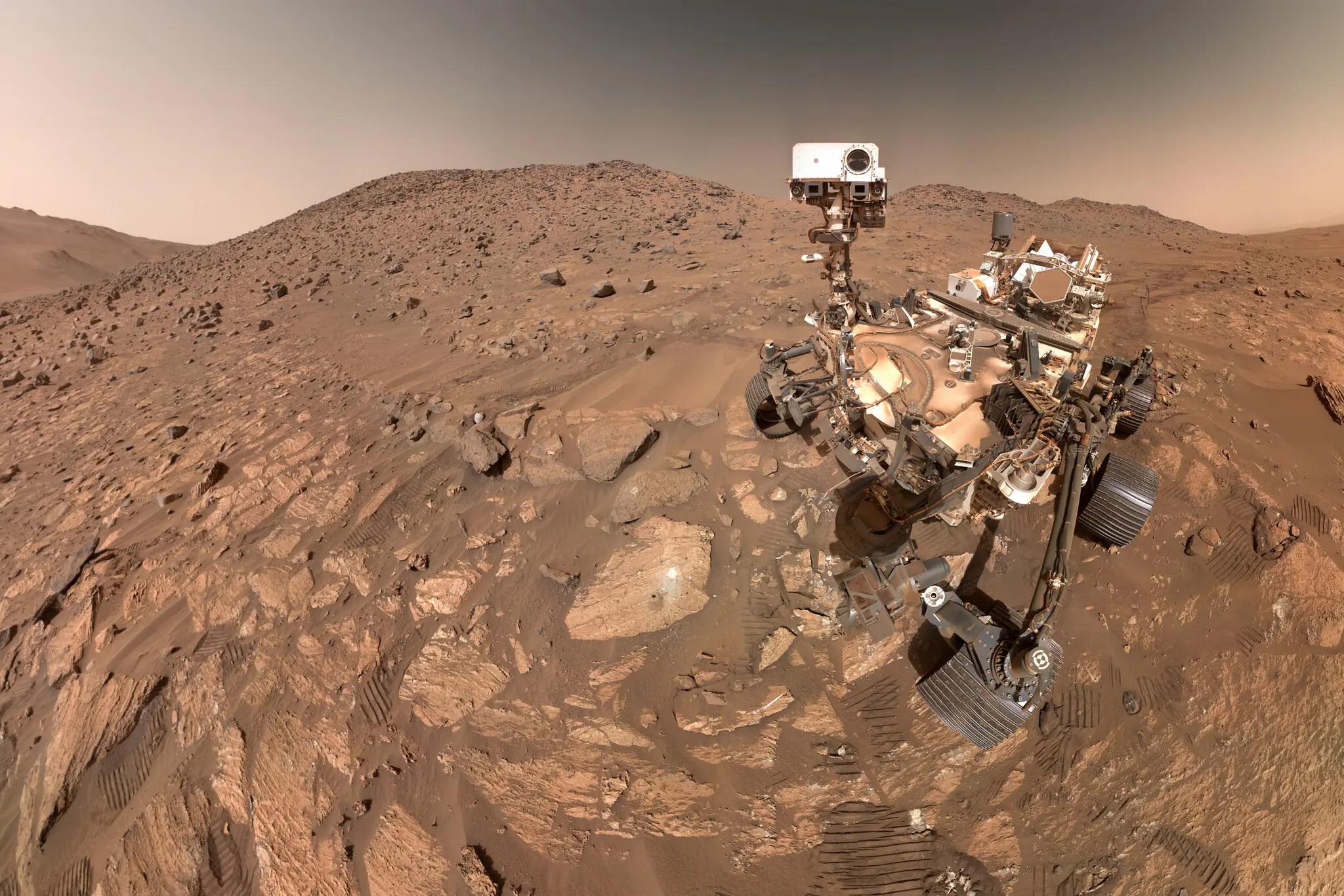
NASA Did Not Say It Found Life on Mars. But It’s Very Excited About This Rock. The rock, studied by NASA’s Perseverance rover, has been closely analyzed by scientists on Earth who say that nonmicrobial processes could also explain its features. The rover has drilled and stashed a piece of the rock, which scientists hope can be brought back to Earth…more
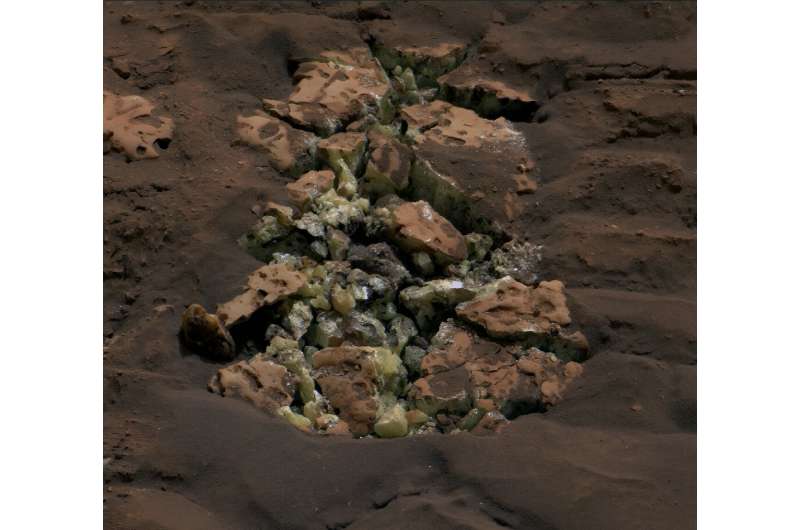
NASA’s Curiosity rover discovers a surprise in a Martian rock Scientists were stunned on May 30 when a rock that NASA’s Curiosity Mars rover drove over cracked open to reveal something never seen before on the Red Planet: yellow sulfur crystals. While people associate sulfur with the odor from rotten eggs (the result of hydrogen sulfide gas), elemental sulfur is odorless…more
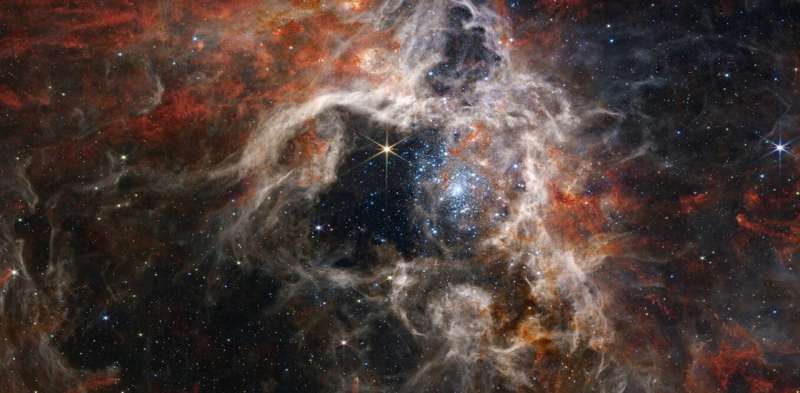
The Higgs particle could have ended the universe by now—here’s why we’re still here Although our universe may seem stable, having existed for a whopping 13.7 billion years, several experiments suggest that it is at risk—walking on the edge of a very dangerous cliff. And it’s all down to the instability of a single fundamental particle: the Higgs boson…more
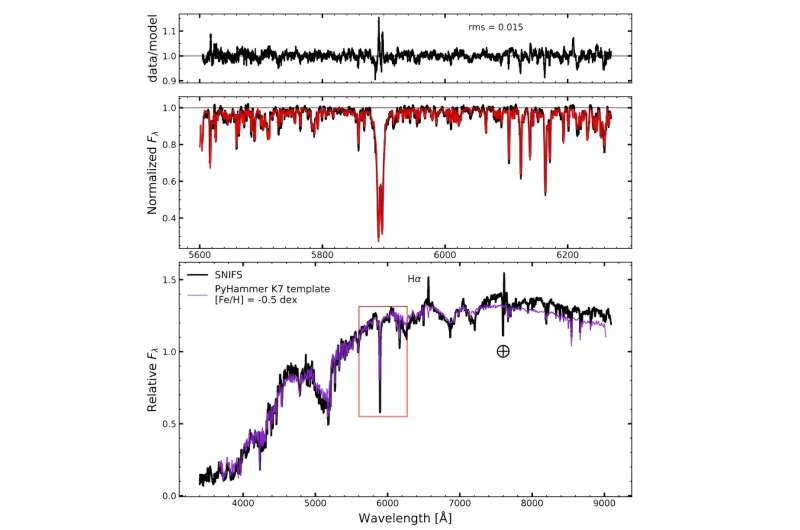
LAMOST J2354 binary hosts an unseen massive white dwarf, study suggests Astronomers from the Ohio State University (OSU) and University of Hawai’i have performed spectroscopic observations of a recently-discovered binary system known as LAMOST J2354, which contains a dark companion star. Results of the observational campaign, presented July 26 on the pre-print server arXiv, suggest that the unseen object is a massive white dwarf…more

Cosmic microwave background experiments could probe connection between cosmic inflation, particle physics Various large-scale astrophysical research projects are set to take place over the next decade, several of which are so-called cosmic microwave background (CMB) experiments. These are large-scale scientific efforts aimed at detecting and studying…more

NASA Science, Cargo Launch on 21st Northrop Grumman Mission to Station Northrop Grumman’s Cygnus spacecraft for the company’s 21st commercial resupply services mission for NASA launched on a SpaceX Falcon 9 rocket from Space Launch Complex 40 at Cape Canaveral Space Force Station in Florida. New scientific experiments and cargo for the agency are bound for the International Space Station…more
NASA Invites Media, Public to Attend Deep Space Food Challenge Finale NASA invites the media and public to explore the nexus of space and food innovation at the agency’s Deep Space Food Challenge symposium and winners’ announcement at the Nationwide and Ohio Farm Bureau 4-H Center in Columbus, Ohio, on Friday, Aug. 16. In 2019, NASA and the CSA (Canadian Space Agency) started the Deep Space Food Challenge, a multi-year international effort…more

Astronomers discover new supergiant-rich stellar cluster Astronomers report the discovery of a new galactic stellar cluster located some 24,000 light years away. The newfound cluster, which received the designation Barbá 2, turns out to host at least several supergiant stars. In general, star clusters are groups of stars sharing a common origin and gravitationally bound…more

Earth’s ‘evil twin’ Venus may have mirrored our planet more than expected New research may have brought Earth and its inhospitable, “evil twin” even closer together. Today, Venus seems to lack the tectonic activity seen on Earth, but surface features like faults, folds and volcanoes indicate the hellish planet — with intense temperatures hot enough to melt lead and fearsome surface pressures — was once tectonically active…more

Watch These Supernovas Explode Across Time “The past is never dead,” William Faulkner once wrote. “It’s not even past.” Nobody knows this better than astronomers. Everything that has ever happened in the history of the universe has left a mark on the sky; with the right technology, much of it is now decipherable…more

 Amateur Astronomers Association of Princeton