
by Victor Davis, Program Chair
Autumn at Peyton Hall
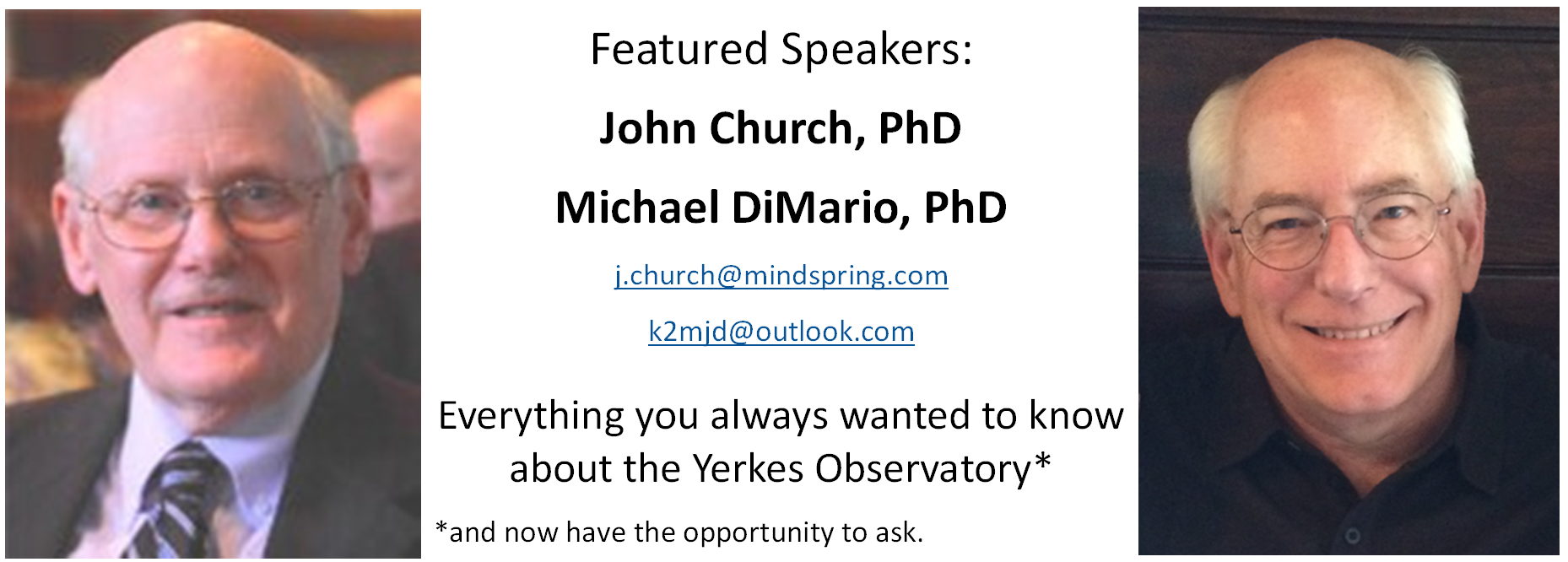
The October, 2023 meeting of the AAAP will take place in Peyton Hall on Tuesday, October 10th at 7:30 PM. As usual, the meeting is open to AAAP members and the public. Participants can join the meeting in-person at Peyton Hall or log in to the Zoom session as early as 7:00 pm to chat informally before the meeting begins. This evening’s guest speakers are AAAP members John Church and Michael DiMario. John will discuss the optical design of the famed Yerkes refractor, still the largest refracting telescope in existence. Michael will discuss the history of the observatory from its conception in 1892 to its recent revitalization.
Options for Attending the October Meeting
You may choose to attend the meeting in person or participate via Zoom or YouTube as we’ve been doing for the past few years. (See How to Participate below for details). Due to security concerns, if you log in before the host has set up internet connectivity in Peyton Hall, you may need to wait in the Waiting Room for a few minutes until the host is prepared to admit you into the meeting. You’ll need to unmute yourself to make comments or ask questions. It’s polite, though not required, for you to enable your camera so other participants can see you.
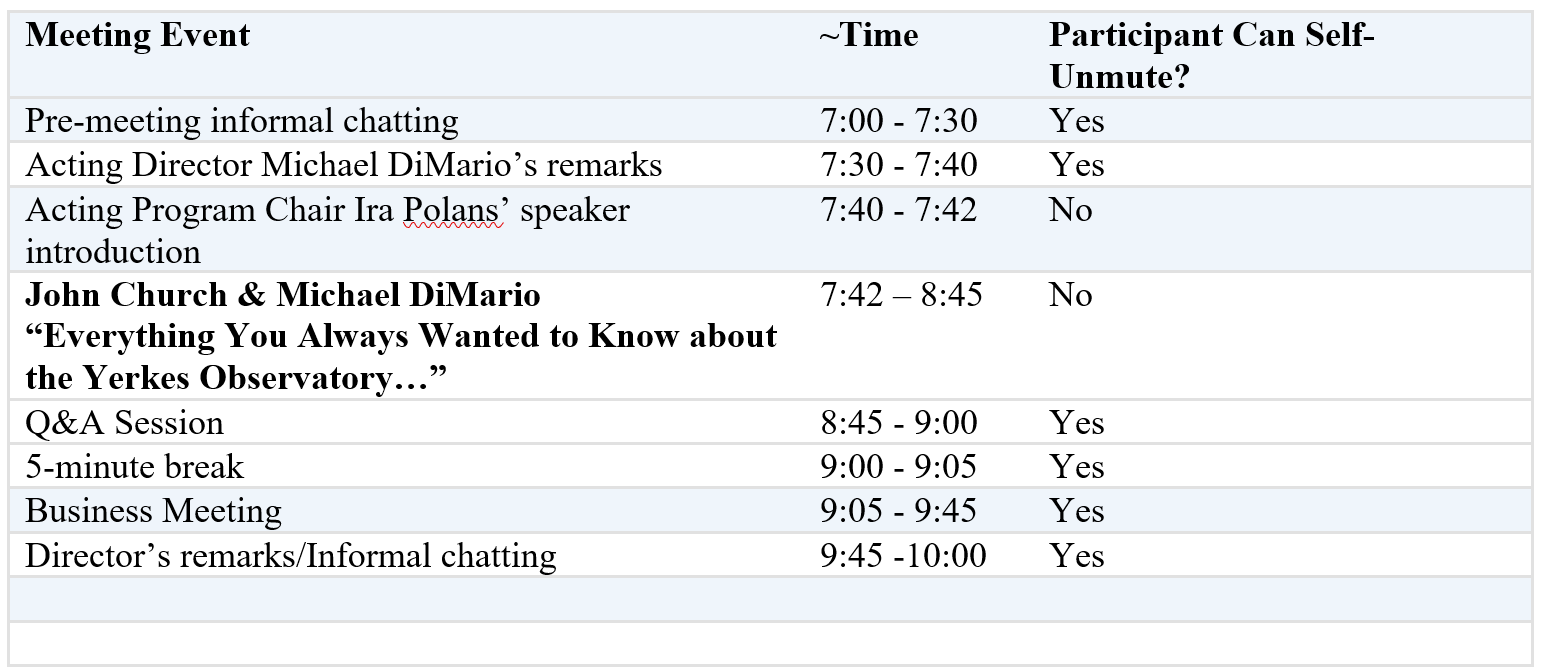
Here’s the anticipated agenda for October’s monthly meeting of the AAAP:
“Meet the Speakers” at Winberie’s
Members are invited to attend the “Meet the Speaker” dinner at Winberie’s Bar and Restaurant before the meeting. Our reservation is for 5:45 pm. Please contact Acting Program Chair Ira Polans if you plan to attend.
Winberie’s Bar and Restaurant
1 Palmer Square E
Princeton, NJ
(609) 921-0700 princeton.winberies.com
Ira Polans, ipolans@princetonastronomy.org
Getting to Peyton Hall
The parking lots across the street (Ivy Lane) from Peyton Hall are now construction sites, unavailable for parking. We’ve been advised by the administration of the astrophysics department that we should park in the new enclosed parking garage off Fitzrandolph street and walk around the stadium and athletic fields. Here’s a map of the campus and walking routes from the parking garage to Peyton Hall. The map shows the recently completed East Garage. Not shown is an access road Sweet Gum that connects from Faculty Road to an entrance at the lower left corner of the garage. Stadium Road connects from Fitzrandolph Road to another entrance at the opposite corner (and higher level) of the garage. It’s about a 10-15 minute walk from the parking garage to Peyton Hall.

Optical Design and Characteristics of the Yerkes 40-inch Refractor
John will discuss the paths taken and not taken with the famed Yerkes 40-inch refractor; its basic optical design and what is known about the refractive indices and radii of its crown and flint elements. Building on a 1982 article he wrote for Sky and Telescope, Dr. Church will cover the various aberrations that can be deduced from the available data as well as those that would result from alternate radii that might have been used. He will also discuss how the objective’s performance would be affected by minor changes in the spacing of the lens elements. He’ll conclude by contrasting the design philosophies between the Yerkes Alvan Clark refractor and AAAP’s own Hastings 6 ¼ inch refractor.
John Church, PhD
A native of Richmond, John Church graduated from the University of Virginia with a bachelor’s degree in chemistry and then earned M.S. and Ph.D. degrees from Lawrence University in Appleton, Wisconsin. His thesis work was concerned with the reaction of crystalline carbohydrate derivatives with oxygen under relatively mild conditions. He spent his career in research and development with American Can Company at their Corporate R&D laboratory in Princeton and then with Colgate-Palmolive at their Corporate Research Center in Piscataway. He is now retired.
John is the author of sixteen scientific, historical, and technical publications, including several on the optics of refracting telescopes as well as one on close conjunctions of Jupiter and Saturn. He holds ten U.S. patents and is the author of a book chapter on the chemistry of bleach. He has written three books and edited several others. One of his Sky & Telescope articles traced the history of the 6 ¼ inch Hastings-Byrne refractor now installed in our observatory in Washington Crossing State Park, which he and many others helped build in the late 1970’s.
John has served as Assistant Director, Director, and Program Chair of the AAAP. This September will mark his 53rd year as a club member. His civic activities include presently serving on the West Windsor Township Zoning Board of Adjustment. He is married and has three children and six grandchildren.
The History and Revitalization of Yerkes Observatory
Mike will present the early history of the Yerkes Observatory from its construction in 1892 through two revitalizations in 1932 and 2020. He will describe the technologies used at its beginning and those still in use today. He’ll recount the use of the Edison dynamo the 15 ton observatory floor collapse 1n 1897, and give an overview of the present-day telescopes in three of the observatory’s domes.
Michael DiMario, PhD
Dr. DiMario is the founder and CEO of Astrum Systems, a global consulting venture focused on employing systems engineering methodologies in early research and development. Dr. DiMario holds an MBA in Management of Technology, an MS in Computer Engineering, and a PhD in Systems Engineering. He has completed significant course work in Space Science. Michael’s corporate career began at General Electric Medical. He served in several executive engineering roles at Bell Laboratories/Lucent Technologies, and at Lockheed Martin, from which he recently retired.
Dr. DiMario also operates a blog highlighting large university-based observatories including solar and radio-frequency telescopes. He has been granted five patents, is credited with numerous trade secrets, published a book and contributed a book chapter on systems engineering, and has written more than forty peer-reviewed papers on quantum magnetometry, systems engineering, and quality management. He has been interviewed by magazines including Wired, GPS World, Sifted, and Financial Times. He co-chairs the INCOSE Early Systems Engineering and Research Working Group, and leads AAAP’s astroimaging Special Interest Group. He holds an amateur radio Extra class license, call sign K2MJD.
How to Participate
Zoom Amateur Astronomers Association of Princeton is inviting you to a scheduled Zoom meeting.
AAAP-October 2023 Meeting-John Church & Michael DiMario-The Yerkes Observatory and the 40-inch Refractor
Topic: AAAP-October 2023 Meeting-John Church & Michael DiMario-The Yerkes Observatory and the 40-inch Refractor
Time: Oct. 10, 2023 07:00 PM Eastern Time (US and Canada)
Join Zoom Meeting
https://us06web.zoom.us/j/85600238601?pwd=rLUESl9xxZVopM9HvX3WhIUeamZqK4.1
Meeting ID: 856 0023 8601
Passcode: 559172
AAAP webcast: This month’s AAAP meeting, beginning with Rex’s opening remarks and ending at the beginning of the business meeting, will be webcast live on YouTube and recorded for subsequent public access on AAAP’s YouTube channel. Be aware that your interactions during this segment, including questions to our guest speaker, may be recorded for posterity.
Join YouTube Live to listen to the speaker using the link below –


A look ahead at future guest speakers:
| November 14, 2023 | Dr. Gary Rendsburg Distinguished Professor of Jewish Studies and History at Rutgers  | Prof. Rendsburg will talk about “The Jewish Calendar,” with emphasis on its astronomical connections to lunar months, intercalated month to adjust to the solar year, festival days, and new moon observances. Suggested by Ira Polans. Also, AAAP member Peter Wraight will show and discuss his 3D printed binoscope designs for which he won two awards for Mechanical Design at last year’s Stellafane convention. | |
| December 12, 2023 | Dr. Mario Motta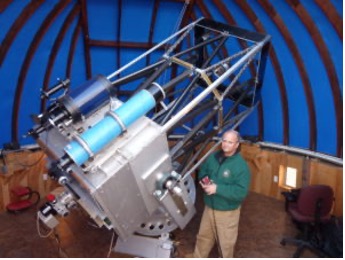 | Dr. Motta is a cardiologist and past president of AAVSO who uses his home-built 32” telescope to image various objects and to study variable stars. He will talk about building his telescope and the observations he makes with it. He would join the meeting via Zoom. Suggested by Michael DiMario. | |
| January 9 2024 | Erika Hoffman Graduate student, University of Maryland ebhoff@umd.edu | Erika will describe her research using high-resolution x-ray spectroscopy to investigate ionized outflows from active galactic nuclei (AGNs). Suggested by Bill Thomas. | |
| February 13 2024 | TBA | ||
| March 12 2024 | TBA | ||
| April 9 2024 | Eclipse Observations | Since this meeting will take place the day after the Total Solar Eclipse of 08 April 2024, and many members will be out of town or returning from their trips, I’m suggesting that we host an online roundup of eclipse observations, with members (and perhaps others) Zooming in to share their experiences. | |
| May 14 2024 | Dr. Tea Temim Research Astronomer, Princeton University Department of Astrophysics | Dr. Temim will describe her research using JWST imagery to study supernova remnants. Suggested by Gene Allen. temim@astro.princeton.edu | |
| June 11 2024 | NJ State Museum planetarium’s Bill Murray, and Jacob Hamer, Assistant Curator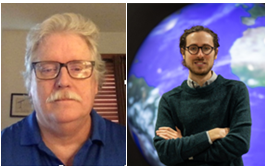 | AAAP’s traditional annual pilgrimage to the NJ State Museum planetarium in Trenton, where members will experience a presentation and a preview of the planetarium’s latest sky show. |
As always, members’ comments and suggestions are gratefully accepted and much appreciated.
victor.davis@verizon.net
program@princetonastronomy.org
(908) 581-1780 cell
The Out-of-Towners Just a note to let you know that Director Rex Parker and Program Chair Victor Davis will be out of the country in October, visiting different hemispheres. Michael DiMario has agreed to be Acting Director for the October meeting, and Ira Polans has agreed to be Acting Program Chair. Many thanks to each of them for stepping up so Rex and I can go gallivanting without worries.
“Exoplanets: Science and Science Fiction” Now a Book!
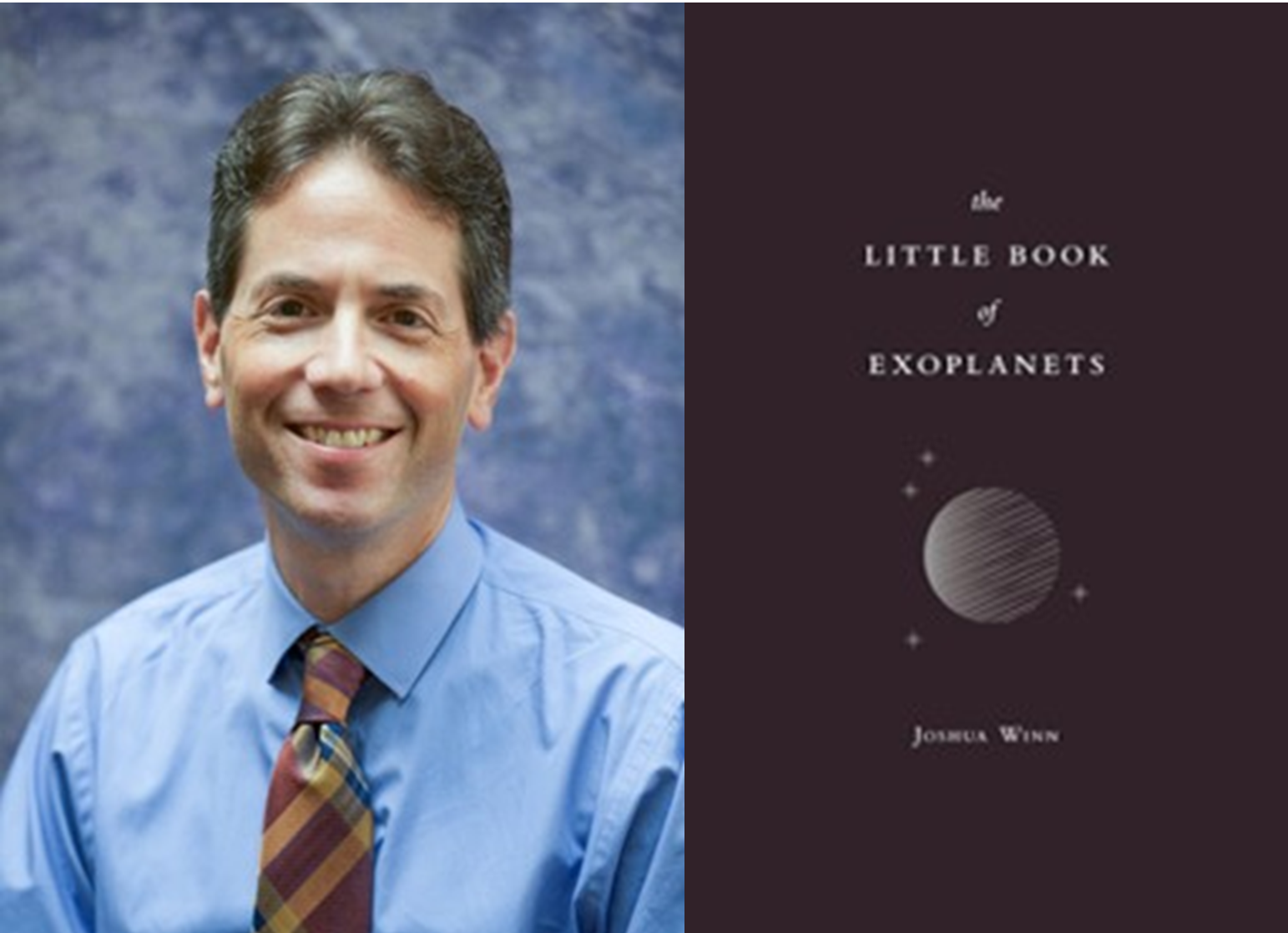
Princeton astrophysicist Prof. Joshua N. Winn, AAAP’s guest speaker last December, has written a book based closely on his presentation to us. The book, “The Little Book of Exoplanets,” is written for the general public. The book describes what we know about exoplanets and how we know what we know about them.
The publisher’s link is:
https://princeton.edu/books/hardcover/9780691215471/the-little-book-of-exoplanets

 Amateur Astronomers Association of Princeton