
by S. Prasad Ganti
For the Indian moon bound spacecraft, Chandrayaan 3 (meaning moon craft), the second time was a charm. Twenty minutes of terror while hundreds of millions of people waited with baited breath. It touched down softly in the southern hemisphere closer to the pole. Coming on the heels of a disastrous crash in 2019, this was an excellent comeback. I would like to cover the journey including the improvements from its predecessor, and then the science which the mission set out to accomplish. Finally the future trends.
Firstly, the journey in space is vastly different from terrestrial movements. The spacecraft including the propulsion unit, the Vikram lander (named for India’s space pioneer Vikram Sarabhai) and Pragyaan rover (meaning “wisdom” in Sanskrit) was launched into space using a GSLV (Geostationary Space Launch Vehicle) Mark III rocket. Thereafter it took a longer fuel saving route covering about forty days before it landed on the moon.
The longer route is also due to the power of the launcher. GSLV Mark III, although the most powerful in ISRO’s (Indian Space Research Organization) arsenal, it does not have the punch to hurl the spacecraft to the moon on a direct trajectory which could take a lot less time. As a result, the spacecraft orbited the Earth several times, with a fuel burning boost elongating the ellipse in each iteration. In the final boost, the spacecraft was sent towards the moon. The reverse process happened closer to the moon, to slow down the spacecraft to get caught by the moon’s gravity. The picture below, courtesy ISRO, shows the path taken.
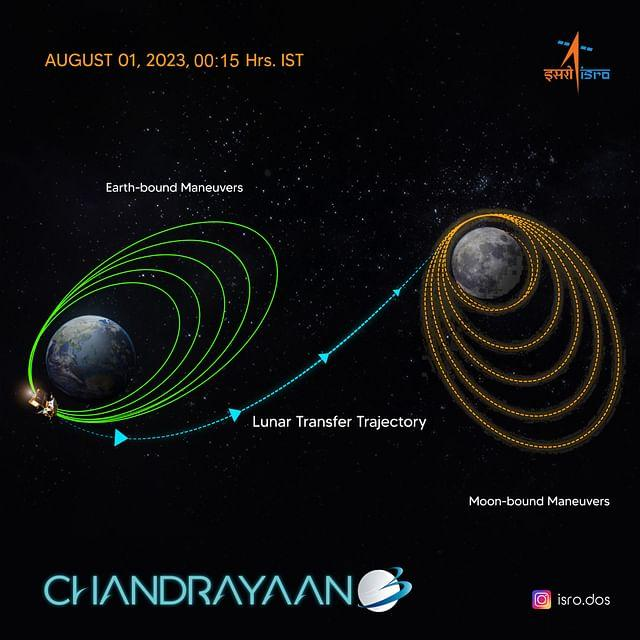
This is similar to a hammer thrower in Olympic games. The hammer is tied to a string. The athlete holds one end of the string and turns around and around. With each turn, the hammer gains momentum. Once the hammer gains significant momentum, the string is let go. The hammer travels and drops at some distance due to gravity.
Before we cover the landing phase, let us see how Chandrayaan 3 is different from its predecessor Chandrayaan 2. The earlier disaster was studied extensively. Multiple engines on the lander were designed to have better coordination in terms of shutting off at different times. The landing legs were made stronger to withstand tougher landings. The AI-driven sensors played an important role in ensuring a secure touchdown on the lunar surface. They helped the lander to anticipate lunar topography and deal with it accordingly. The array of sensors consists of velocimeters (measure the speed with which the surface is approaching) and altimeters (measure the height above the surface) to accurately study the position of the lander with respect to the lunar surface. While a suite of cameras using the advanced computer algorithms to generate a comprehensive image of the lunar surface which was coming up during the landing phase.
The spacecraft utilized an automated landing sequence in its final 20 mins of the journey. No remote human intervention would have been possible anyway. It covered about 500 miles during this phase with an altitude loss of about 20 miles. In a controlled fashion it went through four phases – rough braking, attitude stabilization, fine braking and finally local navigation using its sensors and intelligence. It was like an aircraft making a perfect landing without any pilots. Except that there was a rocky terrain instead of a smooth runway.
The landing site was in the southern hemisphere closer to the pole, something akin to the Antarctic circle on the Earth. All the earlier landings took place closer to the equator where the surface is relatively smoother. India became the fourth nation (after the US, China and the erstwhile Soviet Union) to make a soft landing on the lunar surface. And the first in the southern hemisphere’s rough terrain.
Now the science. The AI algorithms which guided the spacecraft to a smooth landing will also guide the rover on the rough surface and also in optimizing its route. AI will also help in analyzing the data collected by the mission during its 2 week lifetime. The instruments and the spacecraft are expected to work only during one lunar day, which is two weeks of Earth’s days and nights. After the lunar day, the cold of the lunar night is expected to render the equipment lifeless.
The rover basically has two spectroscopes – one called the Alpha particle X-ray Spectrometer (APXS) and the Laser Induced Breakdown Spectroscope (LIBS). Both of them will be used to study the composition of the soil and the rocks. They approach the problem differently. APXS uses alpha particles to bombard the sample and study the resulting emissions. LIBS will melt the sample using the laser beams and study the resulting gases. The rover will specifically look for the elements magnesium, aluminum, silicon, potassium, calcium, titanium, and iron.
The interest in the southern hemisphere and poles is due to the findings of water and ice in significant quantities. They can be used to produce hydrogen and oxygen via electrolysis to power spacecraft from there. The Moon is expected to become a base for such pit stops in the future.
Landing in the southern hemisphere has been a great challenge. It has become a graveyard for several spacecraft including Chandrayaan 2. Just a few days before the landing of Chandrayaan 3, the Russian
spacecraft Luna 25 crashed. Regardless of the geopolitics, it is bad for science and engineering and humanity as a whole. But we are learning as we go along.
Also, a word of appreciation for the folks who made this mission possible. Most of these people are from the second string of educational institutions in India, working on a shoestring budget from a third world government to get the biggest bang for the buck. The ones from elite educational institutions, including yours truly, have sought greener pastures elsewhere and are tending to terrestrial matters. I cannot be more thankful and appreciative of the people who achieved the lofty goals.
The future bodes well for Indian space missions and others. The GSLV launcher is being beefed up with a powerful SCE (Semi Cryogenic Engine) second stage. The private sector investments are picking up steam to supplement the meager government budgets. And, AI will play an increasingly important role in all future international space missions.

 Amateur Astronomers Association of Princeton