
by Victor Davis, Program Chair
Welcome to a New Academic Year at Peyton Hall
The September, 2023 meeting of the AAAP will take place in Peyton Hall on Tuesday, September 12th at 7:30 PM. As usual, the meeting is open to AAAP members and the public. Participants can enter Peyton Hall or log in to the Zoom session as early as 7:00 pm to chat informally before the meeting begins. This evening’s guest speaker is Prof. Suzanne T. Staggs of Princeton University whose presentation is entitled “Looking Backwards with the Cosmic Microwave Background.”
Options for Attending the September Meeting
You may choose to attend the meeting in person or participate via Zoom or YouTube as we’ve been doing for the past few years. (See How to Participate below for details). Members are invited to attend the “Meet the Speaker” dinner at Winberie’s Bar and Restaurant before the meeting. Our reservation is for 5:45 pm. Please contact the Program Chair if you plan to attend.
Winberie’s Bar and Restaurant
1 Palmer Square E
Princeton, NJ
(609) 921-0700
princeton.winberies.com
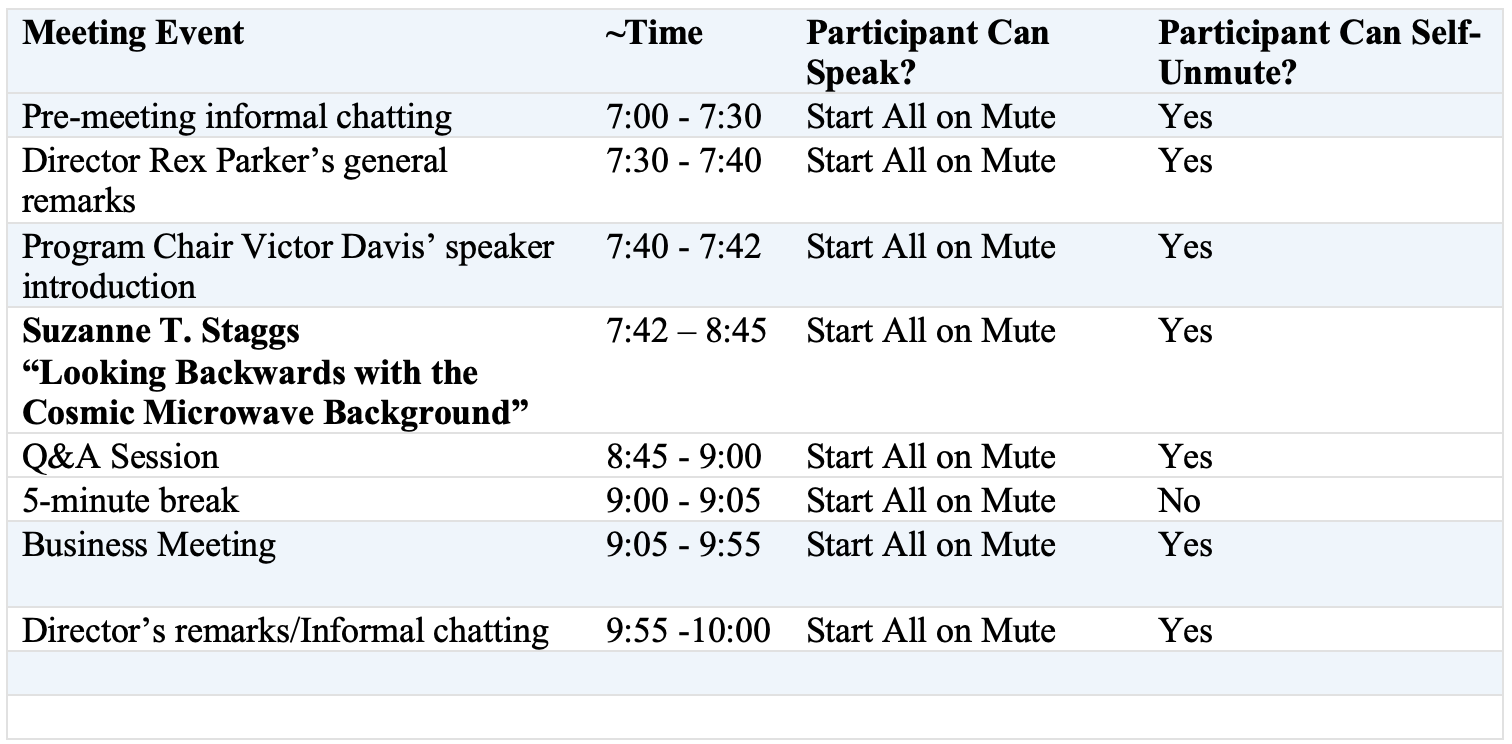
Here is the anticipated agenda for September’s monthly meeting of the AAAP:
Getting to Peyton Hall
The parking lots across the street (Ivy Lane) from Peyton Hall are now construction sites, unavailable for parking. We’ve been advised by the administration of the astrophysics department that we should park in the new enclosed parking garage off Fitzrandolph street and walk around the stadium and athletic fields. Here’s a map of the campus and walking routes from the parking garage to Peyton Hall. The map shows the recently completed East Garage. Not shown is an access road Sweet Gum that connects from Faculty Road to an entrance at the lower left corner of the garage. Stadium Road connects from Fitzrandolph Road to another entrance at the opposite corner (and higher level) of the garage. It’s about a 10-15 minute walk from the parking garage to Peyton Hall.


Featured Speaker: Suzanne T. Staggs
Henry DeWolf Smyth Professor of Physics
Princeton University
staggs@princeton.edu
Looking Backwards with the Cosmic Microwave Background
The cosmic microwave background (CMB) emanates from a brilliant plasma that suffused the universe in its first moments. Since the first deliberate measurements of the radiation comprising the CMB in the mid-60s, our capacity to detect and decode its cosmological signatures has increased remarkably. Prof. Staggs will describe the way the CMB encodes information about not only the large-scale dynamics and structure of the universe, but also about its earliest instants and its likely future. To study the largest length scales in the universe, researchers use thousands and thousands of tiny thermometers which measure the fluctuations in the heat delivered by the CMB, and special-purpose telescopes located in some of the most extreme environments on and above the surface of the earth. After describing some of this instrumentation, Prof. Staggs will conclude by discussing future prospects for even more knowledge she and her research team intend to pry from the CMB.
Suzanne T. Staggs
Suzanne Staggs received her undergraduate degree in physics from Rice University and her PhD in physics from Princeton University. Her thesis advisor was David Wilkinson, one of the leaders of the eponymous Wilkinson Microwave Anisotropy Probe (WMAP) satellite. After two years as a Hubble Fellow at the University of Chicago, she joined the faculty at Princeton, where she is currently the Henry DeWolf Smyth Professor of Physics. She is the current Principal Investigator (PI) of the Atacama Cosmology Telescope (ACT), co-director of the Simons Observatory, an American Physical Society fellow, a member of the National Academy of Science and a member of the American Academy of Arts and Sciences. Her research focus is the experimental study of the cosmic microwave background (CMB) radiation, including precise measurements of its electromagnetic spectrum and thus its blackbody temperature, and exploration of its polarization properties and fine-scale angular anisotropies. Her present CMB work focuses on searching for the signature in the CMB polarization of gravity waves from an inflationary epoch in the primordial universe, and in using the CMB as a backlight to probe the growth of gravitationally-bound structures in the last thirteen billion years. This growth depends on such fundamental quantities as the nature of dark energy, and the mass of the neutrino.
How to Participate
Zoom Amateur Astronomers Association of Princeton is inviting you to a scheduled Zoom meeting.
Topic: AAAP-September 2203 Meeting-Prof. Suzanne T. Staggs, Princeton University, “Looking Backwards with the Cosmic Microwave Background.”
Time: Sep 12, 2023 07:00 PM Eastern Time (US and Canada)
Join Zoom Meeting
https://us06web.zoom.us/j/89855483876?pwd=VWxxTk41Mmtlbk0vdTVNRkdxWXMzZz09
Meeting ID: 898 5548 3876
Passcode: 994729
AAAP webcast: This month’s AAAP meeting, beginning with Rex’s opening remarks and ending at the beginning of the business meeting, will be webcast live on YouTube and recorded for subsequent public access on AAAP’s YouTube channel. Be aware that your interactions during this segment, including questions to our guest speaker, may be recorded for posterity.
Join YouTube Live to listen to the speaker using the link below –

 AAAP Sept Meeting, Prof Suzanne T. Staggs , Looking Backwards with the Cosmic Microwave Background
A look ahead at future guest speakers:
| October 10, 2023 | AAAP members John Church and Michael DiMario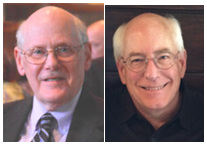 | John and Michael will talk about the efforts to restore the historic Yerkes Observatory and the optics of the famed 40-inch refractor, still the world’s largest refracting telescope | |
| November 14, 2023 | Dr. Gary Rendsburg Distinguished Professor of Jewish Studies and History at Rutgers  | Prof. Rendsburg will talk about “The Jewish Calendar,” with emphasis on its astronomical connections to lunar months, intercalated month to adjust to the solar year, festival days, and new moon observances. Suggested by Ira Polans. Also, AAAP member Peter Wraight will show and discuss his 3D printed binoscope designs for which he won two awards for Mechanical Design at last year’s Stellafane convention. | |
| December 12, 2023 | Dr. Mario Motta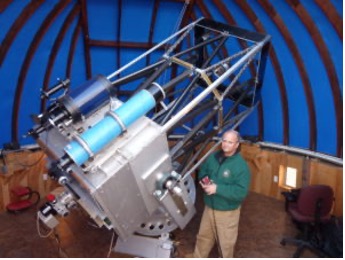 | Dr. Motta is a cardiologist and past president of AAVSO who uses his home-built 32” telescope to image various objects and to study variable stars. He will talk about building his telescope and the observations he makes with it. He would join the meeting via Zoom. Suggested by Michael DiMario. | |
| January 9 2024 | Erika Hoffman Graduate student, University of Maryland ebhoff@umd.edu | Erika will describe her research using high-resolution x-ray spectroscopy to investigate ionized outflows from active galactic nuclei (AGNs). Suggested by Bill Thomas. | |
| February 13 2024 | TBA | ||
| March 12 2024 | TBA | ||
| April 9 2024 | Eclipse Observations | Since this meeting will take place the day after the Total Solar Eclipse of 08 April 2024, and many members will be out of town or returning from their trips, I’m suggesting that we host an online roundup of eclipse observations, with members (and perhaps others) Zooming in to share their experiences. | |
| May 14 2024 | Dr. Tea Temim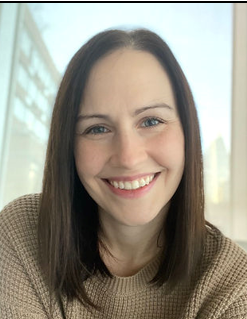 Research Astronomer, Princeton University Department of Astrophysics | Dr. Temim will describe her research using JWST imagery to study supernova remnants. Suggested by Gene Allen. temim@astro.princeton.edu | |
| June 11 2024 | NJ State Museum planetarium’s Bill Murray, and Jacob Hamer, Assistant Curator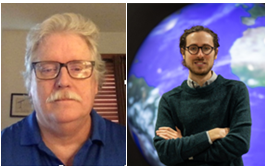 | AAAP’s traditional annual pilgrimage to the NJ State Museum planetarium in Trenton, where members will experience a presentation and a preview of the planetarium’s latest sky show. |
As always, members’ comments and suggestions are gratefully accepted and much appreciated.

 Amateur Astronomers Association of Princeton