

by Rex Parker, PhD director@princetonastronomers.org
Sublime Joys of Summer Stargazing. Here in the Princeton area we’ve been spared much of the extreme heat and stalled weather patterns that have been baking parts of the US this summer. But our telescopes have spent more nights indoors than out with the cloudy, rainy, and smokey skies we’ve tolerated. So when a clear night sky eventually does coms around, don’t miss out! The AAAP Observatory in Washington Crossing will be ready for action. Our rules of operation enable member access to the observatory any time a trained Keyholder is present. You can email me or the observatory chair or call the Observatory phone (609-737-2575) to see if it is open on any given clear night (beyond regular Friday night open house events. Hopefully the huge forest fires in Canada will be quenched by rains as summer goes on. Meanwhile I’m keeping an eye on forecasts to try to get some observing and imaging time whenever the skies do clear out.
Another AAAP Observing Challenge! — Perseid Meteor Shower Could Be Unusually Good. The earth in its solar orbit has already transected the orbit of the comet responsible for the Perseid meteor shower, comet 109P/Swift-Tuttle. Meteors from the “shower” radiating from the constellation Perseus may be visible under good observing conditions in central NJ from now through around August 24, with peak around August 13. Moon brightness is probably the biggest factor in being able to see meteors, and this time around the moon will be in a favorable waning crescent phase in the nights leading up to August 13. Let’s call this another AAAP observer challenge: see how many Perseid meteors you can see and count, and report your count at the first AAAP meeting of the season on Sept 12 at Peyton Hall.
Amateur Astronomer Discovered the Supernova in M101. The impressive supernova in the spiral galaxy Messier 101 is among the closest core-collapse supernovae (Type II) discovered in the past several decades. Japanese amateur and famed supernova hunter Koichi Itagaki has been credited with its the discovery on May 19 2023. Named SN2023ixf, the M101 supernova was confirmed by professionals at Palomar the next day. A recent article in Science describes the amazing lifestyle of Mr. Itagaki, who operates a private observatory in the hills above his home in Yamagata, Japan, about -180 miles north of Tokyo. A colorful description of his telescope setup and discoveries that he made through the years was published recently in Science: https://www.science.org/content/article/amateur-astronomer-may-worlds-top-supernova-hunter
M101 is a giant spiral galaxy 21 million light years distant, sometimes called the Pinwheel Galaxy. It’s located a few degrees from the double star Alcor & Mizar in the Big Dipper’s handle. This type of supernova usually flares quickly to a maximum brightness in a few days then declines in brightness gradually over months to years.
Measuring a Supernova’s Magnitude. During the June meeting at the Planetarium I suggested that it would be a cool AAAP observer challenge to attempt to measure the light curve of the M101 supernova in the months following its explosion on May 19. Even without special photometric filters our equipment can accurately determine stellar magnitudes and changes in star magnitude over time.
Here is how I measured the supernova’s magnitude and its change over time. I acquired new images of M101 on 4 occasions from May 22 to July 21, and had previously imaged the galaxy in April 2022. Camera exposure times (using ZWO cameras with my telescope) were selected so that pixels in the region of the supernova were not saturated, which is important for quantitation. Color images were converted to monochrome before magnitude measurement. I then used the astro software Maxim DL to measure the supernova’s magnitude. Maxim DL has very good stellar photometry capabilities. It lets the user control the star diameter measured and accurately subtract the background brightness, and provides a routine for calibration of magnitude using a known star in the image with data from professional stellar databases such as those provided in TheSkyX.
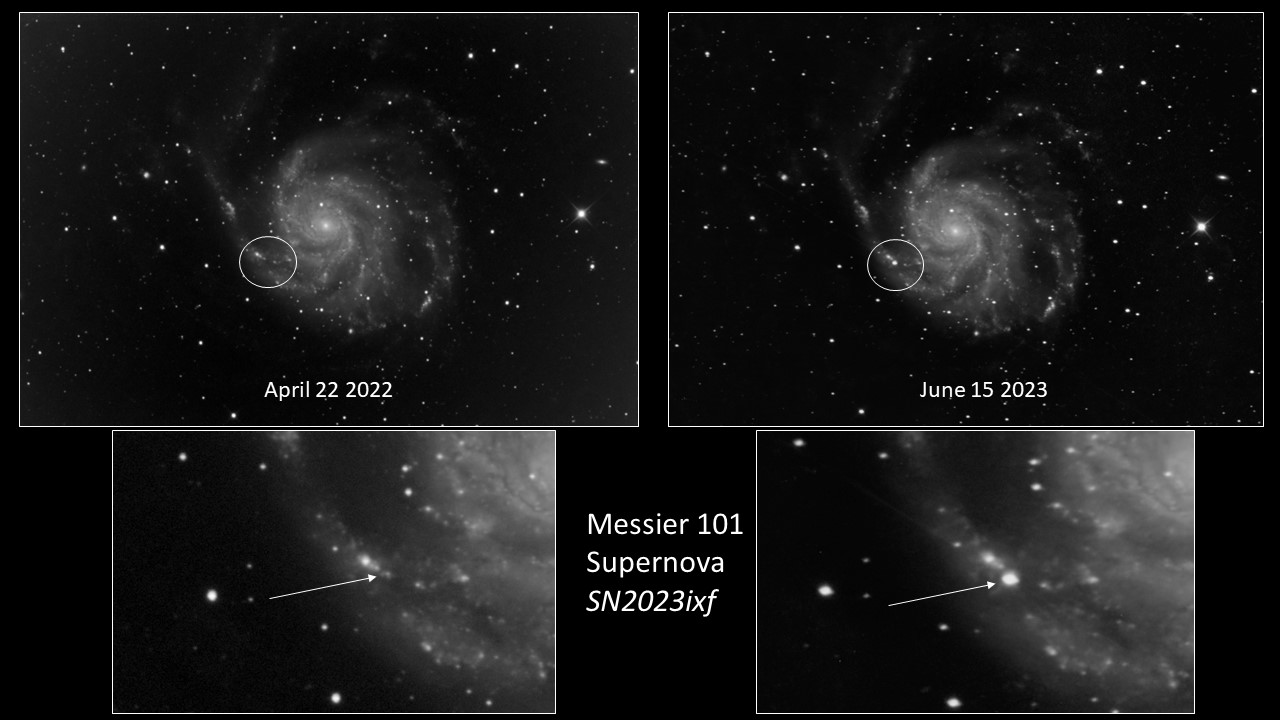
In the images and data (below), the progenitor star region in the image from 2022 was very faint, about magnitude 20.5. Right after the supernova explosion May 19, the magnitude jumped to around 11 by day 3 and 4, and then steadily declined over the next 2 months to magnitude 12.3 by day 63 (see graph). It will be interesting to see how far the supernova light curve will decline in the future, and to contemplate the radical changes its atomic fusion processes, diameter, and radiation spectrum will undergo during this period.
The spiral galaxy Messier 101 before (left) and after (right) the supernova event which first appeared on May19 2023. The supernova SN2023ixf is circled in the upper images and indicated by arrows in the lower zoomed images. AGO 12.5” f/6.7 scope with ASI2400MC camera at gain 0. The magnitudes were measured as discussed in the text above. Images and data by RA Parker.


 Amateur Astronomers Association of Princeton