Poohs’ Hunney Pot

asteroid velocity reprise

by Ted Frimet

I attended a presentation on asteroid occultation and IOTA, hosted at Montclair State University, by NJAG member Albert Carcich. I found Alberts lecture and slide presentation on measuring asteroid size and shape to be very appealing, and an deceptively easy topic to grasp. A thought quickly developed. Could I use the results of one chord, instead of many, to rough estimate an asteroid diameter? Probably not, I’ve been told. Of course, you would have to be at midline, during measurement and lucky. And lacking the negative reports of the “shadow boundaries” during an an asteroid eclipsing a star, the results would be sketchy at best. In fact, I have been told that it is inherently flawed. I agree. Not knowing my head from my tail, I reached out, once more.

I reached out to IOTA membership, and they were very helpful. I was hopeful that knowing how to calculate an asteroid Vt, that the occultation shadow velocity would prove out a ratio, that might divulge its hidden metrics. Either there were no takers, or my education was so lacking that I failed to materialize the math. Probably the latter. As such, I am vying to move forward. I have attempted purchases on the cheap, used copies of: The “Explanatory Supplement to the Astronomical Almanac” by J. Meeus and “Textbook on Spherical Astronomy” by R.M. Green. And Astronomical Tables of the Sun, Moon, and Planets, by J. Meeus. Regretfully, I am unable to locate a copy of the Supplement to the Astronomical Almanac, at a low enough cost. However the Tables, and Textbook should confound and confuse me for a least a few months to come! UACNJ member, Kris Kootale, will set aside another tome, for me to borrow – Meeus’ Astronomical Algorithms, next time we meet on observers duty for 2018 at Jenny Jump.

I will have a tool at my disposal. It is the Occult program. Since the many supported algorithms are very complex, they do not lend themselves to easily being implemented by hand. Certainly not by me! Using Occult, however, I will have a proven staple to compare any results I obtain, otherwise. I should be downloading and fidgeting with software, before any of my books arrive from the U.K., or elsewhere.

There is NOVAS code, available on the Navy’s MIL website for occultation study. However it has been decades since I’ve used Fortran, and I don’t think it a good idea to reverse engineer any C programs. There is, as good fortune even smiles on us all from time to time – a Github site where the code sits ready for compilation. Here, too, I will take a pass, having decided on taking the longer road to knowledge. I am as foolish in my math pursuits, as I am at the eyepiece of a telescope. Perhaps, during my travels I will write snippets of Visual Basic code in .NET with a fully functioning interface. I own that skill. That might even help the next traveler on their way. The next IOTA meeting, in Suffern – NY, is a full week before NEAF. I plan to attend both.

Last AAAP meeting I reached out to membership, voicing my concerns on the CLEA software model, Astrometry of Asteroids. Member Matthew Rapp’s suggestion was fully grounded when he recommended using the sample files to learn from. Being Mac based, and confusing the install with previous software that was buggy, I had my concerns. I was happy to find out that I didn’t need to create a Virtual Machine to install Astrometry. My current installation of Bootcamp, running Windows 10, was more than sufficient. I did, however find it necessary to move forward with the more advanced Astrometry toolkit, which provided me with access to star catalogues not found in the student version.

And now a pause for errata on last months essay, “How to Haul Tail”. I have since revisited the FITS files. I have taken notice that there are two places for observation times and dates in the FITS file format. Please take note that using either FITS header field results in same outcome of 2,208 elapsed seconds.

For asteroid Griqua image 0: First occurrence of the FITS field for date time group:
DATE-OBS= ‘2017-12-27T01:30:21’ /YYYY-MM-DDThh:mm:ss observation start, UT

Second occurrence of the FITS field for date time group:
DATE = ‘2017-12-27′ / Date at start of exposure, UT
TIME-OBS= ’01:30:06.154’ / Time at start of observation, UT

For asteroid Griqua image 7:
First occurrence of the FITS field for date time group:
DATE-OBS= ‘2017-12-27T02:07:06’ /YYYY-MM-DDThh:mm:ss observation start, UT

Second occurrence of the FITS field for date time group:
DATE = ‘2017-12-27′ / Date at start of exposure, UT
TIME-OBS= ’02:06:53.926’ / Time at start of observation, UT

Onwards! I wanted to refine my hunt for asteroids, by learning how to extrapolate their locations in an astrophotography image. Using the Skynet image frame center as the target “home” position was sufficient. The Skynet observers user interface easily communicated that information to me. I have noticed some drift, as the asteroid falls out of the field of view, during some endeavors. I decided that if I was going to continue to calculate and refine asteroid metrics, I was in need of a more precise measurement method. Using the Astrometry program, I can now select navigational, also known as, reference stars. The program effortlessly interpolates the asteroid location, in RA and DEC. It appears to be highly precise, and a decent tool for this student of Amateur Astronomy.

The same can be accomplished in Afterglow software, provided for in the Skynet interface. This post processing tool provides a window into the associated Digital Sloan Survey (DSS) images. You can select any point, on a corresponding frame and read off the correct RA/DEC coordinate. However, there is presently no way to overlay the asteroid image onto a DSS, as they are in two different non-corresponding proportions. You could “point and guess”, however I wanted something a bit more precise. Enter Toolkit for Astrometry.

There are a couple of user interface “traps” in the Astrometry tool kit, however none of them are fatal. For instance, the interface may ask you to load a CD – as I have neither the CD and my Mac Book Pro doesn’t sport a CD ROM interface. I successfully click “no”, and flawlessly move on with the program. A sensitive area to some, however to me was just a passing inconvenience, is that some message boxes will populate with invisible content. I found a quick solution by employing two monitors. After moving the message box to the second, auxiliary monitor, the box properly populated, and I was able to click away my response. I subscribe the error not to the program, but to how it interfaces with my systems graphics card, and subsequent operating system. The interface issue lay with a “screen refresh” routine. Otherwise, please know that the program is intuitive, and easy to use.

Just like my first night out at Jenny Jump, versus skies that were not as dark, it is easy to get lost among the stars. My astrophotography of 1362 Griqua, being limited to 4 second exposures, would only express the brightest objects in frame. And using Astrometry, I would be bombarded by stars of 20th magnitude or more. What to do? Skynet to the rescue! Using the astrometric tools afforded by Afterglow, I selected the navigational stars that would help me in my asteroid hunt.

Deploying Astrometry. Shown below are the reference star results for magnitude = 22 or brighter. This is followed by the magnitude data for Griqua FITS 000, and FITS 007 at 4 seconds exposure. Note that Afterglow photometry, by itself, does not provide RA and DEC.


I then applied a magnitude limit of 16 to the Astrometry initialization file. And proceeded to select three or more reference stars. Below is the result for Griqua FITS 000, followed by FITS 007. Immediately below the reference star images you will find JPEGs from Skynet for comparison.

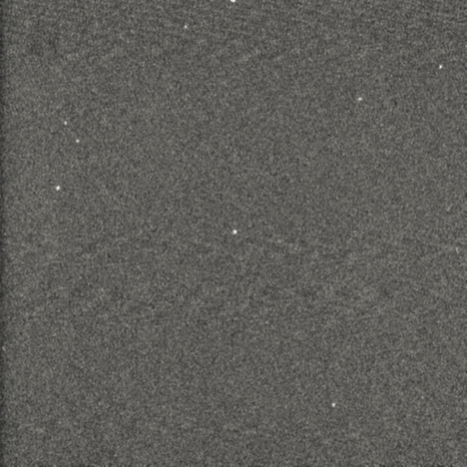


The Griqua asteroid, in both Skynet images appears to hold steadfast in center of frame.
This becomes an ideal test to recalculate and refine tangential velocity, using Astrometry coordinates.

Here are the Astrometry coordinates as reported for:
    Griqua (0) =
    RA = 0h 27m 52.99s Dec = -24° 59′ 22.5”

    Original Griqua (0) observers data from Skynet:
    RA/Dec: 00:27:52.198 | -24:59:39.468

    and Astrometry, this time, for Griqua (7) =
    RA = 0h 27m 55.43s Dec = -24° 58′ 51.8”

    Original Griqua (7) observers data from Skynet:
    RA/Dec: 00:27:54.559 | -24:59:11.705

Below is the sample astrometric solution for Griqua (0).

    2018/02/17 4:26:17 PM
    Image 1 – Astrometric Solution

    Image File Name: GRIQUA_2335994_LUM_000S.FIT
    Object: Griqua 1362
    Observation Date: 2017 December 27, UT: 01:30:21
    

Target Object:
    x = 515.4494, RA = 0h 27m 52.99s
    y = 510.9753, Dec = -24° 59′ 22.5″
    m = 15.07 (No Filter)

Estimated errors cannot be calculated!
    N(=3) is minimum for selected solution type.
Estimated Error in Magnitude (Sigma): 0.03(3)

    Field Center:
    x = 512.0000, RA = 0h 27m 53.13s
    y = 512.0000, Dec = -24° 59′ 23.1″

    Plate Constants for Linear Solution:
    Scale = 0.5865 “/pixel, Field Wd. = 10.01′, Ht. = 10.01′ Notes:

    (X = a*x + b*y + c)
    a = 2.8460361E-06, b = -6.0589289E-09, c = -1.5222572E-03

    (Y = d*x + e*y + f)
    d = -9.6308291E-09, e = -2.8407851E-06, f = 1.5439454E-03

(1) Star not used in astrometric solution.
(2) Star not used in magnitude solution.
(3) Magnitudes are unreliable due to errors in reference star magnitudes and passband differences.

Using last months essay, “How to Haul Tail”, I have followed the same procedure to calculate the tangential velocity of asteroid 1362 Griqua. However, this month, we substitute the Astrometric’s solution for the asteroid coordinates:

    Griqua observation 0 – DEC
    24 degrees 59 minutes 22.5 arc seconds
    (24 x 3600) + (59 x 60) + 22.5 = 89962.5

    Griqua observation 7 – DEC
    24 degrees 58 minutes 51.8 arc seconds
    (24 x 3600) + (58 x 60) + 51.8 = 89931.8

    Griqua observation 0 – RA
    0 hours 27 minutes 52.99 seconds
    (0 x 3600) + (27 x 60) + 52.99 = 1672.99

    Griqua observation 7 – RA
    0 hours 27 minutes 55.43 seconds
    (0 x 3600) + (27 x 60) + 55.43 = 1675.43

    DEC difference = 30.7 arc seconds
    RA difference = 2.44 seconds

I am keeping the time difference, from the already published essay, which was 2207.772.

I found an additional math error that I overlooked in the FITS file format, today. Without passing judgment on the essay precision – I calculated for both, and found a 3 second difference.

After “rounding” the angular velocity the answer ended up the same, as 0.021
    2.44 x 15 x cosine (-25) = 33.171
    sq root of ( ( 33.171 * 33.171) + ( 30.7 * 30.7 ) )
    sq root of (1100.32 + 942.99)
    sq root of (2042.81)
    =45.198

    45.198 / 2207.772 = 0.021 (angular velocity)
    Tangential Velocity = (Angular Velocity x Distance) / 206265
    Vt = (0.021 x 287306800) / 206265
    Vt = (6033442.8) / 206265
    = 29.25 km/s

I have calculated that using Astrometry reference stars, and interpolated coordinates, 1362 Griqua, is moving at a higher measured velocity of 29.25 km/s versus last months calculation (using Skynet data) at 26.5 km/s.

Using an online calculator, we arrive at a solution that results in a 10 percent difference. I am inclined to believe that this is a sufficient precision shift. I will be dipping my hand in the Astrometric’s hunney pot, from time to time, now. Which will make future amateur asteroids analysis a sweeter preoccupation.
Posted in March 2018, Sidereal Times | Tagged , | Leave a comment

Falcon Heavy

by Prasad Ganti

SpaceX added another feather to its cap by launching the Falcon Heavy rocket with a much heavier payload than any other rocket before. Its maiden flight has garnered success. This flight makes it the heaviest launcher in the market and makes Elon Musk of SpaceX a highly accomplished entrepreneur. In addition to building electric cars and solar panels, he is building rockets and also launching satellites to provide internet connections all over the world. He gains my utmost respect.

Much has been written about the launch. Just thought of adding my two cents. Two factors about this launch capture my imagination. Firstly, the price of the launch is very cheap, about a quarter of the next most powerful rocket, the Delta IV Heavy, which is produced by joint venture between Lockheed Martin and Boeing. And Falcon Heavy can launch twice the payload as Delta IV.

Secondly, SpaceX has componentized their launchers. Falcon Heavy uses the same booster as the Falcon 9. It has 3 of the Falcon 9 boosters strapped together. Each booster with 9 Merlin engines. The engines and the Falcon 9 booster become like Lego blocks which can be used to put together different structures in future. The Big F rocket which is part of Musk’s dream of colonizing Mars will use the same Lego blocks to build a bigger structure. No prizes for guessing what the F means!

A major reason for the cheap cost of launches is SpaceX’s ability to reuse the first stage boosters. In fact, 2 of the 3 boosters on this launch, flew previously. And 2 of the 3 boosters from the current launch came back a few minutes after the launch and landed softly in the proximity of the launch pad to be refurbished and reused for future launches. The rocket’s central booster was supposed to come back and land on a ship out at the sea but there was some hiccup in this landing. The second stage of the Falcon containing Musk’s Telsa car was shot into the space. It is circling the Sun between Earth and Mars. Likely to be there for the next few million years or so. Regardless, it was a major success for SpaceX.

Another major factor is that SpaceX has mostly used commercially available off the self-components to reduce costs. Rather than getting them custom built. There is an old story where NASA is reported to have spent a million dollars getting a ball point pen to work in space. Russians had a simpler solution. They used a pencil instead! SpaceX has lot of such cost saving ideas built in.

Of late, private space ventures have proved to be efficient-validating NASA’s mantra of faster, cheaper, and better. NASA itself is working on its Space Launch System (SLS) for a heavy launcher. SLS is using RS-25 engines developed in the space shuttle years. Granted they are updated with more thrust. It is designed to preserve existing space-industry jobs as much as it is to fly cargo into the orbit. Its maiden voyage is not expected until 2020. Do we really need NASA to be in the business of building launchers ? I don’t think so.

Should we depend only on SpaceX ? No, but there are other companies which are coming up to speed. Blue Origin from Amazon’s Jeff Bezos is an example. Orbital Sciences’ Antares rocket is another example. There are other countries doing the launches for lower costs. India’s PSLV (Polar Satellite Launch Vehicle) and GSLV (Geo Stationery Launch Vehicle) launchers cost less and are scaling up in terms of the weight of the payload.

Regardless, NASA is not the only game in the town. In fact, it is no longer the stronger competitor it once was. It should do what it does best. Doing Research and Development. Developing future road maps. And planning space missions. And let the nuts and bolts be done by the better suited private companies.

Posted in March 2018, Sidereal Times | Tagged , | Leave a comment

Snippets

compiled by Arlene & David Kaplan

Artwork credit: ESA

Artwork credit: ESA

Design call for ‘solar sentinel’ mission
UK scientists and engineers will play a leading role in developing a satellite that can warn if Earth is about to be hit by damaging solar storms.
The European Space Agency has requested studies be undertaken to design the mission that would launch in the 2020s…more

Artwork credit: NASA

Artwork credit: NASA

‘Serious gap’ in cosmic expansion rate hints at new physics
A mathematical discrepancy in the expansion rate of the Universe is now “pretty serious”, and could point the way to a major discovery in physics, says a Nobel laureate. The most recent results suggest the inconsistency is not going away. Prof Adam Riess told BBC News that ..more

Dust entering our atmosphere -BBC

Dust entering our atmosphere -BBC

Is dust the source of life on Earth?
Philip Pullman fans will be familiar with the fictionalised idea of dust. But a new University of Edinburgh study suggests it might really be the source of life on earth.
Fast flowing streams of interplanetary dust are continually entering our planet’s atmosphere, travelling at up to 70 km per second…more

Hubble watched the neutron star merger light fade away = BBC

Hubble watched the neutron star merger light fade away -BBC

Gravitational waves: So many new toys to unwrap
Whenever there’s a big science discovery, it’s always nice to get a historical perspective. And so here goes with the remarkable observation of gravitational waves emanating from the merger of two dead stars, or neutron stars, some 130 million light-years from Earth…more

Artwork credit:BBC

Artwork credit:BBC

‘Oumuamua: ‘space cigar’s’ tumble hints at violent past
The space interloper ‘Oumuamua is spinning chaotically and will carry on doing so for more than a billion years.
“At some point or another it’s been in a collision,” says Dr. Wes Fraser from Queen’s University…more

Credit: Getty Images

Credit: Getty Images

Crypto-currency craze ‘hinders search for alien life’
Scientists listening out for broadcasts by extra-terrestrials are struggling to get the computer hardware they need, thanks to the crypto-currency mining craze, a radio-astronomer has said…more

Galaxy NGC 613 -NYT

Galaxy NGC 613 -NYT

He Took a Picture of a Supernova While Setting Up His New Camera
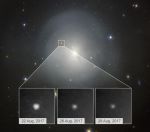
On Sept. 20, 2016, Victor Buso, an amateur astronomer in Rosario, Argentina, was checking out the new camera on his telescope by taking pictures of a nearby spiral galaxy when a star within it went off in a supernova explosion…more

Superionic water: solid or liquid? -NYT

Superionic water: solid or liquid? -NYT

New Form of Water, Both Liquid and Solid, Is ‘Really Strange’
Long theorized to be found in the mantles of Uranus and Neptune, the confirmation of the existence of superionic ice could lead to the development of new materials…more

Posted in March 2018, Sidereal Times | Tagged , | Leave a comment

From the Director

Rex


by Rex Parker, Director

Two proposals for vote at Feb 13 meeting. Last year we didn’t hold the Feb meeting because it would be on Valentine’s Day! This time around you have no such excuse (!) so we hope to see you at Peyton Hall on Feb 13. You are needed to vote on 2 proposals: (1) Amendment to the Constitution and By-Laws; (2) Expenditure authorization for a new astro video camera.

Amendment to Constitution and By-Laws. The amendment proposal is aimed at improving the organizational structure of AAAP by raising Observatory Chair and Outreach Coordinator to Board-level positions. We believe the prestige and recognition of the roles and the effectiveness of the positions would be enhanced by making them Board-level positions. They would be elected by the membership each year as are the other officers (Director, Assistant Director, Treasurer, Secretary, and Program Chair), comprising a 7 member Board of Trustees. Further rationale for this amendment is discussed in last month’s Sidereal times. The relevant sections are Constitution article 3, and By-Laws section 1. The current version is at this link, http://www.princetonastronomy.org/club_by_laws.html.

The proposed amendment also makes an additional change in the By-laws, Section 6.D.a (Finance). This would increase automatic expenditure authorization up to $500 (formerly $200) for astronomy equipment or observatory improvements at the discretion of the Officers. This is based on practicality for operating the Observatory.

Adoption of the Amendment requires a majority vote of the total membership, as provided in Article V of the Constitution.

Expenditure authorization: $2000 for astro video camera. This proposal is aimed at upgrading equipment and technology to improve observing capability for members and public outreach at the Observatory and in the field. The proposal is for $2000 from the treasury to be used to acquire a color CCD video camera and accessories for electronic assisted astronomy (EAA). To defray the cost, last month we sold some older unused astronomy equipment on Astromart, adding over $2000 to the treasury.

This Expenditure proposal must be approved by a majority of the votes cast at the meeting and not less than 30% of the paid membership, as provided in By-Laws section 6.D.c.

The club began its exploration of EAA a few years ago with the Mallincam video setup at the Observatory – with great success. More recently, EAA sessions by members at Starquest in October and at the Observatory in December demonstrated the improved sensitivity and very fast download rates of the latest generation of astro video cameras. Several models are eyepiece sized with low power requirements allowing field use with only a laptop-PC for power supply. Software has been developed allowing near-real-time color display of images on the laptop. Examples include cameras using the Sony EXview HAD CCD sensors such as the Sony ICX825. A short list of recommended cameras will be discussed at the Feb meeting.

Posted in February 2018, Sidereal Times | Tagged , | Leave a comment

From the Program Chair

By Ira Polans

The February meeting will be held on the 13th at 7:30PM in Peyton Hall on the Princeton University campus.

The talk is by Paul Halpern on his book “The Quantum Labyrinth: How Richard Feynman and John Wheeler Revolutionized Time and Reality”.

From black holes and wormholes to gravitational waves and the participatory universe, this talk will show how the work of American physicists Richard Feynman and John Wheeler, who first worked together at Princeton in the early 1940s and had strikingly distinct personalities, had a major impact on contemporary science.

During the break there will be a book signing.

Prior to the meeting there will be a meet-the-speaker dinner at 6PM at Winberie’s in Palmer Square in Princeton. If you’re interested in attending please contact program@princetonastronomy.org no later than Noon on February 13.

We are still looking for volunteers to give a 10 minute talk on an astronomy related topic at a future meeting. If you’re interested in giving one in February or at a later meeting please contact me at program@princetonastronomy.org.

If you have suggestions for speakers please send them to the same email address. Please provide the speaker’s name, topic, and affiliation. Thanks!

We look forward to seeing you at the February meeting and the dinner!

Posted in February 2018, Sidereal Times | Tagged , , | Leave a comment

January 9, 2018 Meeting Minutes

by Victor Davis on behalf of Jim Poinsett, Secretary

Minutes of the January 2018 meeting of the Amateur Astronomers Association of Princeton

  • Director Rex Parker opened the meeting by challenging members to spot several new comets well placed for observation during January. He invited members to report their sightings—or valiant attempts—at the next meeting
  • Science writer Michael Lemonick talked about the lives and accomplishments of the Herschel family; William, his sister Caroline, and son John, based on his book “The Georgian Star: How William and Caroline Herschel Revolutionized Our Understanding of the Cosmos.” The book’s publisher did not provide copies for sale and signing at the meeting.
  • Mr. Lemonick previously spoke to the club in April, 2013 about the search for extrasolar planets, and autographed copies of his book “Mirror Earth.”
  • Member Participation
    • Rex talked about his desire to increase member involvement in club activities and encouraged members to present 10-minute demonstrations or mini-lectures to share their knowledge and experiences. He also put in a pitch for more members to use the online observatory network in which AAAP participates and has a financial stake.
  • Treasurer
    • Rex gave Treasurer Mike Mitrano a check for $2100; proceeds from selling donated equipment on Astromart.
  • Constitutional Amendment
    • At the February meeting, members will be asked to vote on a constitutional amendment to increase board membership to include the Outreach Chair and the Observatory Chair.
  • Outreach
    • Recent experiences with the Mallincam have shown the benefits of what we’ve taken to calling Electronically Assisted Astronomy (EAA). Rex proposed and members were agreeable to making additional purchases to enhance our EAA capabilities. Right now, the leading candidate is the UltraStar, and members are encouraged to conduct research and contribute opinions before a final selection is made.
    • Members discussed strategies for increasing membership, and especially for recruiting younger members to reverse the direction of our skewed demographic. John Miller suggested we need to put more effort into publicizing club activities and  capabilities to schools, newspapers, social media, community organizations, and the general public.
  • Observatory
    • Observatory Chair Dave Skitt is investigating options for motorizing the Washington Crossing observatory’s roll-off roof, a nod to the skewed demographic mentioned above.
    • Bill Murray presented an invitation to join NASA’s All-Sky Fireball Network, which involves mounting a NASA-owned camera on the observatory to observe bright meteors. The camera requires uninterrupted power and a moderately fast internet connection. After a short discussion, members agreed that hosting a camera is desirable. Bill Murray, Rex Parker, and Michael Mitrano agreed to pursue the application process.
    • Dave and Jenn Skitt and Tom Swords have removed the focuser (a formidable brass object) from the Hastings-Byrne refractor. Tom is refurbishing it (gently) for better optical alignment.


Posted in February 2018, Sidereal Times | Tagged , , | Leave a comment

Jupiter & Mars

by John Giles

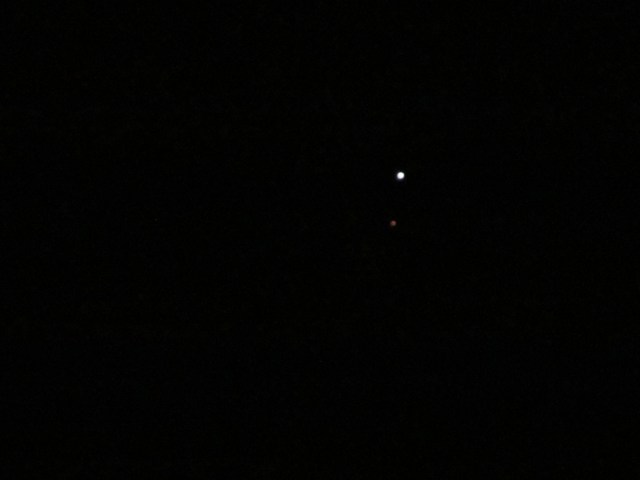
I just happened to catch a SKY & TELESCOPE note on the Jupiter/Mars conjunction on January 6th and 7th. It sounded too good to pass up, so I set my alarm for 5:30 AM on the 7th to see what I could see and try to get a picture. Well, I found it turned out to be really cold! So that left out binoculars, but I’ve seen them before and thought naked eye would be OK. I was all set to drive to a good spot, but to my surprise, I could see them from my driveway, between the tree branches. What a great sight! Next project was to try to get some pictures before the camera fogged up. At -1°F, I didn’t think I had much time. I shot a few and hoped for the best.

Image by John Giles taken on January 7, 2018 at 5:50 AM from Central NJ.

Image by John Giles taken on January 7, 2018 at 5:50 AM from Central NJ.

Posted in February 2018, Sidereal Times | Tagged , , | 1 Comment

How to haul tail

by Theodore R. Frimet

baby its cold outside

Before our end of season, our Observatory Chair hosted a couple of school aged teenagers that needed to make celestial observations on a particular Friday night. Skipping ahead from the experiences of pointing out various stars, the likes of Vega, and Capella, and being somewhat dumbfounded on Polaris (sneaky North star hiding amongst the tree tops and rafters of many a barn), the student chilled to the bone, spoke out between gritted, shivering teeth, “It’s cold out here”. Welcome to Amateur Astronomy, I said.

Last night being no exception to the length of time it takes to properly prepare an amateur, we find yours truly, chilled to the toes. Experiencing unusually warm temperatures for a deep winter’s spell, and being reminiscent of our good fortune this past November, I decided to ditch the Muc-Lucs in favor of a second layer shirt, long johns, and two pairs of socks. Should have brought the Muc-Lucs. Yes, I make mistakes. Hopefully, during the course of this essay, I will fix one or few along the way. And of course, open the wounds of my personal ignorance, as I plod thru new Hypotheses, – and just like a favorite potato recipe – it may be served half-baked. I reckon that my science may not recover, as well as my toes have.

There is no undoing Newtonian classical physics, or the answer of our own respected Professional Astronomer, William Murray. When asked about the velocity relationship during the ellipse orbit of an asteroid, Bill correctly points out that as the asteroid approaches our sun, it increases in velocity. Of course what I failed to really ask Bill, is to provide me with all of my answers to unasked questions and to be a mind reader. I sobbed so quietly as I removed Sol from my sight, expecting the asteroid velocity to purr like a kitty cat in a planetary side-car. The sun persists. Gravity is real. And a gravity well reaches out to the depths of our solar system. The extremis points in the ellipses are areas of acceleration, if not in velocity, are then most certainly changes in direction.

Our asteroid travels in an ellipse and gains momentum on each pass around the sun. Hmmmmm…not unlike the lore of science fiction shows where our space travelers must hurl their craft around the sun to gain needed momentum to make it to Jupiter in a few less months than strategically laid out at the beginning of their fare – our NEO’s are forever gaining speed. Going faster, and faster and eventually reaching, “terminal” escape velocity. Emboldened with the momentum to breach the gravity well of Sol, they faithfully return to the OORT cloud for further dispensation of plans divulged by the sky gods of old. That is unless they don’t have the mass necessary to escape despite the increase in their velocity bank account.

Having some more amateur fun, here, run the clock backwards and decrease the velocity on each pass, to approximate the entry speed of this heavenly body. You’d have to wait awhile for this months eyeful to rewind on my pretentious timepiece. As she punches her time clock, to be on the job, only every 20,000 years. Enter C/2016 R2.

You can jump to the bottom of the essay, or suck it up, put on that 80 lb rucksack soldier, and tramp up that 30 degree incline in the wastelands of the desert. You decide. As there is no return once you enter the next paragraph.

You can’t fix stupid? Sure you can. Be patient, and get thru all of the long reptilian length sentences until you strike gold. Ah, you are still here? Good. Then I hand you the olive branch of tangential velocity to correct last months poor mans calculation of linear velocity.

Working side by side with a lab paper from “A Manual to Accompany Software for the Introductory Astronomy Lab Exercise Edited by Lucy Kulbago, John Carroll University 11/24/2008” I hurriedly excerpt some bits and tidbits to reach another conclusion as to how fast asteroid 1362 Griqua was moving in last months video.

First let’s calculate the angular velocity. I tried avoiding this last month – as this explains why I invented Griqua units of measurement. Alas, the truth be known. You and I must brave the winter of our discontent and move on to newer, richer pastures and relish in the truth that will bear us out in the end – a method and a resulting number that is closer to reality.

So that I do not get lost in the labyrinth of my own observations, I am noting here that Skynet 1362 Griqua observation # is 2335994, and the ID and location of image 0 and image 7 are:
ID: 19892011 RA/DEC: 00:27:52.198 / -24:59:39.468
ID 19892018 RA/DEC: 00:27:54.559 / -24:59:11.705

Both imaged on Prompt-5 telescope employing a Lum filter, and 4 seconds exposure.

The Universal Time (UT) stamp on my first image (image 0) is 01:30:06.154, and on my last (image 7) is 02:06:53.926. Whew! That was a mouthful !

We convert the hours, and minutes to seconds to make the math easier, multiplying minutes by 60 and hours by 3600.

01:30:06.154 = 5,406.154 s
02:06:53.926 = 7,613.926 s

Now take the difference, which will result in the time that passed between observations of image (0) and image (7) at the telescope: 7,613.926 – 5,406.154 = 2,207.772 s

The time elapsed was 2,207.772 seconds !

That was some pretty basic arithmetic. Now we have to delve a little deeper into the frugal realm of Pythagoras.

c (squared) = a(squared) + b(squared)

Or if you will permit me to flaunt my limited mathematical prowess:

c = the square root of ( (a*a) + (b*b) )

Hurray for right ascension and declination. They are the known coordinates of where we looked into the night sky. They happen to have a happy relationship as right angles to each other.

If you would, “one goes up” while “the other goes down”. No? How about, “right ascension or RA” is like horizontal direction, and “declination or DEC” is our vertical direction?

Still no?,…ummm..ok – my bad – I’ll try again – RA and DEC are two legs of a right triangle and we are going to solve for the hypotenuse. Yup, sorry. You asked teacher back in high school, “what am I going to do with geometry?” – well, here it is, my fellow budding amateur.

Take the DEC values, from above, and convert the coordinates to arc seconds. Multiply the minutes by 60 and the degrees by 3600. Sounds familiar, doesn’t it?

24:59:39.469 = 89,979.469 arc seconds
24:59:11.705 = 89,951.705 arc seconds

Now take the difference to find the change in DEC for our images:
89,979.469 – 89,951.705 = 27.764 arc sec

Take the RA values, from above, and convert the coordinates to seconds. Again, multiply the minutes by 60 and the hours by 3600.

00:27:54.559 = 1,674.559 seconds
00:27:52.198 = 1,672.198 seconds

Now, take the difference to find the change in RA for our images:
1674.559 – 1,672.198 = 2.361 sec

Our noteworthy author points out that our RA system is a grid of bent lines from earth bound pole to pole. And that the closer to the poles, the less space between the lines. And the closer to the equator, the more space between the lines. This curvature issue is solved by introducing the cosine into our math.

Another way to look at this, is that the circles that circumscribe the earth, as we vary the latitude, get smaller and smaller as we work our way to either North or South pole. That is what the cosine is there for.

First convert the DEC to degrees by dividing the arc seconds by 3600:
27.764 / 3600 = 0.00771222 degrees

change in RA(adjusted) in arc-seconds = RA in seconds X 15 X cosine(DEC in degrees)

[note: the declination in degrees is NOT the difference, it is the actual DEC rounded off to the nearest degree]

= 2.361 X 15 X cosine(-25)

Pray tell – where doeth the “15” come about, you query?
Tarry you not the Ides of March, as they dare not wary you!

Quoting the Astrometry Bard, straight out of the student manual, p5:
“This may sound strange, but an hour of right ascension is defined as 1/24 of a circle, so an hour of right ascension is equal to 15 degrees.”

Well, not so strange to us, is it? Amateurs know that RA is measured in hours, minutes and seconds conforms neatly to the idea of our Earthly rotation.
i.e., 1 x hr = 15 deg, 2 x hr = 30 deg, 3 x hr = 45 deg, …, 24 hr = 360 deg.

= 2.361 X 15 X cosine (-25)
= 2.361 X 15 X (0.9063)
= 32.097

Back to old Pythagoras:

take the square root of:
(32.097 * 32.097) + (27.764 * 27.764)

(1030.210) + (770.840) = 1801.050

= 42.439 arc seconds

Calculating the angular velocity of asteroid Griqua on December 27, 2017 is:

=42.439 / 2207.772 seconds
= 0.019 arc seconds / second

( yes-sir-ree Bob! that be “arc seconds” per “second” ! )

Now onto the clear blue waters of Tangential Velocity of my beloved Griqua.

We need to know its angular velocity (already calculated as above), and its distance. Since I have no parallax data to provide us with (which would be used to calculate distance to the asteroid) we will peer into one of NASA’s databases to find our distance, on the evening of December 27, 2017, and use the starting time of observation for our starting point in time. However, as we look into a National solution, we find none. So we expand our search to include those found across the pond.

Plugging in our date time group, for our first and last observation into the ephemerides generator, located at the AstDyS-2 sponsored by ESA, and being observant to enter the telescopes’ location at Cerro Tololo, observatory code: 807, I get a delta (distance to asteroid from Earth) that varies from 1.9204 astronomical units (AU) to 1.9206 AU. Let’s use 1.9205, shall we? Lets take a look at the ephemerides data here.

According to a Wikipedia article, last referenced on Wednesday, January 24, 2018 at 16:46 PM EST, the definition of an Astronomical Unit (AU) has been defined exactly as 149597870700 meters, since 2007.

1 AU = 149,600,000 km
1.9205 AU * 149,600,000 = 287,306,800 km

Tangential Velocity = (Angular velocity X distance) / 206,265
Vt = (0.019 X 287,306,800 / 206,265

Vt = 26.5 km/s

Applause, if you please!

Now, fair warning, dear amateur. There is no rest for the weary. And the faint of heart need not travel the road less taken. You may skip the EPILOGUE and feast your eyes on the tantalizing video of a blue tailed comet, as linked at the end of this essay as my timeless gift to you!

EPILOGUE:

Here is a tad of math, that fellow UACNJ member Eric Leonard schooled me on. As an aside to correcting mistakes in units, above, Eric was singularly responsible from rescuing me from my inability to reconcile finite mathematics and integrating my renewed awareness of the celestial sphere into real geometric examples.

Where I shamelessly plodded along and entered values into formulae, Eric was tireless in his approach in making rock solid certain that I walked away from this enterprise, knowing my DEC from my RA.

For more on Eric Leonard, please subscribe to Eric’s “Math From The Gut” videos series on Test Driving Pythagorean Theorem.

Now, let’s visit below, to be rock solid on where the number “206,265” comes from.

First off, let’s state the following, that 206,265 is equal to (360 * 3600) / (2 PI)

In the above statement, 360 is in degrees, and 3600 is in arc seconds per degree, and where 2 PI is the value of a unit circle.

360 degrees * 60 = the number of arc minutes that go around the circle.
360 degrees * 3600 = the number of arc seconds that go around the circle.
one arc second = 1/(360 degrees * 3600)

The relationship of the distance around the unit circle to its degree measurement is as follows:

2 PI km / (360 degrees * 3600 arc seconds/degree)

Inverse the above, plodding our relationship into the denominator:

1 / (360 degrees * 3600 arc seconds /degree) / 2 PI km

Which brings us to rekindling the tangential velocity equation, first found on p25, of the Student Lab Manual, Astrometry of Asteroids, cited earlier in this essay:

Vt = (angular velocity x distance)
—————————————————————
(360 degrees * 3600 arc seconds / degree) / 2 PI km

In the above equation, briefly study the denominator. In its construct, the denominator’s “numerator” holds our number of arc seconds in a circle. And in the denominator we have 2 PI, which is the diameter of a unit circle. Above the “big line”, we will find our angular velocity multiplied by the distance to the asteroid (measurement courtesy ESA ephemerides).

Let’s revisit the equation with a slightly improved understanding of the “206,265” origins.

Still not on board with 206,265 ?
As a quick reprise, here is the brute math of it: [360 * 3600 / 2PI = 206265].

Velocity = (Angular velocity X distance) / 206,265

Let’s do our math a little differently, here (holding off on the distance value, for just for a bit!)

Divide the Angular velocity by 206265 which yields:
v = 0.0000000921 km / s on a unit circle

Generically speaking, we can state an “x” value for km/s, as found below:
(x km /s along a unit circle) * 287,306,800 km / 1 km

And for clarity, re-write it with the “big line” of division, here:

(x km / along unit circle /s ) * (287,306,800 km along comet circle)
———————————————————————————————————————————
1 km along unit circle

Substituting our previous result (v = 0.0000000921 km/s on a unit circle) for the “x km/along unit circle/s), we show the math as found below:

Vt =

(0.0000000921 km/s along a unit circle * 287,306,800 km along comet circle
————————————————————————————————————————————
1 km along unit circle

Vt = (0.0000000921 km/s ) * (287,306,800 along comet circle)
Vt= 26.5 km/s along comet circle

I have restated the equation, below, with correct unit notation, and all with the help and timeless assistance of Eric Leonard.

Vt = (0.019 arc seconds / second x 287,306,800 km) / 206,265 arc seconds / km along a unit circle

Vt = 26.5 km/s

Note: since “arc seconds / second” has the unit “seconds” in the denominator
and “arc seconds / km” has Km as 1/km as in it is in the denominator
then it follows that after we cancel out units, we are left with: km/s

Having already done the “walk of shame” on my 1362 Griqua video, you can note, here, and there that I’ve researched velocity of record as follows:

I used Google translator on the below website link – a German wikipedia. It records the velocity of 1632 Griqua having an average orbital velocity of 16.59 km / s. Which would be a much higher velocity than I have reported in this video. Here is the link to the translation (Sunday, December 31, 2017 9:40 AM EST)

A Russian wiki records the velocity of 1362 Griqua at 16.016 km/s. Here is a link to this translation (Sunday, December 31, 2017 10:03 AM EST):

So, bearing in mind the calculations that have preceded us, according to German and Russian Wiki records, their 16.59 – 16.01 km/s is pretty darn close to our calculation, as performed by this amateurs essay of 26.5 km/s. And is astounding more precise than the “Griqua units” of lore which previously resulted in faux calculation of 430 km/hr.

Let us ballpark our numbers of precise mathematical measurement of 26.5 km/s and either way you rate it, Griqua was hauling tail thru our neck of the solar system – just the other day – astronomically speaking, that is.

You’ve struggled with the math. And slugged it thru my stream of consciousness writing style. And for all of that effort, may I bestow a token of my appreciation upon you:

a blue comet.

Enjoy!

P.S. – Skynet, the Robotic Telescope Network, hosted by UNC Chapel Hill, under study by many of our club members, permits us the opportunity to employ multiple telescopes located around the world. And perhaps, given the chance opportunity to revisit parallax, for a home grown distance calculation by observation, we can schedule two or more telescopes to observe the same NEO, in space and in time. I look forward to your participation and contributions, thru Skynet, or the clubs forthcoming acquisition of Electronically Assisted Astronomy (EAA), or your home observatories. Thank you for reading, -Ted

ἐπίλογος – Cassius:

“The fault, dear Brutus, is not in our stars,
But in ourselves, that we are underlings.”

(Julius Caesar, Act I, Scene III, L. 140-141).

We are not trying to stop a monarch of Rome. The sense of it is that many score years will pass us all by. Then, a youngster gives a fleeting thought to how fast an asteroid travels thru space.

We have given this future amateur astronomer, our pause, our here and now…and paid the purse with mental coin, emerging with a few neural pathways intact.

Here lay your underling. I am yours truly. I have beaten a plowshare back into a sword and cleared a minor path to “brute” understanding of a minor planet’s tangential velocity calculation.

If it be not accurate, perhaps we can put it safely to bed, in the knowledge that it is, at its core, more precise than a “Griqua” guess.

Posted in February 2018, Sidereal Times | Tagged , , | Leave a comment

Comet 2016 R2 (PANSTARRS)

by Rex Parker

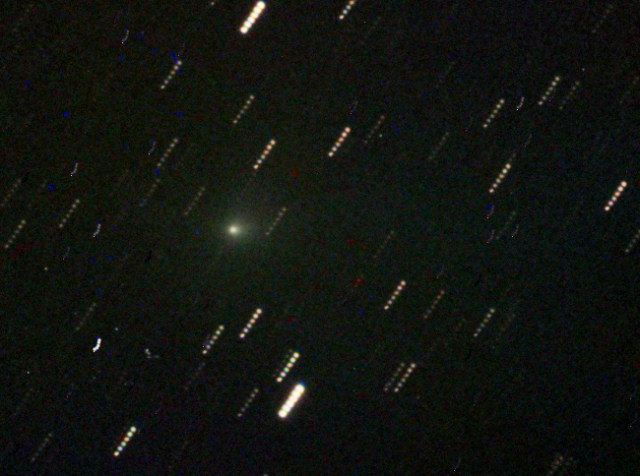
A group of AAAP members met at the Observatory Jan 19 to seek comet 2016 R2 with the Mallincam/5″refractor. They succeeded in this challenge – which took some skill as the comet was very faint, TheSkyX reporting magnitude 13.2 as the comet receded away from earth and sun (well past it’s peak brightness). I was not able to attend that observing session but was able to get an image of the comet on the same night locally, using a 12.5″ telescope and CCD camera at home.

The comet picture below is assembled from 6 x 2 min exposures in each color filter (L,R,G,B) taken at intervals over 40 min. By tracking using the comet’s orbital elements rather than sidereal rate tracking, the comet is stationary in the composite image while the field stars trail. Just the faintest hint of a dispersed comet tail might be seen in the image going to the right from the head.

Comet 2016 R2 from central NJ on Jan 13 at magnitude ~13.2. Image by RAParker.

Comet 2016 R2 from central NJ on Jan 13 at magnitude ~13.2. Image by Rex A. Parker.


This image gives a different look to the comet compared to the technique used by member Ted Frimet using Skynet, who took shorter images at intervals using Skynet with the mount tracking the stars, revealing the comet’s motion against the steady background stars when displayed as video.

Posted in February 2018, Sidereal Times | Tagged , , | Leave a comment