Astrophotography Workshop


The Adirondack Public Observatory is offering a four day workshop in astrophotography this fall from October 19 to October 22 in Tupper Lake, New York. The skies at their observatory are 6.5 magnitude. Three experienced astrophotographers will be taking classes for beginners, intermediate and advanced participants.

Participants can bring their own equipment or use the observatory’s equipment. Cost is $120.00 per person. For more information or questions please call them at (518)359-3538 or visit their website at www.adirondackpublicobservatory.org

Posted in Mid-summer 2017, Sidereal Times | Tagged , | Leave a comment

Ted Frimet’s second attempt at remote astrophotography

(We won’t talk about his first attempt!)
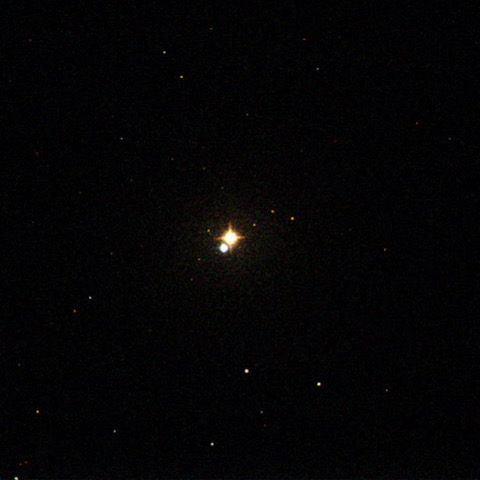
Observation of Albireo was made with three exposures for Red, Green, and Blue Colorized and composited in Gimp for Mac OS X – adjusted curves and thresholds.

Telescope Prompt8 Cerro Tololo Inter-American Observatory thru Skynet Robotic Telescope Network. Time taken: July 27, 2017 03:00:53 thru 03:02:48 0.5 seconds exposure each filter.

Good start Ted!

Posted in Mid-summer 2017, Sidereal Times | Tagged , | Leave a comment

Telescope Time Machine

extrude, slice and dice – best served defocused


by Ted Frimet

Almost every amateur observer wants to get the biggest bang for their buck. This is especially true when they sit down for a spell, to look at the wonders of the universe. Quite a few of us want to get a better view. Telescopes, with all their power, have their own inherent limitations; however, some limits can be overcome. Other destructive imperfections, can only be met passively, and accepted with muted understanding.

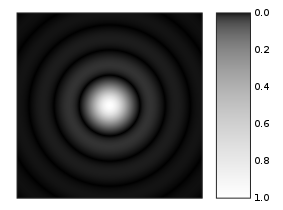
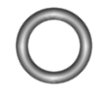
Computer-generated image of an Airy disk. Credit: https://en.wikipedia.org/wiki/Airy_disk

Computer-generated image of an Airy disk. Credit: https://en.wikipedia.org/wiki/Airy_disk

Collimation, one hopes, is the easiest fix after testing one’s telescope. The observer knows with confidence that their prowess at the terminal business end of the eye piece is enhanced with star testing. The Airy Disk knows all, and tells all. I am occasionally confronted by the seasoned observer giving indications that their scope is fully collimated. I am told, by said respected peers, that in all their observational circumstances, they never need to collimate. It gives me pause to reflect that the psychology of denial is prevalent in almost every human endeavor. Fortunately, I have not done a whole lot in my life, and with limited access in scope of experience, my hope for humanity is that the former statement is not found to be a universal truth. So my mantra becomes my appeal for the sake of all sentient life. I say, “collimate” your telescope, whenever it is convenient.

This, though, is not that story. If you are seeking the with and without of collimation, there are, and have been, very well written, and dare I say, “concise” instructions on how to go about your business. This tome, is in response to a thought experiment, timeless reading, and a parents question, during public night. The thought will be exposed below, the reading will have citation, and the parent – who asked simply, “How can I keep my child’s interest in astronomy?” – was met with, “use the telescope as a tool to complement your child’s learning, and their education”.

Neal deGrasse Tyson notes in a lecture licensed by The Great Courses, something that we are all too familiar with. If you could travel faster and faster, approaching the speed of light, your time slows down. He also speaks to the point that the light that we perceive, from distant stars, take a very long time to reach our eyes. Star light travels at light speed. For photons, time has no meaning. That is, if you ‘could’ travel at the speed of light, time would stop for you. But of course, this will probably never happen, as it would violate Special Relativity. However, it is still interesting to note that time has no meaning for a massless photon. The moment it is created, it appears at its destination. Yet, you, the observer, might be observing that very same photon millions, or maybe even billions of years after its instantiation.

I had a dream, a few nights after my first draft of this essay. A slice of a squashed faced astronomer was stuck in an oval cutout. It was if he were pushing his entire face and a partial hand against a window. And I was on “our side” looking at him. Akin to “Alice Thru The Looking Glass”, I was seeing the observer at their eye-piece. Their light was pushing out of their eyepiece, and thru their telescope tube, and into the void. It was the only explanation my less than conscious brain could offer while waking from a dream. You think you see old light. I see you as you were, or are, or will be. Keep in mind, that the light you emanate travels instantaneously to another observer…that is if the observer were massless, or perhaps made of neutrinos. A massless being is not time constrained. Their time simply pays no part in the image you emanate. That is, the massless observer sees your light, instantaneously.

Point your telescope at a star, and rack your focusser, until you get the airy disk. Note the diffraction circles. Each circle is light from your distant star. Your actions focus each solitary circle into a starry point of light. And if done well, we are very happy observers.

The airy disk light rings are the cumulation of the lights three dimensional wave package. You see, almost every illustration I’ve seen shows light as a 2D drawing appearing on a cartesian plane. And it’s an incomplete view of reality. Even in Harold Richard Suiter’s manual, “Star Testing Astronomical Telescopes”, c1994, p58 fig 4.1 shows part of a wave. And then Suiter asks the reader to “try to point out the location of the light wave”. It isn’t that the question is fundamentally flawed, it is that the visual aide is incomplete. One might argue the imposed limitations of graphic art in book production. If the light wave were graphically presented as a three dimensional wave, you might be casting a different light on the subject matter and answering Suiter’s question, forthwith.

Below is my attempt, thru GNU Image Manipulation Program (GIMP ) to show a three dimensional wave. It ain’t pretty- looks more like pasta. What is missing in my model, is that along the length of my pasta, there should be undulations of small and large diameters.


Forget the pasta, and bring in the play dough. Work the play-dough out of an circular extrusion. Along the dough’s length, squish it with your hands, allowing your fingers to make indentations. If you were to cut thru the dough, at say, even intervals, you would have many circles in varying diameters.
Slice the light cone of special relativity and create many circles. They vary in size from small to large – and large to small, too! Except my cone is a wave, it is three dimensional, and has undulations in diameter, throughout.

More than a few years ago, I had the benefit of speaking with, briefly, a man named Charles. Charles was the son of my soon to be mother-in-law’s neighbor, Betty. Nice people. Charles, as a Bell Labs Engineer told me about how I needed to change my perspective on radio frequencies appearing to me as a 2D wave plotted on a x-y chart. And to start thinking of these waves as being in three dimensional space. Many years passed, and now I am reading Harold Suiter. Within the very first couple of chapters, Suiter makes the comparison of light to audio waves. And rightly so – as it no doubt it assists the reader in making the jump from a technological understanding of one established science to the next. So, you might infer from this, that Suiter has encouraged me to make the jump from radio waves to light waves. But after all, we really have not, since radio frequencies are just another component of the electro magnetic spectrum, shared of course, by its cousin, visible light. Star light is a three dimensional wave front.
So, to answer Mr. Suiters question, to point out the where the light is on the light wave, we answer, gingerly – it is on the incoming light wave’s outer circumference of the conic section.

Since photons instantly reach their destination, at no time at all, the airy disk is the result of the wavefront crashing, and smooshing down onto your observers lens. It is as if light’s arrow was thrust in your direction, down your tube, and splattered onto your lens, leaving behind in every instant of your observation, ring, after ring, after ring.

The observed radii of the airy disk increases with the telescope aperture. Not only do you have access to more photons, with a larger aperture, you have access to older light. But you already knew that. You see farther into the time based dimension of the universe and always look at old photons.

But here is the conundrum. You are now in my deep end of the pool. That out of focus light that you see isn’t old light. It is the result of the instantaneous impact of quanta produced, far, far away- for time has no meaning to the traveling array of quanta that makes up the airy disk.

Rack your focus in, and see light as it was. Rack your focus out, and see light as it will be. Did I cross the line? Maybe you could too, if you were slightly out of focus, like me.

Posted in Mid-summer 2017, Sidereal Times | Tagged , | Leave a comment

Dark Matter

by Prasad Ganti

Just when we thought that things are falling into place and that we know enough about the Universe, came the revelation that the Universe is dominated by dark matter and dark energy; which between them account for 96% of whatever is present in the Universe. It is only the 4% of constituents which are under our cross hairs and get termed as “spectacular discoveries”. Although the effects of the 96% constituents has been studied and understood well, its nature is not known.

Dark matter is said to constitute 23% of the Universe. It is not a recent discovery. First thought of during the 1930s by the Swiss Physicist Fritz Zwicky at Caltech. He found that dark matter has influence at Galactic levels, not at the level of stars or their planets. He discovered that the outer reaches of Galaxies rotate at the same speed as the inner ones, unlike in our Solar system where the planet Mercury, the planet closest to Sun, travels a lot faster than the distant Neptune. This led to the speculation that there is some dark unknown matter on the fringes of the galaxies which makes this happen. Not visible to any telescope or any detector mankind has ever devised.

Decades later, the American astronomer Vera Rubin did studies on spiral galaxies and came to the same conclusion as Zwicky did. Firstly that the galaxies rotate around their centers. Secondly, the outer reaches of the galaxies rotate much faster than what the theory of gravitation predicts. Subsequent discoveries like Cosmic Background Microwave Radiation and Gravitational Lensing supported the dark matter theory. Zwicky and Rubin could not be ignored anymore.

The matter, that we know of, which we, the Earth and our Solar system are made up of, is now known as Baryonic matter. It consists of the electrons, protons, neutrons etc. What does the dark matter consists of. There are two theories, neither of them have been proved. The first theory is that there are particles other than known ones like protons, called WIMPs (Weakly Interacting Massive Particles) from which the dark matter could be made of. Labeled Axions, Neutralinos, these are postulated to be much heavier than protons, but do not get influenced by electromagnetic radiation like light or X-rays. But they are subject to the forces of gravity.

Second theory specifies the existence of MACHO (Massive Astrophysical Compact Halo Objects). They are made of regular Baryonic matter that does not emit any kind of radiation but drifts through interstellar space, not affiliated with any solar system. I read an article in a recent issue of Scientific American that these could be primordial black holes. Meaning that the black holes formed during the early life of our Universe.

There are detectors for WIMPs. One example being the CDMS (Cold Dark Matter Search) in Soudan mines in Minnesota. Neither a WIMP nor any MACHO have been discovered to date. There is no room for pessimism though. It took a while to detect neutrinos, the Higgs Boson, and the Gravity waves. All of them were predicted by theory and much later confirmed experimentally.

Nature seems to be a moving target. Just as we think we get getting to know most of the things, the more ignorant we find ourselves to be. The quest to know is a journey and not a destination. Maybe some day, we will know the mystery of the dark matter. And then, some other unknown pops up.

Posted in Mid-summer 2017, Sidereal Times | Tagged , | Leave a comment

The Great Red Spot Spotted!!

by Kevin Mooney

After the little kiddies go home on a public night, there’s always one object you would like to go back to view again later in the evening. That moment came on Friday June 9th when Team 2 spotted the “Great Red Spot” on Jupiter, which was perfectly-positioned front and center on the planet’s surface. That is to say it was front and center from our vantage point. In the telescope that evening, you’d have to look below the two most prominent gas bands to see the unmistakable, oval bulge that is the Red Spot, which is located slightly south of the planet’s equator. While there wasn’t any actual red, or any color for that matter that I could discern, the longer you stare, the more details you can flush out.

We had a lot of Boy Scouts that night and other interested members of the public. There was also a lot of competition for the Red Spot among astronomical objects within view on what turned out to maybe the best Friday night of the year so far. Some of the other objects we saw that night were globular clusters – M5 and M13. Since Ursa Major sits in an ideal part of the sky, we also took time to view M81 and M82 (Is M82 slightly brighter?). There was also some of my favorite doubles: Cor Caroli, Albireo, Mizar, and the Double-Double. By time we turned the telescope back to Jupiter it was after 10:30 p.m. and the Red Spot was gone! That’s partly my fault because I was complaining about how the Phillies lose every time I go to a game. But it was pointed out to me that they also lose when I don’t go to the games. So, I should have just got on with it.

So how fast does the Red Spot actually move across the surface and what are we actually looking at? Apparently, it takes almost a week (Earth week) for the Red Spot to completely rotate around the planet. Most of the club members I have spoken with say they typically get an “edge-on” view of the Red Spot. So we were fortunate to get the whole storm.

In a nutshell, The Red Shot is a gigantic storm that has been swirling across Jupiter for hundreds of years. We really don’t know how long it has been in motion. While it was first recorded in 1831, according to Space.com, it was probably first observed much sooner.

Think of it as a giant cyclone with wind forces of more than 400 mph stretching at about 12,400 miles (or 20,000 kilometers) long and about 7,500 miles (or 12,000 kilometers) wide. So doing the math, the Red Spot could swallow up three Earths. Or, at least, it used to be that size. The storm has been shrinking somewhat in recent years. Now it’s more like the size two Earths.

If you really want a good look at the true size and scope of the Great Red Spot as it appears today, take a look at the photos NASA’s June spacecraft snapped just a few weeks ago. Juno dropped in less than 6,000 miles from the Red Spot’s cloud tops, which is closer than any spacecraft has ever gotten. Astronomers who have closely examined the Red Spot over the years have gathered evidence that suggests it has been continuously feed by other storms, which would explain in part why it has persisted for so long. But how much longer will it go?

We could be witnessing the beginning of the end. Hubble Space Telescope images show the Red Spot has been shrinking at an accelerated pace in recent years. So, get a good look now! We did.

Posted in Mid-summer 2017, Sidereal Times | Tagged , , | Leave a comment

Snippets

compiled by Arlene & David Kaplan

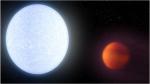
Planet KELT-9b

Planet KELT-9b

Planet is ‘hotter than most stars’
Scientists have found a hellish world where the “surface” of the planet is over 4,000C – almost as hot as our Sun. In part, that’s because KELT-9b’s host star is itself very hot, but also because this alien world resides so close to the furnace.
KELT-9b takes just two days to complete one orbit of the star…more

distribution of planet sizes - NYT

distribution of planet sizes- NYT

Earth-Size Planets Among Final Tally of NASA’s Kepler Telescope
Setting the stage for the next chapter in the quest to end cosmic loneliness, astronomers released a list on Monday of 4,034 objects they are 90 percent sure are planets orbiting other stars. The new list is the final and most reliable result of a four-year cosmic census of a tiny region of the Milky Way…more

A spectrograph of sun's plasma jets -NYT

A spectrograph of sun’s plasma jets -NYT

Solving the Scorching Mystery of the Sun’s Erupting Plasma Jets
Spiky bursts of plasma called spicules swirl around the surface of the sun. Millions erupt every moment, spurting solar material some 6,000 miles high at speeds of about 60 miles per second…more

-NYT

-NYT

Greetings, E.T. (Please Don’t Murder Us.)
A new initiative to beam messages into space may be our best shot yet at learning whether we’re alone in the universe. There’s just one problem: What if we’re not?…more

The Vertex Locator detector -CERN

The Vertex Locator detector -CERN

CERN Physicists Find a Particle With a Double Dose of Charm
Researchers reported on Thursday that in debris flying out from the collisions of protons at the CERN particle physics laboratory outside Geneva, they had spotted a particle that has long been predicted but not detected until now…more

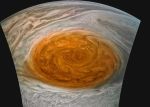
Credit -Jason Major

Credit -Jason Major

Behold Jupiter’s Great Red Spot
An American space agency probe has returned the most detailed pictures ever of Jupiter’s Great Red Spot. The Juno spacecraft passed over the giant storm on Monday as it continued with its series of close passes of the gaseous world…more

James Webb Space Telescope (JWST) mirrors.

James Webb Space Telescope (JWST) mirrors.

James Webb: Swallowing the biggest space telescope
The door has closed on the James Webb Space Telescope (JWST). The successor to Hubble has been locked tight inside a giant chamber where it will undergo a series of tests to simulate conditions off Earth. Engineers must first pump out all the air, and then chill down the telescope to fantastically low temperatures…more

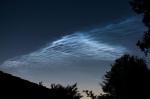
Noctilucent clouds -NatGeo

Noctilucent clouds -NatGeo

Eerie Clouds Glow at Night
In recent weeks, sky-watchers have been reporting nightly outbursts of eerie tendrils glowing in the twilight skies. The hypnotic displays signal the start of viewing season for noctilucent, or night-shining, clouds…more

The rocket carrying the Mayak satellite - Cosmo Mayak

The rocket carrying the Mayak satellite – Cosmo Mayak

Brightest ‘Star’ in the Sky May Soon Be This Russian Satellite
Soon, there may be a new human-made “star” gliding across the heavens that will be brighter than both the International Space Station and the planet Venus. Mayak, the Russian word for “beacon,” is a pyramid-shaped satellite that is the brainchild of a group of students…more

Posted in Mid-summer 2017, Sidereal Times | Tagged , | Leave a comment

From the Director

Rex


by Rex Parker, Director

Remote Astro-Imaging Proposal for Members
Are you ready to move beyond the eyepiece and start doing astrophotography yourself? Would you like to be able to take awe-inspiring astro-images that impress your family and friends? Do you want to extend your technical knowledge by acquiring and processing your own celestial images? If you are thinking “yes” then read on. One of the facts about this avocation is that the equipment and software are expensive. And while you could jump in cold and start using the CCD camera that the club owns, there is another way to start on the learning curve. Through many years in this field I’ve had a chance to meet some very talented folks who have passed along their knowledge, so now it’s time to help pass along some of this to you.

First some background. Although I do a lot of imaging right here in central NJ, my remote observing group (SSRO, Star Shadows Remote Observatory) accesses a telescope in the PROMPT array at the Cerro Tololo Inter-American Observatory (CTIO) in Chile in Chile. PROMPT stands for Panchromatic Robotic Optical Monitoring and Polarimetry Telescopes, designed to study the powerful distant explosions called gamma-ray bursts. Our arrangement to use this telescope is through the University of North Carolina, Chapel Hill, which runs several research programs at CTIO.

Last month I met with the professor who sponsors our remote imaging, Dr. Dan Reichart of UNC’s Physics and Astronomy Dept., at the Morehead Planetarium on campus (photos below). Dr. Reichart and his group developed “Skynet,” a prioritized queue scheduling program running on a computer at UNC. The Skynet Robotic Telescope Network controls several telescopes around the world at observatories in Chile, Australia, Italy, Canada, and US. Each is set up with CCD camera and filters for remote image acquisition. Would you be interested in participating in a “pilot program” for AAAP members to get experience in remote imaging with an account on the Skynet Robotic Telescope Network? A number of tutorial videos are available to help a user get up and running.

This slideshow requires JavaScript.


I have initiated a personal account on UNC’s Skynet with group account capabilities which allows me to administer sub-accounts for AAAP members. The Skynet by-line is “whether you’re a first-time astronomer or a professional, Skynet’s easy-to-use yet powerful interface allows you to get the images you need”. Skynet also has a basic image processing program “Afterglow” that runs on the server, so you don’t need any special software on your PC. You also can download and process your images locally if you like. While there are time limits on the length of exposures, as a training and learning tool Skynet is superb. For more training, you could also enroll in UNC’s for-certificate online astronomy course, which includes 30 min Skynet imaging time, at http://skynet.unc.edu/introastro/ourplaceinspace/. Skynet is ready for AAAP members now – if you are interested in using Skynet for remote imaging, send me a note or talk to me at the meetings as soon as possible.

A role for the Celestron-14 in professional astronomy.
In my meeting with Dan Reichart at UNC last month, he told a story about the Celestron-14 in the picture below. C-14’s are excellent large aperture amateur telescopes, we have one at the club’s observatory, but there’s no mistaking one for a professional research scope. Or is there? Dr. Reichart is an expert in gamma-ray bursts, the very distant, enigmatic and high energy cosmic explosions that have challenged astrophysics for years. As PI of the PROMPT gamma-ray burst project at CTIO in Chile, Dan’s group measures the optical afterglow of the bursts in a collaboration between space-based IR and ground-based optical telescopes. In Sept 2005 using the large 4.1-meter optical and near-IR SOAR telescope at Cerro Pachon in Chile, they detected the optical counterpart to the most distant cosmic explosion ever detected. It was a gamma-ray burst from the edge of the visible universe first seen by NASA/Goddard’s SWIFT telescope, with a redshift of 6.29 translating to about 13 billion light-years from Earth. As confirmation Reichart’s team studied the same exact location in space using a temporary telescope installed at the still-incomplete PROMPT array on the adjacent peak Cerro Tololo — none-other than a Celestron-14 (see photo below)! The data from the C-14 measurements confirmed the interpretation of the SOAR data. Here’s a report from 2005 https://www.nsf.gov/news/news_summ.jsp?cntn_id=104440

Announcements

Board Meeting June 6. The AAAP Board of Trustees will meet on Tues June 6 at 7:30 pm in the Dome Room at Peyton Hall. Board members, committee chairs are urged to attend, and other interested members are welcome. Topics include: Skynet proposal, Jersey Starquest, and administrative changes.

Members’ Night at the Observatory, June 24, dusk till midnight. May 27 did not work out but we’ll give it another try on Sat June 24. The night is reserved for AAAP members, friends, and family, at our Observatory at Washington Crossing State Park, NJ. Even if you know little or nothing about telescopes (especially so) we want to see you out there! Check out the new equipment and software which have improved the observing experience. Experienced members are asked to bring their telescopes to show others. See the website for directions.

Posted in June 2017, Sidereal Times | Tagged , | Leave a comment

From the Assistant Director

by Larry Kane, Assistant Director

I have two brief items of import to the AAAP membership that need updating. The first is the status of our group purchase of AAAP logo shirts and hats. At this writing, the order is ready to be submitted so this is final notice. If you have not, yet, let me know what you are interested in ordering, a T-shirt, a “Polo” shirt or a hat, contact me ASAP and send in your payment. T-shirts with the AAAP logo are $15, Polo shirts are $25 and hats (adjustable) are $15. All items are in black with the two-color logo embroidered on. Let me know the size(s), adult or child, you need and either send the payment to my Pay Pal account (lkane0509@gmail.com) or mail a check to me at 29 George Washington Dr., Monroe Township, NJ 08831. If you hurry, you can still get one of these sought after items. I will submit the order four days after the Sidereal Times is made available.

The other major event, and it’s a big one, is the AAAP Expedition to Oregon to view the August 21st, Total Eclipse of the Sun on property next door to John Church’s brother. As I write this, there are still two motel rooms left under the reservation that I acquired several months ago. Sign-in is August 19 and sign-out is August 21. These rooms are in the Motel 6 Portland-Wilsonville, Oregon. They are about an hour’s drive to our viewing site. So if you are at all interested in either of these rooms, please contact me, ASAP. I have no doubt that this will be an event none of us, who will be in attendance, will forget. So don’t miss out on this opportunity to be a part of the most far-flung AAAP “Field Trip” in memory.

As always, feel free to contact me at either assist.director@princetonastronomy.org or lkane0509@gmail.com or call me at 609-273-1456. Wishing all AAAP members and those they hold dear,

Posted in June 2017, Sidereal Times | Tagged , | Leave a comment

From the Program Chair

By Ira Polans

New Jersey State Planetarium

New Jersey State Planetarium

The June meeting of the AAAP, and our last until next September, will take place on June 13th at the Planetarium of the New Jersey State Museum in Trenton. The meeting starts at 7:30 PM.

In addition to our normal club meeting, attendees will view a live star talk as well as our new science show at the Planetarium, “Wildest Weather in the Solar System“.

There is plenty of parking in front of the planetarium entrance behind the museum. Museum is located at –205 W. State Street, Trenton, NJ 08625.

We look forward to seeing you at the meeting.

Posted in June 2017, Sidereal Times | Tagged , , | Leave a comment

Double Dating

by Theodore R. Frimet

Are Mizar and Alcor sexting?

Mizar was presented to us as an optical double star, by NJ State Planetarium staffer and professional astronomer Bill Murray, at our Bright Spring Deep Sky Objects (DSO) presentation at the planetarium, on a rainy Saturday morning of May 13th.

As Mizar is the first double star on the list (part of the Big Dipper), I made this my priority to learn as much as this amateur could muster. The stellar light, I learned, that appears to broadcast to us from Mizar, is also imparted by its double dater, Alcor.

Mizar and Alcor, after the passing of 120 years of astronomical observation, and research, were revealed to be more than an optical binary. Below, I offer you, below, a revealing look at what is now known to be a our sextuplet!

Zeta Ursae Majoris (aka Mizar A & B), is my newest best friend and first on the bright star DSO list for AAAP Public Nights. Mizar is truly a quadruple system. Alcor, is a binary, and the pair, which I’ll dub, “AlcorUm” is therefore a sextuple (six part) system, about 83 light-years away from Sol..

Referencing author Dava Sobel’s “The Glass Universe”, pages 34-35, we give credit to Edward Pickering who noticed the “unprecedented doubling of the spectrum’s K line” on a Draper Memorial image taken March 29, 1887. Unfortunately, as soon as it was found, it was lost. Later, due to the diligence of Vassar College graduate, Miss Antonia Maury, (with honors in physics, astronomy and philosophy), saw it once again on January 7, 1889.

Sobel writes that Pickerings note read that sometimes it appears as a single, and at other times, a double! His theory eventually was proved that the small k-line separation effect is due to the two stars rotation about each other and that it completes “an orbital period every six months” (Wikipedia – Mizar and Alcor – May 13th 2017 19:42)

To be rock solid truthful, however, although the Draper Memorial group were the first to spectroscopically observe this double dating duo, credit is also due to Riccioli in 1650, G. Kirch and spouse in 1700, and “measured repeatedly since the time of Bradley in 1755”, as read from Robert Burnham’s Celestial Handbook, Volume 3, pages 1953-1954.

From Burnham we find that our optical double star has an observed separation of 8 degrees within the span of 200 years, then the period of our visually observed binary is many thousands of years. A quoted reference from Miss Agnes Clerke in 1905 speaks of a “possible accomplishment of a circuit in 10,000 years…”. Full rotation however, is reported occurring every 20.5386 days. I conclude that Miss Clerke was referring to the separation of the optical binaries, as they fall towards each other gravitationally, and push apart with their remaining momentum. As an aside, if we were able to live a few “circuits”, due diligence would divulge chaos directing the non-ordinary push and shove of such a system. This theory of mine is the result of my most current fling with author, James Gleick’s “Chaos, Making a New Science”.

Ms. Clerke made her observations two years after her honorary election into the Royal Astronomical Society, along with Lady Huggins, in 1903. She was the third woman to have held this rank. Ms. Clerke is referenced in the Sobel bibliography. I must admit to being a slow savory reader, and not having finished The Glass Universe, I cannot vouch for this lady of the Royal Astronomical Society being a Harvard Computer per se. However, at the speed of wiki, we find that overseas she was known for her collating, interpretation and summarization of astronomical research. (Wikipedia – Agnes Mary Clerke – May 14th 2017, 17:36 ).

In summary, so far…“Mizar A was the first spectroscopic binary to be discovered, by Pickering in 1889. Some spectroscopic binaries cannot be visually resolved and are discovered by studying the spectral lines of the suspect system over a long period of time. The two components of Mizar A are both about 35 times as bright as the Sun, and revolve around each other in about 20 days 12 hours and 55 minutes. Mizar B was later found to be a spectroscopic binary as well, its components completing an orbital period every six months.” (ibid)

Mizar’s fainter component, however, has different observed velocity shifts, and periods. Additional measurements showed us a third star within its grasp. Our wiki reference, and subsequent Google search leads us to an article at Sky and Telescope ( http://www.skyandtelescope.com/observing/mizar-a-fresh-look-at-an-old-friend03252015/ ) where further spectroscopy reinforces the observation that Mizar B to be a close orbiting pair of stars.

According to author and amateur astronomer Bob King, in his March 25, 2015 web article cited above, our optical binary double daters have not been found to be outside the family of our sextuplets, since 2009. It was at that time that space.com reported that the 200 inch Hale telescope at California’s Palomar Observatory discovered the companion to Alcor, an M-dwarf star, more commonly referred to as a “red dwarf”. Despite it’s small sounding name, the 2009 observation reports it to be “250 times the mass of Jupiter”, which is according to my star sense, bigger than a bread box, and one-fourth the size of Sol.

With our ventures into exoplanets, perhaps a vying eye, with an acquaintance with high resolutions, (gigahertz, hint hint radio astronomers…) we may be pleasantly surprised with a septuple (seven parts) or a perhaps even a new planetary discovery in AlcorUm.

If only red shift detection could be done at will, and fully funded to keep research active for years to come at the Green Bank Telescope, West Virginia, we’d only need to ask once or maybe twice for a peek under the bed-sheets of our sextuplet daters.

Posted in June 2017, Sidereal Times | Tagged , | Leave a comment