
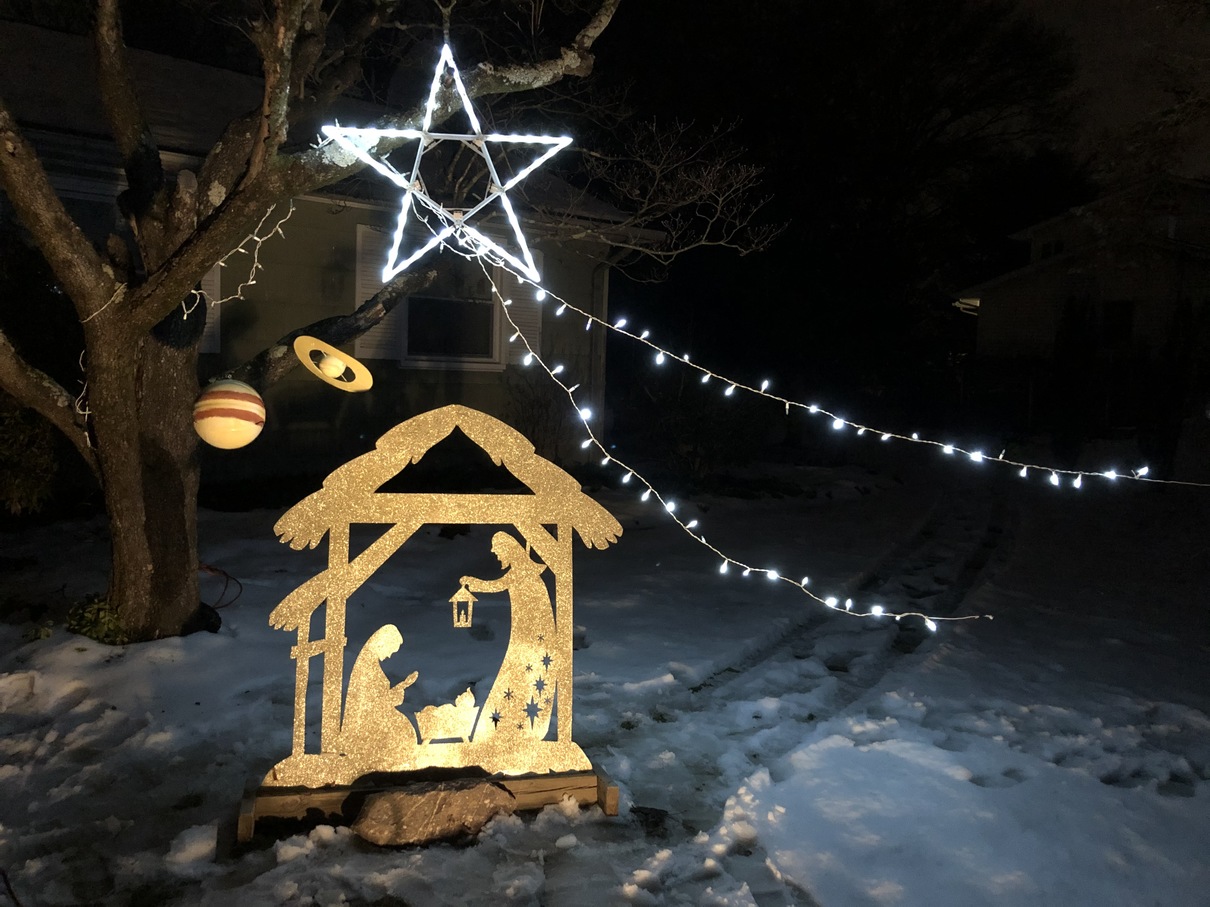
Dave and Jennifer Skitt
by Gene Allen
In early 2020 Celestron introduced a line of low-end telescopes which include some very high-end technology. They did themselves and their customers a great disservice by re-using the StarSense label, because this new tech is orders of magnitude different from all earlier components bearing that name. I purchased and use a $300 StarSense accessory on my AVX mount. It is a camera that does a respectable job of automating a 3-star alignment. It picks up the data from the GPS accessory and, on a GEM, requires that a decent polar alignment has been otherwise accomplished. Similar tech seems to come included on some fork-mounted SCTs, but it is just that: automated multi-star alignment.
To distinguish the new technology one must use “StarSense Explorer,” and so far that only describes four below-entry-level, alt-az, push-to scopes. The genuine magic of the SSE tech is that it uses your fairly late model smartphone to actually plate solve a view of the night sky and present arrows to direct you to your chosen target. The cellphone clips into a bracket with a mirror that offers the phone camera a sufficient chunk of sky. Using a distant target in daylight, you tweak the center of the camera view to match the center of the eyepiece view, and you’re done. No pole star, no star alignment at all – ever. A free app runs the camera and does all the calcs internally, so no internet needed. It is reported to do a great job in all but the most heavily light-polluted skies. It can even be interrupted to answer a phone call without having a seizure. If the tripod is kicked or moved to get a target out of the trees, it re-solves in moments and happily continues. The catalog includes only Messier and Caldwell entries (and their NGC equivalents), but the two big disappointments are that the app needs an activation code to provide the pointing directions, and the code and phone dock are only offered with a telescope purchase. They are not (yet?) available as a separate accessory.
Having read through the 27 pages (as of this writing) of the leading SSE thread on CloudyNights after Dave Skitt brought it to my attention, my conclusion is that the only possible contender of the four is the 130mm reflector for $400. Most components are plastic and flimsy, stretching for bottom dollar. The 114mm reflector is of the discredited Bird-Jones design, and the two LT models ($180) have even less capable tripods and slo-mo control of only altitude. One respondent upgraded the focuser, diagonal, and eyepieces on the 102mm refractor, and then returned it because it still provided inadequate views when compared to his WO 102. Part of the issue is that for nearly the same money as the somewhat better DX models one can buy significantly better optics with conventional go-to automation and tracking.
As one might expect, the CN crew jumped right on it, cannibalizing scopes to jury rig the docks onto capable tubes of all types. My informal sense of the more than 600 entries is that the majority deal with just that. There are numerous appeals for Celestron to offer a semi-universal, maybe dovetail-mounting version of the dock plus the activation code as a separate accessory. Will Celestron do so, or offer it on better tubes? They will miss a tremendous opportunity if they persist in limiting SSE to dismal hardware. The good part is that now that they have shown what’s possible, others are likely to take up the cause. Open source plate solving algorithms are reportedly available, and some wizard will likely reverse engineer the app or come up with their own. Designs to 3D print a lighter weight (though less universal) dock are already underway.
So, returning to Dave’s original query, StarSense Explorer scopes offer unmatched technology on hardware that cannot be recommended with any confidence. Please do your own research and draw your own conclusions. Mine is that they offer exciting potential but are sadly not ready for even beginner prime time. Artemis says, “We go.” I say, “We wait.”

My name is Titus Magnanao. I am new member of the AAAP. I became interested in astronomy after I watched Carl Sagan’s PBS Cosmos series. I am a recently retired environmental engineer from the NJDEP. After not owning a telescope after all these years my wife bought me a telescope on our 20th wedding anniversary. I am thrilled to have it and have diligently been scanning the night sky the past few months. Thank you and I am glad I joined the AAAP. Happy New Year!
compiled by Arlene & David Kaplan
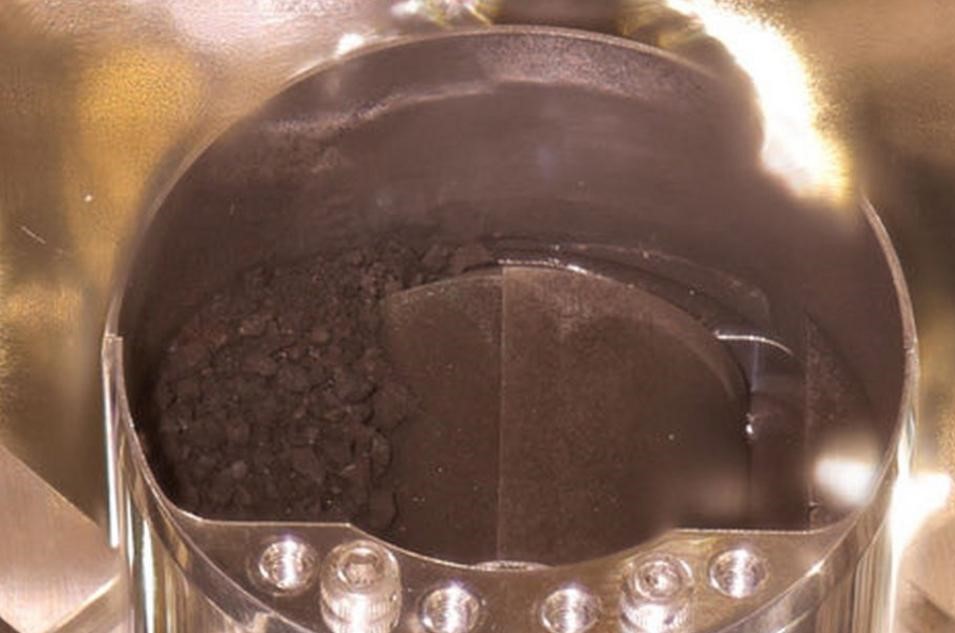
Jupiter, Saturn Will Look Like Double Planet Scientists have been greeted by the sight of jet black chunks of rock and soil from an asteroid after opening a capsule that returned from deep space a week ago. It’s the first significant sample of material to be delivered to Earth from a space rock and was grabbed last year by Japan’s Hayabusa-2 spacecraft…more
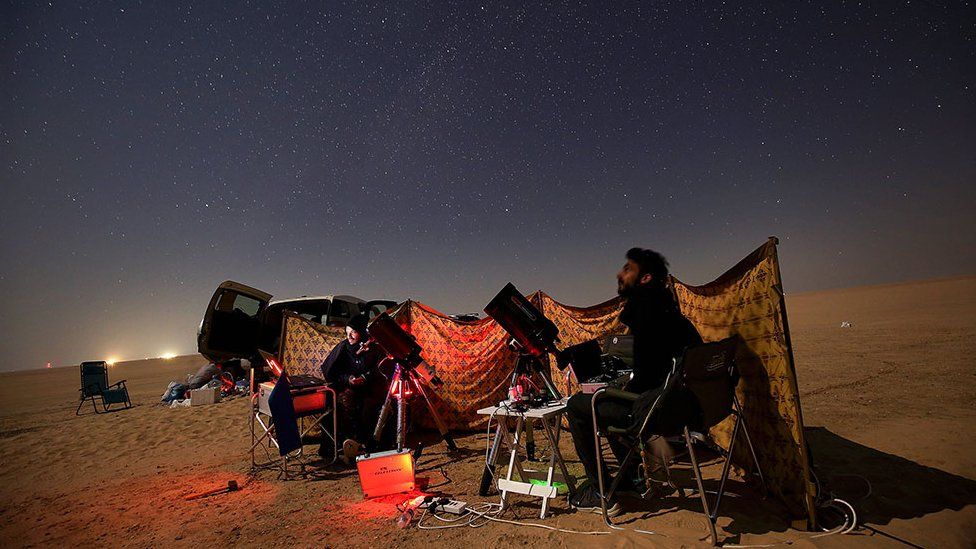
In pictures: The great conjunction It might be Christmas, but for keen stargazers this was the time when Jupiter and Saturn crossed paths in the night sky, reaching their closest point on 21 December. Photographers have been out recording the moment…more
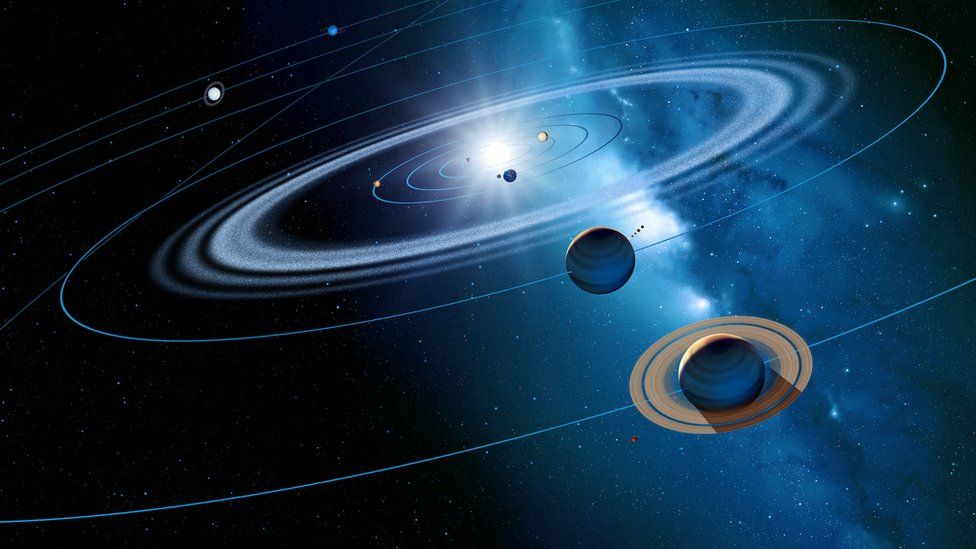
Christmas star: Jupiter and Saturn align in the night sky Jupiter and Saturn have crossed paths in the night sky, appearing to the naked eye as a “double planet”. The timing of this conjunction, as the celestial event is known, has caused some to suggest it may have been the source of a bright light in the sky 2,000 years ago. That became known as the Star of Bethlehem…more
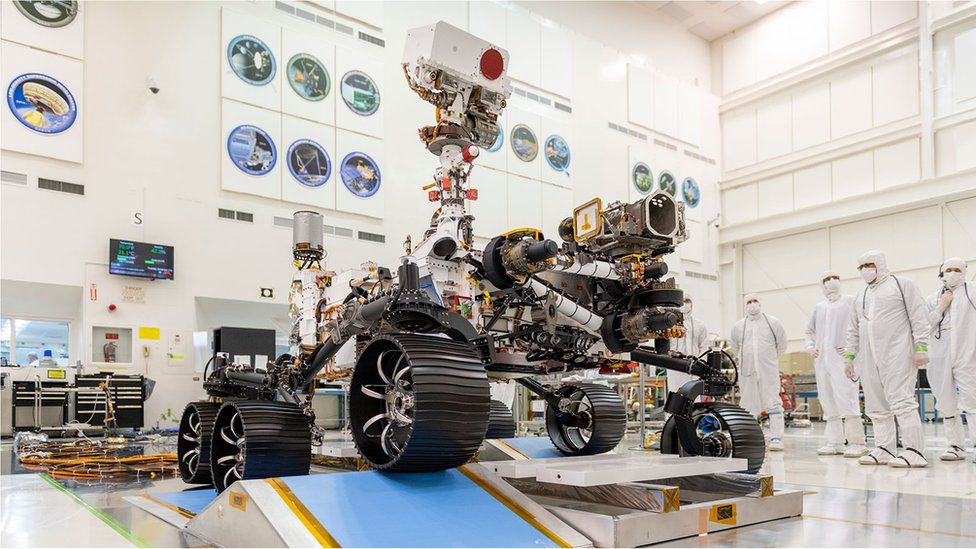
Nasa’s Mars rover and the ‘seven minutes of terror’ The US space agency (Nasa) has released an animation showing how its one-tonne Perseverance rover will land on Mars on 18 February. The robot is being sent to a crater called Jezero where it will search for evidence of past life. But to undertake this science, it must first touch down softly…more
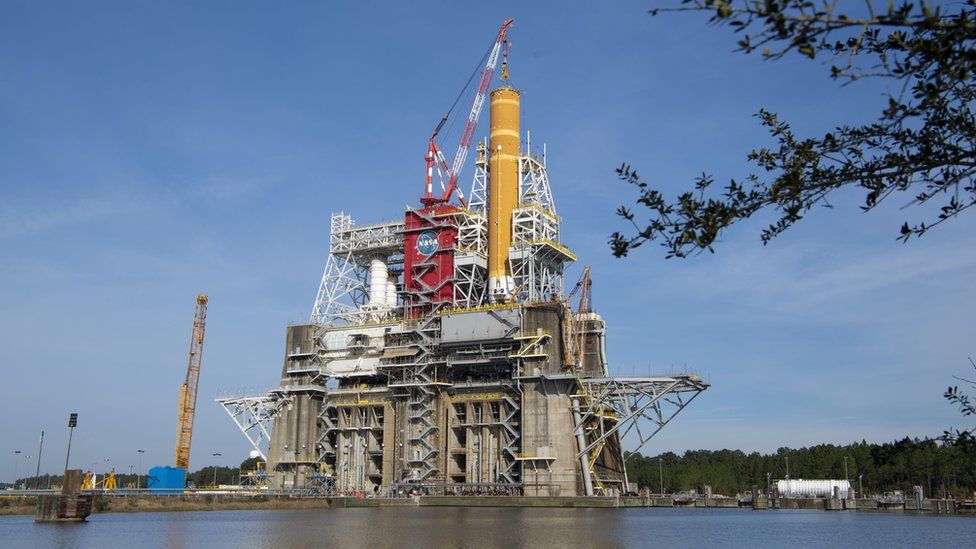
Nasa’s new ‘megarocket’ set for critical tests Nasa has been developing a “megarocket” to send humans to the Moon and, eventually, Mars. The last critical tests of the giant launcher’s core section are expected to take place within the next few weeks. Sometimes compared to the iconic Saturn V, can the Space Launch System (SLS) help capture the excitement of lunar exploration for a new generation?…more
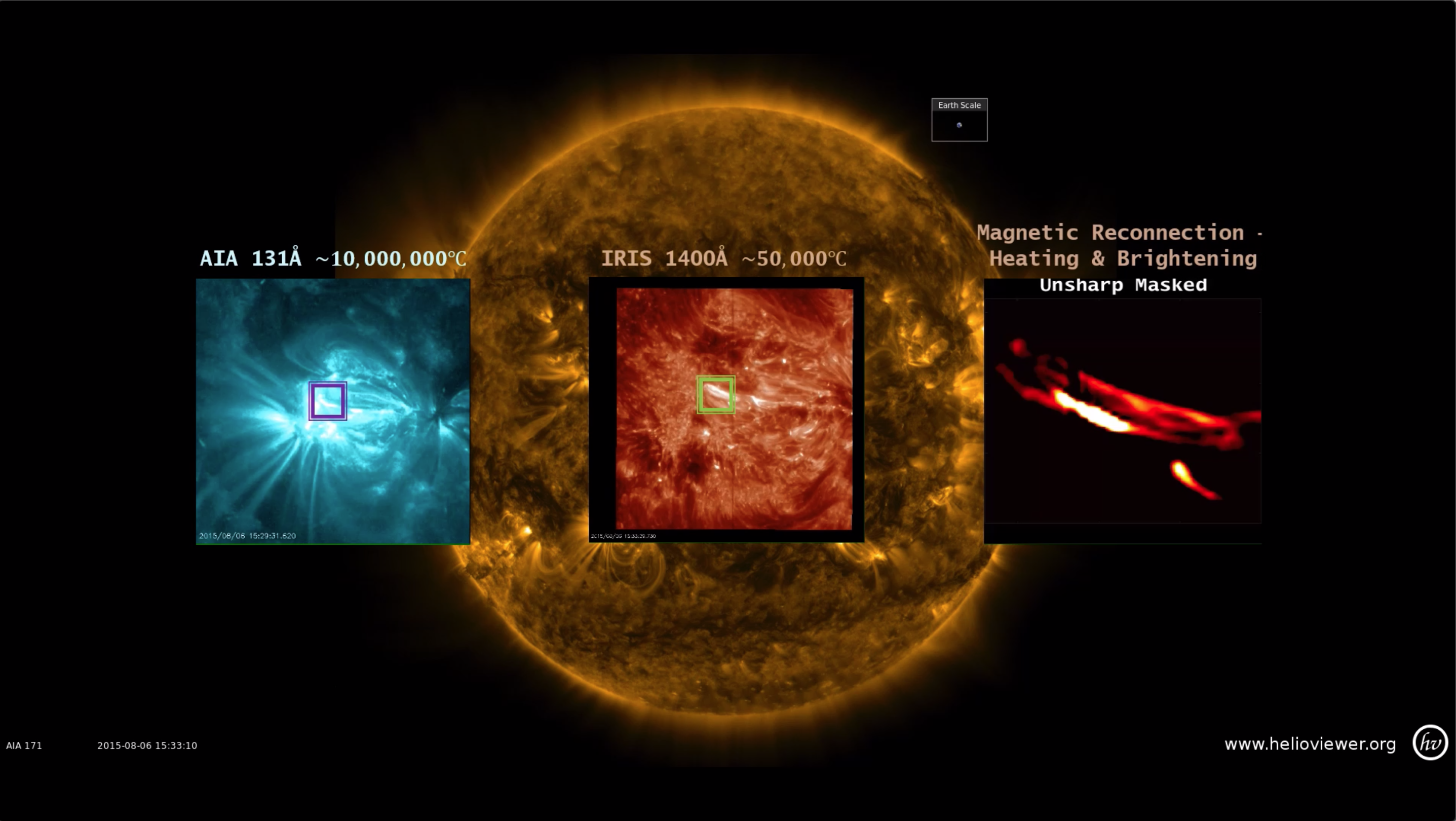
This May Be the First Complete Observation of a Nanoflare Researchers may have found the long-sought “nanoflares” thought to heat the solar corona to its incredible temperatures. A new study published in Nature Astronomy marks the first time researchers have captured the full lifecycle of a putative nanoflare – from bright origins to blistering demise…more
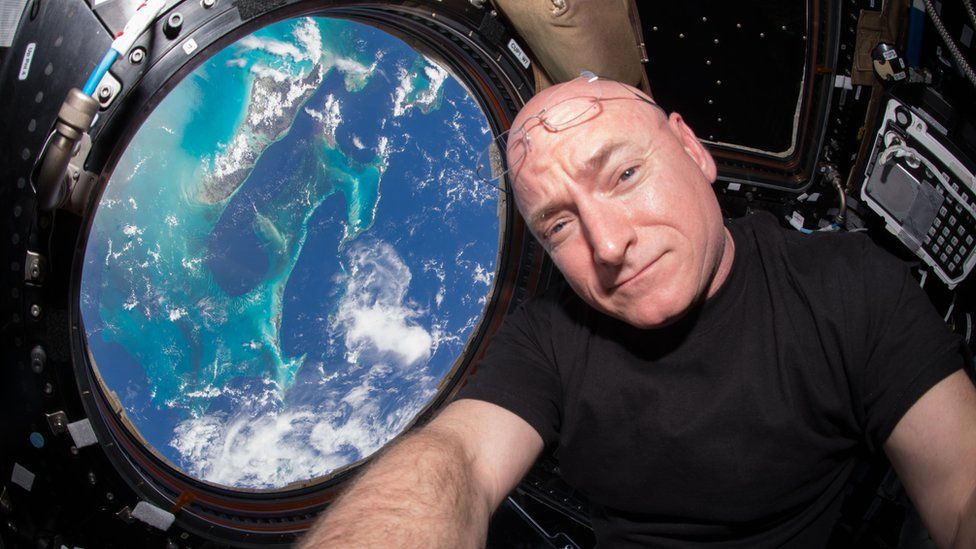
Astronaut Scott Kelly: How to survive a year in space Astronaut Scott Kelly tells the BBC how he managed to live for a year on the International Space Station and why, four years into his retirement from Nasa, he would go back if someone asked. It’s 16 July 2015, and all three occupants of the International Space Station are squeezing ..more
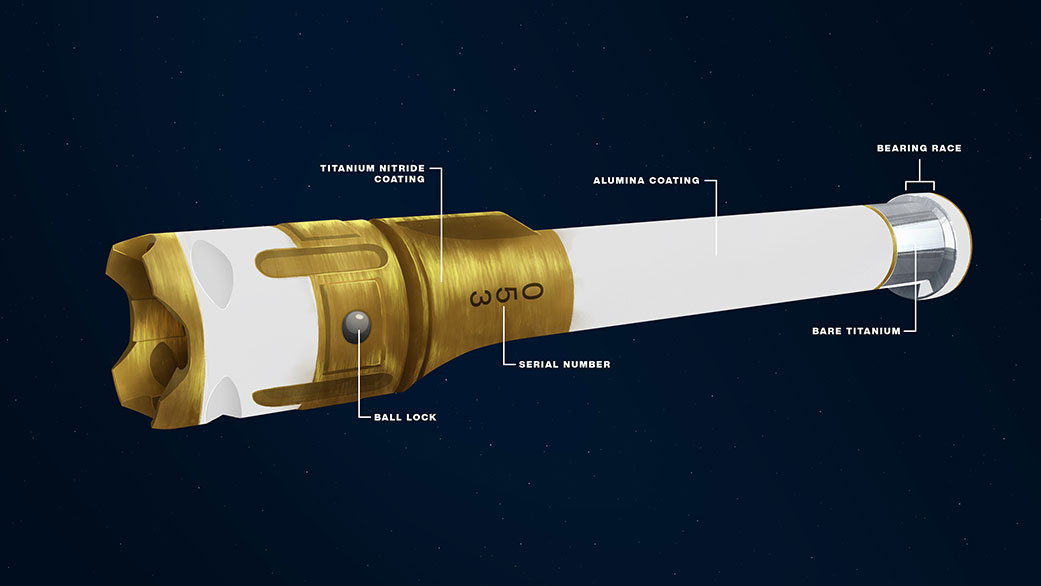
A Martian Roundtrip: NASA’s Perseverance Rover Sample Tubes The tubes carried in the belly of NASA’s Mars 2020 Perseverance rover are destined to carry the first samples in history from another planet back to Earth. Future scientists will use these carefully selected representatives of Martian rock and regolith (broken rock and dust)…more
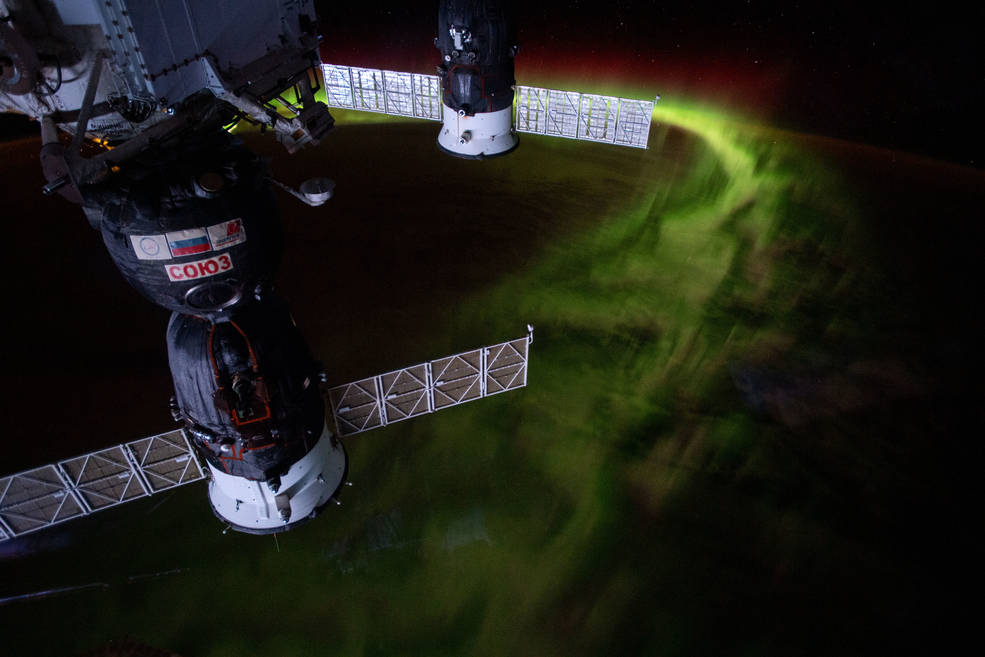
NASA Approves Heliophysics Missions to Explore Sun NASA has approved two heliophysics missions to explore the Sun and the system that drives space weather near Earth. Together, NASA’s contribution to the Extreme Ultraviolet High-Throughput Spectroscopic Telescope Epsilon Mission, or EUVST, and the Electrojet Zeeman Imaging Explorer, or EZIE, will help us understand the Sun and Earth as an interconnected system…more
Join us for the great conjunction tonight, Friday, December 18 on solstice day, December 21 right after sunset (4:37pm). You can join the live astro video session via Zoom produced by the AAAP astro-video group. If conditions are favorable we will stream from the club’s Washington Crossing Observatory with the Celestron-14 as well as with additional member telescopes. Weather permitting, we will begin shortly after sunset at 4:37pm as soon as the skies are dark enough to use the imaging cameras. It will be tricky because of the low position in the southwestern sky, only 17 degrees above the horizon at 5:00pm. A conjunction occurs when two planets reach their minimal angular separation in our skies. This one will be remarkable because the Jovian planets will be only ~0.1 degrees apart, close enough to fit within the field of view of the telescope/camera setup. Conjunctions of Jupiter and Saturn happen every ~20 years but this one will be the tightest since 1623!
The link below will take you to Zoom meeting information posted on the website. Friends and family are welcome to join the session (if we hit our limit you may need to wait). If weather dictates, the date may shift a couple days either way – stay tuned to the website announcement.
by Robert Vanderbei
The conjunction of Jupiter and Saturn will take place in the late afternoon and early evening of Monday, December 21. On that day, the Sun will set at 4:35pm.At that time, Jupiter and Saturn will be low in the southwestern sky, just 20degrees above the horizon. Also, at sunset, the sky is still bright like daytime. For those observers with binoculars, it is possible to find Jupiter at sunset. But, it’s a challenge. Fortunately, darkness comes quickly and by 4:45pm, or maybe 4:50pm, Jupiter should be easy to find in binoculars and also findable without binoculars. At 4:50pm, Jupiter and Saturn will still be 18 degrees above the horizon. It’s low but not terribly low. The separation between the two planets will be just roughly 6 arcminutes. So, for those who have a telescope the conjunction will be an awesome sight. And, for those members who are into astrophotography, it will be a once in a lifetime opportunity to take pics of the event.
But, there will be some serious challenges. Jupiter will be 2.5 magnitudes brighter than Saturn. That’s a factor of 10 times brighter. So, a photograph that nicely shows Jupiter will have Saturn looking very dark. To make a good picture, one will need to take images with different exposures and then do some sort of “high dynamic range (aka HDR)” combo of the images. In addition to Jupiter and Saturn themselves, we’ll also get to see some of their moons. But, the moons will be even fainter and that makes the HDR imaging an even bigger challenge. Also, the fact that this event will only be about 18 degrees above the horizon will mean that the atmospheric “seeing” is likely to be bad. Shown here are two screenshots from the planetarium program Cartes du Ciel (aka Sky Charts) showing how things will look at 4:50pm. One picture just shows Jupiter, Saturn, and their moons. The other picture shows the various stars that are also in this field of view. Jupiter has four bright moons. From left to right they are Callisto, Io, Ganymede, and Europa. Saturn has lots of moons. From left to right, they are Lapetus, Hyperion, Rhea, Mimas, Enceladus, Dione, Tethys, and Titan. Of Saturn’s moons, Hyperion is the dimmest. It’s magnitude 14.9. That magnitude can be seen in, say, 10 second long astrophotographs, but is not visible visually through most amateur telescopes. And, the not completely dark sky will also be a problem. Saturn’s brightest moon is Titan at magnitude 9.0. If the skies are dark enough, that moon could be seem visually through a telescope. The four moons of Jupiter are all about magnitude6 and things of that magnitude do appear in astrophotographs taken at dusk.


by John Church
As we are all aware, there will be a close conjunction of Jupiter and Saturn in the evening sky of Monday Dec. 21, which coincidentally is the same day as the winter solstice. Jupiter passes Saturn once in about every 20 years as seen from Earth, but in most cases they are not nearly so close together in the sky as they will be this time.
About 30 years ago I became interested in such conjunctions as close as or closer than 6 arc minutes, and I researched them with the aid of advanced ephemeris technology. (The upcoming one will be 6.1 arc minutes at closest approach, but I included it as being in the foreseeable future.) I wrote up my results and sent an article to Sky & Telescope for consideration in the Astronomical Computing feature moderated by Roger Sinnott. A corollary was my finding that Jupiter hadn’t actually occulted Saturn as far back as 4000 BC, and won’t do so until at least the year 2800 AD.
Because the ecliptic passes near Regulus (Alpha Leonis, often called the “Royal Star”), I was especially intrigued by close conjunctions that have occurred in its immediate neighborhood, i.e. within 10 degrees. Such events might have had significance for contemporary astrologers. The events of 1794-3 BC struck me as having been possibly associated with the rise of Hammurabi, the “lawgiver king” of Babylonia (reigned ca. 1792-1750 BC). The fine 940 BC triple conjunction near Regulus might have had some connection with King Solomon (reigned ca. 970-931 BC); the lion has long been associated with Israel, and both the five-and six-pointed stars have been called the Seal of Solomon. The coming event is not near Regulus, but is still quite interesting as it will be the closest such conjunction readily visible since the year 1226.
The following table is abridged from my original data. My article appeared in the March 1991 issue of Sky & Telescope, pages 305 to 307. Those who may be interested in the entire article may be able to make copies for their own private use from back issues kept in one of the branch libraries of Princeton University. In the past, these branches have been open to the public free of charge; this may again be the case after the Coronavirus issue has passed. Unfortunately I have no photocopies available.
| Date | UT(hr) | Separation (arc min.) | Celestial Long. (Deg.) | Elongation From Sun (Deg.) | Remarks |
| 4/6/3780 BC | 0 | 5.3 | 266 | 80 W | Fine double (T) |
| 6/28/3501 BC | 20 | 4.5 | 91 | 23 E | Fine double |
| 3/9/3441 BC | 20 | 5.9 | 100 | 137 E | Fine double (T) |
| 3/22/2926 BC | 19 | 1.5 | 273 | 65 W | Naked-eye merge |
| 6/5/2647 BC | 21 | 3.9 | 96 | 45 W | Spectacular (R) |
| 3/16/2072 BC | 20 | -2.4 | 281 | 57 W | Possible Merge |
| 10/7/1794 BC | 23 | 2.7 | 106 | 74 W | Possible Merge (TR) |
| 1/19/1793 BC | 18 | -5.4 | 103 | 178 E | Fine double (TR) |
| 5/1/1793 BC | 2 | 1.3 | 101 | 76 E | Naked-eye merge (TR) |
| 12/26/1278 BC | 3 | 3.3 | 280 | 16 E | Spectacular |
| 9/4/940 BC | 1 | 3.5 | 110 | 42W | Spectacular (TR) |
| 12/28/424 BC | 10 | -1.5 | 298 | 17 E | Naked-eye merge |
| 8/11/86 BC | 18 | 3.7 | 115 | 20 W | Spectacular (TR) |
| 6/29/26 BC | 1 | 16.1 | 123 | 30 E | (TR, M) |
| 3/6/372 AD | 13 | 1.9 | 294 | 53 W | Possible Merge |
| 3/5/1226 AD | 4 | -2.2 | 303 | 49 W | Possible Merge |
| 12/21/2020 AD | 18 | 6.1 | 300 | 30 E | Fine double |
| 3/15/2080 AD | 1 | -6.0 | 312 | 44 W | Fine double |
| 8/24/2417 | 16 | -5.4 | 125 | 27 W | Fine double |
Notes to the table: All dates before 2020 AD are in the Julian rather than the Gregorian calendar. A negative sign under “Separation” indicates that Saturn was or will be south of Jupiter at the time of closest approach. Celestial longitudes are measured along the ecliptic eastward from the vernal equinox of date. “T” means that the event is part of a “triple conjunction” of the two planets; “R” means the event was near Regulus, and “M” means that there was also a “massing” of other planets in the vicinity. This was the case with the 26 BC event (not a particularly close one), but included because of this as well as nearness to Regulus. Events closer to the sun than 15 degrees were omitted. Please see the original of the article for full details and accompanying illustrations.
by Robert Vanderbei
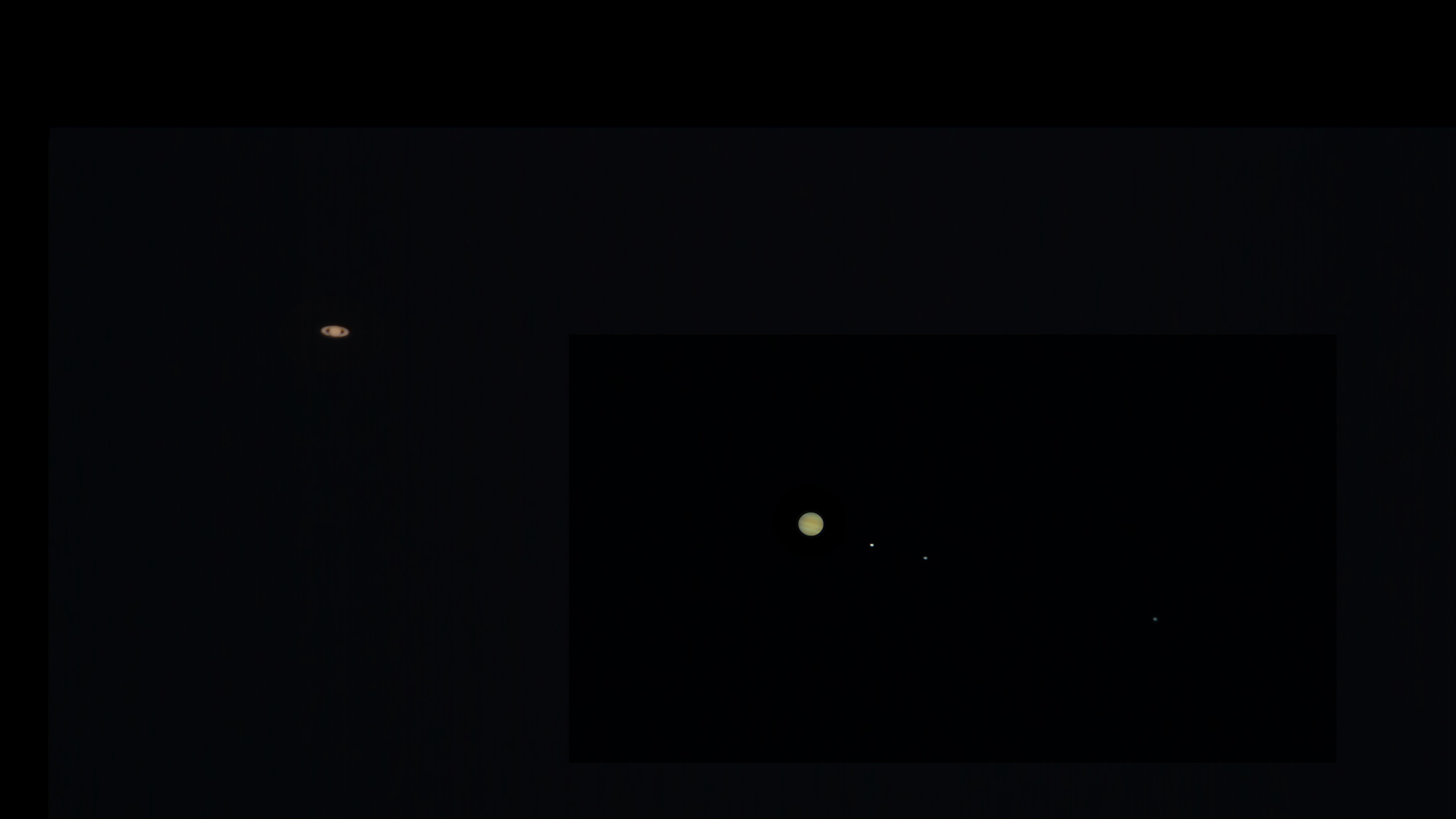
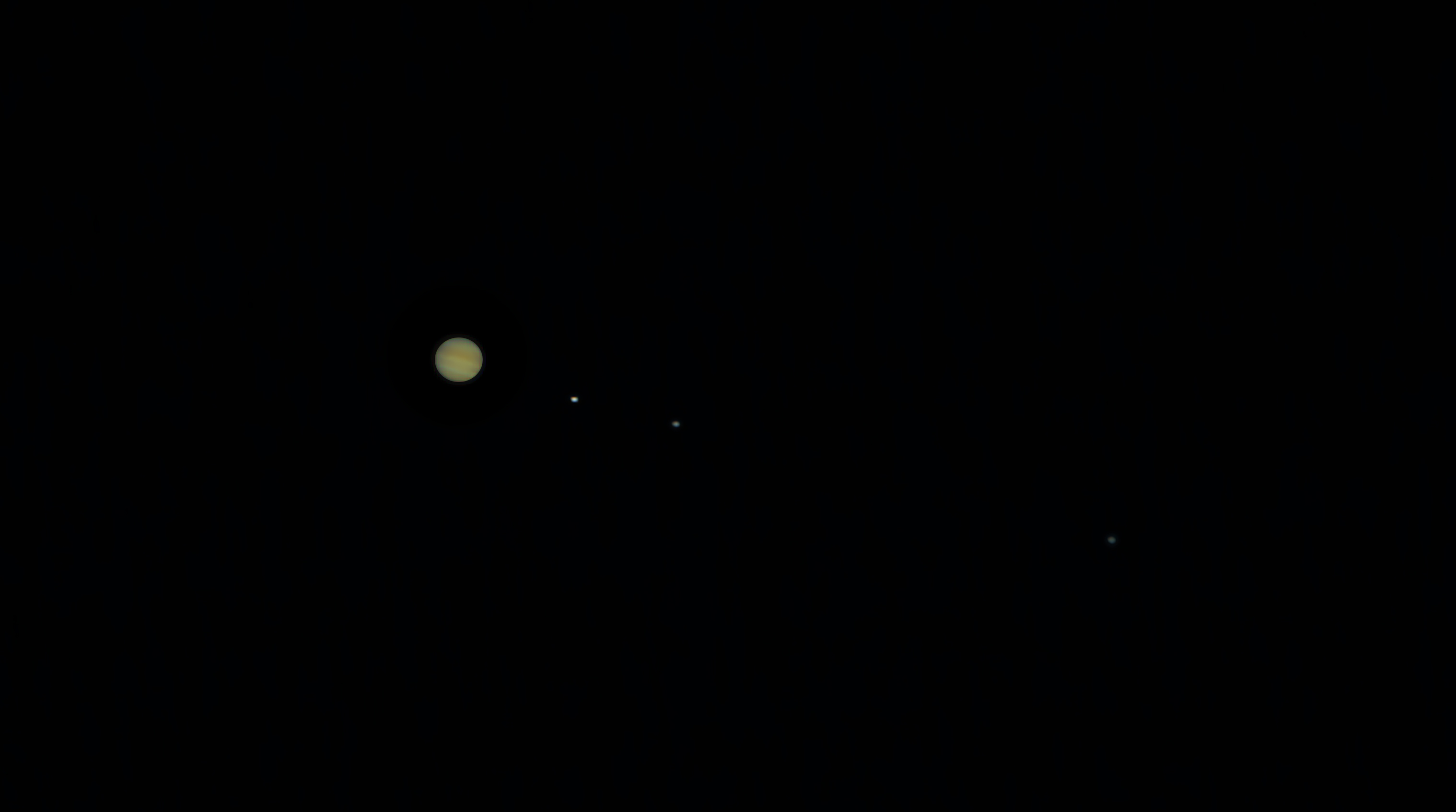
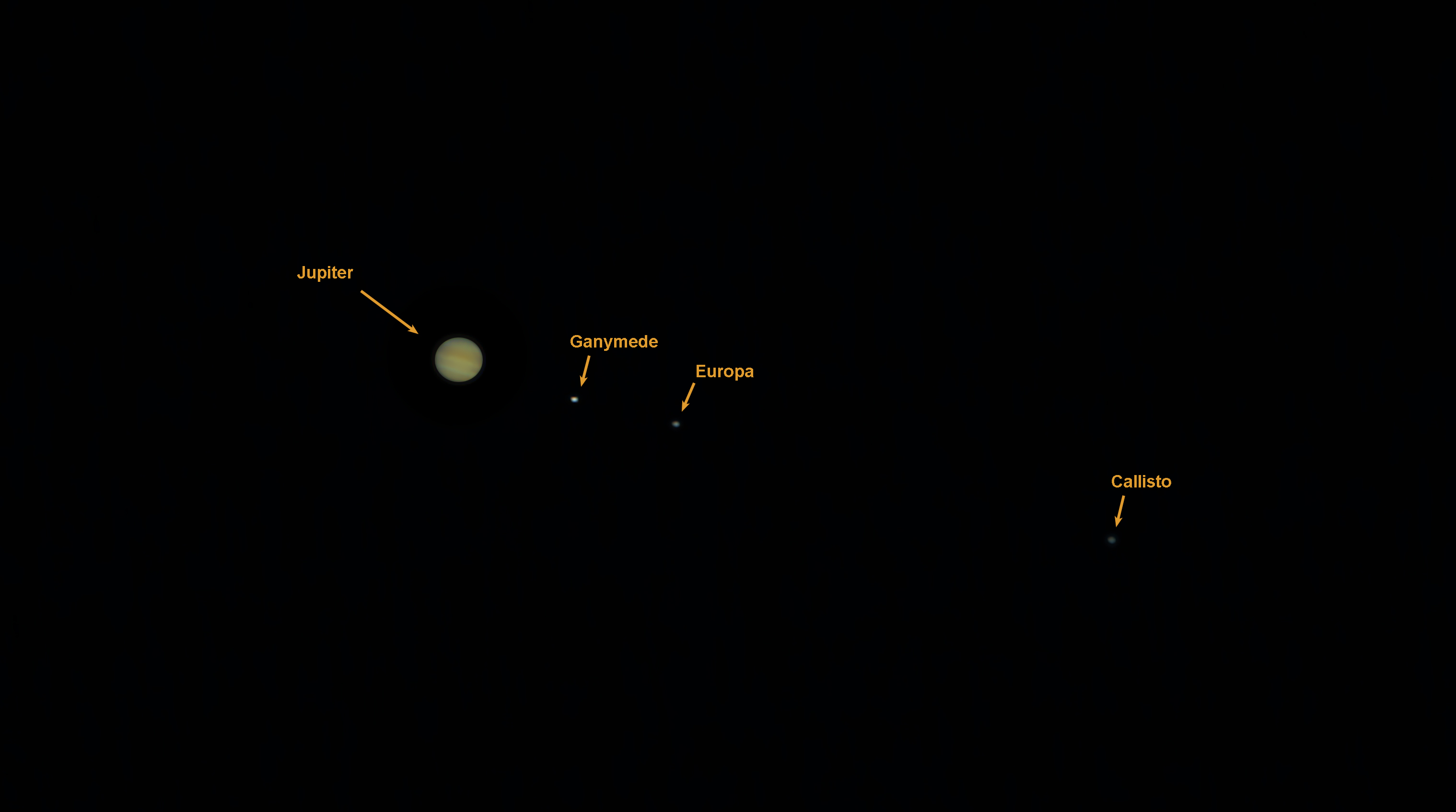
On Monday, Dec. 21, Jupiter will “lap” Saturn in their mutual race around the Sun. At the closest approach, their angular separation will be just 6 arcminutes. That’s the closest Jupiter/Saturn conjunction in about 400 years. And, it will happen on the day of the winter solstice. This will be an interesting event to see especially if viewed through a telescope. In preparation for the event, I have in recent weeks taken some pics of Jupiter and Saturn using my 10-inch Ritchey-Chretien telescope. Shown here is a mosaic image I made from two distinct pictures, one of Jupiter and one of Saturn taken at about 4:45pm on December 10. I made the mosaic showing what a 6-arcminute separation would look like. By the way, one of the really cool things was that my picture of Jupiter also has Ganymede, Europa and Callisto in it. That’s pretty cool given that it was only just a few minutes after sunset when I took that picture. It was not yet dark outside.
by Robert Vanderbei
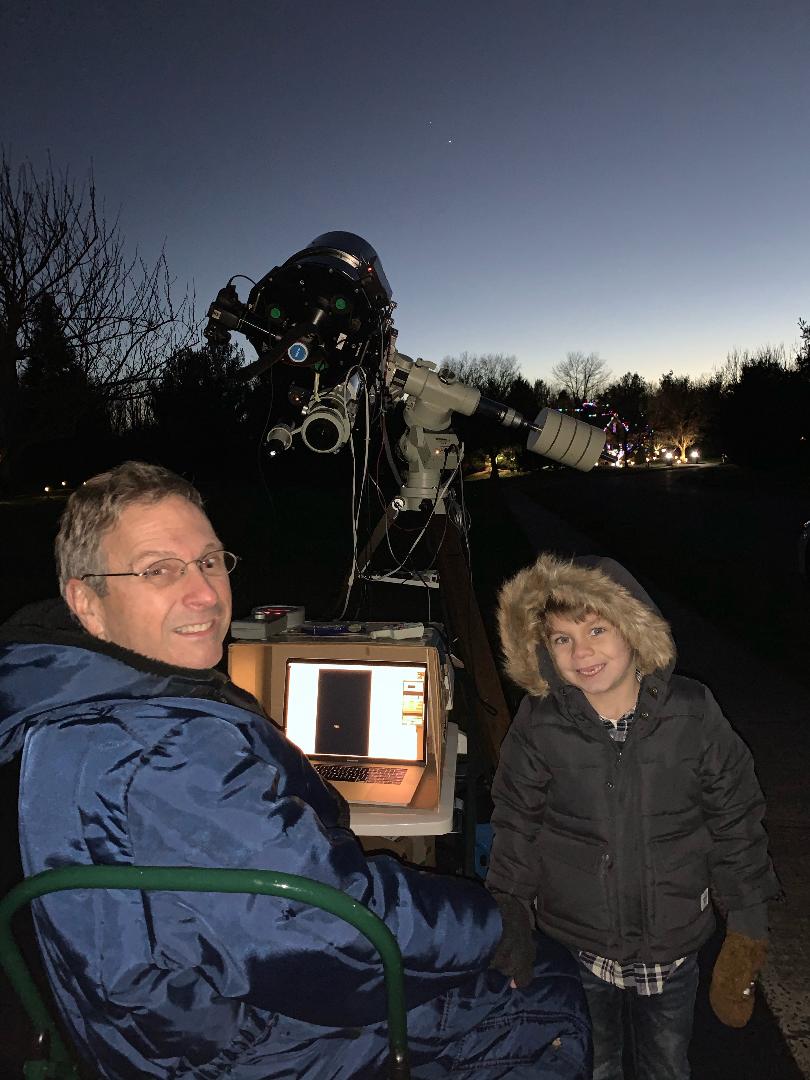
You can see both Jupiter and Saturn in the sky and Saturn on my computer’s screen too.
by Richard Sherman


 Amateur Astronomers Association of Princeton