● Rex Parker announced the Washington Crossing State Park gave permission to proceed with the WC Observatory support columns repair.
● The monthly Member Meeting is now being streamed to Yahoo, for real-time and archived viewing, initialized by Ira Polans and David Skitt.
● R. Parker displayed various astrophotos: H II star-forming regions within and outside the Milky Way Galaxy.
● The evening’s guest speaker, Princeton University’s Guðmundur Stefánsson, Ph.D., was introduced by Program Chair Victor Davis. Stefansson’s presentation was titled: Searching for New Worlds with Next-generation Astronomical Instruments. Initially, there were approximately 55 attendees. The talk was well received.
● About 9 P.M., the Journal Club presentation was made by member Ira Polans. Titled: “Johannes Kepler, Parallax, and the Astronomical Unit”, the book describes how Kepler and his contemporaries measured the size of the Solar System.
Business Meeting:
● Assistant Director Larry Kane reviewed his observatory repair fundraising efforts. Treasurer Michael Mitrano reported these fundraising contributions from AAAP members have currently totaled about $4,000+.
● David Skitt reviewed the club’s membership to the Night Sky Network (NASA) and how it can benefit individuals at the AAAP. https://nightsky.jpl.nasa.gov/index.cfm
● Dave also had a Zoom meeting with a member of the public wanting advice on buying a telescope. This was followed by statements from several members who were also approached to give advice on the same subject.
● Dave and Tom Swords discussed the purchase of “Bahtinov masks” to aid in the focusing of telescopes and cameras..
Objectives for smaller telescopes are sometimes designed to conform to the “Herschel condition” proposed by John Herschel in two papers in the early 1820’s. These objectives perform well at nearby distances as well as on celestial objects at infinity in restricted fields of view. They don’t, however, completely satisfy Abbe’s 1873 sine condition for zero coma, although they usually show very little of this particular aberration.
Hastings wrote that our present lens resembled a Herschel in design, but he didn’t reveal his actual calculations. I find that at 5614 A., near the middle of the visible spectrum, A. E. Conrady’s quantity known as “offense against the sine condition” (OSC) is – 0.00026 for our lens: this is small, but not zero. When scaled to the size of our lens, I find an OSC value of + 0.00022 for one purposely-designed Herschel lens (Boutry, “Instrumental Optics” p. 143) at 5460 angstroms, also near the middle of the spectrum. These values are far below Conrady’s maximum tolerance of +/– 0.0025 for a visual teslescope.
Objectives can be designed to show OSC values of +/- 0.00001 or even less. The formula set that I gave in Sky & Telescope for November 1984 (based on the 18th-century work of Clairaut and d’Alembert as adapted in 1887 by C. Moser) does this quickly. The spot diagrams in my January talk show that coma for our lens is indeed very small, even as far as half a degree off-axis (full field one degree, or about two moon diameters).
Hastings concentrated on correcting spherical aberration, and he succeeded with this in all his work. He was also an early supporter of making the minimum focus at the middle and brightest part of the visible spectrum near 5600 A. instead of at the usual longer wavelength of the sodium D2 line at 5890 A. He did this in the form of our 1879 lens and a 4-inch flint-in-front predecessor, as well as with larger objectives made later.
I’ve recently been able to “deconstruct” Herschel’s design procedures as published in an Edinburgh scientific journal in 1822. This wasn’t easy due to Herschel’s use of an algebraic sign convention differing from the one used today, and his numerical tables required nonlinear interpolation. My provisional conclusion is that our 1879 lens isn’t a Herschel type. Neither did Hastings use the older and better methods of Clairaut and d’Alembert. Whatever particular method Hastings did use, it still resulted in an excellent lens.
After the weather gets better, I intend to make some simple empirical tests to see how our lens works on objects 50 to 75 feet away. According to Conrady, Fraunhofer made such tests in the halls of his workshop at the Benediktbeuern cloister in Bavaria. If so, then he might have been making Herschel-type objectives, consciously or otherwise. After March 1821 he would likely have known about Herschel’s published work.
Interestingly, as shown 12 years after making our lens, Hastings by then had become less of an admirer of Herschel’s design methods (Sidereal Messenger Vol. X, 1891, p. 315). This was part of a long essay on the history of telescopes delivered as an address at the dedication of the Goodsell Observatory at Carleton College in June of 1891. At this period Hastings was a consultant to Brashear and had designed the 16.2-inch lens of Carleton’s new telescope.
Herschel did visit Benediktbeuern in 1824 (Fraunhofer died in 1826). Herschel had hoped to learn more about Fraunhofer’s secret methods of making exceptionally fine optical glass, but in this he was disappointed (Myles Jackson, “Spectrum of Belief”, MIT Press, 2000).
Speaking of Fraunhofer, it’s odd that he seems to have been unaware of the 1760’s work of Clairaut and d’Alembert on fully correcting coma. Fraunhofer left so few written records that we’ll probably never know if he did or not. In support of his not knowing is the fact that at least some of his finest products do have a small amount of coma, as mentioned in my 1984 article.
Late last year, I subscribed to the BBC’s Sky at Night magazine, which is available in the USA in both print and digital editions. There is a 2-for-1 sale ongoing now where you can get two years for the price of one. Personally, I prefer it to Sky & Telescope because it has more articles and arguably better images. In the February 2021 edition, they write about what we would see of the heavens if we lived on Mars.
“On Mars, thanks to the dusty atmosphere, you would see a sunset dyed purple and blue, with the faraway Sun reduced to a shrunken blue coin before it set…. Depending on the time of year, you might also see…Earth, a strikingly bright spark of silvery blue, which at its best would blaze brighter than magnitude -2.5. If Earth was showing a full or gibbous phase, through your telescope you would clearly see its familiar green continents and blue oceans on the dayside, and the lights of its cities glinting on the nightside. And just imagine what an incredible sight a crescent Earth would be through your highest-powered eyepiece…. However you set up you telescope a problem would quickly present itself: Mars has no ‘North Star’ like Polaris here on Earth, to align….”
And then regarding the moon(s):
“Our Moon crawls relatively slowly across the heaven. In contrast, Mars’s two moons, Phobos and Deimos, move far more rapidly across the sky. To the naked eye Phobos would resemble a pebble one third as wide as Earth’s moon, while Deimos would appear more like a bright star. But both would shine brightly enough to cast your shadow on the rocks…”
The article, entitled “The Red Planet’s Sky at Night,” is available online for free—the magazine allows non-subscribers three (3) free articles per month. Here is the link to the full article: What does the night sky look like on Mars? – skyatnightmagazine
I am a financial services professional, father of three school age children, residing in Newtown PA. Growing up in Romania in the 1980s, for me looking at the Milky Way was a daily occurrence in late summer evenings. I miss that, so in the summer of 2019 I decided to take my family on vacation to Cherry Springs State Park. We had a great time and since then I gradually explored more and more my interest in astronomy. LinkedIn, Twitter
How NJ played a role in the Perseverance rover mission This week, we got to witness history in space exploration as the Perseverance rover safely landed on the surface of Mars. The rovers main mission is to search for signs that life once existed on the red planet. Being the most sophisticated rover to ever land on Mars, it took many years and a team of dedicated...more
-NYT
Seven Hundred Leagues Beneath Titan’s Methane Seas What could be more exciting than flying a helicopter over the deserts of Mars? How about playing Captain Nemo on Saturn’s large, foggy moon Titan — plumbing the depths of a methane ocean, dodging hydrocarbon icebergs…more
-NYT
A Famous Black Hole Gets a Massive Update One of the biggest and first known black holes in the Milky Way galaxy is more massive than astronomers thought, a team of scientists announced on Thursday. The finding throws a wrench into long-held models of how massive stars evolve on the way to the ultimate doom...more
-ESA
CaSSIS mission: The camera capturing Mars’ craters and canyons This month the Red Planet entered its new year, what is known as Year 36, and it has not long been overtaken by Earth in its orbit of the Sun. The distance between Earth and Mars constantly changes because of their different speeds around the Sun, therefore the optimum launch window for missions is just once every 26 months…more
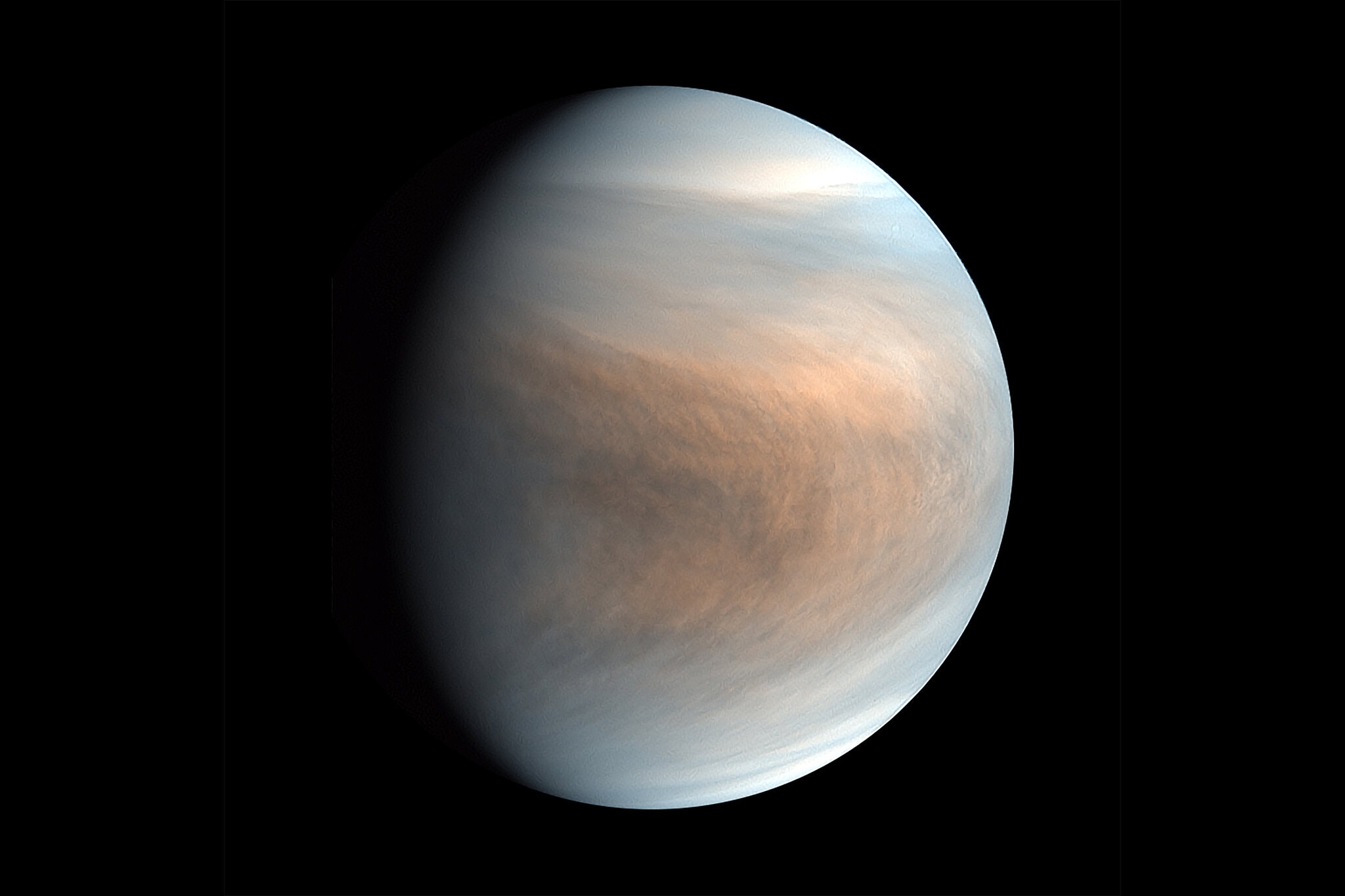
Life on Venus? The Picture Gets Cloudier A team of astronomers made a blockbuster claim in the fall. They said they had discovered compelling evidence pointing to life floating in the clouds of Venus. If true, that would be stunning. People have long gazed into the cosmos and wondered whether something is alive out there…more
-NASA
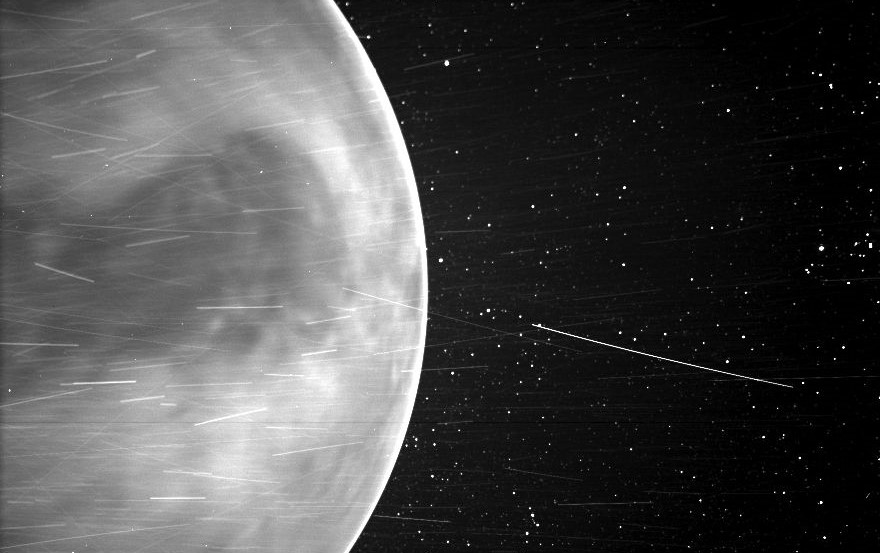
NASA’s Parker Solar Probe captures stunning Venus photo during close flyby NASA’s Parker Solar Probe nailed its fourth swing past Venus on Feb. 20, and mission scientists celebrated by releasing a stunning image captured during a similar maneuver in July. Parker Solar Probe launched in August 2018 with a daring mission…more
-The Gateway Foundation
Company plans to start building private Voyager space stationVoyager Station will be able to accommodate 400 guests, its builders say. Orbital Assembly Corporation (OAC) recently unveiled new details about its ambitious Voyager Station, which is projected to be the first commercial space station operating with artificial gravity…more
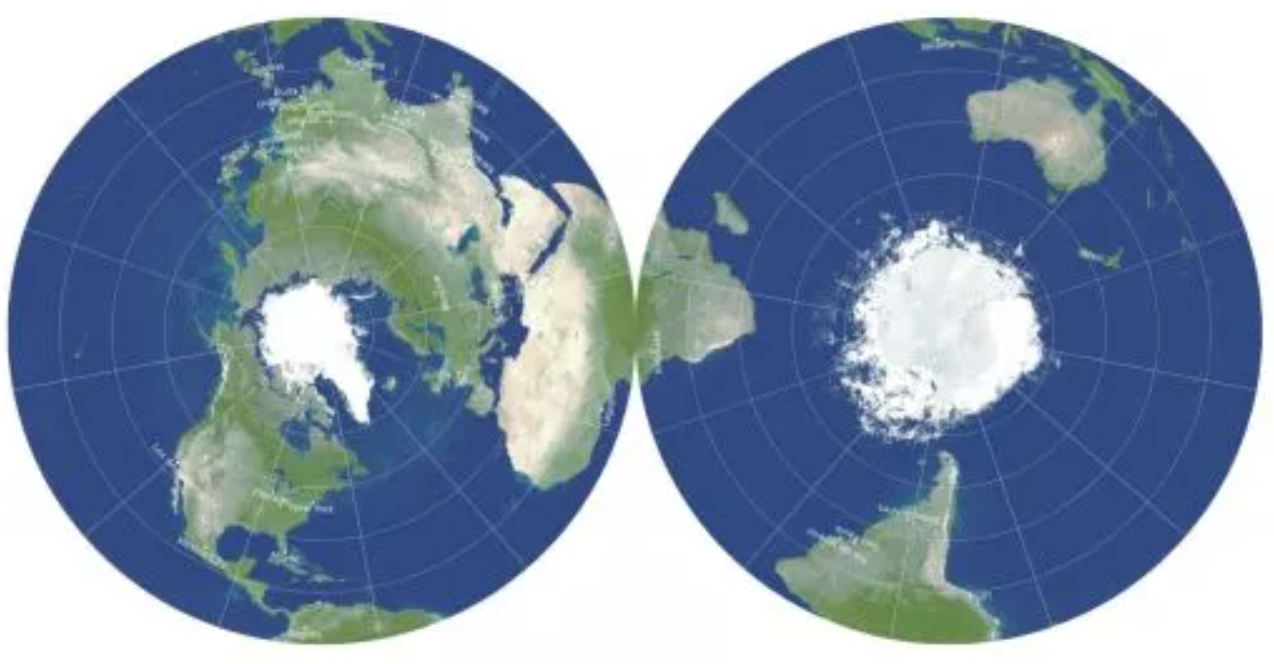
Astrophysicists create the most accurate ‘flat map’ of Earth ever Earth is a sphere, so how can it be accurately portrayed on a 2D map? Simply flatten Earth into two pancakes, one depicting the Northern Hemisphere and the other the Southern, with the equator running around the edge, a new study finds. This double-sided pancake map is the most accurate flat map of Earth ever created. (Image credit: J. Richard Gott, Robert Vanderbei and David Goldberg)..more
by Rex Parker, Phd director@princetonastronomy.org
Next meeting by Zoom on Feb 09 at 7:30. We continue to dream of getting back together in Peyton Hall on campus, but for the next few months at least we anticipate running the meeting virtually with Zoom. The meeting on Feb 09 will feature a guest speaker from Princeton University Astrophysics Dept. – see the section below by Program Chair Victor Davis for more information.
Meanwhile I’d like to reiterate the request for financial contributions to the Gene Ramsey Memorial Reconstruction Fund. It’s a great way to honor Gene, who did so much for many years for AAAP and especially the Observatory. For more information please see Assistant Director Larry Kane’s appeal via e-mail sent to all members Jan 16. Checks to AAAP can be mailed to Treasurer, Amateur Astronomers Assoc. of Princeton, Inc., PO Box 2017, Princeton, NJ 08543. Contributions can also be made electronically via a secure ‘Donate’ button at the end of Larry’s appeal in this issue of Sidereal Times or by clicking the donate button on the website. Contributions are tax-deductible. Please consider corporate matching if that is an option for you.
Challenging the paradigm. At the January meeting we talked about renewed interest in the extrasolar traveler Oumuamua, a quite unusual “cometary” object that swiftly flew in and out of the solar system in late summer 2017. It was studied by every telescope that could see it for about 11 days before it was gone, including some of the most sophisticated instruments in the world. The data collected are remarkable. I have been following the story ever since, and members may recall we had a couple of discussions about it at AAAP meetings. Not surprisingly most professional astronomers interpret Oumuamua, at least publicly, as a highly unusual natural interstellar object. Avi Loeb, noted astrophysicist and among other roles the chair of the Harvard Astronomy Dept. and the Board on Physics and Astronomy of the National Academies, is one of the few with the courage and insight to say that Oumuamua may really be alien tech.
Dr. Loeb’s new book, Extraterrestrial: The First Sign of Intelligent Life Beyond Earth (Houghton Mifflin Harcourt, publishers) was published January 26. With strong Princeton connections that will be familiar to AAAP members, the book confronts the age-old question “are we alone?” in a new and exciting way. Dr Loeb suggests that in 2017 evidence passed through our solar system which answers “no” to the question. The book shows how the existing paradigm of astronomy and science needs to change, and might be able to, in order to see this question differently. The astrophysical evidence is provided, examined critically, and interpreted. The author considers what consequences would follow if scientists gave it the same credence they give to conjectures about supersymmetry, extra dimensions, dark matter, and the multiverse, which have less supporting evidence than Oumuamua provides. He also asks are we as a civilization ready, if the answer is “no we are not alone”. This important work is central to the interests of our organization. So I am challenging AAAP members to read the book for a serious discussion aiming for the March meeting.
Of moths and the milky way. What’s plaguing the dark skies and astronomy is really bothering the birds, moths, and butterflies, too. Light pollution and skyglow are obscuring our ability to see ourselves in relation to the cosmos, and most of the global population will never see the Milky Way galaxy we are part of. And now we are learning that artificial lighting at night is greatly distressing many other animals, especially birds and insects. Life evolved and flourished on earth over millions of years in rhythm with diurnal/nocturnal light cycles and seasons, but the cadence has been disturbed by excessive artificial outdoor lighting. Moths and butterflies (the order Lepidoptera) are particularly sensitive to both the intensity and spectral character of artificial light – blue light interferes more than amber-tinted lights. Artificial light at night confuses adult moths and blocks normal behavior, trapping them in the glow and interfering with their life cycle and reproduction. And many bird species rely on caterpillars for protein and other nutrients. A meta-analysis of the literature was reported by Boyes et al. in 2020 in the journal Insect Conservation and Diversity, Is light pollution driving moth population declines? A review of causal mechanisms across the life cycle.https://onlinelibrary.wiley.com/doi/10.1111/icad.12447)
Beyond the direct glare of light fixtures, reflection and scattering of all those photons by ground and atmosphere is perceived by our eyes as skyglow, the background brightness that obliterates all but the brightest stars. Making it even worse, the installation of energy saving LED outdoor lighting actually worsened the problem initially because atmospheric scattering is greater for the shorter wavelength blue light of early LED’s than it is for the amber colors subsequently developed.
The degree of light pollution at AAAP’s Observatory at Washington Crossing State Park is likely to get worse with the large scale development now being planned to satisfy the state’s affordable housing dictate. Fortunately, Hopewell Township has a very good outdoor lighting ordinance, recently updated with a requirement for amber-colored LED’s (color temp. 2700 K or below). If your town does not have an updated lighting ordinance, ask the municipal leaders to consider the Hopewell ordinance as a model. The International Dark-Sky Association (IDA) also provides documents and references for towns and individuals https://www.darksky.org/. Along with the IDA, the US Naval Observatory in Flagstaff AZ has been at the forefront of the physics and photometric technology to measure light pollution. They discovered the light source color (spectral power distribution) relationship to skyglow brightness, and created the first guidelines for amber LED’s.
Land preservation, large scale and local, is hugely beneficial to preserving both darker skies and threatened animal species. Fields of native plants and wildflowers are the most critical habitat for moths and butterflies and their caterpillars, and every acre preserved is one that doesn’t have outdoor lighting. As amateur astronomers we can urge our friends and neighbors to minimize contributing to light pollution by following a few guidelines: full cutoff shielding of light fixtures, using the minimum light needed for the task at hand, shutting off outdoor lights before turning in for the night. Swap your outdoor lights for amber-yellow LED lamps, and eliminate blue-tinted lights that are most harmful to circadian rhythms and dark skies. It can get worse — yet it can also get better.
In mid January, I sent an email to the entire AAAP membership, announcing the establishment of the Gene Ramsey Memorial Observatory Reconstruction Fund in order to raise money that will go to the repairs needed by the observatory Gene spent so much of his time and love to maintain. If you did not receive this email, please let me know and I will forward it to you.
After this initial email, I sent a follow-up announcement which pointed out that donations by check should be made to the AAAP, not the fund. Doing so will help our Treasurer keep track of the donations if they are designated as a donation being made for the repair fund. To do this, write a three or four word description on the “memo line” of your check. You can also donate electronically using the ‘Donate’ button at the end of my appeal or via the ‘Donate’ button on the website. Remember that the AAAP is a 501 (c) 3 organization. This means that any donation you make is deductible from your federal income taxes.
Before the onset of the Covid-19 pandemic, the AAAP Board and membership voted to spend up to $10,000 for the repairs to the columns that support the structure’s roll-off roof. Repairs cannot be made at present, but this provides a unique time period in which we can raise the needed funds. As I am writing this article, we have pledges to the fund of $2,200. Therefore, I am urging all of the members of the AAAP, to make a donation in any amount that you are comfortable making. Doing so will both honor the memory of Gene and his positive impact on the observatory, and insure that once the repairs are completed, the club will be able to continue its invaluable program of public outreach and education.
Another fundraising avenue we will follow is a direct approach to the vendors that AAAP members support with their purchases of astronomy equipment. If you look back at the last year or so, it is probably a considerable amount of money spent in pursuit of your hobby. Therefore, I am requesting that each AAAP member send to me an estimate of your expenses for the last twelve months, the vendors that supplied your equipment, wherever they are, and your zip code. This information will be used, without your name, to compile a list of the economic impact the AAAP has had on each vendor that our membership has supported. Hopefully, this support will translate to financial support for our observatory.
Please email me at assist.director@princetonastronomy.org if you have any questions or concerns.
The February meeting of 2021 will take place (virtually) on Tuesday, 9th at 7:30 PM. (See Joining the Meeting with Zoom below for details). This meeting is open to AAAP members and the general public. Due to the number of possible attendees, we will use the Waiting Room. This means when you login into Zoom you will not be taken directly to the meeting. The waiting room will be opened at 7:00 PM. Prior to the meeting start time (7:30 PM) you may socialize with others in the waiting room. The meeting room has a capacity of 100 people.
For the Q&A session, you may ask your question using chat or may unmute yourself and ask your question directly to the speaker. To address background noise issues, we are going to follow the rules in the table below regarding audio. If you are not speaking, please remember to mute yourself. You are encouraged, but not required to turn your video on.
Meeting Event
Participant Can Speak?
Participant Can Self-Unmute?
Rex’ General Remarks
Yes
Yes
Victor’s Speaker Introduction
Yes
Yes
Speaker Presentation
No
No
Q&A Session
Start All on Mute
Yes
Journal Club presentation
Start All on Mute
No
5-minute bio break
Yes
Yes
Business Meeting
Start All on Mute
Yes
Director’s closing remarks
No
No
Only the Business part of the meeting will be locked.
Featured Speaker: Princeton University postdoc Dr. Guðmundur Kári Stefánsson will speak on Searching for New Worlds with Next-generation Astronomical Instruments.
Exoplanet science has seen an explosion in activity since the discovery of the first planets outside our solar system in the 1990s. We now know of over 4,000 exoplanets, and that rocky planets are prevalent in the Galaxy. Is it just a matter of time when we will detect Earth 2.0? In this talk, Dr. Stefánsson will discuss new and exciting discoveries in exoplanet science, and in particular his ongoing research on developing and using next generation technologies to better detect and characterize exoplanets orbiting nearby stars. The main science goal of these new instruments is to better detect rocky planets orbiting in the habitable-zone—the region around the star where liquid water could be sustained on the surface of the planet. Dr. Stefánsson will end with a look to the future, discussing what exciting possible science results await with upcoming and future ground- and space-based observatories.
Dr. Guðmundur Stefánsson is a Henry Norris Russell Fellow at Princeton University. His research focuses on developing and using next-generation instruments to better detect and characterize planets outside our solar system. Dr. Stefánsson received his PhD in Astronomy & Astrophysics at the Pennsylvania State University in 2019 as a Fulbright and NASA Earth and Space Science Fellow. As part of his PhD research, he led the development of a new technique employing Engineered Diffusers—low-cost nanofabricated optical devices capable of molding the focal-plane image of a star into a stabilized top-hat shape—capable of delivering space-quality photometric observations of transiting exoplanets from the ground. Dr. Stefánsson contributed to the design, construction, and commissioning of two next-generation planet-finding spectrographs—The Habitable-zone Planet Finder and the NEID radial velocity instrument—designed from the bottom-up to detect terrestrial planets orbiting in the habitable-zone of nearby stars.
January’s Journal Club Presentation: Ira Polans will speak on Johannes Kepler, Parallax, and the Astronomical Unit, describing how Kepler and his contemporaries measured the size of the Solar System.
AAAP webcast: This month’s AAAP meeting, beginning with Rex’s opening remarks and ending at the break before the business meeting, will be webcast live on YouTube and recorded for subsequent public access on AAAP’s YouTube channel. Be aware that your interactions during this segment, including questions to our guest speaker, may be recorded for posterity. Here is YouTube live link https://youtu.be/isNIMP7rD14.
Using Zoom: While we are, social distancing the AAAP Board has chosen to use Zoom for our meetings, based our belief that many members have already have used Zoom and its ease of learning. One of its great features is you can choose whether you want to install the software on your computer or use it within your browser.
How to Join the February Meeting: For the meeting, we are going to follow a simple two-step process:
Please make sure you have Zoom installed on your computer. You do not need a Zoom account or need to create one to join the meeting. Nor are you required to use a webcam.
Please visit our websitefor the link to the meeting
This session will be recorded and saved on YouTube. Send me an email at program@princetonastronomy.org if you have any concerns.
NOTE: We plan to open the meeting site 30 minutes to the 7:30 start time. This way you won’t have to rush to join the meeting. A maximum of 100 attendees can join the meeting.
More Information: The Zoom site has many training videos most are for people who are hosting a meeting. If you’re unsure how Zoom works you might want to view the videos on how to join a meeting or how to check your computer’s audio and video before the meeting.
We hope to make these short presentations a regular feature of our monthly meetings. If you are interested in presenting a topic of interest, please contact either director@princetonastronomy.org or program@princetonastronomy.org. We’d like to keep our momentum going!
Upcoming Programs: Here’s a look ahead at upcoming guest speakers. We’re expecting to conduct virtual meetings for the remainder of this academic year. In an effort to turn necessity into a virtue, we’re casting our recruiting net a bit wider than usual, inviting speakers for whom a visit to Princeton would be impractical or inconvenient. Suggestions for guest speakers for September, 2021 and beyond are welcome.
March 9 – Keivan Stassun: Prof. Stassun is the Stevenson Professor of Astrophysics at Vanderbilt University. He will describe The Life and Death of Stars, the title of a course he delivered for The Learning Company.
April 13 – Alexandra Kroll Davatzes: Prof. Davatzes is an Associate Professor at Temple University. Her talk will describe Precambrian Meteor Impacts and Implications for Early Earth.
May 11 – Alex Hayes: Prof. Hayes is an Associate Professor of Astronomy at Cornell University and Director of its Spacecraft Planetary Image Facility. He will speak on Ocean Worlds of the Outer Solar System, plus he will give a brief report on the Mars 2020 mission.
June 8 – Anna Schauer: Dr. Schauer, a new mother, is the NASA Hubble Fellow at the University of Texas at Austin. She leads the team researching what she’s nicknamed the Ultimately Large Telescope, a lunar liquid-mirror telescope that will aim at investigating First Star Formation.
Looking forward to you joining us on Zoom or YouTube Live webcast at the February meeting!
● A presentation on the physics of a refracting telescope, including a history of several instruments, including our own Hastings-Byrne was provided by member John Church.
● Amateur Astronomy Journals section was provided by Bob Vanderbei, with astro images he has taken over the last twelve months and Bill Murray, reviewing the history of Project Diana.
Business Meeting:
● Director Rex Parker presented a discussion of the 982.00 Mhz signal that came from the region of Proxima Centauri and lasted 30 hours. He also introduced a discussion of the suggestion by Avi Loeb, of Harvard University, that Oumuamua (the interstellar object that entered our solar system) was sent by alien intelligence.
It is described in his recent book Extraterrestrial.
Observatory:
● Observatory Chair, Dave Skitt, stated that two groups came out to view the “great conjunction of Jupiter and Saturn.”
● Dave also had a Zoom meeting with a member of the public wanting advice on buying a telescope. This was followed by statements from several members who were also approached to give advice on the same subject.
● Dave and Tom Swords discussed the purchase of “Bahtinov masks” to aid in the focusing of telescopes and cameras..
Program Manager:
● Victor Davis said that speakers are lined up until the end of the current academic year. He indicated that virtual meetings are allowing for the retention of speakers who would not normally come to Princeton to speak at our meetings. He added that this is “surprisingly easy.”
I’ve often wondered what actual methods Charles Hastings used when designing the 6-1/4” objective now sitting at the business end of our fine refractor in Washington Crossing State Park. I’ll start by quoting Hastings’ own words on p. 39 of Vol. 2 of the Sidereal Messenger for 1883:
“Anxious to test still farther the theory [i.e. the theory which he had developed from scratch when starting his lens design work, see below], I constructed an objective of 6-1/3 inches aperture [reduced to 6-1/4 inches by Byrne’s cell] of entirely different materials and curves resembling those chosen by Fraunhofer in most of his objectives. This also was made strictly in accordance with the theory and with the most gratifying results, Of interest to the optician is the fact that its focal length differed by less than 1/10 of an inch from that given by calculation. [Note: H. designed for a focal length of 91 inches, while this lens has an actual focal length of 91.07 inches, i.e. 2313 mm.] This lens is now in the possession of Mr. C. H. Rockwell, at Tarrytown, N.Y., and was used by him at Honolulu in observing the last transit of Mercury. Though I have not had the opportunity for testing the telescope in astronomical work which I could wish, the ease with which I saw ζ Bootis double in 1879 (Hall 0”.55, 1874.4) and γ2 Andromedae elongated during the same summer, convinces one that it is of the highest excellence, even independently of the severe physical tests to which it has been subjected in my hands.”
The theory that Hastings was referring to was elaborated at some length in an article in the American Journal of Science for March 1882 (Third Series, Vol. XXIII no. 135), p. 167. The general idea was to concentrate the greatest amount of visible light energy into the smallest possible area. By considering the intensities of the various wavelengths of light, he arrived at the conclusion that the wavelength for the minimum intercept distance (i.e. back focus or distance from the rear vertex of the rear element of the achromat) for paraxial (i.e. nearly central) rays should be 5614 A., which is a solar line visible in a good spectroscope and very close to the wavelength of maximum sensitivity of human vision. He also concluded that when achromatism was considered, the marginal rays for the C line (6561 A.) and a wavelength as close as possible to 4990 A. should be united. He found that the closest spectroscopic line readily available was at 5005 A. Hence this was his recommendation, and it fact it was achieved in our actual objective (Sky & Telescope for March 1979, p. 294).
Hastings didn’t publish the actual calculations which led him to these conclusions. However, he did write the following passage in this same article:
“The second objective had a clear aperture of 6-1/4 inches and a focal length of 91 inches. The crown lens is in advance and the curves are such as to satisfy, for a first approximation, the conditions proposed by Sir John Herschel [Phil Trans.1821, p. 222]. This form, though ordinarily known as Herschel’s, cannot be said to differ from that chosen by Fraunhofer at a date earlier than that of the publication of Herschel’s paper.”
The so-called “Herschel condition” is that spherical aberration should vanish not only for objects at infinite distances (i.e. astronomical objects), but also at nearer points for use as a terrestrial telescope. This would also allow easy testing of lenses in the workshop and on convenient daytime objects in the vicinity. It continues to be a useful principle in this area, but it’s mathematically incompatible with the Abbe or “sine condition” that both spherical aberration and coma should be made as small as possible in astronomical telescopes. It’s fortunate however that satisfying the Herschel condition coincidentally leads to objectives with very low coma that are usually perfectly satisfactory for astronomical work.
In the second article of this series I plan to go more completely into the Herschel condition and determine if Hastings actually tried to make our objective follow Herschel’s formulas.








 Amateur Astronomers Association of Princeton