Electrum and Lead

by John Church

Let them draw together the bones of the metal.
           – Ezra Pound, The Alchemist

I venture that one reason amateur astronomers like their hobby so much is that despite all the turmoil here on Earth, the heavens are generally peaceful, quiet, and predictable.  We do have the rare supernovas in faraway galaxies, collisions of comet fragments with Jupiter or even Earth, and other events that temporarily disturb the scene.  By and large, however, the universe goes on its way, free and clear of our petty problems and providing a beautiful panorama for us to explore and contemplate.

Ancient civilizations were impressed with the cycles of the moon and planets and the yearly return of the seasons.  They constructed many temples and monuments to monitor these phenomena, wanting to know promptly if any baleful influences had come along to disrupt the orderly procession.  Eclipses of the sun and moon came in for special study because of their drama, as did the appearances of comets. These were especially sinister, because they came according to no apparent schedule and were therefore thought to presage catastrophes.

I used to regularly observe and time occultations of stars by the moon.  When this happens at its dark edge, the event can be quite striking as the star suddenly disappears.  Apart from their inherent interest, good timings of these events were scientifically valuable.  Predictions for any given location were available from the U.S. Naval Observatory.  These were accurate to within a second or two, but not much more than that.  The main reason for the uncertainty is that the moon has a very irregular edge; its profile as seen from Earth is constantly changing depending on what the perspective is at any given moment.  By collecting enough such timings, mostly by amateurs, professional astronomers could refine the local topography of the moon and even its orbit.  Nowadays, using retroreflectors left on the moon by astronauts, highly accurate laser ranging can take care of any remaining orbital adjustments.

It might be thought that our present-day mathematics could precisely predict the orbits of planets.  This is true in one sense, but not in another.  We do have computer programs that can carry out numerical approximations of the planetary orbits to excellent accuracy.  However, due to the mutual gravitational attractions of the planets, it is fundamentally impossible to carry this out on a strictly theoretical basis.  Even a simple system consisting of only three mutually attracting bodies cannot be solved exactly, although two can be handled. This inconvenience to us doesn’t bother the planets themselves.  Merrily they roll along according to exact laws that they alone know, like T. S. Eliot’s cat who knew its own deep and inscrutable singular name even if no one else did.

Regarding the mechanics involved in computing orbits, the topic of the “speed of gravity” is an interesting one.  The prevailing wisdom is that gravitational effects are propagated through space with the speed of light.  However, some scientists with special expertise in orbital calculations 1 have proposed that perturbation effects must travel at a much greater speed, otherwise the solar system would be chaotic.  Interestingly, computer models of colliding galaxies seem to tacitly acknowledge that gravitational effects occur nearly instantaneously over the enormous distances involved.

Be that as it may, the programs that I mentioned are good enough to locate apparent planetary positions as seen from Earth over many thousands of years.  It can be entertaining to try to reconstruct planetary lineups, both at the present and in ancient times.  Some years ago I decided to use such a program to try to determine if Jupiter had ever passed directly in front of Saturn, as seen from Earth, in historical times.  I could find no previously published record of such a calculation.  Even if this kind of event had never occurred, it still would be interesting to see if they had ever come so close to one another that they would have appeared as one body to the unaided eye.  This would have been a significant event to the astrologers of yesterday and might have had historical importance as an omen. 

Jupiter overtakes Saturn about once every twenty years. Since they move in orbital planes that are not tilted very much with respect to one another, there is always the chance that Jupiter will appear to come very close to or even pass in front of Saturn at these times.  I was especially interested in whether this had ever occurred near the bright star Regulus in Leo, Regulus having always been of major astrological importance.  The fact that Regulus is also near one of the two points in the sky where the orbits of Jupiter and Saturn appear to cross each other as seen from Earth, makes events near this star even more likely to involve close passes.  Fine events with Regulus close by did indeed occur in the years 1793, 940, 86, and 27-26 BC, but not since then.  None of these events involved an actual occultation of Saturn by Jupiter.

After doing all the calculations, it became clear that Jupiter had never passed directly in front of Saturn any later than 4000 BC and will not do so any earlier than 2800 AD, these being the limits of the time period for which this particular program is valid.  However, they have come so close on several occasions that they would have appeared briefly as one object even to people with very sharp eyesight.  These would have been exciting events to witness. The most recent one that would have been really striking was in 1226 AD.   Some of us were able to see and photograph them within about 6 arc minutes of each other low in the evening sky in December, 2020.

Who can say whether such apparitions had any real influence on what was happening then, through the interpretations of astrologers?  I like to think that they might have.  In particular, the complex events of 27-26 BC. near Regulus also had Venus and Mars passing nearby.  This may have been taken as a favorable sign for the assumption by Octavian of the formal title of Cæsar Augustus.

Astrologers long ago associated Jupiter with the precious metal electrum, an old name for a naturally-occurring mixture of about one-quarter silver and three-quarters gold as well as for amber, or fossilized tree sap.  (The word “electron” is derived from the fact that amber easily takes on a static charge, and we get “electricity”from the same root.)  Saturn, on the other hand, was linked with common ordinary lead.  Jupiter is bright and attractive in the sky, while Saturn is a dull, slow-moving object.  Gold, silver, and lead sometimes occur together in lead ores, but are rarely if ever combined intentionally.  As a chemist, I find it interesting that Jupiter and Saturn have also remained unalloyed in the sky within the span of human memory and will continue so for at least another 800 years.

1 See for example T. Van Flandern, “The Speed of Gravity – What the Experiments Say,” Physics Letters A, 250 (1-3): 1-11 (Dec. 21, 1998).

The above article was adapted from Chapter 18 of the author’s book From Eve and Morning, 2003.  For more on Jupiter-Saturn events, see the author’s article in the March 1991 issue of Sky & Telescope starting on page 305.
Posted in February 2022, Sidereal Times | Tagged , | Leave a comment

James Webb Space Telescope reaches home

by S. Prasad Ganti

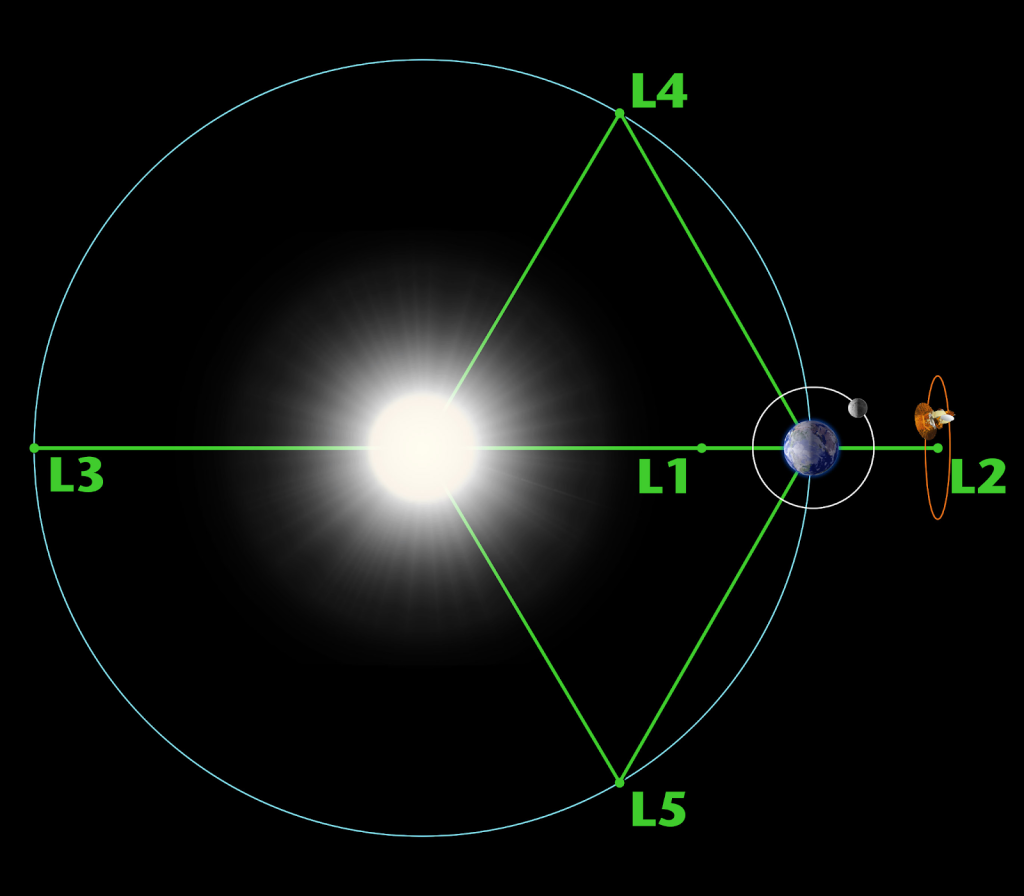
The perilous journey on the ground as well as in the space is complete. Continuing our journey with the James Webb space telescope, which was launched on Christmas day at the fag end of 2021. Some deployment tasks have been completed in space. The solar panels have been unfurled. So have the heat shield and the complex mirror. Each of them is a huge undertaking and a potential point of failure. More importantly, it has reached its home at the L2 Lagrangian point about a million miles away from Earth on the other side of the Sun-Earth axis. Picture given below from the internet shows the L2 Lagrangian point in relation to the Earth and the Sun.  

The telescope will be parked here or rather will be moving along with the Earth around the Sun. With some tiny orbiting around the L2 point in a perpendicular plane. With respect to the Earth, it will appear at the same point all the time. Hopefully for the next decade or even longer. The L2 Lagrangian point is named for the French mathematician Joseph Lagrange. It is a point at which the combined forces of gravity due to the Earth and the Sun are supposed to be minimal. It is difficult for me to visualize the forces involved. Lagrange solved this “three body” problem mathematically to arrive at five such points in space named L1 through L5 shown in my favorite picture above. L2 is the most appropriate place for the task at hand, which is to see the vast swath of Universe away from the Sun. 

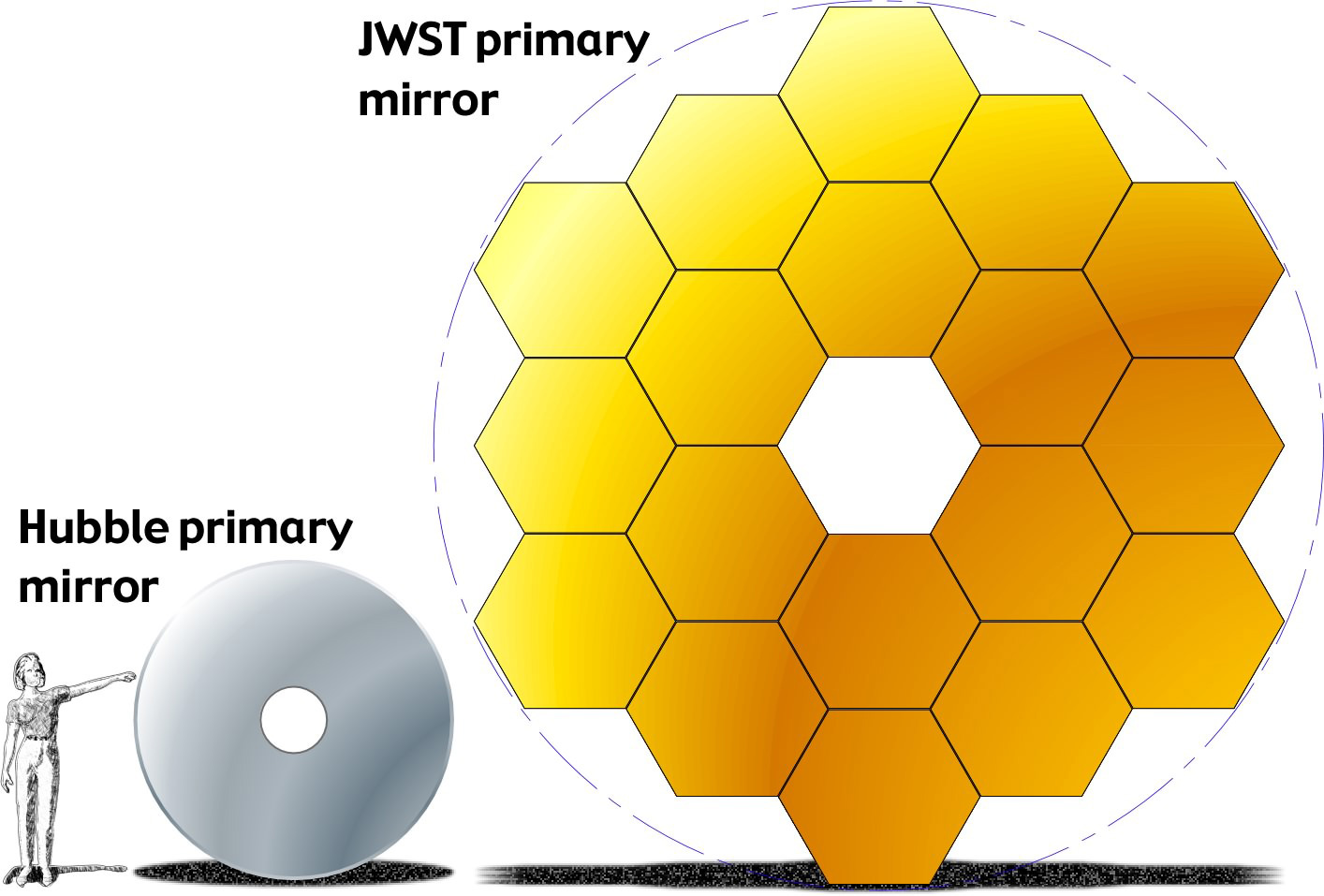
The telescope itself is a piece of engineering marvel. It took ages and cost a lot of money to engineer, construct and test. And finally send it to its home at the L2 point about a million miles away. Several nuances of engineering about this marvel fascinate me. And how human thinking strives to make things better and better. A true successor to the current Hubble telescope, which had a shaky start with a faulty mirror corrected by floating astronauts in space. Hubble has lived beyond its expected lifetime and contributed enormously to our knowledge of the Universe. Webb will be a quantum jump over the Hubble. Comparing and contrasting with Hubble, it weighs much less at 6.5 tons vs. 11 tons for Hubble. Yet its mirror is more than double the size, weighing about a tenth. The mirror has been designed using the divide and conquer technique. Casting larger mirrors is fraught with exponentially larger difficulty and is fragile enough to be sent into space as one piece. It has 18 hexagonal segments, each made of an ultralight metal called Beryllium. This metal has been mined in Utah and exists largely in powdered form and is difficult to work with in forming larger pieces. Each segment is polished to extremely low tolerance and is coated with gold. Gold is a good reflector and never loses its sheen. Hence gold captivates humanity as well ! Another favorite picture of mine given below, courtesy NASA.

The mirror could not be sent into space as one piece due to the real estate limitation of the largest rocket which was used to launch. It had to be folded. A segmented design helped towards this end. And the unfolding went very well once it reached space. What is left before Webb starts doing real science is the process of tuning the giant mirror. It is expected to take the next three months. Why such a long time ? 

Firstly, the mirror has to be absolutely perfect to help us take a good peek at the Universe. Each of the 18 segments has an actuator connected to a motor. Commands are given to the motor to move the segment for alignment. And motors do generate heat while operating. Heat is something which Webb cannot tolerate. Since it will be observing the Universe  in the infrared region, which is basically heat, it needs to be kept very very cold. The huge sun shield on the side of the telescope facing the Sun does a lot of the shielding. Any heat from the telescope’s internal instruments will not be acceptable. Hence the process is very slow. 

The motors can be asked to move only very small distances (about a millimeter) and can operate for only a short period of time each day. It is supposed to be the same speed as the growth of the grass. We are watching the paint dry ! The process is to do some alignment and take pictures of a reference star and then check for clarity. And repeat the process until sufficient clarity is obtained. This iterative slow process will happen over the next three months and then we will hope to have some excellent results and the knowledge thereof. We waited so long. Another three months in the quest for perfection !

Posted in February 2022, Sidereal Times | Tagged , | Leave a comment

Restoring a Classic Edmund Reflector

by Kevin Meredith

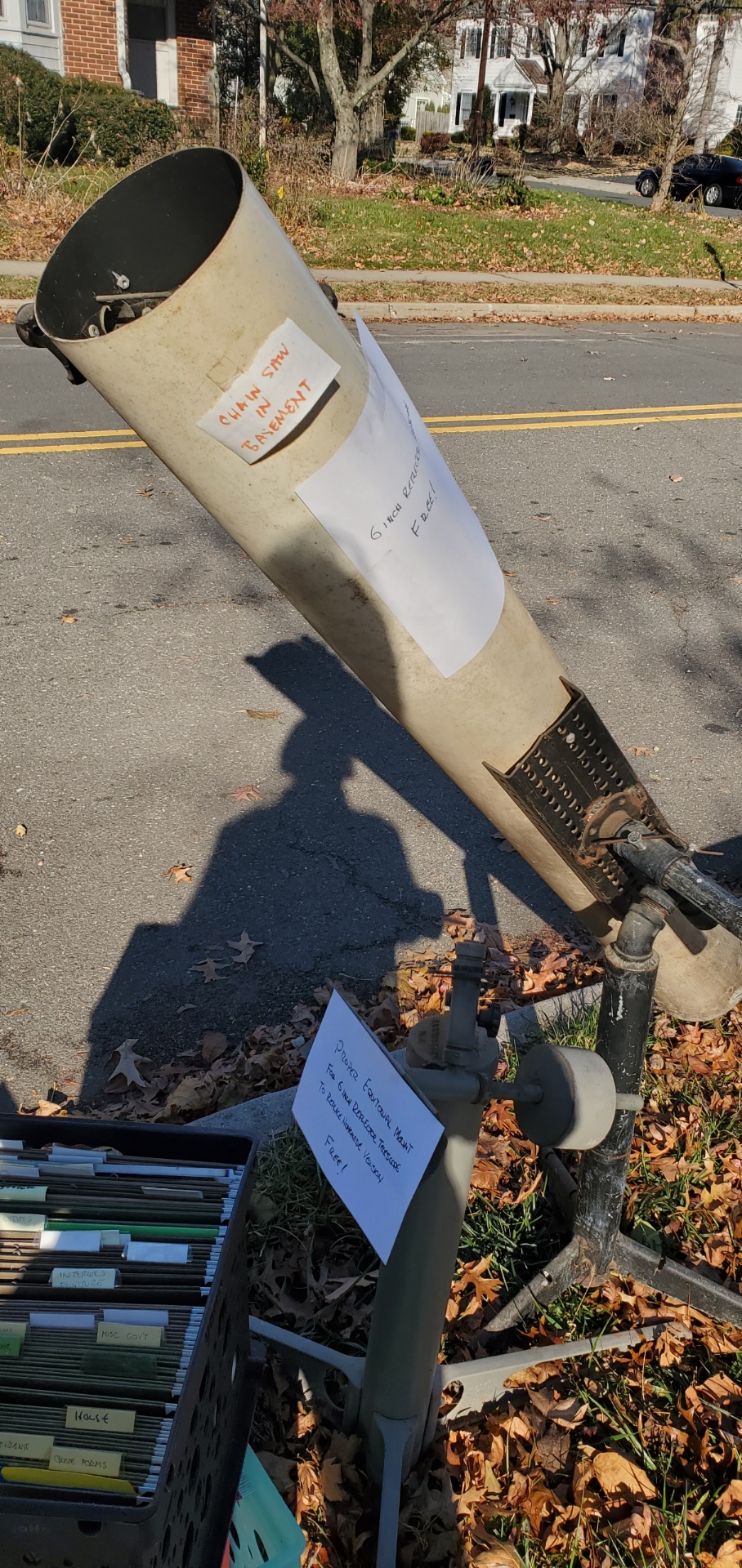
In December 2021, I was given an unexpected early Xmas present. My girlfriend was walking through Princeton when she noticed this interesting collection on the side of the road, and she texted to ask if I wanted it. After I responded immediately in the affirmative, she knocked on the door and got the owner, Bob, to hold it for me in his garage. I should explain that up until this point, my best telescope had been an imported 4.5-inch Bushnell Newtonian; usable, but rather tacky. (As a matter of fact, the big screw holding the azimuth axis together on its mount had snapped earlier in the year – it was plastic.) So you can understand that a 6-inch scope represented a significant step up for me. I drove over a few days later to pick it up. Bob was a spry older gentleman with an enthusiastic attitude. He told us he was moving house, and needed to divest himself of some bulky items. The telescope was an Edmund Scientific scope that he himself had built from a kit his parents gave him in 1964. It was on an equatorial mount, also home built from stock plumbing fittings at the same time, to save a few dollars on a manufactured mount. You can see Bob welding it together in the newspaper clipping. Bob also gave me two original eyepieces and an Edscorp equatorial mount that he had acquired later but had never got around to re-mounting the scope.

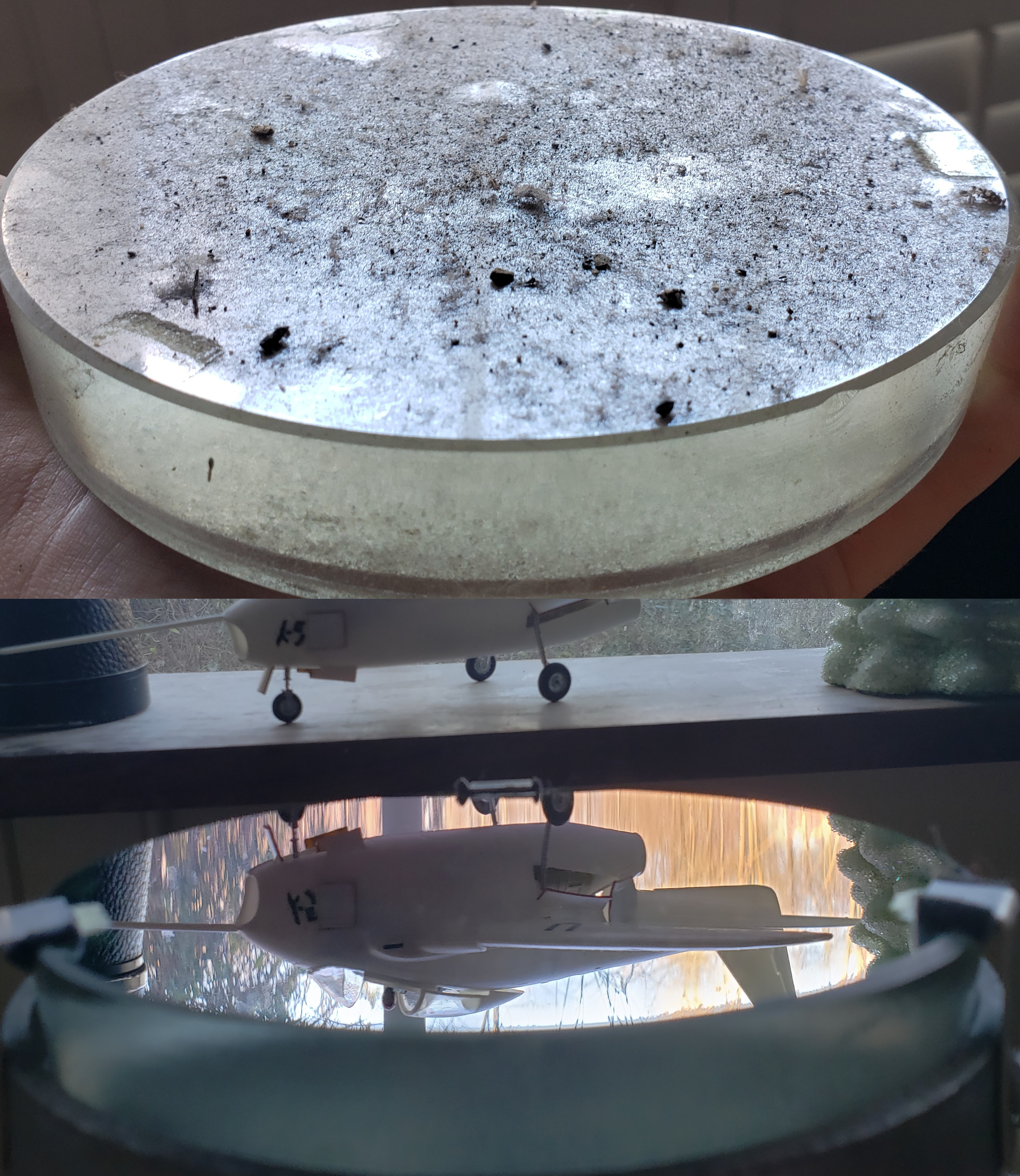
After hauling everything home, I carefully disassembled the instrument to its component parts, which were all covered in a few decades’ worth of grime. The pyrex 6-inch primary mirror was coated in a thick layer of detritus and dead bugs. Miraculously, after giving them a careful wash, both primary and secondary mirrors were in good condition. I put a small dot of red ink in the center of the primary mirror to help with collimation. To protect the optics, I constructed a dust plug for the tube from some layered foam board and hot glue. I thoroughly cleaned every other part of the telescope inside and out, applying a little lithium grease to the movable parts in the focuser and mirror cell. Scrubbing the interior of the tube was quite a reach as it is about 5 feet long. Dividing 5 feet by the 6 inch mirror diameter gives the scope a focal ratio of f/10 or so; more on this later. A lot of the steel screws and nuts that held it together were corroded, or had been replaced with mismatched parts, so I replaced everything with new stainless steel screws and locknuts for security. Although the cream enamel on the aluminum tube still shows plenty of scuffs and scratches, I decided not to re-paint anything. The marks of use should testify to the enjoyment this instrument has provided.

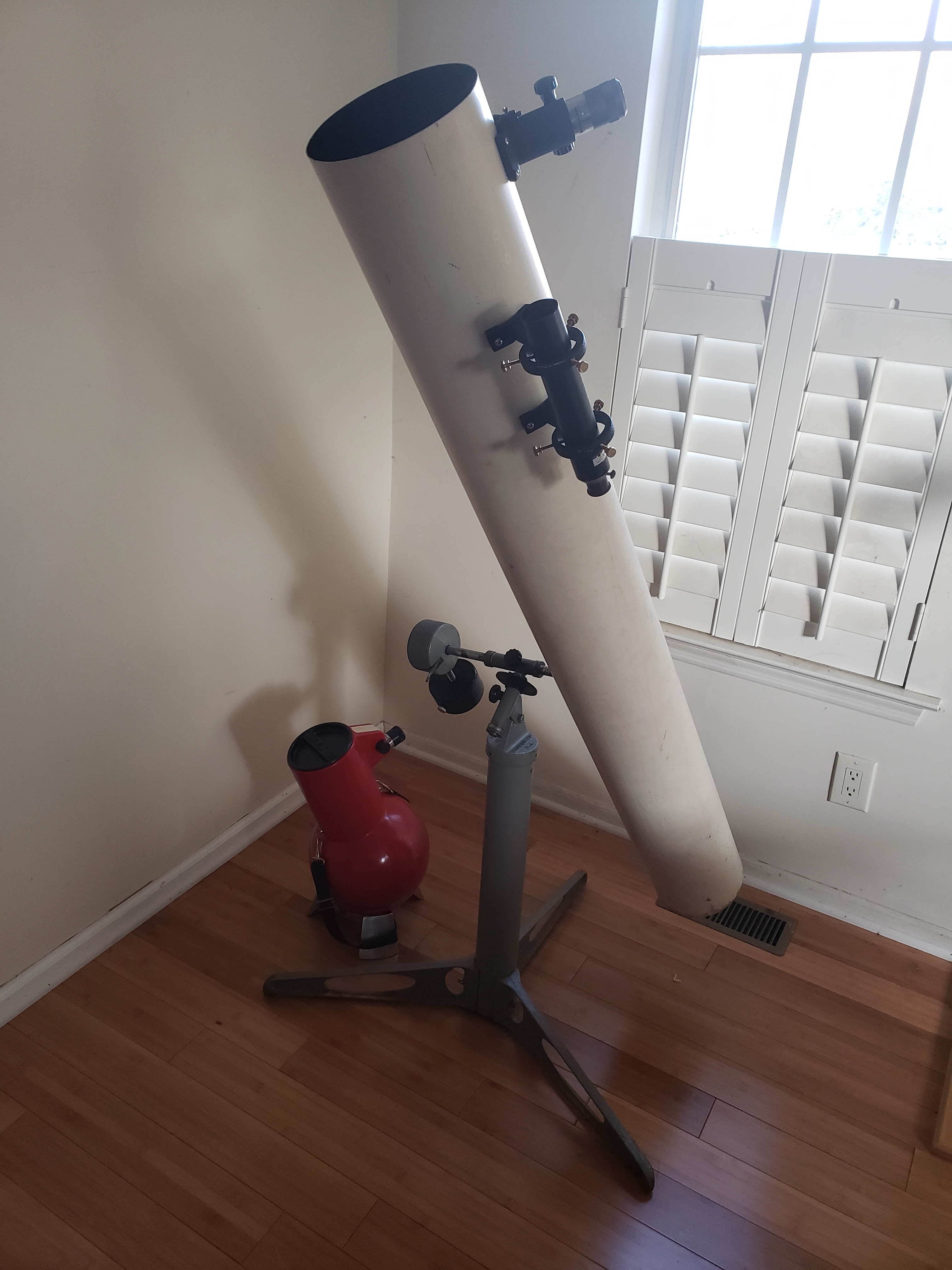
I decided to put the telescope on the Edscorp mount I had been given. The mount first received a thorough cleaning and lubrication. I fixed two stainless bolts in place protruding from the telescope tube, and used wing nuts to fasten it to the plate on the mount. This allows for quick take down and reassembly. However I quickly discovered that the bottom end of the OTA would often hit the mount legs, and the counterweight was not sufficient to balance it. A quick check revealed that this particular mount was actually designed for use with Edmund’s smaller 4.5-inch reflector. The larger mount would have included an RA clock drive and more weight. Nevertheless, this mount seemed sturdy enough to hold the scope, so I moved the mounting further down on the tube and added an extra counterweight. The second weight is fixed to a bolt that I tapped into the original weight at right angles, to achieve balance in both axes. The final result stays where it is aimed and can be quickly adjusted for using heavy eyepieces or camera gear.

Collimation of this telescope is fairly simple. The tricky part is aligning the secondary mirror, which is mounted to a simple brass rod. The rod goes back through a hole in the tube to the eyepiece assembly where it is held in place by a set screw. One must simultaneously hold the mirror in place and tighten the screw while looking through a collimating eyepiece. This operation almost requires three hands, but is made easier using a foam board wedge to hold the mirror at the correct distance from the tube wall to center it. The primary mirror cell employs the common three-screw adjustment system and is relatively easy to align.

A little research revealed a few things. It seems that this particular telescope kit was sold by Edmund from the late 1950’s to early 1970’s as the Super Space Conqueror. At the time, an assembled model would have cost around $200, which is $1800 today adjusted for inflation – it was near the top of their range, and indeed I was impressed by the quality of the components. Apart from the optics and the bakelite focusing knobs, everything is metal, with an aluminium tube and mirror cell and chromed brass focusing gear. At the time, Edmund was also selling 3-inch reflectors with cardboard tubes for 30 bucks!

Oddly, all the printed materials referred to their 6-inch model as having a parabolic mirror with a focal ratio of f/8, meaning that the focal length and tube should be about 4 feet long. Yet my example, with its 5 foot tube, is certainly f/10. I have a small clue as to why this might be. Bob gave me a cardboard star-finder that came with the kit, with the name and address of the Anchor Optical Co. It is shown above with the slip cover he made for it in school, illustrating altitude and azimuth. Anchor was Edmund’s clearing house for their, shall we say, less desirable optical components. Perhaps, to shift a few f/10 mirrors, they sold a version of the kit with a longer tube. If anyone reading has more definite information I would be happy to know it.

I have taken the telescope out on a few of the clearer nights this winter. Using both the originals and some newer eyepieces, I have been able to observe fine detail in many subjects. These include the Moon, Jupiter, Saturn, the Orion Nebula including five distinct stars in the trapezium, the Pleiades, and various other stellar clusters. A video of the Moon crossing my small CCD can be found at https://youtu.be/wTJ8OJwEcxA Although some might consider it primitive in today’s world of off-the-shelf SCT’s with go-to tracking mounts, it has been great fun to restore and use this old Newtonian on its simple equatorial mount. It makes me wonder how much less light polluted the night skies over New Jersey might have been nearly 60 years ago when it was assembled. It has sparked my interest in astronomy again, and I hope this telescope will see another half-century or more of use.

Posted in February 2022, Sidereal Times | Tagged , | 7 Comments

New 3.2 megapixel SPAD sensor from Canon

By Richard Sherman

I recently posted a link to Canon’s announcement about its 3.2 megapixel SPAD sensor on the Discord server, but I didn’t see any comments. This is a potentially revolutionary announcement for astrophotographers so I thought I better share a bit more in Sidereal Times. 

As a professional photographer, I receive a lot of product release news, but this one stopped me in my tracks. On December 15, 2021, Canon announced that it had developed a 3.2 megapixel SPAD sensor offering “higher resolution than full HD images even in low-light environments.”  A SPAD sensor, or Single Photon Avalanche Diode, is an alternative to the CCD and CMOS sensors that are familiar to astrophotographers. Perhaps the key in that jumble of acronyms is “Avalanche.” With SPAD sensors, just one photon of light is needed to reach each pixel in order for a usable image to be created. If you think about digital camera sensors as having a bunch of little buckets across the sensor plane waiting for light to pour in, then a SPAD sensor only needs one photon per bucket. The sensor then creates an “avalanche” of electrons based on just one photon. In contrast, CMOS sensors must wait for more photons to fill up the buckets to create a usable electrical signal, resulting in longer exposure times and electronic noise. And noise is the enemy of astrophotographers.

Source:  Canon

SPAD sensors have been around for several years, and firms like Sony and Panasonic offer versions of it. You can read more about the technology online (e.g., 24,000 frames per second, and three dimensional imaging), but I will wrap up with a quick list of potential astrophotography benefits with the new 3.2 megapixel version from Canon.

  1. Clearer images in low to “no light” environments. Please take a look at the far right image above. That image is taken in light imperceptible to the human eye! 
  2. Faster images. Because SPAD sensors only need one photon, the “shutter” (which is no longer mechanical but a virtual one that opens or closes the buckets of pixels in mirrorless and astronomy cameras) needs to be open for a fraction of the time that a CMOS sensor requires. Canon claims its new sensor needs only one-tenth the amount of light as CMOS sensors, and I suspect it could become even more efficient over time.
  3. Potentially darker skies. These sensors have immediate applicability in security cameras. So instead of lighting every corner of a warehouse at night, we can turn off the lights and still “see” clearly faces and license plates in color in the dark.

Canon plans to begin manufacturing the new 3.2 megapixel SPAD sensor in the second half of this year, and a new manufacturing plant in Japan will be built to scale production. How long we have to wait until this sensor reaches our astrophotography cameras is uncertain. Once it does, however, we will be enjoying low noise images of deep sky objects that might be imperceptible in our existing CMOS or CCD cameras. And for those who enjoy taking photographs of the night sky and the Milky Way without a telescope, we will be able to throw away those heavy, annoying tripods. 

I hope this article is helpful, and that everyone is as excited is I am for the next-generation of astronomy cameras based on SPAD sensors. As Hall of Fame musician Tom Petty sang, “the waiting is the hardest part.”

Posted in February 2022, Sidereal Times | Tagged , | Leave a comment

From the lens of Lisa

by Lisa Ann Fanning

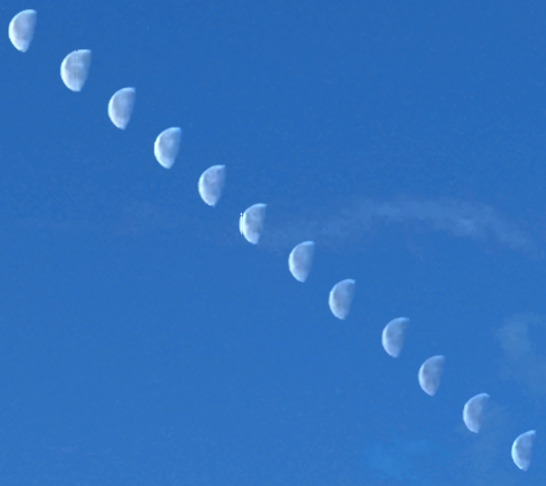
Fly me to the moon! (01/21/22)

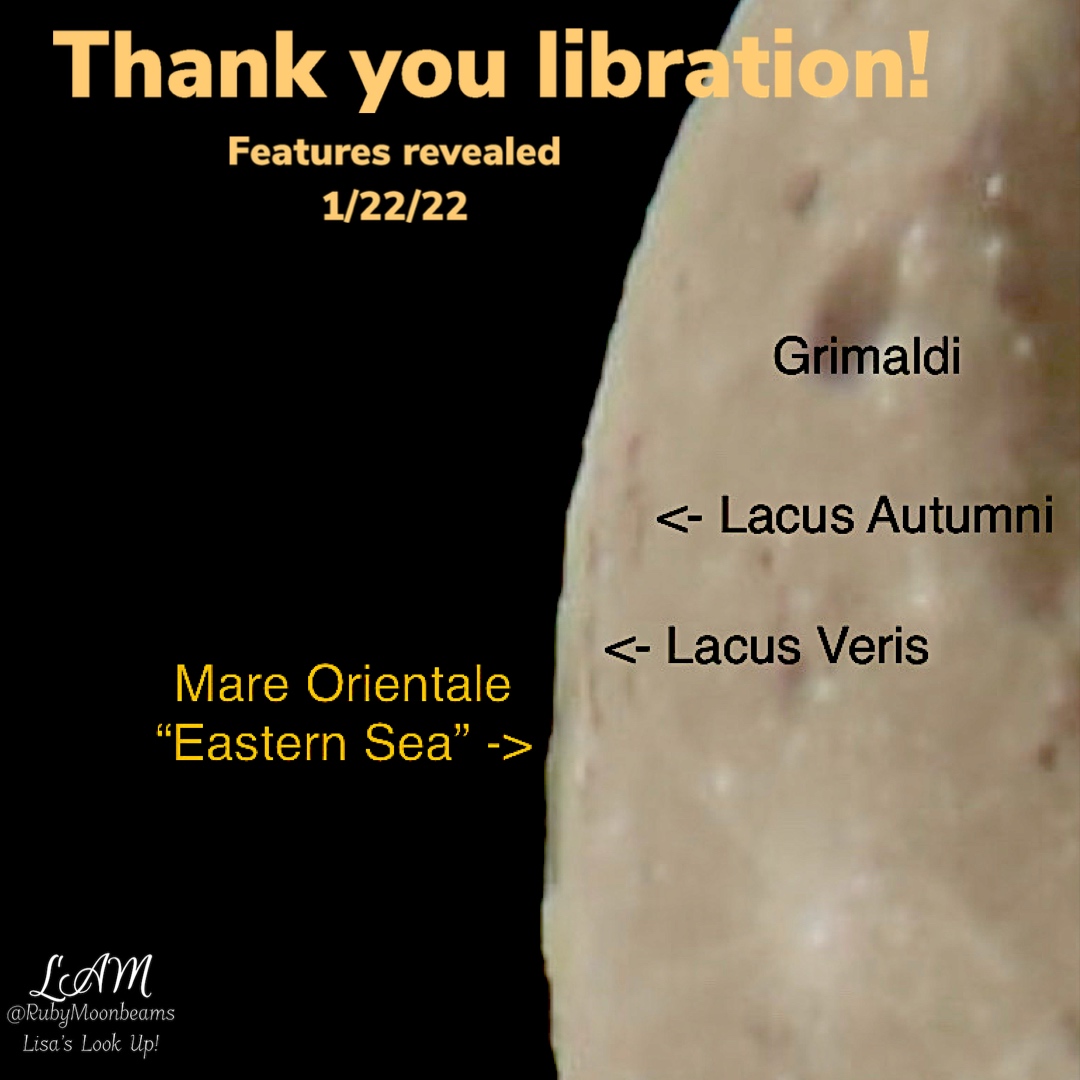
Thrilled to see Mare Orientale thanks to libration recently! (Grimaldi for reference)

Welcome back Venus to the morning sky 1/22/22

Moonset from Morganville 1/24/22

Posted in February 2022, Sidereal Times | Tagged , | Leave a comment

Snippets

compiled by Arlene & David Kaplan

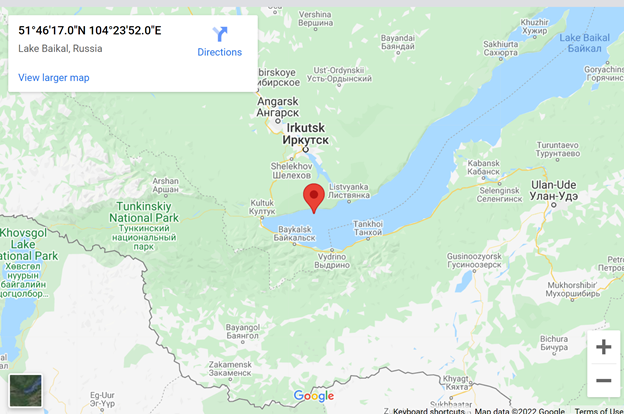
-Baikal-GVD

Very Large Volume Neutrino Telescopes Baikal
The Baikal deep underwater neutrino telescope (or Baikal-GVD – Gigaton Volume Detector) is an international project in the field of astroparticle physics and neutrino astronomy. The construction of Baikal-GVD is motivated by its discovery potential in astrophysics, cosmology and particle physics…more

-BBC
-BBC

Durham University fiber-optics help largest 3D map of Universe An international team of scientists has produced the most detailed three-dimensional map of the Universe yet. Within seven months, their Dark Energy Spectroscopic Instrument (DESI) has broken all 3D galaxy survey records. A component built by Durham University…more

-Tom Jacobs

Citizen Scientists Spot Jupiter-like Planet in NASA TESS Data Tom Jacobs of Bellevue, Washington, loves treasure hunts. Since 2010, the former U.S. naval officer has participated in online volunteer projects that allow anyone who is interested — “citizen scientists” — to look through NASA telescope data for signs of exoplanets, planets beyond our solar system. Now, Jacobs has helped discover a giant gaseous planet about…more

-WP

What is a Lagrange point, the final destination for the James Webb Space Telescope? The James Webb Space Telescope, launched Dec. 25, has now arrived at the destination from which it will begin its in-depth examination of the distant universe. However, unlike its predecessor, the Hubble Space Telescope, the James Webb Telescope won’t be orbiting Earth…more

-space.com

James Webb Space Telescope marks deployment of all mirrors NASA’s massive new observatory has notched another milestone. After nearly a full month in space, the James Webb Space Telescope, also known as JWST or Webb, is nearly at the end of its deployment work. The complicated series of deployments has seen the telescope transform from its tightly-folded launch configuration to what looks like a real observatory, although science observations remain months away…more

-space.com

Scorching alien planet takes seasons to an extreme Scientists got a close look at an extreme case of seasons thanks to a retired NASA telescope. Researchers used NASA’s Spitzer Space Telescope to film a year on an exoplanet called XO-3b. Conveniently, a year on this world lasts only three Earth days…more

– space.com

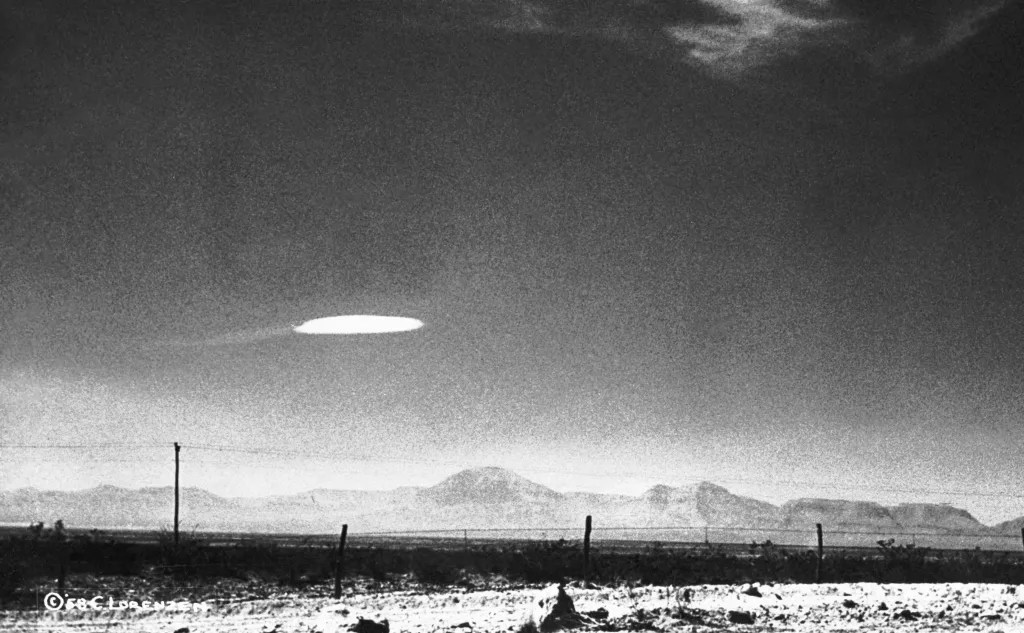
Pentagon launches new UFO office. Not all believers are happy about it. A new office in the Pentagon will investigate sightings of unidentified flying objects (UFOs) — but longtime UFO enthusiasts are skeptical. According to NBC, putting the new “Unidentified Aerial Phenomena” program in the purview of the Office of the Under Secretary of Defense for Intelligence &…more

-NASA

NASA catches sun sending powerful flare into space Our sun just had a medium-sized energy burp. NASA’s Solar Dynamics Observatory (SDO) caught a mid-level solar flare on Thursday (Jan. 20) with a peak at 1:01 a.m. EST (0601 GMT). You can see the flash on the limb, or edge, of the sun, thanks to SDO’s powerful imaging…more

Posted in February 2022, Sidereal Times | Tagged , | Leave a comment

From The Director

by Rex Parker, PhD director@princetonastronomy.org

Happy New Year!  Let us renew our hope for the new year and commit to connecting with other members of the amateur astronomy community and AAAP especially.  I look forward to seeing you in the upcoming Zoom sessions.  The first meeting of 2022 will be on January 11 (7:30pm) with an astronomer who has strong Hubble Space Telescope connections.  Please see program chair Victor Davis’s section below for more on the program. 

Astrovideo Live Winter Sessions.  We are renewing the hit sessions which debuted last winter.  The new dates are Jan 7, Feb 4, and Mar 4, Friday evenings close to a new moon. All members are welcome to join in these live observing sessions.  Those of you making progress with your own astrovideo telescope setups are urged to contribute your own video stream to the Zoom sessions – please contact me if interested. An email will be sent with the Zoom link a few days before each date.

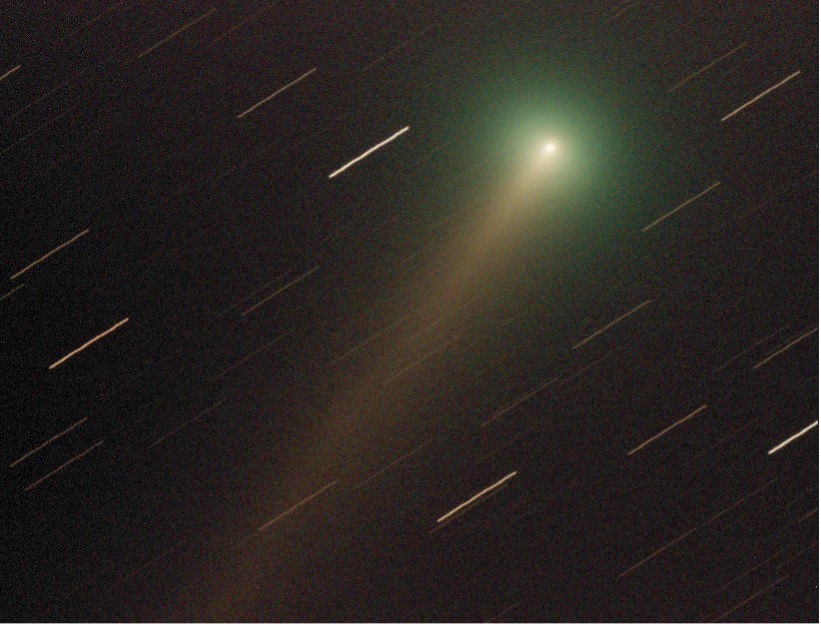
The Greenness of Comets.  The current hit movie Don’t Look Up (Netflix) portrays the government and industry attempting to acquire the valuable rare minerals in a newly discovered comet on a fatal collision course with earth.  Trillions of dollars of wealth and massive job opportunities are seen, blinding the authorities from seeing the impending disaster from the collision that the astronomers (played by Leonardo DiCaprio and Jennifer Lawrence) calculate from the data.  This is a fitting allegory for climate change and human denial, yet in a literal sense the color of comets really is green.  Why is that?

The images below of comet C/2021 A1 are from my home observatory in NJ using a 12.5” telescope and ZWO ASI071 camera, taken on Dec 8 just before morning twilight.  The green glow is quite apparent in these images which are carefully color-balanced.  The stars are trailing because the mount is tracking the comet (13x2min subframes, left panel;  6x2min subframes, right panel).  Known as Comet Leonard after its discoverer at the University of Arizona, it makes a good stand-in actor for the movie Don’t Look Up.  Although it won’t collide with the earth, Comet Leonard was found using Catalina Sky Survey’s 1.5m infrared telescope on Mt Lemmon.  Just like the movie, the Catalina survey is supported by NASA and the Near Earth Object Observation Program under the Planetary Defense Coordination Office.

From an astrochemistry view the emission of green or blue-green color from a comet’s nucleus but not the tail is an intriguing puzzle, only recently solved.  It is not the same photochemistry mechanism as others in astronomy, for example the fluorescent blue-green emission from ionized oxygen seen in planetary nebulae in the telescope. The nucleus of a comet is an agglomeration of rock, dust, and frozen gases.  As it gets closer to the sun, increasing heat causes the gases to sublimate and form a nebulous envelope around the nucleus known as the coma.  The tail of a comet is an extension of the coma drawn out by the solar wind.  Yet the green around the nucleus disappears in the tail which instead displays a reddish brown color.  

It has been thought for years that a comet’s green comes from the breakdown of the reactive molecule dicarbon (C2).  Dicarbon is an abundant molecule in the universe although not on earth, and multiple valence electronic states in its chemistry give it a rich spectroscopy.  The famous British scientist Wollaston reported the emission spectra of blue-green flames as early as 1802, the first glimpse of dicarbon.  Now a new study has solved the question of green in comets.  In this laboratory work, dicarbon chloride (C2Cl4) was irradiated by UV-laser, a way to generate dicarbon for spectral analysis (Borsovszky et al., Photodissociation of dicarbon: How nature breaks an unusual multiple bond. Proc Natl Acad Sci USA 2021, Vol 118, No 52).  Further irradiation at longer wavelengths generates a metastable state of the C2 molecule (a radical) which decays and radiates a characteristic greenish photon.  The emission spectrum of dicarbon is known as the Swan band, after the Scot physicist William Swan in the 1850s.  Swan bands are a characteristic of the spectra of carbon stars and some nebulae as well as comets.  Dicarbon photoemission in the Swan band requires two “forbidden” electron transitions which are favored in the environment of space but not on earth.  The spectral pattern (color) is a sensitive probe of local environment.  In their 2021 paper, Borsovszky et al. determined that the half-life of the C2 radical is a little under 2 days under the conditions of a comet at ~1 AU distance from the Sun.  This is the first solid explanation of why the head of a comet but not the tail glows green, because the dicarbon radical with its short half-life is dissipated as material streams out to the tail.  

The Unjournal Club Wants You.  Doing astronomy in AAAP is a little different when we cannot meet in person for regular meetings.  For now, the best way to keep the comm channels active is to use our monthly Zoom meetings to highlight club activities and facilitate member conversations.  These take place during the 2nd hour after the main speaker, when the informal “Journal Club” presentation by a member is slotted each month.  Help us break the boundaries set by Zooming by volunteering to give an “unjournal” club session!  I say “unjournal” here because these short episodes don’t need scholarly, journal-like topics, they only need to engage members with what you care about in astronomy.  It works great with Zoom screen sharing of PowerPoint slides, JPEG’s, etc from your home computer or mobile device.  To get on the schedule for an upcoming meeting, please contact me or program chair Victor Davis.

Progress on the New Initiatives

  • Merchandise store.  Thanks to member Rich Sherman who did all the setup, the merchandise store is launched now.  The club will benefit with 15% of each sale, and it is not limited to members although at present we are not advertising.  The store link is  http://aaap1962.logosoftwear.com/ (also posted on the upper right of the first page of each issue of ST on the website);  the password is SiderealTimes.
  • Social Media and the Discord AAAP Server.  Thanks to Debbie Mayes who provided an initial social media action plan which is under review by the board.  Len Cacciatore, Dave Skitt, Debbie Mays, Rich Sherman and I did an initial test of two social text-like apps (Groupme and Discord).  We decided to go forward with Discordfor member trial — it has excellent features and potential to help communication in the club.  The AAAP Discord server has been set up with three channels– General, Observatory, and Astrophotography.  Members were invited to join with a link sent Dec 14.  If you missed that invite and are interested, keep tuned in for a new invitation to be sent by email around Jan 5.  The invitation-only sign-up helps make this private for members of AAAP.  Please give it a try-out and provide some feedback to me or others on the Board.   
  • Telescope Loaner Program.  We are getting the equipment organized and a system is being set up to track loan outs.  Member Todd Reichart is spearheading this initiative with input from Dave S. and me, and it is nearly ready to launch.  
  • NASA/JPL Night Sky Network.  NSN and its usefulness in the club needs more time and thought but has great promise.  One idea is that we could begin using it to handle some of the roster functions.  Ira Polans and the Board are currently working on this.
Posted in January 2022, Sidereal Times | Tagged , | Leave a comment

From the Program Chair

By Victor Davis

The January, 2022 meeting of the AAAP will take place (virtually) on Tuesday, January 11th at 7:30 PM. (See How to Join the January Meeting below for details). This meeting is open to AAAP members and the general public. Participants will be able to log in to the meeting as early as 7:00 pm to chat informally with others who log in early. We will not be using the “waiting room;” participants will enter the meeting as soon as they log in. However, they will enter the meeting space with their microphones muted. This will help to remedy some of the background noise we experienced at last month’s meeting. Please be aware you must unmute yourself to be heard by other participants.

For the Q&A session, you may ask your question using chat or may unmute yourself and ask your question directly to the speaker. To address background noise issues, we are going to follow the rules in the table below regarding audio. If you are not speaking, please remember to mute yourself. You are encouraged, but not required, to turn your video on.

Meeting EventParticipant Can Speak?Participant Can Self-Unmute?
Director Rex’s General RemarksYesYes
Program Chair Victor’s  Speaker IntroductionYesYes
Speaker PresentationNoNo
Q&A SessionStart All on MuteYes                                    
5-minute bio breakYesYes
Journal Club presentation (none scheduled)Start All on MuteNo
Business MeetingStart All on MuteYes
Director’s closing remarksNoNo
   
Only the Business part of the meeting will be locked.

Featured Speaker:  Prof. Robert Williams, Astronomer Emeritus at the Space Telescope Science Institute (STScI).

Observing Galaxy Formation with the Hubble Space Telescope

From his unique perspective as former Director of the Space Telescope Science Institute, Prof. Williams will present a brief history of the Hubble Space Telescope (HST), including its travails and the servicing of the telescope by NASA astronauts. He’ll describe the history of how HST has obtained clear views of objects in the distant Universe, and the basic principles by which astronomers have used the Hubble to look back in time to piece together the formation of structure in the Universe after the Big Bang. Prof. Williams will compare computer simulations and actual Hubble observations which indicate that small perturbations in the early Universe grew to form galaxies that now fill the cosmos.

About the Hubble Deep Field

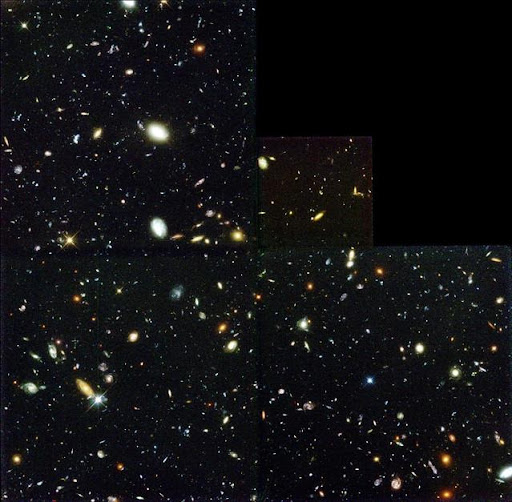
Once HST’s spherical aberration was remedied by installing corrective optics in 1993, Prof. Williams proposed to use a substantial portion of his Director’s Discretionary time for Hubble to stare at a relatively blank portion of the sky to capture images of an unknown number of distant objects.  At the time, the idea of devoting such a valuable resource to what many considered a fool’s errand was not well received. Nevertheless, between December 18 and 28, 1995, Hubble stared at a small patch of sky in Ursa Major  (RA: 12h 36m 49.4s; Dec: +62º 12’ 58”) about 2.6 arc-minutes on a side (1/12 the apparent diameter of the full Moon). During the course of about 150 orbits, Hubble took 342 separate exposures through four broadband filters totaling about 141 hours. 

–NASA

Almost all of the 3,000 objects in the Hubble Deep Field (HDF) are galaxies, some of which are among the most distant (hence youngest) known. This iconic image revolutionized our understanding of the numbers and evolution of galaxies in the observable Universe. Over the years, deeper images including ones captured at non-visual wavelengths have expanded on the theme started by the HDF. For his leadership of the HDF project, Prof. Williams was awarded the Beatrice Tinsley Prize of the American Astronomical Society and NASA’s Distinguished Public Service Medal.

unnamed

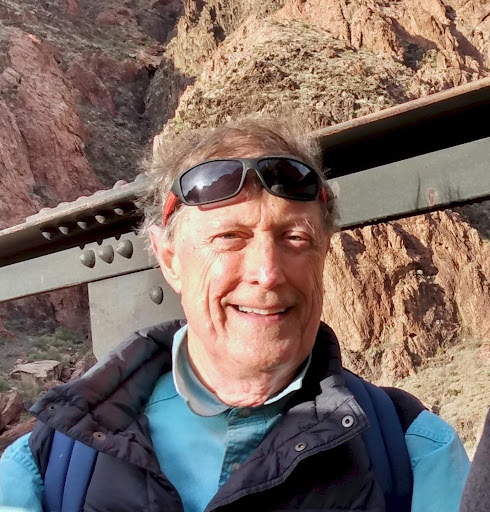
Robert Williams received his undergraduate degree from UC Berkeley and his PhD in astronomy from the University of Wisconsin. He was Senior Fulbright Professor at University College London. He received the Alexander von Humboldt award from the German government and the Karl Schwarzschild Medal for career achievement in astrophysics by the German Astronomische Gesellschaft.

In addition to his emeritus position at STScI, Prof. Williams is Distinguished Osterbrock Professor at UC Santa Cruz. Before assuming his present positions, he spent eight years in Chile as Director of the Cerro Tololo Interamerican Observatory. Prior to that, he was Professor of Astronomy at the University of Arizona, in Tucson.  Prof. Williams is an elected member of the American Academy of Arts and Sciences. 

Prof. Williams is a strong advocate for science education and has lectured around the world on astronomical discoveries and the importance of science in modern life. He and his wife, Elaine, a pediatric psychologist, co-founded a non-profit organization in Baltimore that places adults with autism in the workplace. Prof. Williams’ research specialties include novae, nebulae, and emission-line spectroscopy and analysis.


AAAP webcast:  This month’s AAAP meeting, beginning with Rex’s opening remarks and ending at the break before the business meeting, will be webcast live on YouTube and recorded for subsequent public access on AAAP’s YouTube channel. Be aware that your interactions during this segment, including questions to our guest speaker, may be recorded for posterity.  

YouTube Link: Amateur Astronomers Association of Princeton, January 11, 2022 Meeting, 7:30 PM EST

This session will be recorded and saved on YouTube. Send me an email at program@princetonastronomy.org if you have any concerns. 

Using Zoom: While we are social distancing, the AAAP Board has chosen to use Zoom for our meetings, based our belief that many members have already have used Zoom and its ease of learning. One of its great features is you can choose whether you want to install the software on your computer or use it within your browser.

How to Join the January Meeting: For the meeting, we are going to follow a simple two-step process:

  1. Please make sure you have Zoom installed on your computer. You do not need a Zoom account or need to create one to join the meeting. Nor are you required to use a webcam.
  2. Please visit our website for the Zoom link.

This session will be recorded and saved on YouTube. Send me an email at program@princetonastronomy.org if you have any concerns.

NOTE: The Zoom site has many training videos. If you’re unsure how Zoom works you might want to view the videos on how to join a meeting or how to check your computer’s audio and video before the meeting.

Link to join January’s Zoom Meeting
Amateur Astronomers Association of Princeton is inviting you to a scheduled Zoom meeting.

Topic: January 11, 2022 Monthly AAAP club meeting with former STScI Director, Robert Williams
Time: Jan 11, 2022 07:00 PM Eastern Time (US and Canada)

Join Zoom Meeting
https://us06web.zoom.us/j/88211456054?pwd=bHd5YzAra1BEQVBqTnlJYWRNT3Rudz09

Meeting ID: 882 1145 6054
Passcode: 045800

Find your local number: https://us06web.zoom.us/u/kbNaHdJPep

“Unjournal Club”

There is not currently a member who has stepped up to make a short presentation to the club in January. It’s not too late! Thanks to Surabhi Jain-Agarwal for December’s virtual and vicarious trip to Iceland. Sorry about the puffins. At this writing Surabhi is out of town, hopefully gathering material for an upcoming travelogue. 

Update: Surabhi has decided to make a short presentation on the effects of light pollution on the night sky, climate change and our health and ecosystem. She will talk about the steps members can take to curb it in their own communities and towns.

We hope to make these short presentations a regular feature of our monthly meetings. We’d like to know what members are doing or what members are thinking about in the broad range of topics encompassed by astronomy. A brief ten-minute (or so) presentation is a good way to introduce yourself and the topics you care about to other club members. If you are interested in presenting a topic of interest, please contact either director@princetonastronomy.org or program@princetonastronomy.org.

A look ahead at future guest speakers:

February 8, 2022Chris Spalding, a 51 Pegasi b postdoctoral fellow in astronomy at Princeton University, will talk about his research to understand planet formation by way of simple theoretical descriptions of planetary dynamics.
March 8, 2022Rosanne Di Stefano, of the Center for Astrophysics/Harvard and Smithsonian, led a team who used the Chandra X-ray observatory to search for brightness dips in X-ray binaries. They may have detected a transiting exoplanet in the spiral galaxy M51. To date, all exoplanet candidates (4,000+ and counting) have been discovered within 3,000 light-years of Earth. An exoplanet in M51, 28 million light-years away, would be thousands of times farther away than those in the Milky Way.
June 14, 2022Bill Murray, AAAP Outreach Chair and astronomer at the New Jersey State Museum will once again (following a Covid hiatus) give club members a private sky tour at the museum’s planetarium. He’ll show off the refurbished planetarium’s state-of-the-art Digital Sky 2 8K projection system. This is an opportunity to put aside Zooming and commiserate with astro-buddies in the real world.

Thanks to Bill Thomas, Ira Polans, and Dave Skitt for their valuable advice and assistance.

As always, your comments and suggestions are gratefully accepted.

Posted in January 2022, Sidereal Times | Tagged , | Leave a comment

Minutes of the December 14th, 2021 AAAP Members General Meeting (online)

by Gene Allen, Secretary

The meeting was convened on Zoom by Director Dr. Rex Parker at 1930 with the agenda for the evening.

Program Chair Victor Davis introduced featured speaker Dr. Joleen Carlberg who presented “The Fiery Fate of Exoplanets” from her home in Silver Springs, MD. The talk was interrupted for about twenty minutes by what turned out to be a power failure in her neighborhood, but it was successfully resumed.

The business meeting convened at 2200 with a twenty minute Unjournal Club Presentation by member Surabhi Agarwal about her “Iceland Adventure” and views of its auroras and fiery underground.

Rex presented a Sky X depiction of the orbit of Comet Leonard and impressive astrophotos taken of it by members Robert Vanderbei, Tom Swords, and himself. Robert’s photo of the partial lunar eclipse was also shared.

The newly opened AAAP Online Merchandise Shop was described by Lead Facilitator Rich Sherman. It can be accessed from the AAAP website with the password SiderealTimes. Although purchases made now are unlikely to ship before January, members are encouraged to support the club by way of the 15% that returns to our treasury.

Dave Skitt reminded members that purchases made through Amazon Smile can also return a share to the AAAP as a legitimate charity.

The newly set up AAAP Server on Discord was described by Rex and Lead Facilitator Len Cacciatore. It is a communication platform that allows multiple forms of media and is restricted to AAAP members. An email invitation to join was sent to all members on this date. Rules and moderators will be set up as members join. Discussion revealed some dissention about choosing Discord over other platforms, but while the choice was properly considered, it is being operated on a trial basis. No cost is involved, so if it does not prove useful or substantial support grows for an alternative, we can change.

Rex proposed that interested members set aside January 7, February 4, and March 4 as possible dates for our Astrovideo Live Winter Zoom Sessions. These dates are near the New Moon, and if weathered out, hardware and technique discussions will be conducted. Members who are developing an astrovideo/EAA capability are invited to add their setups to those of our veterans.

Observatory Chair Dave Skitt presented the status of several issues. The state has finally responded to us with the specific documents we still need to provide for them to consider granting permission to repair the deteriorating roof-supporting columns. Water is currently still defended against freezing by light bulbs in the bathroom, but it will be turned off and drained shortly. The cooling function in the AAAP owned ZWO ASI294 Pro astronomy camera has been conclusively proven defective and the camera will need to be returned to them for servicing. Dave is accumulating needed bits and pieces to be added to our spare hardware for the Scope Loaner Program.

Available hardware is being prepared to be offered to members in the Scope Loaner Program. Dave, Rex, and Tom are assembling the pieces, but we need one or more members to step forward as facilitators for this program.

Miscellaneous discussions wound down and the meeting was adjourned at 2240.

Between Zoom and the live YouTube feed, approximately 55 people attended the speaker’s presentation. The business meeting began a half hour later than usual but 40 some stuck around for at least part of it. As of today we have 173 active members.

Posted in January 2022, Sidereal Times | Tagged , , | Leave a comment

Secretary’s Scribblings

by Gene Allen, Secretary

As the recently appointed Secretary of the AAAP, I have been deeply immersed in learning how to accomplish the duties of the position and tweaking the tools to better fit my use. There has been a lapse in the performance of these duties while the position was vacant, and I will be working to recover from that. All new member emails to date have been entered! That part, at least, should be current. Please be patient with me, but do report any issues you may have to secretary@princetonastronomy.org.

We are in transition from basing dues payments on the AAAP fiscal year to assigning each member a renewal month. I think this will be helpful. I was never sure how the fiscal year ran, and neither could I remember whether I had paid for whatever that year was. For new members, the renewal month is the month following the application month and for continuing members, it is the month following the last renewal payment you made. You will receive a renewal email notice roughly at the start of your renewal month and can pay anytime during that month or earlier. If you have not paid your dues by the first of the month following your renewal month, you will be overdue and receive another notice to that effect. If you still have not paid by the end of the month following your renewal month, your membership will be terminated, and your email address will be removed from the server. If you subsequently renew during the first year after termination, you can be reinstated, but your dues will not be prorated, and your renewal month will remain the same. More than a year out, you will have to reapply.

Since this is a new procedure, and we have had a significant lapse in notifications, we will be lax in enforcing the strict timeline specified above. We are also having problems with the website, and until that gets resolved it will be difficult but not impossible for new members to join. We did have one new member work it out so far. Fortunately, renewals still work fine, which I confirmed by renewing both my wife and myself on December 22nd. 

The January renewal reminders have been sent, and I include a link to the renewal page to make it super simple. I also invite feedback about what we are doing well and what we could improve, with the intention of improving member retention. We gained 65 new members this year, and it would be great if they all stay with us!

Gene Allen

Posted in January 2022, Sidereal Times | Tagged , , | Leave a comment