Gamma Ray Bursts

by S. Prasad Ganti

The cold war between the US and the Soviet Union gave some insights into some of the violent cosmic explosions in our Universe. In the 1960s, US launched the Vela satellite to detect any nuclear tests performed by other countries, notably the Soviet Union. Typically it involved looking for Gamma rays, which  is the radiation at the highest end of the spectrum of electromagnetic waves. 

Gamma rays are the most energetic of all the electromagnetic radiation. The energy of the radiation is proportional to the frequency. Gamma rays having the highest frequencies, have the most energy. 

In 1967, the Vela satellite detected an intense burst of Gamma rays lasting for a few seconds. Chaos prevailed in the Pentagon for a few days, not knowing where the radiation was coming from.Was there any indication that it came from any nuclear test on the earth or from some source in outer space. Whether to react or take a risk of letting go of a nuclear test by any country. 

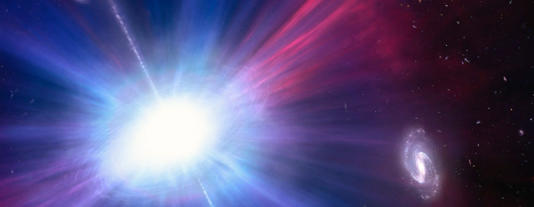
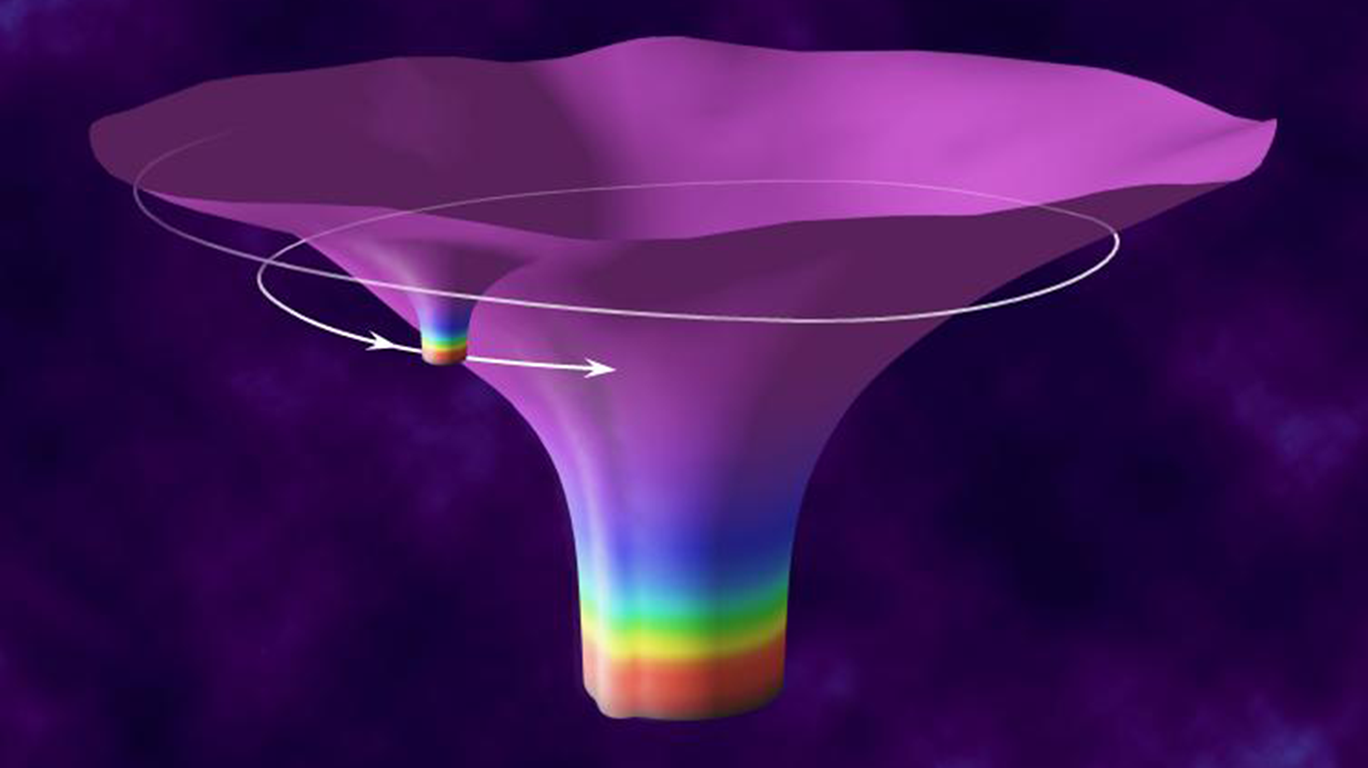
Further investigations revealed that the burst came from outer space. Its terrestrial origins were ruled out. Several such bursts have been detected since then. All of them coming from outside of our galaxy Milky Way. Now it is known that Gamma Ray Burst indicates the birth of a black hole, either from a hyper nova resulting from the collapse of a rapidly spinning massive star,  or a binary pair of neutron stars collapsing into a black hole, or a highly magnetized neutron star called a Magnetar “falling” into a black hole. Something similar to conditions which lead to the generation of gravity waves. 

Gamma ray bursts are short lived. From a few seconds to a few days. But very intense, outshining the entire output of solar systems or even galaxies during these brief time intervals. Why were they not detected earlier than the cold war period ? Mainly because gamma rays cannot penetrate earth’s atmosphere. Of the electromagnetic radiation, earth’s atmosphere lets only radio waves and visible light reach the surface. Absent such a protective blanket, no life would have been possible on earth. Gamma rays being very energetic are very harmful for life on earth. Gamma rays can be detected in space easily. That is why we had to wait till the launch of a gamma ray detector to space against the backdrop of the cold war.

All the Gamma ray bursts detected so far have come from distant galaxies. None from the  Milky way. Such violent conditions are very rare for a given location. But since the Universe is so vast with billions of galaxies each with billions of stars, the probability of some event happening somewhere is high. It is theorized that a Gamma ray burst in our own Milky way, about 6000 light years away in one of its arms, was responsible for the first mass extinction of life experienced on earth. Around 430 million years ago, before plants and animals  moved to the land, much before the dinosaurs ruled, this extinction took place. Called Ordovician extinction, the unconfirmed cause depleted the ozone layer due to the Gamma ray burst and exposed the Ocean life to the deadly gamma rays. But no evidence exists to support this theory. Alternate theory is the glaciation and cooling down of oceans could have led to this event. It is just too much in the past to leave any direct concrete traces which last till the current times.

In the 1990s, there was the Compton Gamma ray observatory and now the Fermi Gamma ray telescope in space studying the gamma rays. On the ground, techniques have been developed to detect gamma rays. Whenever gamma rays strike the earth’s atmosphere, they produce electron-positron pairs from the air molecules. As these pairs streak through the earth’s atmosphere, they produce something known as Cherenkov radiation. This radiation can be studied to determine the direction and the source of  gamma rays.    

This is another example of astronomy branching out beyond the visible light.

Posted in Mid-summer 2023, Sidereal Times | Tagged , | Leave a comment

Snippets

compiled by Arlene & David Kaplan

-Charles Emerson/BBC

Leeds 2023: Mobile observatory bus begins city-wide tour A mobile observatory promising to take visitors “to the stars and back” is going on tour around Leeds. Moon Palace, a former school bus, is on the move until late November as part of Leeds 2023 – a year-long celebration of the city and its culture…more

-NYT
-NYT

NASA Reaches Voyager 2 With a Last-Ditch ‘Shout’ Across the Void It took an interstellar “shout” across the solar system. But NASA’s Jet Propulsion Laboratory said on Friday that it re-established full communications with Voyager 2, an aging probe exploring the outer edges of the solar system. “After two weeks of not hearing anything…more

-BBC

James Webb telescope captures end stages of dying star’s life Mesmerising images of the end stages of a distant star’s life have been captured by the James Webb space telescope (JWST).They show an unprecedented level of detail of a doughnut-like structure of glowing gas known as the Ring Nebula…more

-BBC

Euclid: ‘Dark explorer’ opens its eyes on the cosmos Europe’s new space telescope, Euclid, has returned its first images. Engineers switched on the cameras of the €1.4bn (£1.2bn) observatory to begin a phase of testing and captured a wide vista of stars and galaxies. Once properly set up, Euclid will start building a 3D map of the cosmos in an effort to tie down the nature of so-called dark matter and dark energy…more

-NYT

Titanium Clouds Engulf This Ultrahot Neptune-like Planet Astronomers have come across the shiniest planet ever found, a mere 265 light years from our solar system. But that’s hardly its only standout trait. Shrouded by thick metallic clouds, this world’s temperature reaches a blistering 3,000 degrees Fahrenheit, and it quite likely rains scorching-hot drops of titanium…more

-NYT

NASA Seeks a Nuclear-Powered Rocket to Get to Mars in Half the Time In less than four years, NASA could be testing a nuclear rocket in space. The space agency and the Defense Advanced Research Projects Agency, or DARPA, announced on Wednesday that Lockheed Martin had been selected to design, build and test a propulsion system that could one day speed astronauts on a trip to Mars…more

-NYT

Scientist’s Deep Dive for Alien Life Leaves His Peers Dubious On Jan. 8, 2014, a fireball from space blazed through Earth’s atmosphere and crashed into the sea, north of Manus Island off the northeastern coast of Papua New Guinea. Its location, velocity and brightness were recorded by U.S. government sensors and quietly tucked away in a database of similar events…more

-NYT

Break Out the S’mores: This Star Is Cooler Than a Campfire When you sit at a campfire and look up at the stars, even the tiniest pinpricks of light that you see are massive furnaces, producing intense heat. But hidden among these infernal embers are celestial bodies so dim that they’re invisible to the naked eye…more

Posted in Mid-summer 2023, Sidereal Times | Tagged , | Leave a comment

From The Director

by Rex Parker, PhD director@princetonastronomers.org

Next meeting at the Planetarium – in Person Only.  We want to see you in person at the next monthly meeting of AAAP on June 13 meeting (7:30pm) at the Planetarium in Trenton.  This is the last meeting of the academic season and will be held in-person-only because of technical barriers to broadcasting the dome show.  For more info see Victor’s article below.

Profound Events.  Having spent a few days last week reflecting on the philosophical aspects of  life turning 70, there’s no experience more ineffable than the astronomical.  There may seem to be great portent in recent events here, which may resonate with AAAP members.  From a 4 billion year old meteorite landing close to the AAAP Observatory, with a black bear roaming around nearby (see photo below), to the sudden flare of a supernova in the great spiral galaxy Messier 101.  The M101 supernova SN 2023ixf first appeared on May 19 (my date of great reflection) and is well positioned for observing, transiting around 11pm locally now.  The credit for discovery of the supernova has gone to amateur astronomer Koichi Itagaki from Japan, confirmed the next day (May 20) by the Zwicky Transient Facility (ZTF) at Palomar CA.

Infrared photo of a bear in the Washington Crossing Park area near the Observatory taken on May 25 at night using a wildlife camera.

Several members of the AAAP astroimaging sub-group obtained interesting images of the supernova.  I offer mine here with some interpretation of the color. The galaxy M101 has a magnitude about 7.9, but low apparent surface brightness being a face-on spiral. Although it is 21 million light years away it is relatively close as galaxies go, and easy to find in a scope near the naked-eye double star Alcor and Mizar in the handle of the big dipper.  I used Maxim-DL’s Pinpoint Astrometry with the data in this image to obtain a calibrated magnitude = 9.37 for SN 2023ixf (see image below). Its color appears bluish-white. This is a type 2 supernova, formed from the rapid collapse and violent explosion of a massive star, and is typically low in red H-alpha emissions.  This is because the spectrum of type 2 SN’s have strong Balmer hydrogen absorption lines (remember my Unjournal talk a couple months ago!), including absorption in the well-known H-alpha band at 656nm (red).  This is one feature distinguishing Type 2 from type 1 SN. Absorption is the inverse of emission, and this aspect of the physics would appear to explain my observation that the SN starlight profile is deficient in red.  Shown in the graph on the right of the image, the RGB filters of the CMOS sensor array provide a form of rough spectroscopy.  It can be seen in the profile graph that the blue and green intensities are higher than the red in the profile, consistent with the physics of a type 2 supernova.   

The spiral galaxy Messier 101 with the supernova SN 2023ixf indicated by the cyan arrow on the left.  The graph shows the light profile of the SN recorded by the CMOS sensor R,G,B Bayer matrix filters. Image is the mean of 5x10min exp. with a ZWO ASI2400MC camera and 12.5” f/6.7 reflector.  Software is Diffraction Limited’s Maxim DL v6, image by RA Parker.

Posted in June 2023, Sidereal Times | Tagged , | Leave a comment

From the Program Chair

By Victor Davis

The June, 2023 meeting of the AAAP will take place on Tuesday, June 13th at 7:30 PM. The location, as has been the club’s tradition for many years excepting the recent pandemic years, is the planetarium of the NJ State Museum in Trenton. This special academic year-end meeting is traditionally hosted AAAP’s longtime member, current Outreach Chair, and planetarium staffer Bill Murray. This year’s presentation will be given by Bill’s new boss at the planetarium, Dr. Jacob Hamer.

The museum’s address is 205 West State Street, Trenton, NJ. There is plenty of free parking behind the museum, near the planetarium entrance.

Dr. Hamer will talk of the legacy of the Arecibo radio telescope and present a preview of the planetarium’s new sky show projected onto the dome by its recently refurbished projection equipment. This is an IN-PERSON ONLY event; you must be present in the planetarium to experience the program and participate in the meeting’s agenda. There will be no option to zoom at this meeting, nor will there be a recorded version to play back later.

Here’s the anticipated agenda for June’s monthly meeting of the AAAP:

(Times are approximate)

Dr. Jacob Hamer

Dr. Hamer received a B.A. in Physics and in Mathematics from the CUNY Macaulay Honors College at Hunter College in New York City, New York in 2017. While he was at Hunter College, he carried out research on galaxy evolution at the American Museum of Natural History. Jacob then completed his Ph.D. in Astronomy and Astrophysics at Johns Hopkins University in 2022. Jacob’s doctoral research focused on exoplanets, planets orbiting stars other than our Sun, the first of which orbiting a Sun-like star was discovered the day Jacob was born. He investigated how short-period exoplanets and their stars interact, and how those systems evolve over time. In February 2023, Jacob joined the NJ State Museum as Assistant Curator of Planetarium Education.

60 Years of Discoveries with the Arecibo Observatory

The Arecibo Observatory was founded in 1963 to study the ionosphere; its ability to carry out radio astronomy was merely a secondary benefit. But over the next 60 years Arecibo would become an astronomical powerhouse. It made important discoveries in planetary science as well as in the study of small solar system bodies. It also allowed astronomers to observe the raw material that will form the next generations of stars. Perhaps its most famous contributions to the field concerned the extreme fate of some high mass stars; its observations of pulsars would lead to not one but two Nobel Prizes. Finally, Arecibo allowed astronomers to consider the question “Are we alone?”.

As always, your comments and suggestions are gratefully accepted.

Posted in June 2023, Sidereal Times | Tagged , , | Leave a comment

Minutes of the May 9, 2023, AAAP Members General Meeting

by Gene Allen, Secretary

The meeting was convened in Peyton Hall and on Zoom by Director Rex Parker at 1935. Following a brief introduction and presentation of an agenda, Program Chair Victor Davis introduced Speaker Alain Maury, an international citizen and professional astronomer currently visiting the US. His topic was The Hunt for Near Earth Asteroids. From the dawn of the space age when only 20 Near Earth Asteroids were known, advancements in technology have enabled the count to exceed 30,000 by 2022. Mr. Maury described that progress and his long and still ongoing participation in the effort. His impressive accomplishments are detailed on the website that also describes his lodge and observatory in San Pedro de Atacama, Chile, just a few miles north of ALMA. https://www.spaceobs.com/en/Alain-Maury-s-Blog/Who-am-I

There were 31 attending in person and 33 on Zoom.

After questions and a brief break, the business meeting resumed at 2116 with only 17 still connected online and 20 in the auditorium. Contributions by members other than the elected officers were acknowledged.

               Surabhi Agarwal, longtime Webmaster and newsletter Editor

               Debbie Mayes, enthusiastic promoter recently named Promotions Chair

               Mike DeMario, astrophotography advocate recently named Astroimaging Chair

               Rich Sherman, singlehandedly established AAAP Merchandise

               Ira Polans, former Chair and continuing Program Committee contributor plus network coordinator

The AAAP Membership Roster had been updated that day to show 201 current members, meaning that the required 15% quorum amounts to 30. Nominations Chair Lee Sandberg reported that no further nominations had been received. A motion was made and seconded to accept the slate of incumbent officers.

Director: Rex Parker

Assistant Director: Larry Kane

Treasurer: Michael Mitrano

Secretary: Gene Allen

Program Chair: Victor Davis

Observatory Co-Chairs: Jen & Dave Skitt

Outreach Chair: Bill Murray

There were 17 members present in the auditorium and all voted in favor. Online another 9 votes in favor were received with no dissentions. The total, however, was only 26. John Church had given his proxy in favor and that made 27, still short of making it a valid election. It’s rather shameful that not even 15% can show up for an annual election.

The loaner telescopes are still not ready to loan out.

The eclipse travel group meeting came up with a weak consensus of a group willing to travel to Texas and another that might coordinate to some location in the middle of the country. Assistant Director Larry Kane is coordinating research and participation.

Ten minute Unjournal Presentations by members are still invited.

Outreach Chair Bill Murray will be following a star show at the NJ State Museum Planetarium with a convoy to Simpson Observatory on May 12 and 19, weather permitting.

The June meeting talk will be about Arecibo and held at the NJ State Museum Planetarium at 205 W State St in Trenton. A live star show will be included.

A wide field telescope field of view to compliment the C14 is being assembled. It currently consists of a SkyWatcher Evo 50 scope and a ZWO ASI585MC astronomical camera. The four Board members present in the auditorium approved spending up to $1,000 to complete that project.

Observatory Co-Chair Dave Skitt offered an update on the other projects at the Observatory.

  • We are still seeking someone to coordinate and oversee professional installation of new carpet.
  • Opening the observatory is planned to observe the occultation of Jupiter by the Moon at dawn on May 17
  • While the Nature Center post in the state park is currently vacant, the traditional solar viewing event held there over Memorial Day weekend is being planned as an AAAP event. Members able to help answer questions and manage visitors or who can bring a properly filtered solar scope are encouraged to be in contact with Dave.
  • A bear has been sighted near the park. Heads up!

The fate of the Holmdel Horn is still undetermined.

Monitor the increasing Sun activity for possible auroras reaching down into our area.

The meeting was adjourned at 2159.

Posted in June 2023, Sidereal Times | Tagged , , | Leave a comment

New Summer AAAP Merchandise

by Rich Sherman, Merchandise Chair

We are happy to announce that we have added a second merchandise vendor.  This new site offers a wide range of primarily non-apparel items—from bags and magnets, to towels and cups, and lots of stuff in between.  The website is:  https://aaap-next-gen-store.printify.me/products.  The password is: SiderealTimes.

Note that we now have TWO vendors to meet all your AAAP gear needs on our website.  Just click on the “Membership” tab and select “Merchandise.”  or click here AAAP Shopping

Why do we have two vendors?  One is apparel:  https://www.logosoftwear.com/shareandsell/?store=AAAP1962. The new vendor is primarily non-apparel:   https://aaap-next-gen-store.printify.me/products.  The password for both is:  SiderealTimes.  If you have any questions or need a custom order, send an email Rich Sherman at merchandise@princetonastronomy.org.

Posted in June 2023, Sidereal Times | Tagged , | Leave a comment

From the Observatory Chair

By David Skitt

The Solar Observing Memorial Day Weekend event on Saturday, May 27th, held at AAAP’s Observatory in Washington Crossing State Park was awesome! We had 10 volunteers/keyholders.  Not sure of the breakdown of members in attendance versus general public but we had at least 60 +/- people wander through.  Some said they follow us on SM or our website and that’s how they heard about it.  Some came because we talked about it Friday night.  There was a park musket firing demo at 2 pm which probably added some passers-by.  I gave some flyers to the visitors center around 12:20; there was no one manning the main entrance kiosk or I would have given them some.  I’ve been told the park entrance fees have been waived until the state budget is finalized.  One of the park park volunteers at the VC came by for a look.

We had two, dual setups with whitelight/hydrogen alpha filtered scopes, one single HA scope, three single whitelight scopes and one binocular/whitelight setup.  Inside the obs’y we had two whitelight visual scopes and were using the two cameras with whitelight filters. Plenty of options for the viewers.

I took some pictures as did Jen, Larry Kane and John Miller. 

Jen, John M. John H. and Larry manned the literature table under a canopy I brought.  The donation can attracted $109.  On Friday night, a friend of one (maybe several) of our members donated a used Celestron 114mm GT newtonian scope (yes, one of the bird-jones designs).  It needs some collimation but seems to track OK.   Tom and I will have a go at it sometime.

All in all it was fun and informative weekend at the Observatory.

Posted in June 2023, May 2023, Sidereal Times | Tagged , | Leave a comment

Safe Solar Viewer – The “Scope On A Stick”

by Tom Swords

At the 2023 AAAP solar event on Memorial weekend, I employed my “Scope on a Stick” solar viewer. It allows one or more viewers to easily and safely see the solar disk in white light cast onto a white screen.

I constructed the instrument using the instructions located here: http://richardsont.people.cofc.edu/safe_solar_folder/index.html

Here is the link to Surplus Shed. They have the lens kits.
https://www.surplusshed.com/search.php?search=safe+solar+viewer

The device can be hand held or mounted to a manual or guided mount with the appropriate hardware. There are alternative construction materials and designs in the instruction guide. The guide is being updated for the 2024 solar eclipse. See the link above for the instructions for details.

The instructions explain the different optical components and how to employ them. It makes for a great “hands on” project to see how the optical components work together.

I took the basic design and modified it for durability. I used aluminum square tubing, aluminum angle and wood that I had on hand.

I was fortunate to have a 60mm achromatic lens for my construction in place of the singlet objective that came with the kit. The singlet lens provided with the kit from Surplus Shed had worked just fine. I simply desired a larger image.

The instrument will provide for safe viewing of the solar eclipse in 2024.

This was an interesting project and I am quite pleased that it works as well as it does!

Posted in June 2023, Sidereal Times | Tagged , , | Leave a comment

From The Digital Desk of New Member Joseph Matthews

by Joe Matthews

Joseph_Matthews

After thinking about joining  AAAP for about 5 years, I finally made my decision on December 31, 2022.  I have been interested in Astronomy since reading Issac Asimov’s 1968 book, “The Universe from Flat Earth to Quasar’s”.  I wanted to go to University after High School but finances were tight, so I enlisted in the US Navy.  While stationed at Pearl Harbor circa 1975-1977, I enjoyed a few astronomy classes at the University of Hawaii.  My favorite course was given by, if I recall his name correctly, Dr. William Hickox, our textbook was by Shipman “Black Holes Quasars & the Universe”.
After enlistment, life got in the way and I worked various jobs finally working in Information Technology mainly as a Network Engineer and retired in 2019.  In retirement, I have renewed the goal of my youth and have been self-studying Astronomy, spending time on GalaxyZoo, observing and devoting a lot of time to Astrophotography.

Posted in June 2023, Sidereal Times | Tagged | Leave a comment

Black holes, Entropy, and information

by S. Prasad Ganti

In the century following Albert Einstein’s General theory of relativity, the term “Black holes” entered our lexicon. In addition to a greater understanding, Black holes have been confirmed via indirect means and also photographed in the last few ears. Greater understanding resulted from relating Black holes to a thermodynamic concept called Entropy, and also relating to information theory or quantum computing. 

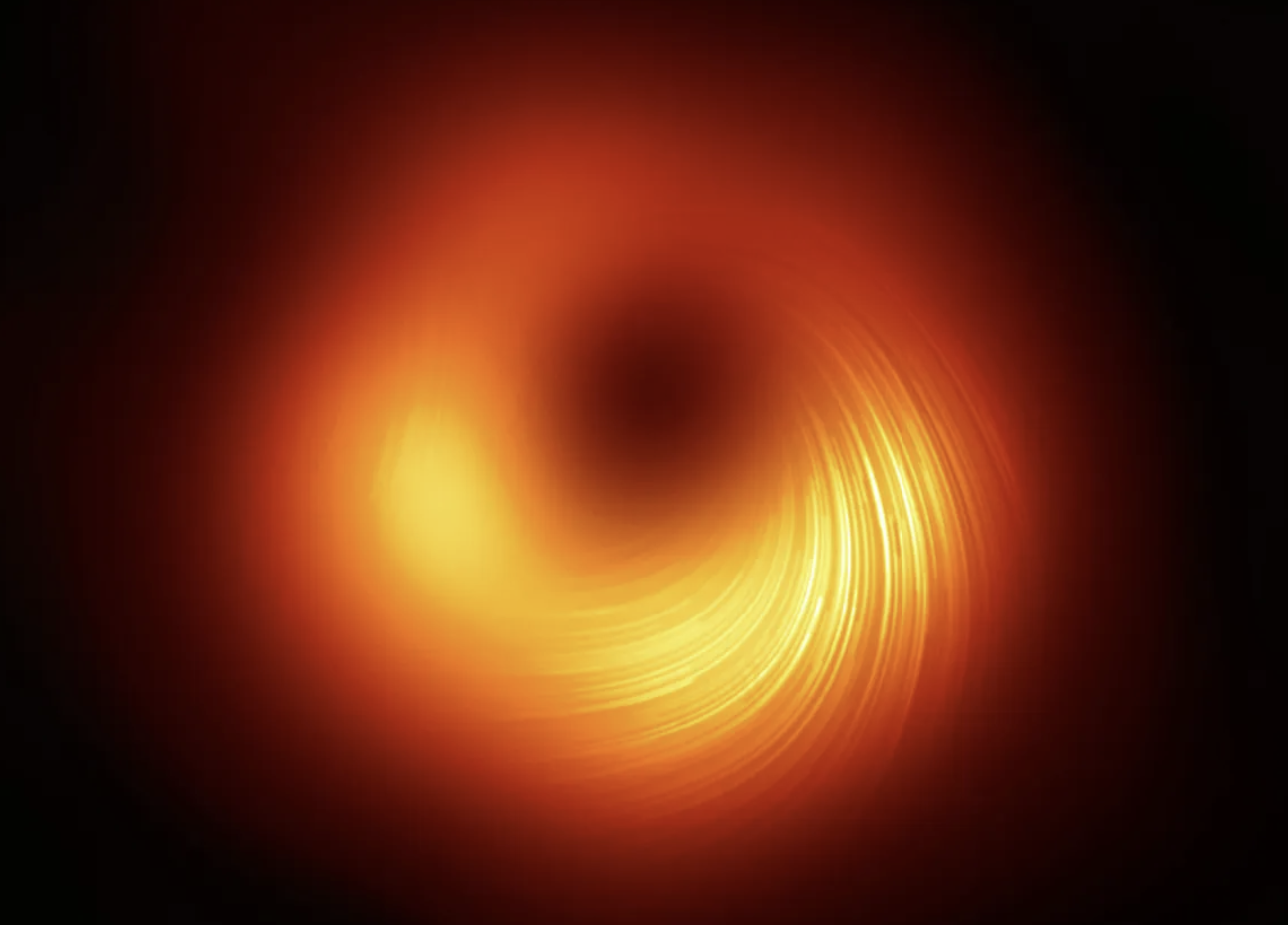
Albert Einstein did not come up with the idea of Black holes. It came up as a solution to the equations of Einstein’s General theory of relativity. Solved by a German Physicist Karl Schwarzschild. A Black hole is a very compact and dense, a few miles to a few hundred miles in diameter and weighing millions of solar masses, an object which sucks in all the matter in its vicinity. It warps space and time to a great extent that the time literally stops at the singularity within the Black hole. Super massive Black holes are at the center of all galaxies including our own Milky way. Our Black hole is known as Sagittarius A*. It probably started off as a graveyard of a massive star or a huge lump of coalescing gas, heavier than 1.4 solar masses which is known as Chandrasekhar limit. It probably grew by sucking in matter in its neighborhood. Like a corporation growing using the mergers and acquisitions route.   

It was presumed that the Black holes live forever and accumulate matter as they go along. Steven Hawking found that Black holes do emit radiation. They are not at absolute zero cold temperatures. The temperature of a Black hole is inversely proportional to its mass. Heavier Black holes are colder while lighter ones are hotter. As per laws of Physics, any object which is hotter than absolute zero, known as a black body, produces radiation. This radiation is known as Hawking radiation. The formula for the temperature of a Black hole is engraved on the floor of Westminster Abbey where Hawking is buried. The following link points to details and picture of the formula:

https://www.westminster-abbey.org/abbey-commemorations/commemorations/stephen-hawking

As the Black holes “evaporate”, they become lighter and hotter and more radiation they emit. Becoming hotter and shrinking in size until they disappear. But they accumulate mass as well and become heavy. This dynamics plays out over billions of years, closer to the age of the Universe. Entropy is a pretty abstract concept. I struggled with understanding it for several years. I don’t pretend to understand it fully. Basically, it is a measure of disorder in a system. Things being scattered around a house or molecules being in different energy levels in a closed surrounding etc. It also involves the number of combinations in which things can be arranged, like a deck of cards. Thermodynamics is an area which deals with energy associated with heat. Two of the three laws of Thermodynamics are relevant to our discussion. One is the familiar law that energy is conserved – neither created nor destroyed but just converted from one form to another. 

The second law states that the overall entropy in the Universe keeps increasing over time. The Universe started with zero Entropy and will keep increasing with its age. Rudolph Clausius, the Physicist who came up with the idea of Entropy,  summarized by saying “the energy of the world is constant, the entropy strives for a maximum”. Entropy is what prevents heat from flowing from cold to hot or for time to go back into the past, although neither of them would violate the principle of energy conservation. The famous equation quantifying Entropy is engraved on the tomb of Ludwig Boltzmann, the Austrian Physicist. The picture below, courtesy Wikipedia, has his bust with the formula on the top of his tombstone. 

The Black holes do have entropy by the virtue of having a temperature. Neither the entropy nor the temperature of a Black hole are zero. Information is represented as bits in computers. The number of bits required to store information is closely related to the Boltzman equation for Entropy. Information does share something with Entropy.

The basis for Hawking radiation is the generation of a virtual pair of submicroscopic particles close to the Event horizon. Event horizon is the point of no return for matter falling into a Black hole. Quantum mechanics tells us that these particles are “entangled”, which means that by studying one particle we can predict what the other particle would look like. For example, their spins are interrelated even after they leave their origin and travel vast distances. Even if one of the particles falls into the Black hole and another escapes in the form of Hawking radiation. 

In normal circumstances such virtual pairs are created and destroyed all the time contributing to the vacuum energy of space. Such “entangled” particles near the Event horizon of the Black hole ensure that the information on matter which gets sucked into a Black hole is not lost, as was perceived earlier. It is stored in the Hawking radiation which emanates from the Black hole. In the book “Einstein’s shadow’”, Seth Fletcher writes “The idea that all the information about the interior of a black hole is engraved on a surface just outside the event horizon is called the holographic principle. Entanglement holds no matter how much distance separates the two particles-even if they are separated by the event horizon of  a black hole. Entanglement plays an important factor in black hole evaporation. In quantum theory, a vacuum is never entirely empty. Spontaneous creation and annihilation of pairs of virtual particles. Near the event horizon, gravity rips a pair of virtual particles, one could fall into the black hole and other could escape. The escaping one becomes a real particle of Hawking radiation”. 

The recent book titled  “Black Holes” by Brian Cox and Jeff Forshaw  summarizes thus “Entangled systems have a rich structure that encodes information in the correlations across the system. The information is lost if the entanglements are broken”. The behavior of particles at quantum levels is the basis of modern day Quantum computing. Entanglement is one of the key features which is exploited by the Quantum computers.  

The notion that the Black holes and Quantum computers share commonality is an interesting one. Cross pollination of ideas not just to understand the abstract, but put to use to the benefit of humanity.   

Posted in June 2023, Sidereal Times | Tagged , | Leave a comment