Keyholder Duty Assignments

by Gene Ramsey, Observatory Chair

Team 1 – April 5, May 17, June 28, Aug. 9, Sep. 20
Team 2 – April 12, May 24, July 5, Aug. 16, Sep, 27
Team 3 – April 19, May 31, July 12, Aug. 23, Oct. 4
Team 4 – April 26, June 7, July 19, Aug 30, Oct. 11
Team 5 – May 3, June 14, July 26, Sep. 6, Oct. 18
Team 6 – May 10, June 21, Aug. 2, Sep. 13, Oct. 25

All teams will remain the same except that new keyholders will be assigned to replace those who have left. Team leaders and keyholders will be notified well before their first assigned duty night. New key-holders are needed to fill out the teams. Anyone interested in becoming a keyholder, please contact Gene Ramsey at 609-306-4267.

Posted in April 2013, Sidereal Times | Tagged , , | Leave a comment

Synopsis: Big Bang by Simon Singh

by Prasad Ganti

Big Bang is a very comprehensive summary of the physical sciences, leading to astronomy and eventually to cosmology. This is by far the best book from Simon Singh. A well articulated story starting from the ancient Greeks to the modern Nobel prize winners in which he describes in detail the Greek’s assumptionsof a round and spinning earth, and their measurements of Earth’s circumference (Eratosthenes), relative sizes of moon and earth (Anaxagoras), and the distance to Sun (Aristarchus).

Moving to the middle ages, the story of Tyco Brahe who took observational astronomy to an entirely new level of accuracy. Kepler who was myopic and suffered multiple visions from birth interpreted Tyco’s experimental data correctly. Next comes Galileo’s experiments with pendulums, falling bodies, his observation of planets with the newly invented telescope, and his ultimate friction with the Church. Singh mentions how Galileo could uniquely maintain religious beliefs and scientific dogmas in his mind at the same time, without any conflicts.

The book continues with how Newton stood on the shoulders of giants and built on the planetary model to explain gravity. Singh writes how William Herschel used the telescope to discover the distant planets and their satellites. Herschel came up with a rough size of the Milky Way. His son John started recording celestial pictures in the newly invented medium: photography. With this technique, astronomy entered a new phase.

Singh relates how Einstein came up with his thought experiments leading to theories of relativity (special and general). For the first time I could understand that special theory of relativity applied to bodies moving at constant speeds while general relativity applied to accelerating or decelerating bodies. Time dilation and length contraction occur in fast moving bodies. Later sections relate how Einstein’s theories lead to Alexander Friedman’s prediction of an evolving Universe; how George Lemaitre’s concluded that the general theory of relativity implied a moment of creation, and hence the Big Bang. Einstein ended up denouncing both and came up with a cosmological constant, which proved to be the biggest blunder of his life. George Lemaitre, a Belgian monk, who, like Galileo, had a good balance between science and religion, letting neither interfere with the other, but at the same time being deeply involved with both.

Singh relates how John Goodricke discovered that the Cepheid stars have variable brightness because, unlike our Sun, they are not in a state of equilibrium. They go through cycles of contraction and expansion. Henrietta Leavitt found a relationship between the period of fluctuation and apparent brightness by collecting data from a group of Cepheids in the Magellanic cloud. A team of astronomers found the distance to one Cepheid. Henrietta’s relationship was used to calculate distances of other Cepheids. Edwin Hubble’s greatest contribution was to prove that Andromeda is a separate Galaxy and that the Universe is undoubtedly expanding. Hubble’s Law vindicated George Lemaitre and Alexander Friedman.

Ralph Alpher and George Gamow predicted that in the early Universe, after the Big Bang, matter existed as plasma, which cooled to 3000 degree centigrade and condensed to atoms, as the cosmic fog lifted, and the cosmic background radiation was emitted in all directions. Penzias and Wilson of AT&T discovered this red-shifted light in the microwave region. Fred Hoyle, in spite of his adherence to the losing steady state theory, made a significant contribution to the explanation of the nucleosynthesis of heavy elementsfrom dying stars.

The final chapters explain Cosmic Background Explorer’s (COBE’s) precise measurements of cosmic background radiation and subtle temperature differences in radiation of early Universe, leading to creation of stars and galaxies. This was the climactic moment for the big bang theory.

This book is a must read by anyone interested in cosmology.

Posted in April 2013, Sidereal Times | Tagged , , | 2 Comments

PANSTARRS

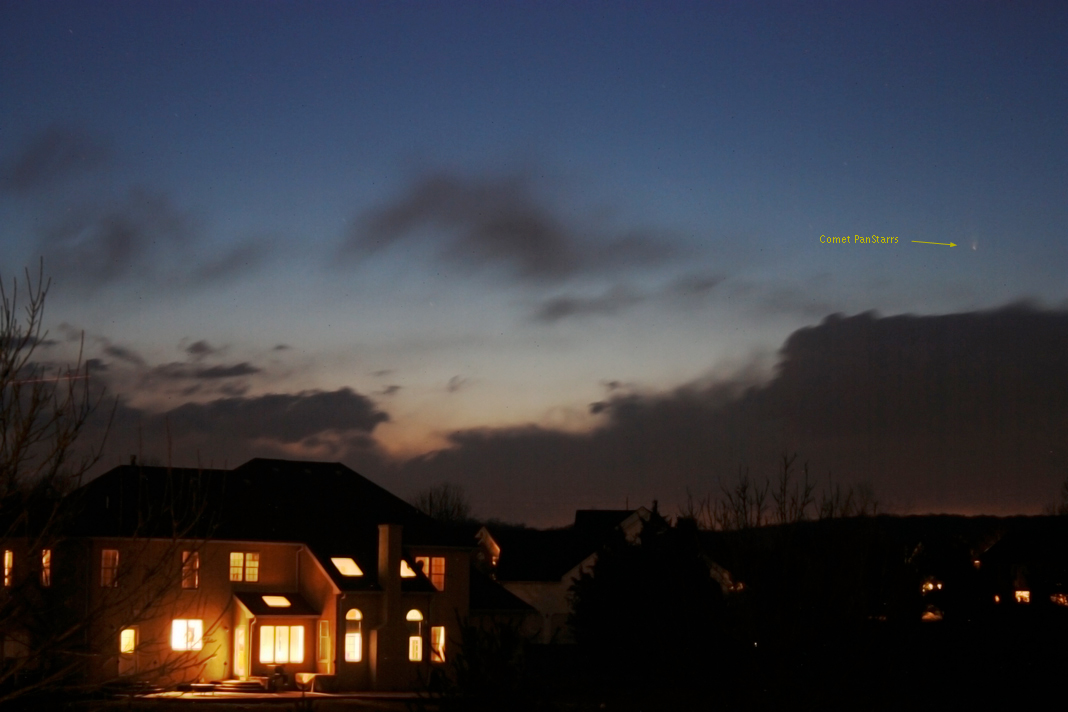
The View of Comet PANSTARRS from Suburban NJ, March 19. Photo Credit: Robert Vanderbei

The View of Comet PANSTARRS from Suburban NJ, March 19. Photo credit: Robert Vanderbei

Posted in April 2013, Sidereal Times | Tagged , | Leave a comment

Telescope and Astronomy Books For Sale

I am looking to sell my Meade ETX and my small collection of astronomy books. I bought the scope in the late 1990’s, so it doesn’t have go-to capabilities. Also, I have a Barlow lens, three eyepiece filters (gray, yellow and blue) and a black hard case. If anyone is interested, please email me, and I will provide a complete list of the books that includes Burnham’s Celestial Handbook in hardcover.

Normally, it would put a smile on my face to donate these items; however, I find myself in a difficult financial position.

If anyone is interested please email or call me.
Ben Reed
609-490-0578.
bwreed57@gmail.com

Posted in April 2013, Sidereal Times | Tagged , , | Leave a comment

Antares Inaugural Blast Off Set for Mid-April

by Dr. Ken Kremer, AAAP, Spaceflight Magazine & Universe Today

First Stage of Antares Rocket at Wallops Flight Facility

First Stage of Antares Rocket at Wallops Flight Facility
Photo Credit: Ken Kremer

NASA announced that the private Antares rocket from Orbital Sciences Corp. is slated to soar to space between April 17 and 19 from the newly constructed, seaside launch pad dubbed 0-A at the Mid-Atlantic Regional Spaceport (MARS) at NASA’s Wallops Flight Facility in Virginia.

The two-stage Antares rocket serves as the launcher for the unmanned, commercial, Cygnus cargo-resupply spacecraft also developed by Orbital. Both Antares and Cygnus were constructed under NASA’s Commercial Orbital Transportation Services (COTS) program to replace the ISS cargo upmass capability previously tasked to NASA’s now retired Space Shuttle’s.

In mid-March 2013, I visited NASA Wallops for an up-close personal tour of the impressive Antares first stage rocket erected at the launch complex following the successful 29-second hot-fire engine test in late February that cleared the last hurdle to approve the Antares launch. Umbilical lines were still connected to the rocket.

The inaugural Antares test flight is called the A-One Test Launch Mission. It will validate the medium-class rocket for later flights to the ISS. The first stage is powered by dual, liquid-fueled, AJ26, first-stage rocket engines that generate a combined total thrust of 680,000 lbs. The upper stage features a Castor 30, solid rocket motor with thrust vectoring. Antares can loft payloads weighing over 5000 kg to LEO.

Orbital won a $1.9 billion contract with NASA to launch at least eight resupply missions and deliver approximately 20,000 kilograms of supplies and equipment to the ISS; similar to the SpaceX Falcon 9/Dragon system.

I will attend the April launch of Antares, which is the most powerful rocket ever to ascend near major American East Coast population centers. The launch is open to the public. NASA Wallops is about a four-hour drive south of Princeton.

Read more about Antares at my Universe Today article here:
Powerful Private Rocket Crucial to ISS Set for Maiden April Blast Off from Virginia – Launch Pad Gallery

Outreach by Dr. Ken Kremer:
Northeast Astronomy Forum (NEAF): Suffern, NY, April 20/21. “Curiosity and the Search for Life on Mars (3-D)” & “Retirement of NASA’s Space Shuttles”
Littlebrook Elementary School: Princeton, NJ, April 11. “A Trio of NASA Mars Rovers (in 3-D)”
Washington Crossing State Park, Nature Center: Titusville, NJ, Apr 28, 130 PM. “Curiosity Rover Explores Mars (3-D)” & “NASA Future Human Spaceflight”

Please contact Ken for more info or science outreach presentations.
Email: kremerken@yahoo.com website: www.kenkremer.com
http://www.universetoday.com/author/ken-kremer/

Posted in April 2013, Sidereal Times | Tagged , | Leave a comment

Thank you, Mr. Ramsey.

by Micheal Wright

Thank you, Mr. Ramsey.

Thank you, Mr. Ramsey.


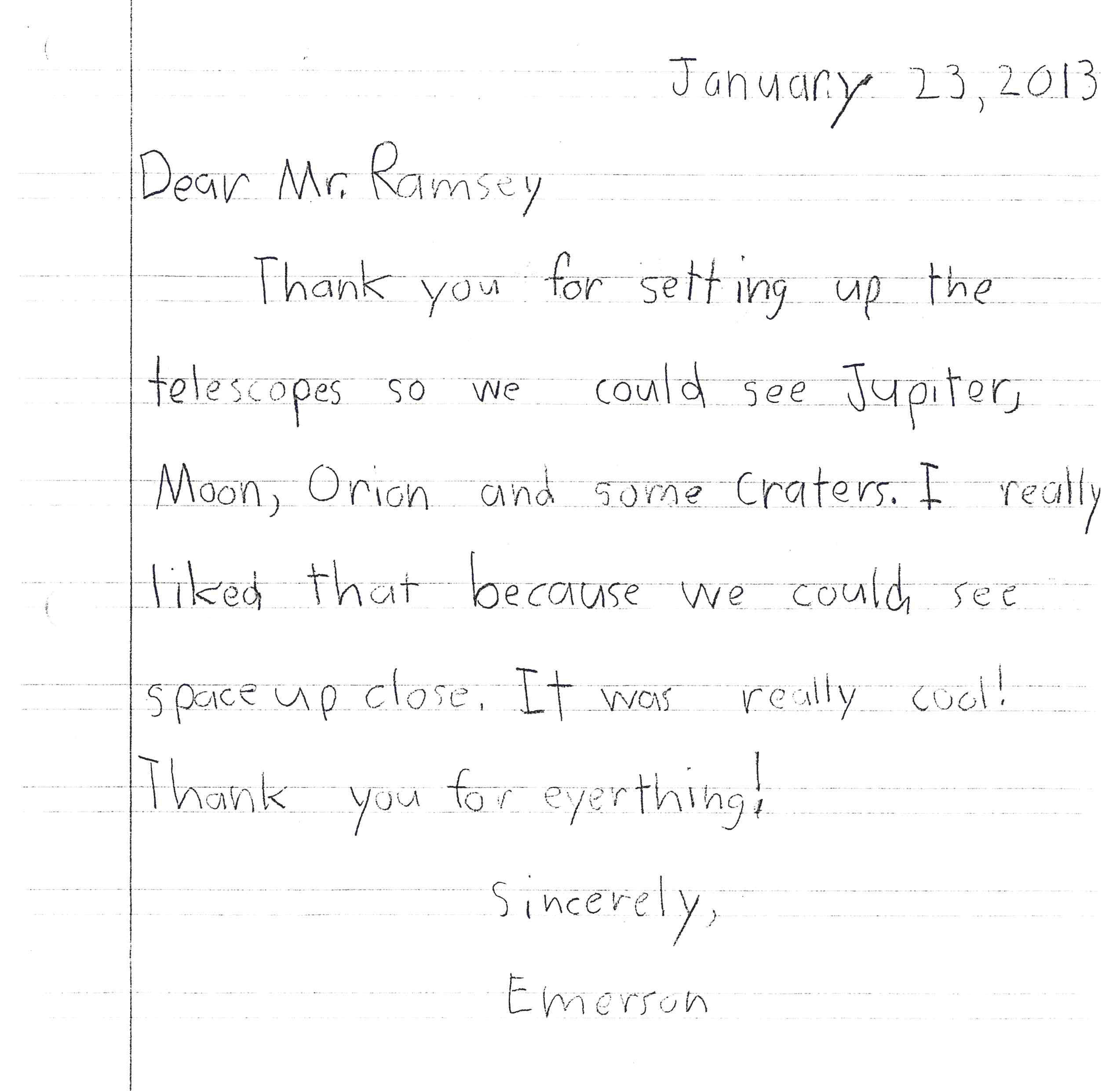
On January 22, 2103, Gene Ramsey, David and Jen Skitt, and I hosted one of the coldest star parties in recent memory at Hopewell Elementary School. The temperature was 17°F, but the children enjoyed “space up close.” Gene received several thank you letters from the students like the one above.

Posted in April 2013, Sidereal Times | Tagged , , | Leave a comment

Invitation to students

Poetry Contest

Poetry Contest

Posted in April 2013, Sidereal Times | Tagged | Leave a comment

The Intertwined Lives of Galaxies and Their Supermassive Black Holes

by Michael Wright

Our monthly lectures will continue on Tuesday, March 12 at 8:00 pm in Peyton Hall on the Princeton University Campus. Our speaker this month will be Dr. Rachel Somerville, who will present a lecture entitled “The Intertwined Lives of Galaxies and their Supermassive Black Holes.”

Dr. Rachel Somerville

Dr. Rachel Somerville. Photo Credit: Rutgers University

Astrophysicists have strong evidence that in the hearts of many, perhaps all, massive galaxies lurk supermassive black holes with masses millions to billions times the mass of our Sun. These black holes can grow by gobbling up stars and gas that fall into the center of their host galaxies. Some of this accreted mass is converted into energy, causing the black holes to release enormous amounts of radiation and produce giant jets of relativistic particles in some cases. Dr. Somerville will explain the observational evidence that supermassive black holes exist, and that they power quasars, some of the most luminous objects in the Universe. She will talk about how galaxies form and evolve over cosmic time and how supermassive black holes shape the galaxy properties that we can observe. She will showcase recent results from the Cosmic Assembly Near-infrared Deep Extragalactic Legacy Survey (CANDELS), the largest project ever undertaken with the Hubble Space Telescope.

Dr. Somerville has won several prizes for work. Most recently, the American Institute of Physics and the American Astronomical Society awarded her the 2013 Dannie Heineman Prize for Astrophysics “for providing fundamental insights into galaxy formation and evolution using semi-analytic modeling, simulations and observations.”

Dr. Somerville has been a member of several large observational teams, including the Hubble Ultra Deep Field team and the Great Observatories Origins Deep Survey (GOODS) team. She currently leads the theory working group for CANDELS. She received her Ph.D. from UC Santa Cruz, and did postdoctoral work at the Hebrew University, Jerusalem and the Institute of Astronomy, Cambridge. Dr. Somerville has served on the faculty at the Univ. of Michigan and headed the theory group at the Max Planck Institute for Astronomy in Heidelberg, Germany. She formerly served on the science staff at the Space Telescope Science Institute and as a research professor at Johns Hopkins University. She currently holds the George A. and Margaret M. Downsbrough Chair in Astrophysics in the Department of Physics and Astronomy at Rutgers.

Posted in March 2013, Sidereal Times | Tagged , , | Leave a comment

50th Anniversary Celebration

Dear Friends,

It is our honor to invite you and your family to join us to celebrate our AAAP’s 50th Anniversary. Mark your calendars now to “Celebrate the past and Inspire the future!”

We are planning to commemorate this milestone with a special dinner, program and outdoor observing. The event will be held at the Institute for Advanced Study in Princeton, New Jersey on Saturday, May 11th, 2013.

Warm Regards,
Surabhi Agarwal & Bob Vanderbei
AAAP 50th Anniversary Celebration Co-Chairs

Posted in March 2013, Sidereal Times | Tagged , , , | Leave a comment