
by John Church
Pierre de Fermat’s famous “Last Theorem” states that there are no examples of x^n + y^n = z^n for n greater than 2, where x, y, z, and n are positive integers. When making this statement in the margin
of a book, he said that there wasn’t room to show the proof. A lengthy proof was published by Andrew
Wiles in 1995, using techniques that would not have been available to Fermat,
I believe that Fermat must have had, if not an actual proof, at least a reasonable explanation of his
theorem. Here is an intuitive graphical approach that he might have used to convince him that there
would be no such examples for n larger than 2. He already knew that there exists an arbitrarily large
number of positive integer primitive “Pythagorean” triples x, y, and z that satisfy the equation x2 + y2 =
z2. And obviously there is an infinite number of positive integer triples that satisfy the equation x1 + y1
= z1 In order to avoid unnecessary duplication, we specify that x < y.
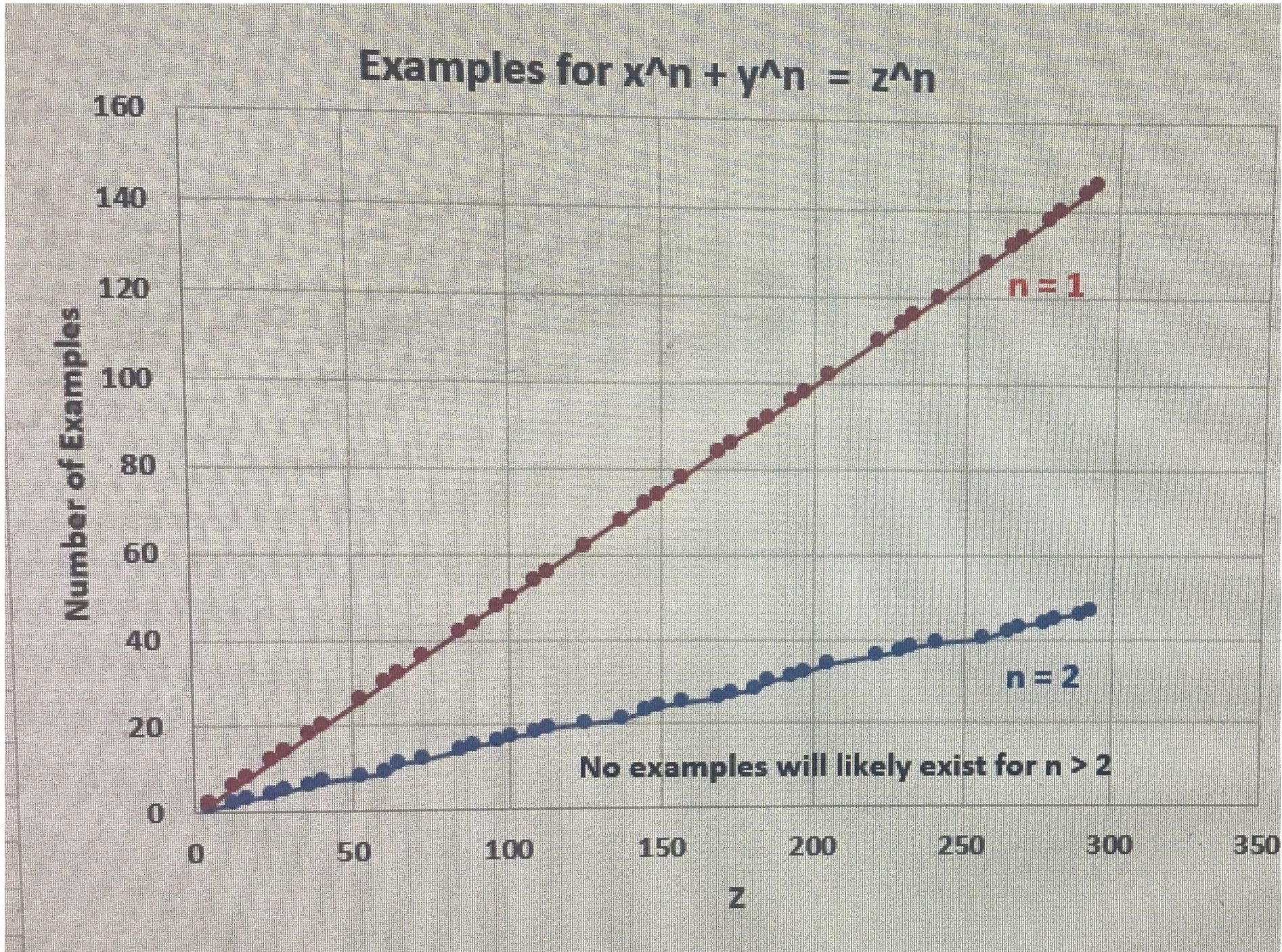
Pretending we’re Fermat, let’s graphically explore the relationship between exponents (n) 1 and 2 in the first two equations. We’ll take the right-hand term (z) as the independent variable, i.e. the horizontal axis. Z is always odd for n = 2, as in 32 + 42 = 52 and so on. For uniformity, we keep that convention for n = 1, where we see that the number of triples with respect to z increases linearly as far as we like.
The idea is to pair off the cases for n = 1 and n = 2 and compare the results.
For example, with the 5-12-13 Pythagorean triple, there are six possibilities for n = 1 where x < y: 1 + 12, 2 + 11, 3 + 10, 4 + 9, 5 + 8, and 6 + 7. The number of possibilities is always (z-1)/2. For exponent 2, the smallest z is 5 for the 3-4-5 triple, but again the number of triples again increases linearly as far as we like with respect to z. (Data is from a list of triples on Wikipedia).
In the chart below, the upper line is for n = 1 and the lower line is for n = 2. If Fermat had made such a chart, simple inspection should have suggested to him that no examples would likely exist for n >2. (Such has actually been shown for a number of particular integers.) Interestingly, the ratio of the two
like slopes is approximately 3:1
A note from the editor, Surabhi Agarwal: After reading John’s article, if your curiosity has been sparked, I highly recommend the following two books on the subject:
- Fermat’s Last Theorem: Unlocking the Secret of an Ancient Mathematical Problem by Amir D. Aczel
- Fermat’s Last Theorem by Simon Singh.

 Amateur Astronomers Association of Princeton