
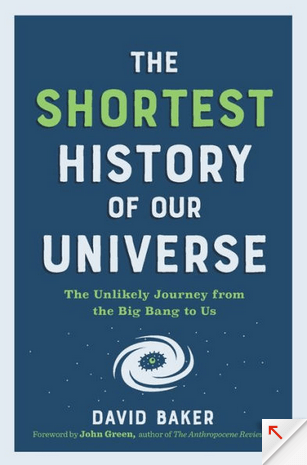
Book Review: by Rich Sherman
The Shortest History of the Universe by David Baker, Ph.D.
Published 2023
Grade: B+
$16.95, paperback, at Barnes & Noble
240 pages
A few months back I had some time to kill after an early dinner and swung by the Barnes & Noble bookstore on Route 1. Scanning the science shelves, I found this little book, thumbed through it for a bit and headed to the cash register. After sitting on my home bookshelf for many weeks, I finally got a chance to read the book.
I’ve been reading some long, not-so-easy-to-digest books on various subjects, and Baker’s short book was a nice relief. Short and to the point, it feels more like a small plate rather than a big meal. “The Shortest History of the Universe” addresses the evolution of the universe in simple language, but this is only part of the story. The title is actually misleading. Much of the book is dedicated to the geologic and anthropologic history of planet Earth. There is a lot of fascinating information here, but I think this section could be much shorter. For example, I don’t think we need to know the symptoms and sufferings of various plagues in detail.
The author finishes the book with a look forward and what might happen to Earth and the Universe. And this is what we would expect. To conclude, I would say I learned a lot (for example, I did not know the entire surface of the Earth was covered by ice three times in its history), I appreciated the brevity of the book, but got a little bored with the extraneous details about Earth’s anthropologic evolution.
www.RichardShermanPhotography
check out my book at https://www.neverhomeheroes.com/index

Book Review: by Tony Vinayak
The Last Stargazers by Emily Levesque
Published 2022
Grade: A-
$11.07, paperback, on Amazon
400 pages
This book is a love letter to astronomy. Written by an astronomer, for those of us who
always find wonder looking up at a sparkling night sky. The book dives deeper into the
profession of an observational astronomer over the years. They are the ones who collect
their data using optical and/or radio telescopes. Emily explains how this data gathering has
evolved over the decades – from peeping into the telescope’s eyepiece with your own eye
(that’s what you did if you were Galileo), to recording on glass plates (remember film
photography), to CCDs, and now to gigapixels of digital images captured by the recently
unveiled Vera Rubin Observatory in Chile.
The author is an astrophysicist and her passion and enthusiasm for astronomy comes
through in each chapter of the book. It is full of stories and incidents from her own
experiences over the years. Imagine riding aboard a 747 with a telescope (that’s what the
SOFIA airborne observatory is — Stratospheric Observatory for Infrared Astronomy) and as
a bonus getting to enjoy a dazzling display of aurora in the southern skies. There is a
chapter devoted to the fascinating Laser Interferometer Gravitational Observatory (LIGO)
— you may recall we had a virtual tour of one of the LIGO facilities last year during one of
our monthly meetings.
Towards the end of the book Emily laments about the lost sense of adventure and
serendipity of operating the telescopes manually as they are now mostly remote and
robotic. A well-written and enjoyable book to read even if you have a passing interest in
astronomy.

 Amateur Astronomers Association of Princeton