
by S. Prasad Ganti
“The Perfect Machine” is the name of a book written by Ronald Florence. It covers the design, construction and the installation of the 200 inch Hale telescope at the Mount Palomar observatory, close to San Diego in southern California. Recently I had the opportunity to visit Los Angeles and San Diego to be with family and friends. I spent a few hours at the Palomar observatory. Having read the book a few years back, I was thrilled to see the perfect machine.
The telescope was conceived by George Hale who was known for his research in solar astronomy, and importantly for constructing the 60 inch Yerkes telescope near Chicago and the 100 inch telescope at Mount Wilson near Los Angeles. He also cofounded Caltech. In 1928 Hale secured Rockefeller foundation sponsorship for the 200 inch telescope. It took a couple of decades before the construction could complete, just after the second world war. By that time Hale had passed away. The New York Times suggested that the new telescope be named in his honor.
The main part of a reflecting telescope is its mirror. Palomar’s mirror is 200 inches in diameter and was cast in Corning, New York. It is a very painstaking glass making process taking months to get it right. Heating sand in a rotating furnace followed by a very slow cooling process. Contemporary mirrors are not cast as a single piece. Instead they are composed of multiple segments, with each segment controlled by an actuator/motor. This is a scalable design but requires a lot of computing power to precisely move the actuators in tandem so that all the pieces work as one big mirror. Back in those days, such technology did not exist. Hence the need to cast it as one big piece. The cast was sent by a special freight train from New York to Caltech in California. Caltech has a polishing lab where the mirror was polished to very fine tolerances. The polishing work took longer since the work was interrupted by the second world war as Caltech turned to wartime research.
The next critical piece in the telescope is the mount. The telescope moves within the mount to point to a specific area in the sky and once locked to an object in the sky, to keep the telescope moving so that the object remains locked even as the earth below is rotating on its axis. It is like chasing a star as it is moving from east to west in the nightly skies. Today’s technology is different from what existed in those days. The current mounts are called alt-azimuth mounts. Such mounts move in two directions – one up and down vertically, other horizontally firstly to locate a given object and then to move with the object as it moves across the sky. This motion requires a lot of computing power and is the standard mount today on modern telescopes.
Back in the 1940s, Hale telescope was designed using the equatorial mount. A superstructure called the yoke (a Y or U shaped structure) is permanently aligned parallel to the axis of earth’s rotation. This fixes one axis of movement. The only manipulation required is to move the mount across the sky as the star moves through the night. This movement is called the right ascension. The telescope itself is mounted between the two arms of the yoke and is free to move in the vertical plane, called the declination. For a long time, I had a tough time imagining what the mount would look like. Pictures did not help me that much. When I saw the real mount, I could realize how it worked.
The picture given below is courtesy Palomar Observatory/Caltech. The thick tube in the middle of the picture is one arm of the yoke. The angle of this arm with respect to the floor aligns with the earth’s axis of rotation. The black truss structure extending to the top of the observatory is the telescope hung between the two arms of the yoke (the second arm of the yoke is behind the first arm, not visible from this angle). The telescope itself is free to swing up and down between the two arms of the yoke and is controlled by a motor. At the bottom of the truss is the mirror facing the sky. Towards the upper end of the truss are the secondary mirror and the electronics required to capture the images.
The yoke itself is connected to a horse shoe bearing which is on the right of the yoke. One motor moves the yoke on this bearing to position the telescope to a particular object in the sky. Once set, a second motor moves the yoke to track the object in the sky as the night progresses to dawn. This rotation of the yoke is on the axis which is parallel to earth’s rotation. These three motors are the key controllers of the telescope.

The following youtube video explains the mount in 2.5 mins while the second video explains the history of Mount Palomar design and construction. Both the videos show the detailed design of the equatorial mount and how it turns.
The whole structure of the mount and the telescope are housed in an outer cylindrical structure with a dome at the top. The dome has a slit on the top. This slit is open during the night for observations. The whole dome rotates on bearings at the top of the cylindrical structure. This rotation would position the open slit to the part of the sky which needs to be observed. Given below is the picture of the dome which I shot using my iPad pro. The dome is painted white to reflect the sunlight. The temperature inside the observatory needs to be constant so that the telescope remains in alignment all the time. The dark band at the bottom of the dome, but higher than the steps and the front door, indicates the track on which the dome rotates.
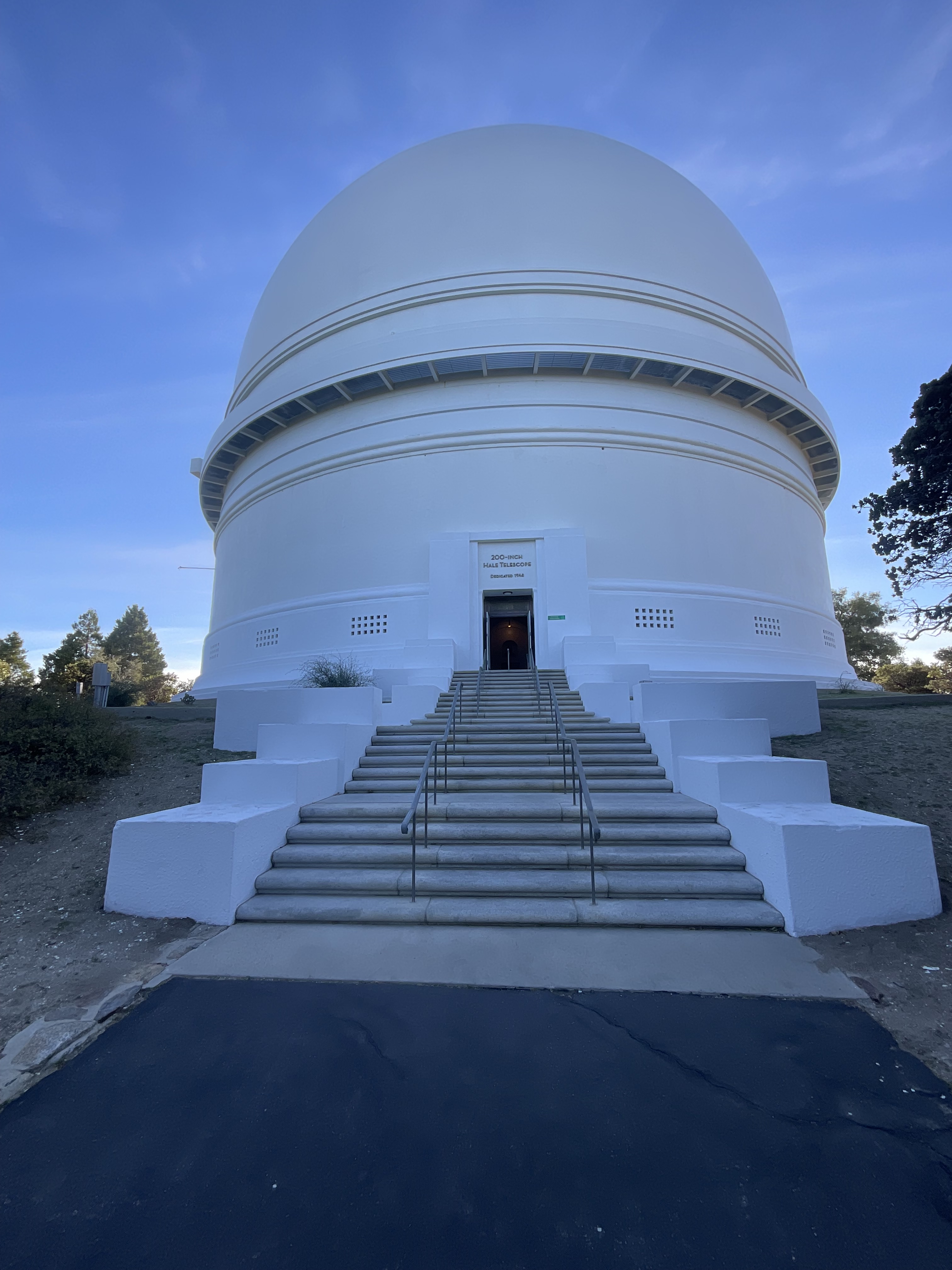
The whole mount, truss and the dome were designed by Russell Porter, who is a polymath considered as one of the founding fathers of amateur astronomy. Porter also contributed to the design of buildings at the Palomar observatory and Caltech campus. He made about 1000 drawings of the telescope and its related instruments and buildings.
The telescope works in the visible, infrared and ultraviolet ranges. It is a pretty wide range given the technology with which the mirror was built. Fred Zwicky used this telescope to detect supernovae. Maarten Schmidt discovered the first Quasar in 1963. These objects are very bright in the whole universe. But Schmidt’s spectroscopy revealed that the light is so red shifted which indicates that they are billions of light years away, formed during the infant stages of our universe. Now it is postulated that such objects represent supermassive black holes and the accretion disk of gases around them is the bright light we are seeing. Thousands of Quasars have been discovered since.
The telescope has been fitted with adaptive optics on its secondary mirror to modernize it. Adaptive optics is used to compensate for the distortions in the atmosphere which make the stars twinkle. The twinkle looks good in the sky, but makes the observations unsteady. Adaptive optics divides a mirror into smaller segments with each segment controlled separately by an actuator/motor. A reference laser is shot into the skies. The reflected picture of the laser is used to find out how much distortion the atmosphere is causing. Accordingly each actuator is moved differently to change the shape of the mirror to provide a sharp picture. Adaptive optics is a standard design for all modern telescopes.
It is a fascinating story of how the telescope was conceived, designed and constructed and the discoveries it made and the efforts to modernize it. My tributes to George Hale and Russell Porter, two of the most important people who built the Mount Palomar observatory.

 Amateur Astronomers Association of Princeton