
by Michael DiMario, Astrophotography Chair
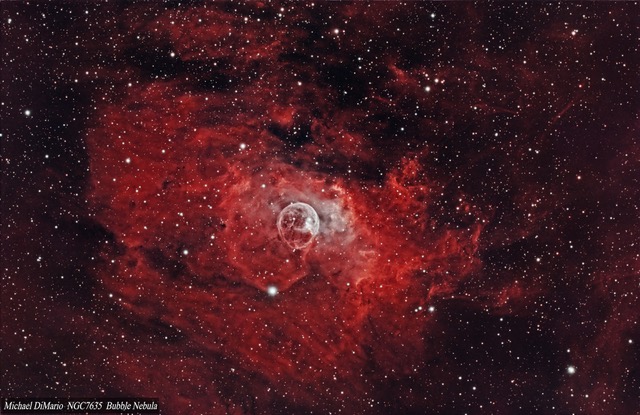
Bubble Nebula NGC7635 taken by Michael DiMario
Telescope: Celestron C9.25 Edge HD at FL 1645mm f7.0
Mount: Losmandy GM811G
Exposures: 229 subframes @ 300 sec each over 5 nights for 19 hours of integration; ASI2600MC-P; Optolong L-Ultimate filter
Processing software: Pixinsight
Location, Bortle, and Date: Doylestown, PA; Bortle 6; August 22-30, 2025
Description and Story: The Bubble Nebula NGC7635 is a rich ionized hydrogen region (HII) in the constellation Cassiopeia. The “bubble” shape was created from the stellar wind created by the intensely hot central star (SAO 20575) and is within a giant, glowing molecular cloud. The Bubble itself is about 10 light-years in diameter.
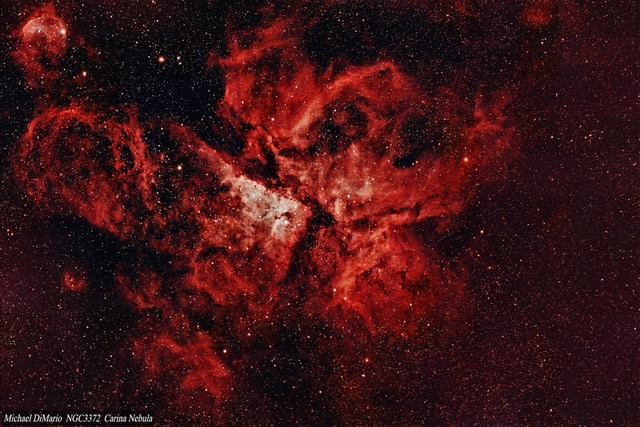
Great Carina Nebula NGC3372 taken by Michael DiMario
Telescope: Takahashi FSQ85EDX FL 455mm f5.3
Mount: Losmandy GM811G
Exposures: 27 subs @ 30 sec each; ASI2600MC-P; Antilla Triband filter
Processing software: Pixinsight
Location, Bortle, and Date: Big Cypress, FL; Bortle 2; March 31, 2024
Description and Story: Great Carina Nebula is located in the southern sky constellation Carina located in the Carina–Sagittarius Arm of the Milky Way galaxy. The nebula is approximately 8,500 light-years from Earth. The nebula is one of the largest diffuse nebulae in Earth’s sky whereby it is four times as large as and brighter than the Orion Nebula.
This image taken in 2024, was reprocessed in Pixinsight. This evening’s session began with a 6-foot alligator very near my observing spot. Fortunately, it moved quickly back to the water. As darkness enveloped, the Everglades continued to be challenging with passing clouds, very large mosquitoes seemingly the size and whirring of humming birds, and python hunters with their large floodlights. The area of sky where the Great Carina Nebula was located was clear and was not my observing plan that night. However, NGC3372 was an opportunity to be taken that night as it was visible given its very low altitude. It was challenging as it was approximately 1-5 deg above the southern horizon, over far off trees and a field of many astronomers’ red lights. Imaging at this low of an altitude is equivalent to looking through approximately 11-26 atmospheres as opposed to 1 atmosphere at zenith.
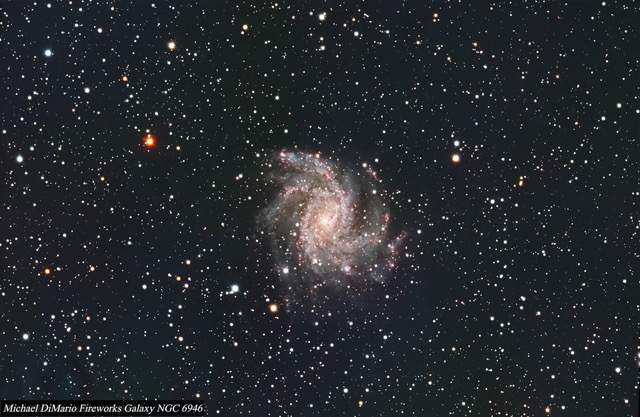
Fireworks Galaxy NGC6946 taken by Michael DiMario
Telescope: Celestron C9.25 Edge HD at FL 2350mm f10.0
Mount: Losmandy GM811G
Exposures: 86 subframes @ 200 sec each over 2 nights with Antilla Triband filter; 90 subframes @ 200 sec each broadband over 3 nights for 9.8 hours of integration; ASI2600MC-P
Processing software: Pixinsight
Location, Bortle, and Date: Doylestown, PA; Bortle 6; October 3-18, 2025
Description and Story: The Fireworks Galaxy is located between the constellations of Cepheus and Cygnus. Its distance from Earth is about 25.2 million light-years. It is heavily obscured by interstellar matter due to its location close to the galactic plane of the Milky Way. NGC 6946 has also been classified as a double-barred spiral galaxy, with the inner, smaller bar presumably responsible for funneling gas into its center. Due to its large number of star formation, it has been classified as an active starburst galaxy. However, this galaxy derives its name not from its star nursery capability but from the ten supernovae observed since 1917. The number of observed supernovae in this galaxy is ten times the number observed in our Milky Way galaxy, even though the Milky Way has twice as many stars.
Fireworks Galaxy was a challenging project given its small field of view (FOV) and thus imaging at native FL of 2350mm. The tracking of the Losmandy GM811G mount was outstanding. A bright Moon in early October forced the use of the Antilla Triband filter with remaining subframes taken in broadband (no filters) when Moon was absent.
3i/Atlas the Interstellar Comet taken by Daniel Mints
Telescope: Meade LX200 EMC reduced to 1650mm
Mount: ZWO AM5N
Exposures: ZWO533MCPro – 35 subframes @ 60 sec each with Antilla Triband filter
Processing software: Pixinsight/Lightroom
Location, Bortle, and Date: Hillsborough, NJ; Bortle 6; Early Morning, November 18, 2025
Description and Story: Interstellar Comet 2I/Borisov—sometimes called “Atlas of the stars” for the vast journey it represents—made history in 2019 as only the second known visitor from beyond our solar system. Discovered by amateur astronomer Gennadiy Borisov, the comet entered the Sun’s neighborhood at an extraordinary speed and on a sharply hyperbolic path, clear signs that it was not bound to our star. Unlike typical comets shaped by billions of years of orbiting the Sun, 2I/Borisov came from the deep cold between the stars, probably carrying pristine material left over from the formation of a distant, unknown planetary system.

Messier 16 (Eagle Nebula) and Comet C/2025 R2 (SWAN) conjunction taken by Daniel Mints
Telescope: Samyang 135mm
Mount: ZWO AM3
Exposures: ZWO183MMPro – 240 subframes @ 30 sec each (LRGB mono captured)
Processing software: Pixinsight/Lightroom
Location, Bortle, and Date: Rockland, TX; Bortle 1; October 17, 2025
Description and Story: The conjunction of Messier 16 (the Eagle Nebula) and Comet C/2025 R2 (SWAN) creates a stunning celestial scene where two very different cosmic objects briefly share the same patch of sky. The Eagle Nebula, located about 7,000 light-years away in the constellation Serpens, is a vast star-forming region famous for the towering Pillars of Creation. These immense columns of gas and dust are nurseries where new stars ignite, shaping the nebula with intense radiation and sculpting its iconic form. The visual pairing of the fast-moving comet with the distant, majestic Eagle Nebula tells a story of two cosmic journeys: one fleeting and ephemeral, the other spanning millions of years.


 Amateur Astronomers Association of Princeton