
by Victor Davis
The Universe in a Computer
The November, 2025 meeting of the AAAP will take place in Peyton Hall on the campus of Princeton University on Tuesday, November 11th at 7:30 PM. As usual, the meeting is open to AAAP members and the public. Participants can join the meeting in-person at Peyton Hall or log in to the Zoom session as early as 7:00 pm to chat informally before the meeting begins.
The evening’s guest speaker, Romain Teyssier will describe his work using supercomputers to model the dynamics of the Universe, and the success and shortcomings in our current model, Lambda Cold Dark Matter in reproducing the properties and behavior that we see.
Options for Attending the Meeting
You may choose to attend the meeting in person or participate via Zoom or YouTube as we’ve been doing for the past few years. (See How to Participate below for details). Due to security concerns, if you log in before the host has set up internet connectivity in Peyton Hall, you may need to wait in the Waiting Room for a few minutes until the host is prepared to admit you into the meeting. You’ll need to unmute yourself to make comments or ask questions. It’s polite, though not required, for you to enable your camera so other participants can see you. The meeting will be recorded and edited for posting to our club’s YouTube channel.
Join us for our “meet the speaker” dinner
Prof. Teyssier will be joining us for our traditional “meet the speaker” dinner at Winberie’s before the meeting. Our reservation is for 5:45 pm Tuesday, November 11th. Please contact the Program Chair if you plan to attend.
Here’s the anticipated agenda for November 11th, 2025’s monthly meeting of the AAAP:
| Meeting Event | ~Time | Participant Can Self-Unmute? |
| Pre-meeting informal chatting | 7:00 – 7:30 | Yes |
| Director Rex Parker’s remarks | 7:30 – 7:40 | Yes |
| Program Chair Victor Davis’ speaker introduction | 7:40 – 7:42 | Yes |
| Guest speaker: Romain Teyssier Professor of Astrophysical Sciences and Applied and Computational Mathematics Princeton University “The Universe in a Computer” | 7:42 – 8:40 | No |
| Q&A Session | 8:40 – 8:55 | Yes |
| 5-minute break | 8:55 – 9:00 | Yes |
| Business Meeting | 9:00 – 9:55 | Yes |
| Director Rex Parker’s remarks/Informal chatting | 9:55 -10:00 | Yes |
(Times are approximate)
Getting to Peyton Hall
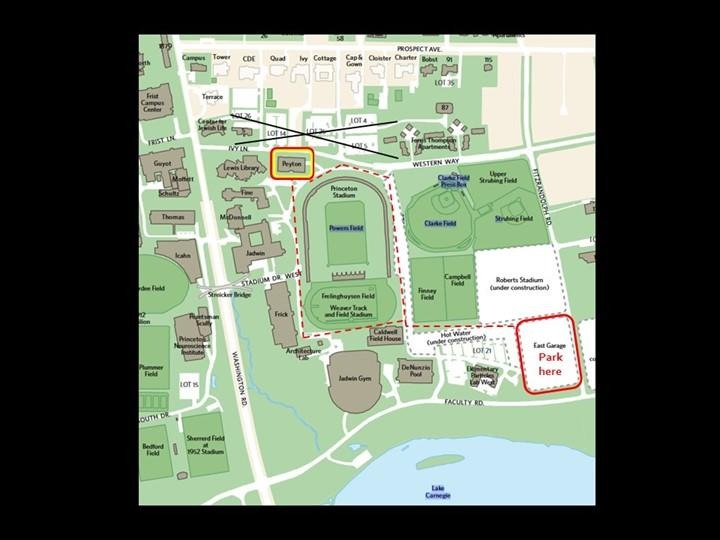
The parking lots across the street (Ivy Lane) from Peyton Hall are now construction sites, unavailable for parking. We’ve been advised by the administration of the astrophysics department that we should park in the new enclosed parking garage off Fitzrandolph street and walk around the stadium and athletic fields. Here’s a map of the campus and walking routes from the parking garage to Peyton Hall. The map shows the recently completed East Garage. Not shown is an access road Sweet Gum that connects from Faculty Road to an entrance at the lower left corner of the garage. Stadium Road connects from Fitzrandolph Road to another entrance at the opposite corner (and higher level) of the garage. It’s about a 10-15 minute walk from the parking garage to Peyton Hall.
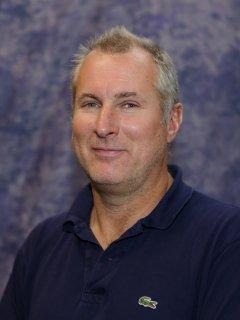
Featured Speaker: Romain Teyssier Professor of Astrophysical Sciences and Applied and Computational Mathematics Princeton University teyssier@princeton.edu |
The Universe in a Computer
Our current model of the Universe, known as the Lambda Cold Dark Matter (^CDM) model, is so successful at describing the distribution of galaxies in the Universe that we actually see that we can use large galaxy surveys as high-precision experiments to determine the fundamental constants of nature. Modeling the dynamics of dark matter, dark energy, and baryons requires large computer simulations to reproduce the many observed properties of galaxies. Prof. Teyssier will also discuss the limits of our current knowledge from the Big Bang to present day galaxies such as the Milky Way and the recent cracks in the ^CDM model as revealed by recent observations.

Romain Teyssier
Romain Teyssier, PhD, is a Professor of Astrophysical Sciences and Applied and Computational Mathematics at Princeton University, where he teaches astrophysics and computational sciences. He is an expert in cosmology and star and galaxy formation. He is the main author of the RAMSES code, a massively parallel Adaptive Mesh Refinement code for self-gravitating, magnetized, radiative flows. His main research activity is to perform simulations of cosmic structure using supercomputers, in order to understand the origin of astrophysical objects such as stars like our Sun and galaxies such as the Milky Way. He is also modeling the evolution of the Universe in the context of Euclid and LSST.
Prof. Teyssier graduated from the Ecole Polytechnique in Palaiseau, France, and earned his PhD in Astrophysics from Paris Saclay University. He held a postdoctoral position at Lawrence Livermore National Laboratory in the US, then became a research scientist at the French Alternative Energies and Atomic Energy Commission. He was Professor of Computational Astrophysics at the University of Zurich before coming to Princeton in 2021.
How to Participate (Links)
Zoom
Amateur Astronomers Association of Princeton is inviting you to a scheduled Zoom meeting.
Time: November 11, 2025 07:00 PM Eastern Time (US and Canada)
Join Zoom Meeting


Click the above icons for Zoom and YouTube
A look ahead at future guest speakers:
| Date | Featured Speaker | Topic |
| December 9 |  Jiaxuan Li Graduate Student Princeton University jiaxuanl@princeton.edu  Sihao Cheng Postdoc Member Institute for Advanced Study scheng@ias.edu  Eritas Yang Graduate Student Princeton University eritas.yang@princeton.edu | Discovery of Dwarf Planet Candidate in an Extremely Wide Orbit Dr. Cheng and colleagues discovered in publicly available data from the Dark Energy Camera a dwarf planet candidate, 2017 OF201, currently located at a distance of 90.5 au. Its orbit is extremely wide and extends to the inner Oort cloud, with a semi-major axis of 838 au and a perihelion of 44.9 au precisely determined from 19 observations over seven years. Assuming a typical albedo of 0.15, they estimate a diameter about 700 km, making it the second-largest known object in this dynamical population and a likely dwarf planet. Thanks to Nick Mellis for suggesting these speakers. |
| January 13 2026 | Jamie Rankin Research Scholar Princeton University jsrankin@princeton.edu  | Dr. Rankin will talk about her work as Project Manager for the Voyagers’ last gasp; observing the interaction between the solar and interstellar media as these spacecraft (still transmitting data since their launch in 1977!) leave the Sun’s influence. She’ll also speak more broadly about exciting things about how the Sun interacts with the interstellar medium and about the Princeton-led Interstellar Mapping and Acceleration Probe (IMAP) mission launched this past September. Dr. Rankin’s role is described in a recent book “The Clock in the Sun” by Pierre Sokolsky. |
| February 10 2026 | John Bochanski Associate Professor and Chair, Department of Computer Science and Physics Rider University jbochanski@rider.edu  | Dr. Bochanski has been connected to the Legacy Survey of Space and Time Discovery Alliance since his graduate studies more than 15 years ago. Rider University is part of the global effort using the Vera C. Rubin Observatory to map the optical sky. The Rubin observatory (formerly the Large Synoptic Survey Telescope, LSST) will capture more information about our Universe than all other optical telescopes throughout history combined. The observatory released its first images this past June. Prof. Bochanski will discuss the project’s history and discoveries. Thanks to Nick Mellis for suggesting this speaker. |
| March 10 2026 | Robert Vanderbei Emeritus Professor in the Department of Operations Research and Financial Engineering Princeton University AAAP Assistant Director rvdb@princeton.edu  | Prof. Bob Vanderbei will talk about stellar dynamics. |
| April 14 2026 | Brian Lacki Astronomer Berkeley SETI Research Center astrobrianlacki@gmail.com  | September’s guest speaker Edwin Turner voiced his less-than-optimistic view of the prospect for discovering extraterrestrial life. Dr. Lacki, affiliated with Breakthrough Listen, a SETI initiative, recently submitted for publication a catalog of objects he and his team consider to be realistic and valuable observation targets. Dr Lacki will talk about the catalog, “One of Everything: The Breakthrough Listen Exotica Catalog” and opine on the prospects of finding technosignatures and extraterrestrial intelligence. Thanks to Ira Polans for suggesting this speaker. |
| May 12 2026 | John Horgan Science Writer horganism3@gmail.com  | Mr. Horgan will discuss his controversial 1996 book The End of Science, in which he argues that pure science, defined as “the primordial human quest to understand the universe and our place in it,” may be coming to an end. Horgan claims that science will not achieve insights into nature as profound as evolution by natural selection, the double helix, the Big Bang, relativity theory or quantum mechanics. In the future, he suggests, scientists will refine, extend and apply this pre-existing knowledge but will not achieve any more great “revolutions or revelations.” Shades of Auguste Comte, perhaps? We expect to have copies of his book(s) for sale for the author to sign at the conclusion of his presentation. Thanks to Rex Parker for recruiting this speaker. |
| June 9 2026 | Jacob Hamer Assistant Curator NJ State Museum Planetarium Jacob.Hamer@sos.nj.gov  | As usual, the June meeting will take place in the planetarium at the NJ State Museum in Trenton. There will be no streaming of this live-only sky show and PowerPoint presentation. Topic to be announced. |
| September 2026 | Michael DiMario Chair of AAAP’s Astro-imaging SIG K2mjd@outlook.com  | Dr. DiMario will present a primer on astro-imaging. |
| October 2026 | Becka Phillipson Assistant Professor in Physics Villanova University | Prof. Phillipson, originally scheduled to be October 2025’s guest speaker, is an unconfirmed prospect to try again in 2026. |
As always, members’ comments and suggestions are gratefully accepted and much appreciated. Thanks to Ira Polans and Dave Skitt for setting up the online links and connecting the meeting to the world outside Peyton Hall.
program@princetonastronomy.org
(908) 581-1780 cell

 Amateur Astronomers Association of Princeton