

by Rex Parker, PhD
director@princetonastronomy.org
October 14, 2025 Meeting on Campus. I look forward to seeing you for our monthly meeting Oct 14 at Peyton Hall of Astrophysics. Our guest speaker will be Becka Phillipson, Asst Prof in Physics at Villanova University. Her expertise includes black hole and neutron star studies, active galactic nuclei, and time domain astronomy (that is, observable changes in astronomical position, brightness, and structure during human-centric time periods). Dr. Phillipson uses machine learning and artificial intelligence to pursue these areas, making Oct 14 a great opportunity for us to get closer to the cutting edge of astrophysics, and better understand where and how AI is being used. We will also stream the meeting via Zoom as usual, but it’s better to attend in person at Peyton Hall if you can. Please see Victor’s article in this issue for more information.
“Unjournal Club” at the meeting, Oct 14. If you have been wondering what the new generation of “smart telescopes” is all about, you can have an insider’s look at Peyton Hall after the break on Oct 14. The Unjournal Club (aka, the 10min member talk) will be given by the Unistellar Project Team, the student members who have been exploring astronomy with the club’s Unistellar EVScope2. The students have put together a short presentation describing how they used and shared this powerful yet portable advanced telescope over the summer. The scope will be on display for us to marvel at. You will want to be present at the meeting for this!
Here’s some more background on the Unistellar scope.The club acquired through generous donation last spring a Unistellar EVScope2. You may be familiar with the SeeStar smart scopes from ZWO, which several members now own and enjoy. The Unistellar is similar in concept and function but unique in design. It is mirror-based (114mm Newtonian reflector), so this larger aperture gathers more photons than other refractor lens-based smart scopes on the market. The EVScope2 features a high sensitivity Sony CMOS sensor (STARVIS technology). This particular model also features a Nikon electronic eyepiece, along with integrated mobile app to view emerging images on a smart phone or tablet. Up to 10 persons can simultaneously observe via local Wifi without an external internet connection. The scope quickly and automatically aligns itself and tracks without polar alignment. With its carbon tripod it is highly portable, lightweight, and simple to set up, making the deep sky accessible despite light pollution.
Proposal for a Youth/Student Group in AAAP. We have an opportunity to support the development of a youth group within AAAP. Some of the student members in AAAP who led the Unistellar observing project this summer (described above) have proposed an ongoing youth sub-group within AAAP. They would be students in high school or above, be dues-paying members (usually with their parents), and would be engaged in learning and sharing astronomy and astro technology with other students and adults. They would help with AAAP outreach programs and develop contacts within schools and libraries in the area. The Board endorses this proposal and will establish some guidelines and appoint an advisor(s), under which the group can operate through the auspices of AAAP. This will be discussed at the Oct 14 meeting, when you will get a chance to meet a few of our energetic young amateur astronomers. I hope you will be present at Peyton for this discussion.
Announcement: EAA Is Now Part of the AAAP Astroimaging Group. The AAAP-exclusive astrophotography interest group is being expanded to include EAA activities (EAA is electronically assisted astronomy), or what I like to call astrovideo. Further, the Group.io website dedicated to AAAP astroimagers will now support equipment and software discussions of EAA as well as astrophotography and EAA. Please contact Michael Dimario at astroimagers@princetonastronomy.org and Gene Allen at secretary@princetonastronomy.org to sign up or share ideas.
New Findings in the Search for Biosignatures of Extraterrestrial Life. In AAAP as elsewhere in astronomy, exoplanet research and the possibility for biosignatures of extraterrestrial life are hot topics. The idea of water-rich “Hycean” exoplanets and the suggestion of biosignature gases in exoplanet K218b are being debated (discussed in my article in May 2025 Sidereal Times). A new paper suggests that the hypothesis of deep water oceans on these worlds is likely wrong (Sept 18, Astrophysical Journal Letters; link to the free article: https://iopscience.iop.org/article/10.3847/2041-8213/adff73). The current paper challenges the ideas of how large planets with water-rich atmospheres can form, with implications for interpreting recent exoplanet spectral data from JWST.
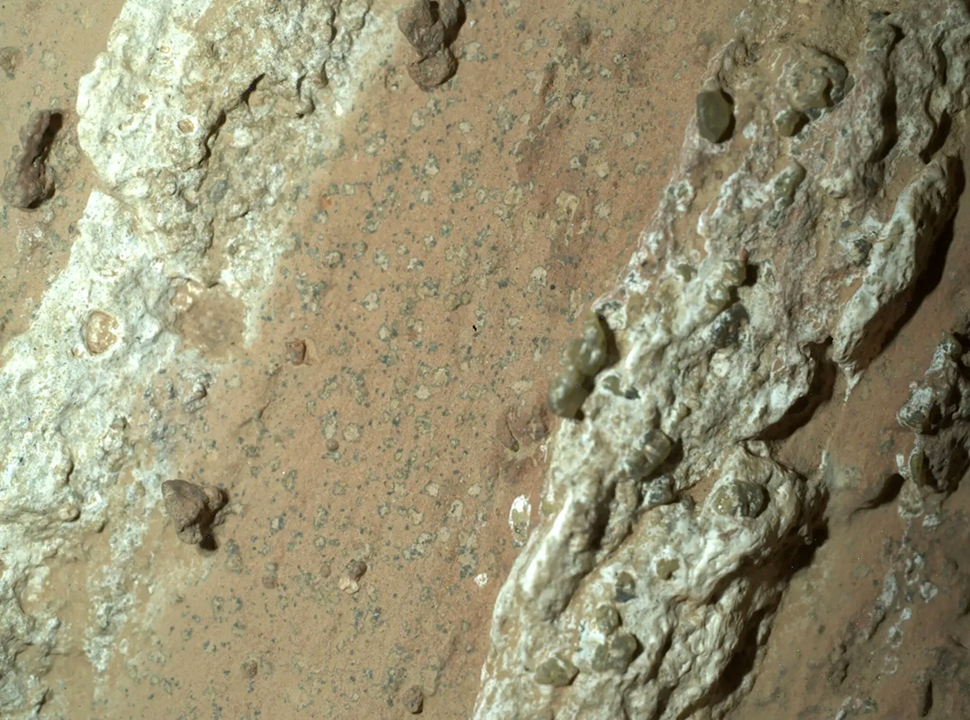
Closer to home, NASA released a head-turning report from a new analysis of photographic images from a Mars rock collected by Perseverance rover in 2024. The specimen from an ancient dry riverbed in Jezero Crater could be a type of fossil revealing chemical evidence of ancient microbial life. The study was published in the Sept 10 issue of Nature, with lead author from the SUNY Dept of Geosciences (link: Redox-driven mineral and organic associations in Jezero Crater, Mars | Nature). The specimen, nicknamed “Cheyava Falls,” shows contrasting spots consistent with ancient microbial redox activity (oxidation-reduction reactions), based on mineral features found in known fossils on earth. Of course, other non-biological explanations exist and NASA stressed that these are not confirmed fossils. Most importantly, the findings support the need to fund and execute a Mars rock sample return mission as originally planned and now being reevaluated by NASA.
A Possible Fossil Biosignature on Mars? NASA’s Perseverance Mars rover found and imaged this rock nicknamed Cheyava Falls. The irregular mm-sized spots in the red matrix in the image are being interpreted as possible redox biochemical reaction products from microbial life, perhaps billions of years ago. Credit: NASA

 Amateur Astronomers Association of Princeton