
by Michael DiMario
The Jelly Fish Nebula, located in the Gemini Constellation 5000 light years from Earth, is a result of possibly several supernova remnants of spinning neutron stars. The nebula is 70 light years in diameter and is composed of two shells that may the result of multiple events. The inner shell remnant is between 5000 to 35000 years old while the outer shell maybe 100,000 years old interacting with molecular clouds.
The structure of IC 443 is influenced by its surroundings. In the southeast part of the nebula, the supernova’s blast wave is interacting with a dense molecular cloud. The cloud has slowed down the wave so it is moving between 67,000 to 89,000 mph. Toward the northeast part of the nebula the blast wave is hitting a cloud of hydrogen that is less dense and thus moving at between 180,000 and 220,000 mph.
Image was taken over the course of two nights April 1-2 at Big Cypress National Preserve, Florida in competition with a seven-foot alligator that occupied my imaging location. IC 443 image was captured with 300 light frames of 60 sec or 5 hours total integration. First set of 150 light frames used an Optolong Ultimate Ha-OIII filter and second set of 150 light frames used an Askar D2 OIII-SII filter. Telescope: Takahashi Baby-Q 85mm, f5.3; Camera: ASI2600MC Pro; other aids ASIAIR, OAG ASI174 mini, filter wheel; mount ZWO AM5N. PixInsight was used for image processing.

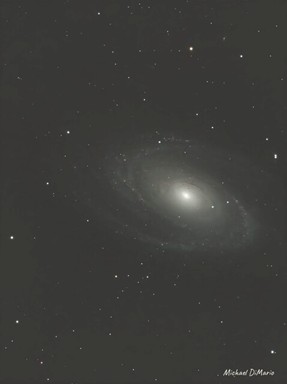
Messier 81 was first discovered by Johann Elert Bode on 31 December 1774 and thus its acquired name. M81 is one of the brightest galaxies in the night sky. It is located 11.6 million light-years from Earth in the constellation Ursa Major and has an apparent magnitude of 6.9. Through a pair of binoculars, the galaxy appears as a faint patch of light in the same field of view as M82. A small telescope will resolve M81’s core. The galaxy is best observed during April.
The galaxy’s central bulge contains much older, redder stars. It is significantly larger than the Milky Way’s bulge whereby a black hole of 70 million solar masses resides at the center of and is about 15 times the mass of the Milky Way’s central black hole. The galaxy’s spiral arms extend downward into its nucleus and comprise young, bluish, hot stars formed in the past few million years.
M81 image was salvaged from a failed attempt of capturing two galaxies M81 and M82 in a single image. The M81 image was cropped out of the failed image. Image was captured April 28th in Bortle 5 skies of Doylestown, PA. M81 image is comprised of 75 light frames of 60 sec each or integration of 1.25 hours. Image was captured with a Celestron 9.25 Edge HD SCT with a 0.7x reducer. Camera is a ASI2600MC Pro, filter is an Antilla Triband, guidance was with ASIAIR and OAG with a ASI174mm mini camera. Mount used is a Losmandy GM811. PixInsight was used for image processing.

 Amateur Astronomers Association of Princeton