

by Rex Parker, PhD
director@princetonastronomy.org
Next Meeting at the Planetarium – in Person Only – Bring Friends and Family! We want to see you (and your family and friends) in person at the next monthly meeting of AAAP on Tuesday June 10 (7:30pm) at the NJ State Museum Planetarium in Trenton https://www.nj.gov/state/museum/explore-planetarium.shtml. This is the last meeting of the academic season and will be held in-person-only, as the planetarium dome show does not suit Zoom presentation. The planetarium completed an extensive upgrade recently, and the 52-foot dome is equipped with a state-of-the-art ultra-high resolution 8K projection system. AAAP has a long history with the planetarium and interactions with the museum are an important part of our outreach efforts. For more info on the presentation and speaker please see Victor’s article below.
The Diameter of a Star. What do you find compelling as you learn more about astronomy? Perhaps a long-standing question still unanswered is in your mind. Our club can be a forum for addressing these discussions, for example each month there is an opportunity for you to give the Unjournal Club presentation at the meeting (the 10-min member talk following intermission).
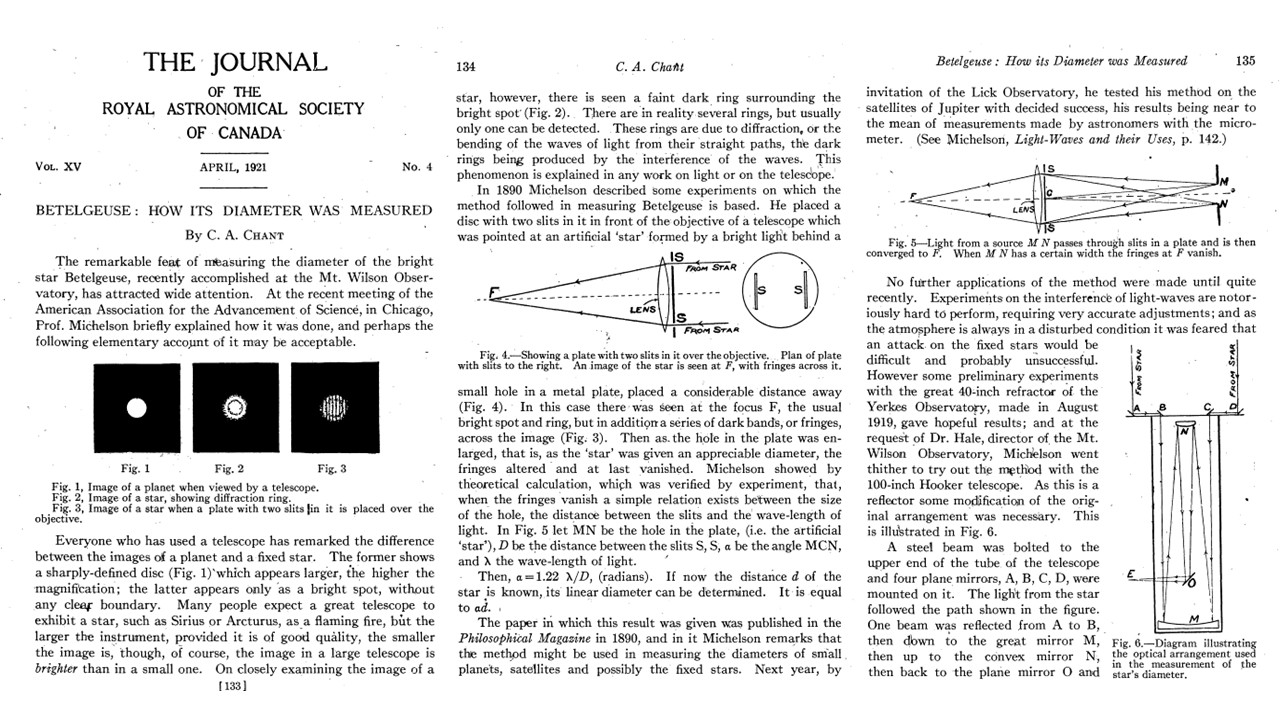
I have long been curious about how a star’s diameter can be determined directly. All who have used a telescope have noticed how a planet shows a disc but a star only shows as a spot, no matter how great the telescope. In fact, the larger the telescope the smaller the image is, though brighter. Closer examination shows one or more dark rings around the star, diffraction rings caused by interference of the light waves by the optics. This is the key to the method Michelson used in the very first determination of a star’s diameter (Figure below, left panel).
Ever since the amazing on-site presentation to AAAP from the LIGO Observatory, I have been totally fascinated with interferometry. If you missed that, here’s the YouTube recording, https://www.youtube.com/watch?v=lR6pcV0KoBc. Long before LIGO’s gravity wave breakthrough, Albert Michelson developed light interferometry and used it for many discoveries. The one that gets most attention is the 1887 Michelson-Morley experiment at Case Western University that disproved “luminiferous aether” as the medium for propagation of light waves. This was the major breakthrough in physics that enabled Albert Einstein to set forward his theory of special relativity in 1905.
Closer to what we ourselves see through telescopes is Michelson’s innovative measurement of the diameter of a star using interferometry in 1920. He had conceived the idea as early as 1890 and succeeded in getting the diameter of Jupiter’s moons. Decades later he experimented with the 40-in refractor at Yerkes, and was invited by George Ellery Hale of Mt Wilson in California to set up his stellar interferometer on the 100-inch Hooker Telescope (Figure below). This led to successful measurement of the angular diameter of the red giant star Betelgeuse (150 light years distant) to be 0.047 arc-sec. The geometric solution to the calculation is described in the paper reproduced in the figure below and we should note that an accurate distance to the star is necessary for this method to work. The interferometric measurement led to a calculated Betelgeuse diameter of 240 million miles, which in our solar system would extend to the orbit of Mars. Below is a picture of the first pages of a contemporary journal article describing the feat. This measurement of a star’s diameter brought the highest precision ever to astronomy, and proved to be a key breakthrough as the understanding of the galaxy unfolded at Mt Wilson with Hale, Edwin Hubble, and colleagues.
Figure. An image of the first 3 pages of the article, Betelgeuse: How its Diameter Was Measured, by Chant, C. A., Journal of the Royal Astronomical Society of Canada, Vol. 15, p.133, April 1921. Archive from the NASA Astrophysics Data System.

 Amateur Astronomers Association of Princeton