

by Rex Parker, PhD director@princetonastronomers.org
Meeting Nov 12 at Peyton Hall. We hope to see you in person at Peyton Hall on campus for the next monthly meeting on November 12 (7:30pm). Our speaker will be Princeton University post-doc Manuel Cuesta from the Dept of Astrophysics, who will discuss his heliophysics research with the Parker Solar Probe. A lot has been accomplished since launch of the Parker Solar Probe by NASA in August 2018. The craft was designed and built by Johns Hopkins Applied Physics Laboratory and was named after physicist Eugene Parker, professor emeritus at Univ of Chicago. For more information about the guest speaker on Nov 12 see program chair Victor Davis’s section below.
Also at the Nov 12 meeting, member David Ackerman will give a member talk (“unjournal club” after the break) on progress in building and using a spectroheliograph. This is an optical instrument designed to study the sun at a single wavelength (monochromatic light). He’ll describe making the instrument using 3-D printing and other methods and will show recent solar data from this instrument of the sun in action at its current peak of activity.
The NASA Situation and What We Can Do. The Parker Solar Probe is a great recent example of the engineering and science prowess of NASA and collaborators.The Oct 14 launch of NASA’s Europa Clipper on a SpaceX Falcon Heavy rocket was good news and some relief especially after Hurricane Milton crossed Florida and narrowly missed Cape Canaveral the prior week. Yet despite success in recent science missions and plans to send humans to the moon and Mars in the Artemis and Gateway projects, a sweeping new report from the National Academies of Sciences, Engineering, and Medicine has elevated worries about the future of the space agency.
As I described at the Sept 8 meeting, the “NASA at a Crossroads” report by the National Academy highlighted the results of an in-depth analysis. It revealed serious deficiencies of NASA’s infrastructure which are critical to future space missions (Figure below, and website https://nap.nationalacademies.org/catalog/27519/nasa-at-a-crossroads-maintaining-workforce-infrastructure-and-technology-preeminence). “Overburdened and underfunded” were terms describing several operations, such as the Deep Space Network, the world-wide array of giant radio antennas supporting interplanetary missions including the Mars rovers operated by JPL. Without the Deep Space Network, image data from James Webb Space Telescope would not make it to earthside. The ability to fund NASA’s aging core is especially difficult because of the huge expenses needed for the future lunar and Mars projects. Most alarmingly, the Academy report described an erosion in engineering expertise, including challenges in being able to recruit top talent in comparison to other organizations and companies. In other words, the prestige of NASA is not as attractive as it once was in the minds of people entering or advancing in the engineering and scientific fields.
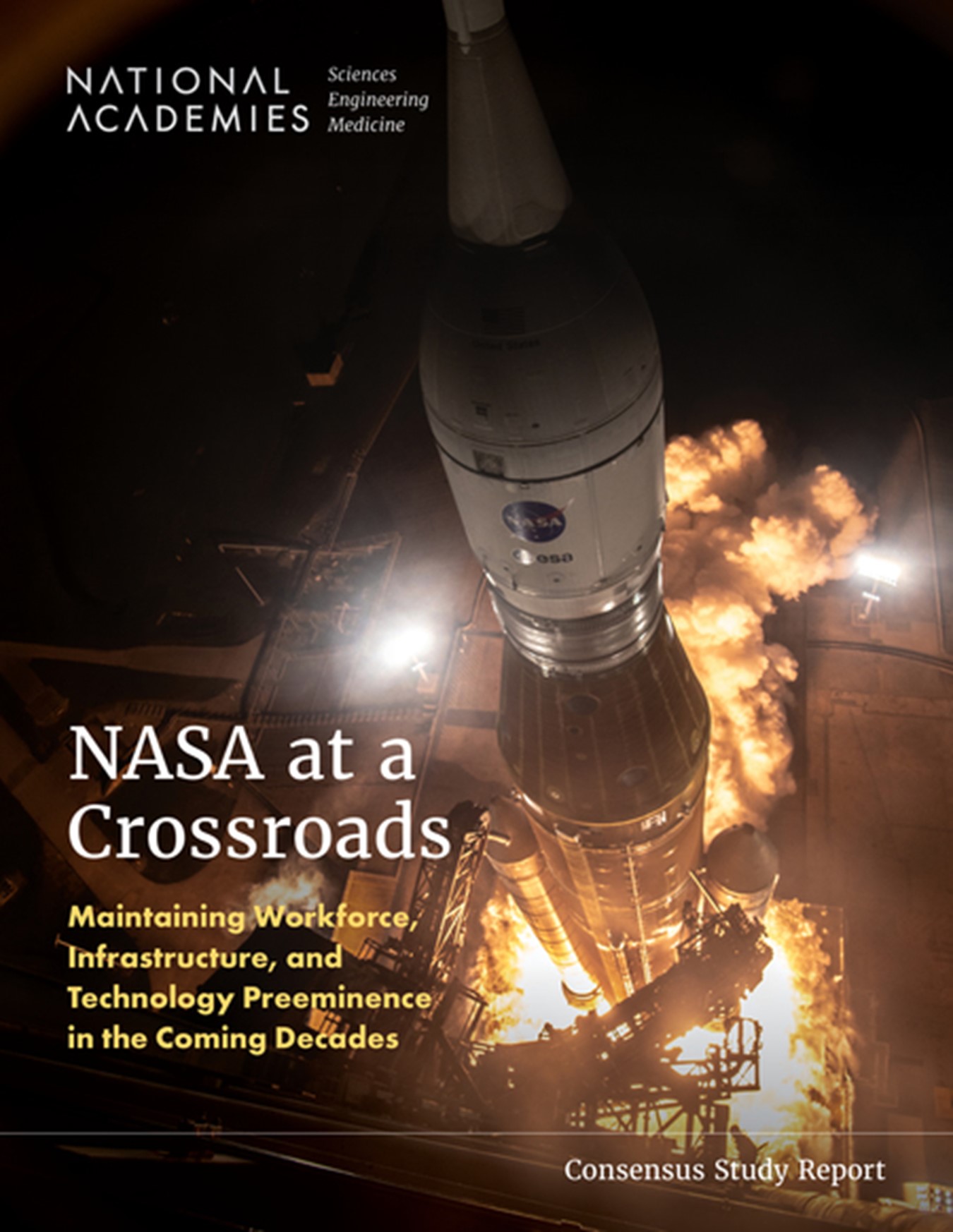
Can we as amateur astronomers do anything to influence the attractiveness to young people of science and engineering education and career tracks in the US? Nature deficit disorder is a term describing the loss of time spent in the natural environment, especially damaging for kids growing up in cities who may never experience a dark starlit night with milky way glowing overhead. It seems that this has a dampening effect on the psyches of young people as well as adults who might otherwise be much more interested in space sciences and engineering. As time goes on, the educational pipeline of talented young people finds career outlets in other directions away from the natural sciences and engineering. So, this is where we as amateur astronomers and space exploration enthusiasts might be able to help. AAAP’s focus on outreach and bringing astronomy to the public and students can inspire and enable others to find that essential curiosity and love for the celestial sphere and nature as a whole. We can do our part to help engage people of all ages in embracing astronomy and space sciences. What else? This is worthy of more discussion at our upcoming meetings, and I welcome your input.
Looking for Field Trip Proposals. In years past we’ve had some memorable astronomy field trips for AAAP members. Most notable was the guided nighttime tour of the US Naval Observatory along with the Smithsonian Air & Space Museum in Washington in Nov 2015. We also had an excellent local tour of the Princeton Plasma Physics Lab back in Feb 2015. I would like to hear proposals from you – ideas for astro field trips. One that comes to my mind is the ”other” Smithsonian Air & Space Museum — the Udvar-Hazy Center near Dulles airport in the DC area.
After the Break. One of the ways we promote astronomy is to highlight member activities in the second half of our monthly meetings, after the break. We also reserve a slot after the break for the Unjournal Club, in which members have the floor (and screen) to discuss recent astro-related articles from the journals and magazines or other personal astronomy experiences and projects to share with fellow members. Just shoot an email to me, or to the Program Chair, to hold a place at upcoming meetings. If you have images, slides, or other content to share, please note that it’s best to bring them on a USB drive to insert into my already-connected laptop to show during the meeting.
Check Out the AAAP YouTube Channel. Our monthly meetings at Peyton Hall are simulcast live via Zoom, and the recordings are converted to YouTube and (after editing) posted on the AAAP YouTube Channel. The videos are a great way to view the meetings you may have missed or review parts that may have been hard to grasp, since some of our topics do go pretty deep. The AAAP YouTube channel currently offers over 60 videos produced inside AAAP during the last few years (thanks to Victor, Dave, and Ira!) and has gathered well over 9000 views to date. Beyond recordings of the meetings and guest speaker presentations, it features how-to videos, cool celestial events from the observatory, astro video sessions from member telescopes, and interviews with knowledgeable club members. Here’s the link: https://www.youtube.com/@amateurastronomersassociat1439

 Amateur Astronomers Association of Princeton