
by S. Prasad Ganti
In 2015, gravity waves were detected by LIGO (Laser Interferometer Gravitational-wave Observatory) from the locations at Louisiana and Washington states. This proved one of the significant predictions of Einstein’s General theory of relativity. Generated by very violent incidents like the merger of black holes or neutron stars, the fabric of space gets stretched and compressed, resulting in gravitational waves. Although a great achievement using the most sophisticated and intelligently engineered detectors, it is just the beginning. We just detected one of the many possible flavors of gravitational waves. Other flavors need different kinds of detectors.
Just like electromagnetic waves have different flavors depending on frequency – some in form light which we can see, some in form of heat (infrared) which we feel, some biting our skin (ultraviolet), some passing through our bodies but stopped by bones (X-rays) etc., we have different flavors of gravitational waves, depending on the frequency of the waves. The following picture courtesy of “Nature” illustrates the different flavors. Unlike the electromagnetic waves which range from a few hertz to several gigahertz, the gravitational waves top out at megahertz, but extend to very low frequencies, which are difficult to imagine.

Waves in the water result from a disturbance, like throwing a stone in a pond or the effect of the moon’s gravitational pull on the earth’s seas and oceans. Similarly electromagnetic waves are disturbances of related electrical and magnetic fields in space. Gravity waves are a result of disturbances resulting from very heavy bodies like neutron stars and black holes colliding with each other.
The frequency of the gravitational waves is determined by the nature of the violent phenomena in the universe. The waves we have detected so far are from the merger of black holes and neutron stars. Fortunately they are far away from us and have occurred long back in the past. We are just detecting them now due to the vast distances involved. As the picture above shows, we have covered a very small part of the overall spectrum of the frequencies.
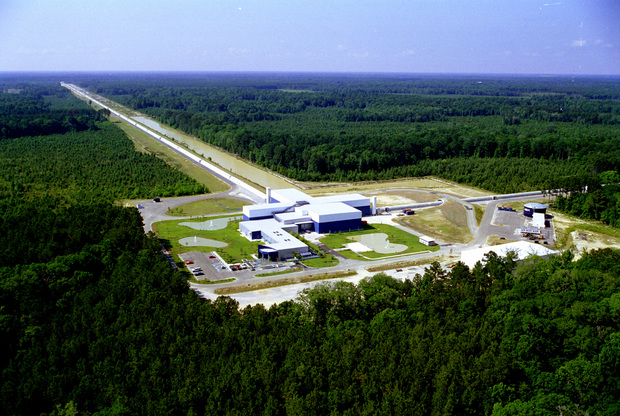
LIGO (Laser Interference Gravitational Observatory) has 2 centers, one in Louisiana and another in Washington state, which has two arms each of 2.5 miles in length and are perpendicular to each other. Laser beams are fired from the common point across the 2 arms. They get reflected back by a mirror at the ends of each of the 2 arms. In case of gravity waves in the vicinity, there will be a slight difference between the timing of the return of the 2 laser beams back to their starting points. The whole setup is very carefully engineered to eliminate the difference from other things like local vibrations. If the returning laser beams are out of sync, they form a wave pattern due to interference. This pattern represents the gravity wave. Shown below is the picture of the Livingston, Louisiana LIGO facility, courtesy Caltech LIGO.
A third LIGO detector called Virgo is located in Italy. Another one called Kagra is operational in Japan. The next one called LIGO-India is coming up in India. Multiple detectors confirm the same event and rule out any local influences on each detector.
Next detector will be a space based one called LISA (laser Interferometer Space Antenna). It will be used to detect lower frequency gravitational waves. It is still in the design phase and is expected to be in place by the mid 2030s. There will be 3 spacecraft in space, about a million and half miles from each other. Each spacecraft simultaneously transmits its own laser signal while receiving signals from each of the other two in the constellation. The incoming and outgoing beams are combined to form an interference pattern. These three such patterns are transmitted to the earth where a signal analysis is done in the computers to detect the presence or absence of gravitational waves.
Gravitational waves are not continuously transmitted signals like light from stars. They are observed for a few seconds to a few minutes for each violent event taking place in the universe.
Going further down the spectrum to lower frequencies, another technique called Pulsar Timing Arrays (PTA) will be used. They do not use any laser beams or interference patterns. Instead they use radio signals received from Pulsars, which are rotating neutron stars. These signals are very precise, very narrow and steadily being transmitted towards the earth. In fact, there are many Pulsars in the Universe. Only those whose pencil-like beams are directed towards the earth can be observed. Any presence of gravitational waves will cause some irregularities in the pulses. Otherwise these pulses are very precise like the atomic clocks on the earth.
For this detection to work, the existing radio telescopes like the Greenbank, FAST (China), GMRT (India) and Parkes (Australia) are being roped in. Very fine tuned and precise radio receivers are used to receive the pulses. All the known sources of noise and errors are filtered out. The calibration process itself takes a year or more. And all the participating radio telescopes form an array. In the future, gravitational waves may be found using this technique. The array is getting ready to be used.
Lower down the spectrum scale, the gravitational waves may be found in the patterns of CMB (Cosmic Microwave Background) radiation. Which is basically an afterglow from the birth of the Universe at the time of the Big Bang. Since the waves may be stretched in one direction rather than the other, the radiation would be polarized. No such detections have been made yet. But the future looks promising.
These exciting technologies will tell us more about the different flavors of the gravitational waves. Multi messenger astronomy which includes gravitational waves is really important. There are some limitations of the electromagnetic radiation which could not have escaped the first 400,000 years after the Big Bang when the cosmic fog consisting of electrons and quarks prevailed. No other telescope can view these conditions. Gravity would have escaped those conditions and could be detected using gravitational wave detectors. The next chapter of such discoveries is awaiting us.

 Amateur Astronomers Association of Princeton