
by Michael DiMario, AAAP Astroimaging Chair
The summer thus far in eastern PA and NJ has been self-evident in poor weather from clouds, humidity, storms, and extreme heat making astroimaging difficult to say the least. However, a few tremendous images were taken by AAAP members concentrating on the northern constellation Cygnus. Cygnus is one of the most recognizable constellations of the northern summer and autumn sky, and it features a prominent asterism known as the Northern Cross (in contrast to the Southern Cross) with the brightest star in Cygnus and first-magnitude Deneb, a blue supergiant, forming at the head of the Northern Cross. Deneb also forms an additional asterism known as the Summer Triangle. The constellation is home to Cygnus X-1, a distant X-ray binary containing a supergiant and unseen massive companion that was the first object widely held to be a black hole. There are 97-star systems in Cygnus that have known planets as a result of the Kepler Mission.
Clear skies,
Michael DiMario, PhD
AAAP Astroimaging Chair
David Wilton – Cygnus Wall

The Cygnus Wall, part of the North America Nebula (NGC 7000), photons were collected multi-nights of 15–27 June 2024. Total integration time of 13 hours, 18 minutes using a Televue 127 refractor and ZWO ASI2600 monochrome camera on a Paramount MYT mount. Post processing with PixInsight. The nebula is in the “Hubble palette,” that is using narrowband sulfur II, hydrogen-alpha, and oxygen III filters in the red, green, and blue channels; the stars were imaged with red, green, and blue filters.
David Wilton – Witch’s Broom
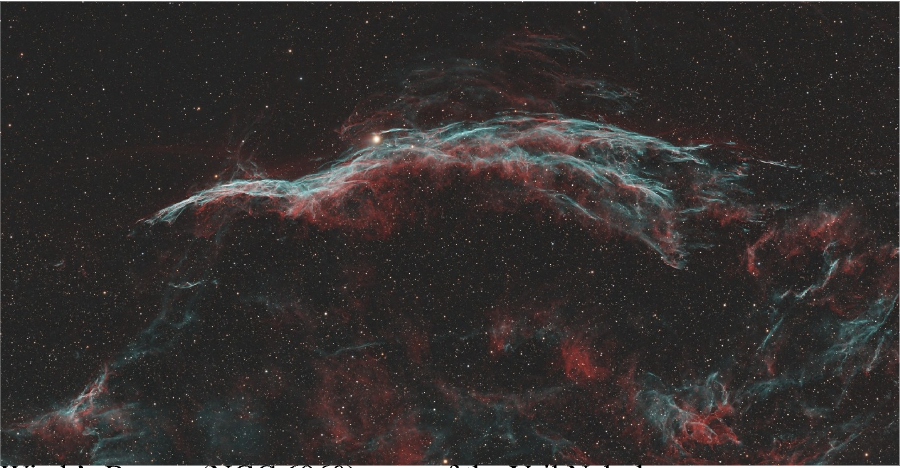
Witch’s Broom (NGC 6960), part of the Veil Nebula, a supernova remnant in Cygnus. Image was captured 7–8 June 2024 with 7 hours, 56 minutes integration time, using a Televue 127 refractor and ZWO ASI2600 monochrome camera on a Paramount MYT mount. Post processing with PixInsight. The nebula is imaged with narrowband hydrogen-alpha and oxygen III filters (HOO palette); the stars were imaged with red, green, and blue filters.
Rex Parker – Bat Nebula (NGC 6995)
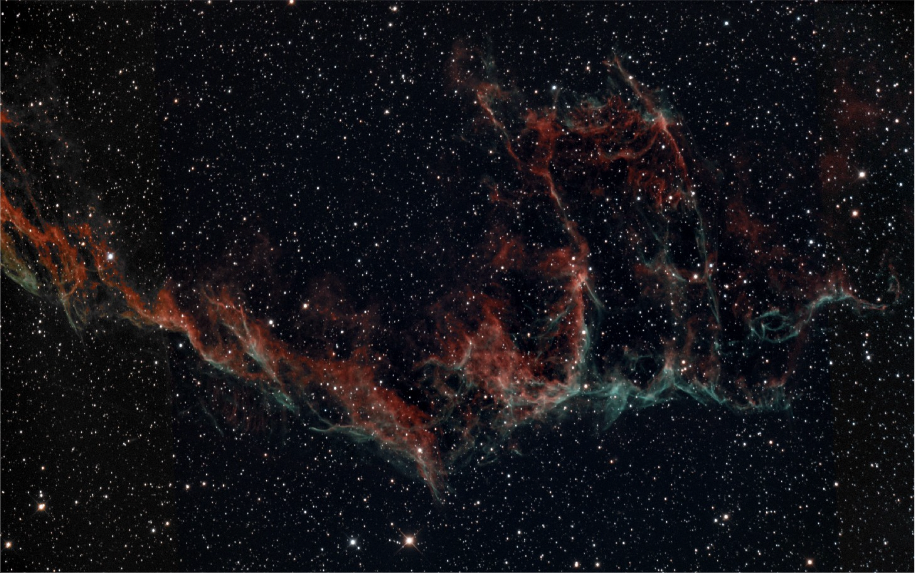
NGC 6995 or known as the Bat Nebula is part of the eastern Veil Nebula in Cygnus. The Veil Nebula is a supernova remnant from an event about 5000 years ago. Image was captured using a AGO 12.5” Dall-Kirkham Cassegrain scope, ASI2400MC Pro camera with an Antlia Triband filter. Integration of 41×10 min subs, gain 140 (unity). Processed in Astrometric Stacking Program (ASTAP) and minimally in Photoshop (PS).
Oleg Shargorodsky – Crescent Nebula (NGC 6888)
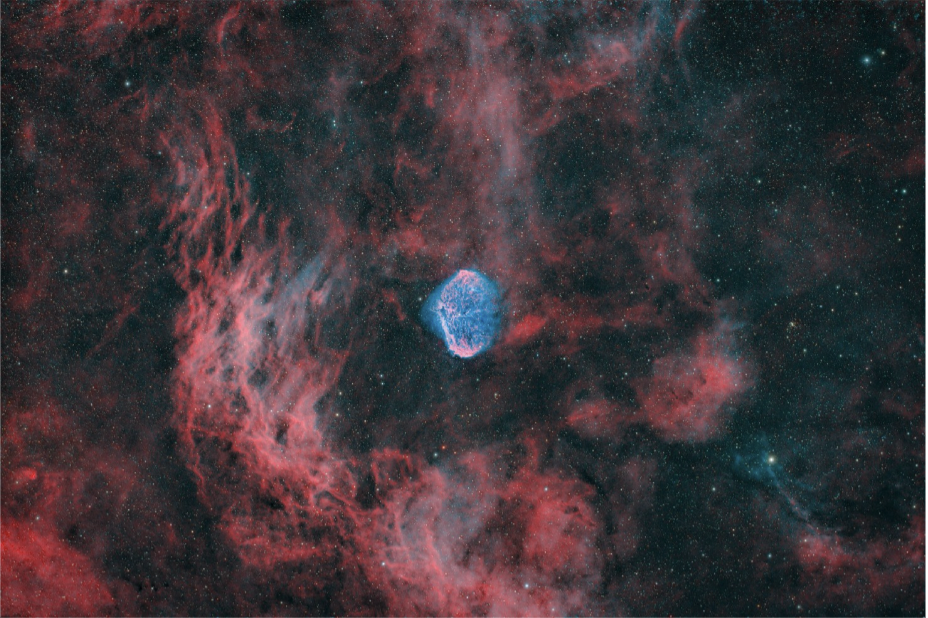
The Crescent Nebula (NGC 6888) is an emission nebula in the constellation Cygnus, about 5000 ly from Earth. It was discovered by William Herschel in 1792. It is formed by the fast stellar wind from the Wolf-Rayet star WR 136 (HD 192163) colliding with and energizing the slower moving wind ejected by the star when it became a red giant around 250,000 to 400,000 years ago. The Crescent Nebula image was captured using a ASKAR 108mm FRA600 Quintuplet scope, an ASKAR 0.7x f/3.9 Full Frame Reducer on an iOptron CEM40 mount using a ZWO ASl2600mc pro camera, ZWO ASI 120MM-mini guider, and an Antlia ALP-T Dual Narrowband OIII (5nm) and H-a (5nm) Filter. Image processing using PixInsight and Lightroom.

 Amateur Astronomers Association of Princeton