
by Michael DiMario, AAAP Astroimaging Chair
The astroimaging section of this month’s Sidereal Times displays several images from the AAAP membership. The solar eclipse of April 8th may reveal Comet 12P/Pons-Brooks, nick named the Devil Comet, shown as the first image in this edition’s collection near Jupiter. Other images taken in New Jersey skies show the finest images are possible in light polluted skies with the skill and talent of the AAAP membership.
Image descriptions are edited or authored by Michael DiMario for clarity and composition.
Image capture data provided by imager.
Dan Mints — Comet 12P/Pons-Brooks
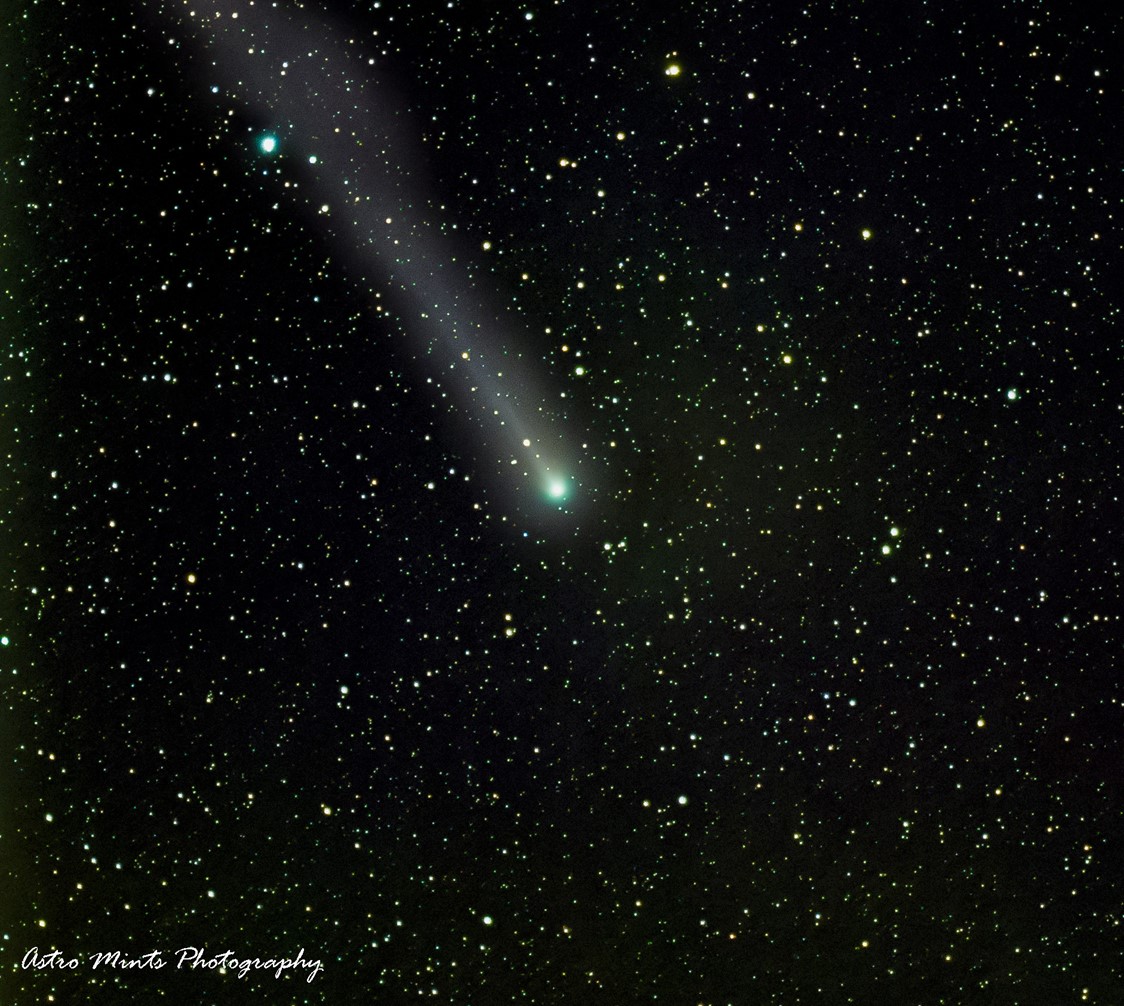
Comet 12P/Pons-Brooks was imaged on March 11, 2024. Image was captured with a ZWO ASI 533MC Pro camera and a Samyang 135MM Telephoto Lens. Comet image frame stacking with PixInsight.
Comet 12P/Pon-Brooks, or called the Devil or Millennium Falcon comet, is a periodic comet with an orbital period of 71.2 years. Comets with an orbital period of less than 200 years are referred to as Halley-type comets. It is one of the brightest known periodic comets, reaching an absolute visual magnitude of about 5 in its approach to perihelion. Comet Pons-Brooks was discovered at Marseilles Observatory in July 1812 by Jean-Louis Pons, and on its next appearance in 1883 by William Robert Brooks thus giving its name. This comet is nick named the Devil or Millennium Falcon (Star Wars) comet due to an outburst that caused the coma to distort into a horseshoe or horned shape, with a dark center and bright wings due to an uneven spewing of gas and dust.
Comet 12P/Pons–Brooks has been identified as a comet observed in 1385 and in 1457. The 1385 was recorded by the Chinese and was also mentioned in some European sources. A comet observed by Paolo dal Pozzo Toscanelli, an Italian astronomer and mathematician, in January 1457 and mentioned in Chinese sources is also identified as comet 12P/Pons-Brooks. In both apparitions the comet had magnitude 3 or brighter. It is possible that it was also a comet recorded in Chinese sources in September 245 CE.
It might be visible during the total solar eclipse — The next perihelion passage is 21 April 2024, with closest approach to Earth being 1.55 AU on 2 June 2024. The comet is expected to brighten to about apparent magnitude 4.5. The comet nucleus is estimated to be around 30 km in diameter. That’s just two weeks after the April 8th total solar eclipse and Comet Pons-Brooks will be in the sky near the Sun during totality. It may be bright enough to pick up with binoculars, or naked eye should the comet outburst. Do look for it near Jupiter.
Daniel Mints — Jellyfish Nebula IC443
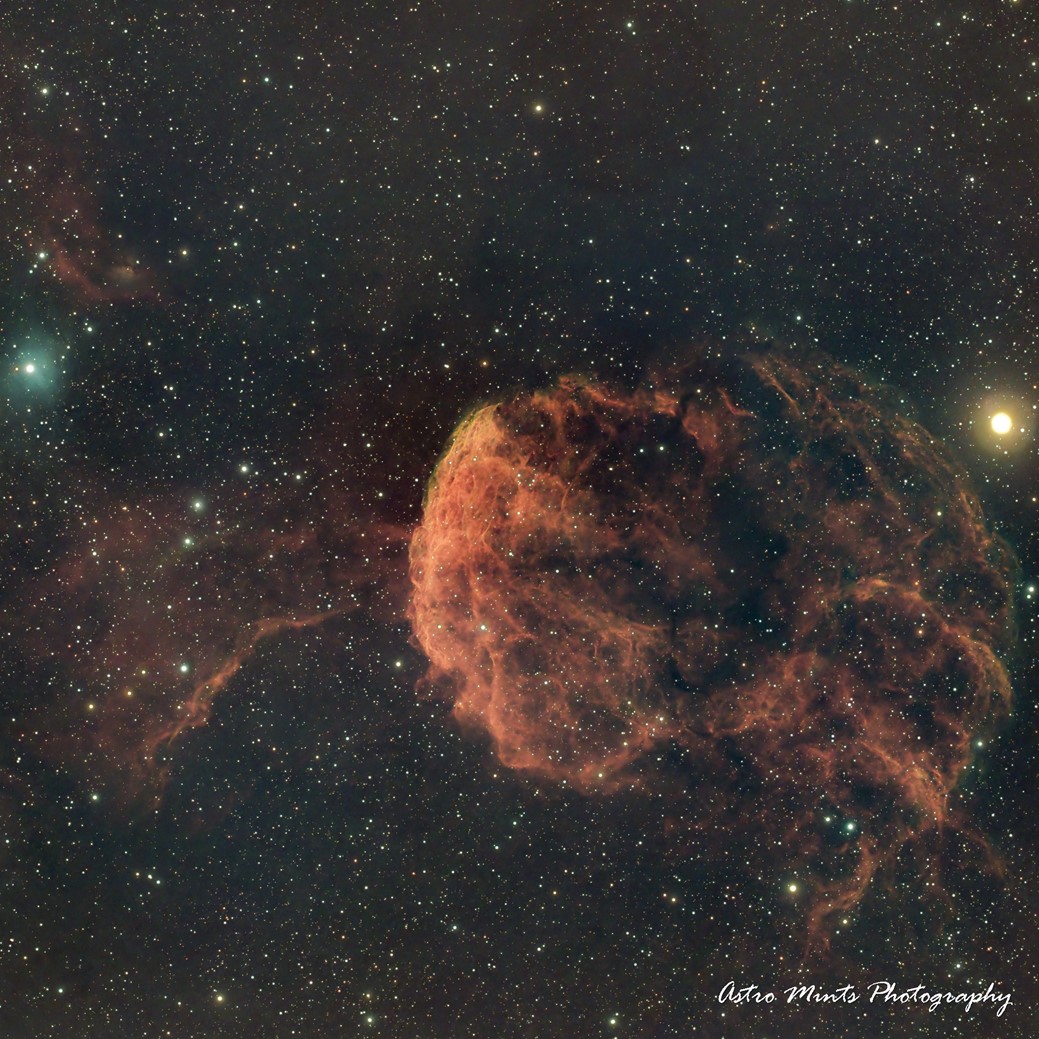
Jellyfish Nebula image captured using an Askar V 384mm at f/4.8 with a ZWO 533MC Pro camera and Antlia Triband LP Filter. Image processing of 120 x 5 min subs stacked in PixInsight – 2x Drizzle for extra detail on the nebula. Processed with BlurXTerminator 2.0 and NoiseXTerminator. Post processed in Lightroom for color and contrast adjustment.
The Jellyfish nebula is a supernova remnant, 70 ly in diameter, of about 35,000 years ago located approximately 5,000 ly from Earth in the Gemini constellation. The supernova event produced the nebula and a neutron star. The presence of the neutron star and the nebula’s location in a star forming region indicate that the remnant was created by a Type II supernova, one triggered by a rapid collapse of a star with a mass at least 8 times that of the Sun. The neutron star is moving away from the Jellyfish Nebula at about 800,000 km/h.
Robert Vanderbei — M35 (upper left) and NGC 2158 (lower right)
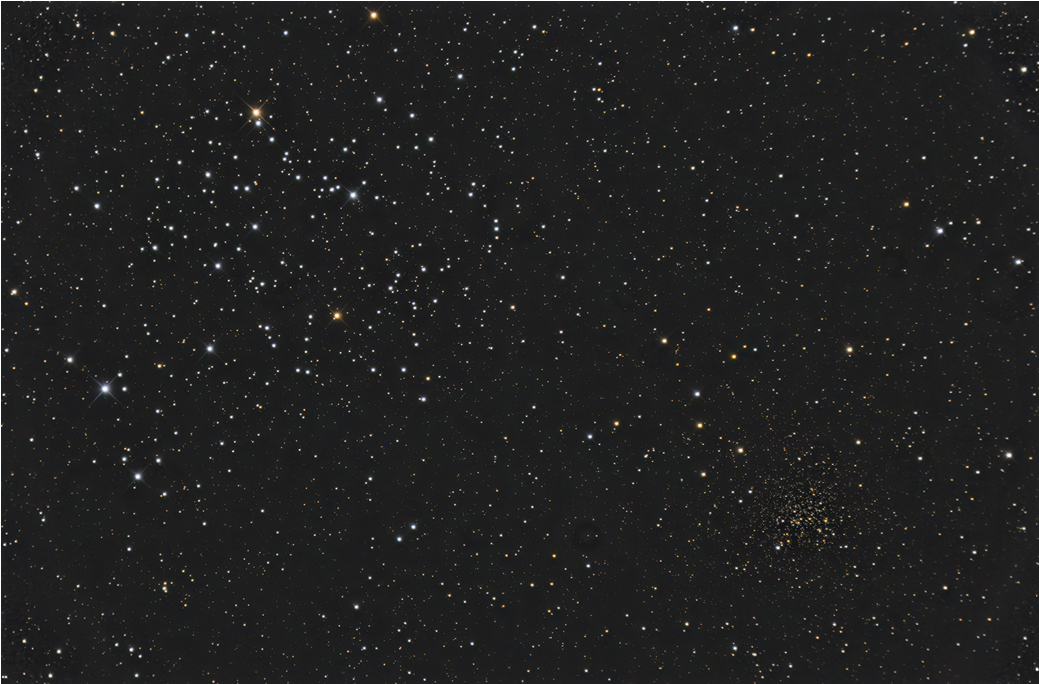
M35 and NGC 2158 image captured using a 10” Ritchey-Chretien reflector, a ZWO ASI2400MC-Pro camera. Integration of 4 5-minute live stacks of 30-sec exposures.
Exposures: Four 5-minute live stacks of 30-second exposures. Processed using SharpCap.
M35, located in the constellation Gemini, is about 2,970 ly away and consists of about 500 stars. NGC2158 is about 9,000 ly away. It is a middle-age open cluster. The stars are very metal poor.
Joe Matthews — IC 2162
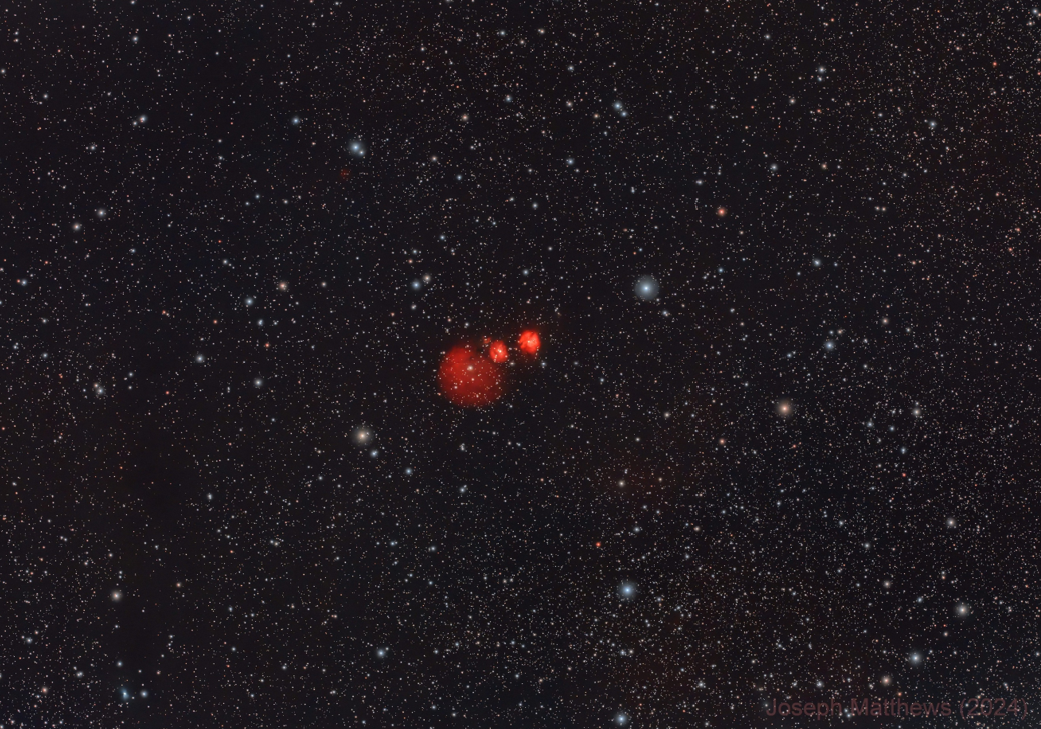
IC 2162 was imaged using a William Optics Fluorostar 91/FLT91, ZWO ASI2600MC camera, and Optolong L-eNhance filter. Image integration of 34 frames at 300-sec per frame for an integration of 2-hr 50-min.
IC 2162 is a compact diffused nebula lying about the tip of Orion’s cudgel. The IC 2162 is positioned at about 2.5 degrees south of the “Monkey Head Nebula” belongs to Orion. IC 2162 has a smaller size of 15 arc minutes than that of the Monkey Head nebula. The nebula has fewer characteristics in its shape and has no familiar nicknames like “Monkey Head Nebula”, but some call it the Mushroom Nebula.
Joseph Matthews – NGC 2245/IC 447/IC 2169 Dreyer’s Nebula
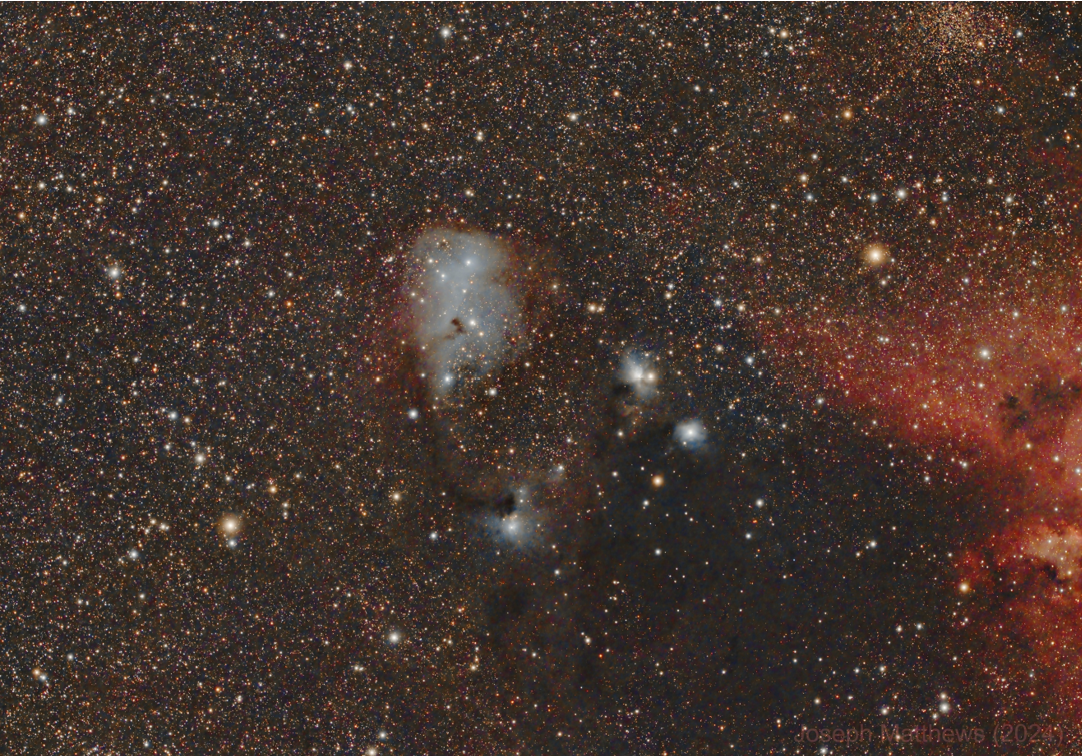
NGC 2245/IC 447/IC 2169 was imaged using a William Optics Fluorostar 91/FLT91, ZWO ASI2600MC camera, and Optolong L-Pro filter. Image integration of 34 frames at 300-sec per frame for an integration of 2-hr 50-min.
NGC 2245/IC447/ IC 2169 is a bright blue reflection nebula in the constellation of Monoceros about 2 deg west of the Cone Nebula and Christmas Tree Cluster. This complex belongs to a large molecular cloud, the Monoceros R1 (Mon R1) Complex with a mean distance from Earth around 716 pc. It is an active star forming region and hosts many young stars and Herbig-Haro objects, bright patches of nebulosity associated with new born stars. The astronomer Edward E. Barnard exposed photographic plates of this region on 11 October 1888 using a 12-inch refractor and again on 21st and 24 January 1894 using the 6-inch Willard lens. He reported the discovery to John Dreyer, the compiler of the NGC and IC catalogues who listed IC 447 as Dreyer’s Nebula.
Joseph Matthews – M53 (center) and NGC 5053 (upper right)
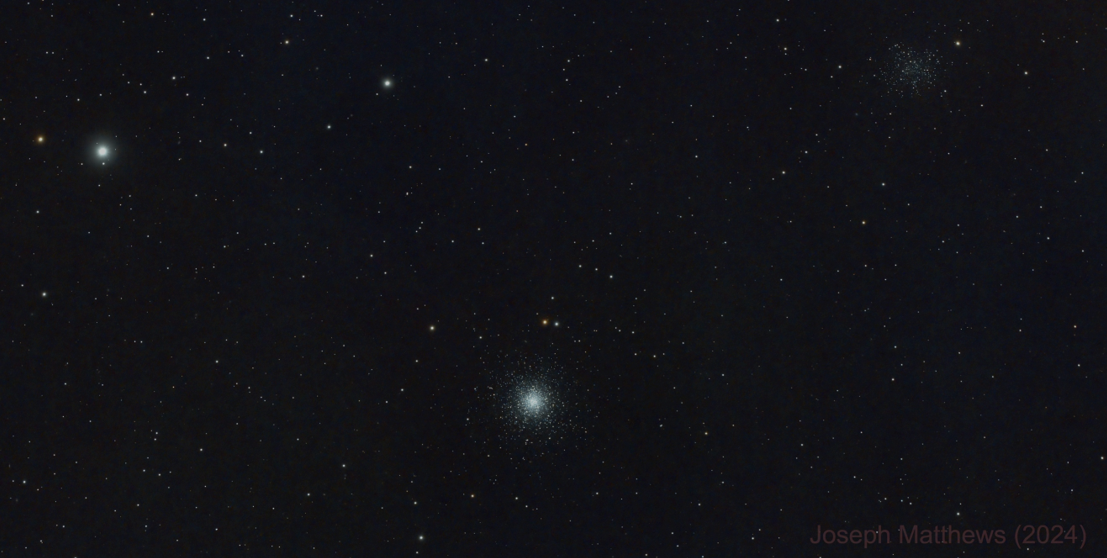
M53 and NGC 5053 was imaged using a William Optics Fluorostar 91/FLT91, ZWO ASI2600MC camera, and Optolong L-Pro filter. Image integration of 53 frames at 120-sec per frame for an integration of 1-hr 46-min.
M53 is a globular star cluster located in the northern constellation Coma Berenices. The cluster has an apparent magnitude of 8.33 and lies at an approximate distance of 58,000 ly from Earth. It has the designation NGC 5024 in the New General Catalogue. The best time of year to observe M53 is in the months of March, April and May. M53 lies about 60,000 light years from the galactic center and, being roughly at the same distance from the solar system, it is one of the more distant globulars. M53 lies in the vicinity of another globular cluster, NGC 5053. NGC 5053 is considerably fainter, looser and less populated, and can be seen in the same field of view as M53 as it lies only a degree to the east. There is reported to be a tidal bridge linking M53 and NGC 5053. The fainter cluster, which is in fact slightly closer to us than M53, contains only about 3,500 stars and only appears as a patch of light in 8-inch telescopes. M53 was discovered by the German astronomer Johann Elert Bode on February 3, 1775.
Purnendu Gupta – Solar Sunspot AR3590

Sunspot AR3590 photographed on Feb 24, 2024 from my front yard. At the time this was the biggest sunspot of the current solar cycle and wide enough to fit several Earths. The current solar cycle (#25) is the latest of the 11-year solar activity period which started in Dec 2019 and is expected to continue to 2030. A few days prior to this, on Feb 21-22 this active region had produced the three instances of the largest category of solar flares, X flares, within a 24-hour period. One of those was a X6.4, the largest solar flare in the current solar cycle.
The image is created out of a 25% stack of a 1 min video at 24 fps (ISO 100, 1/100 shutter) using a Canon 70d DSLR in video mode and a Celestron with a solar filter. Telescope used was a 430 mm f/6 refractor on a tracked alt-az mount. Image processed in PIPP, AutoStakkert!, Registax, and GIMP.

 Amateur Astronomers Association of Princeton