
by S. Prasad Ganti
In Hindu mythology, Aditya is the Sun god, something akin to Ra in Egyptian mythology. Studying the Sun has been occurring for most of human history. In the last few decades done using telescopes – both space based and land based. India launched a spacecraft named Aditya a few months back. In the beginning of the new year 2024, Aditya reached a parking slot called L1 Lagrangian point which is about a million miles from the Earth and towards the Sun on the Earth-Sun axis.
At the L1 Lagrangian point parking slot, the spacecraft just hangs in without spending much fuel. It is a good vantage point as well, being able to see the Sun all the time without any day or night. The picture below, courtesy ISRO (Indian Space Research Organization), shows all the 5 Lagrangian points where the gravitational forces are minimal as the forces from the Sun and the Earth cancel each other out. It is like living with very little gravity.
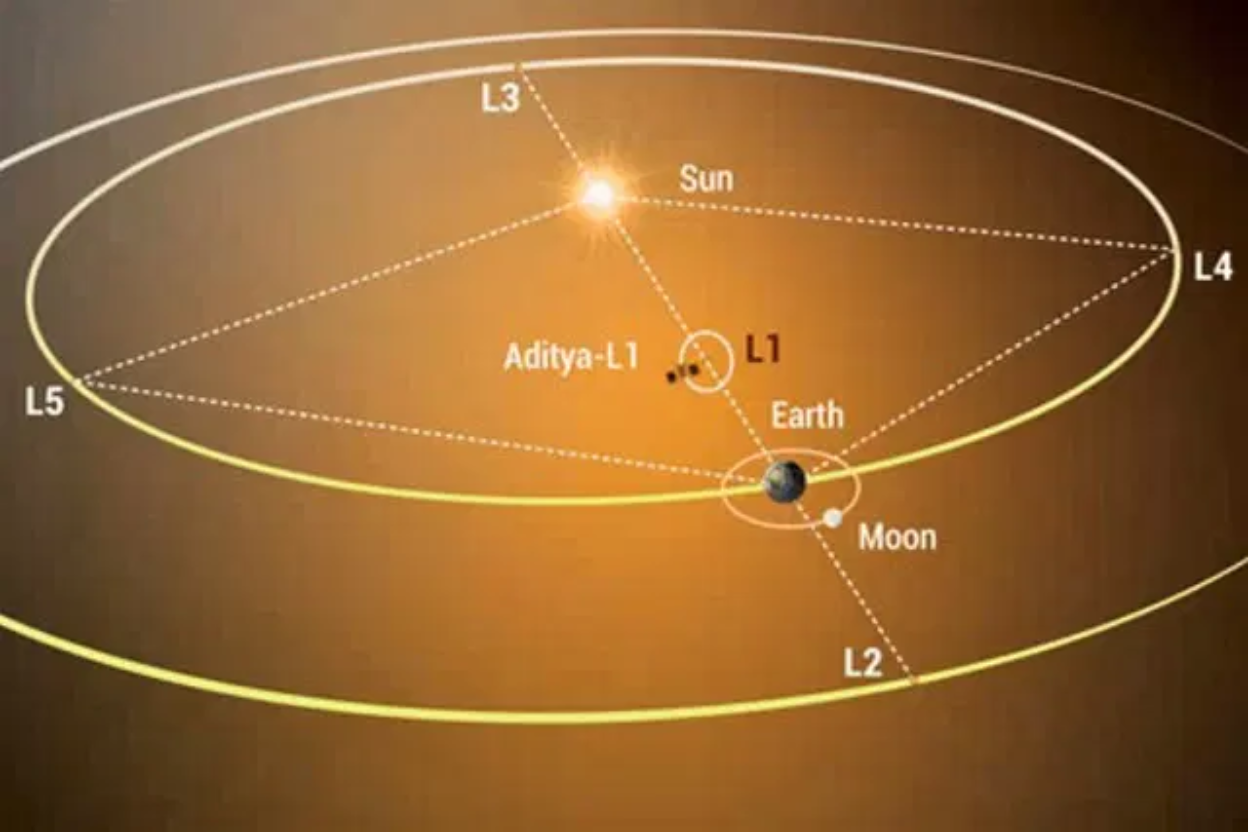
These points came as a solution to a problem called the 3 body problem. The Earth, Sun and the spacecraft forming the 3 bodies. This problem was first solved by the mathematician Leonard Euler who came up with 3 of the points. Joseph Lagrange then completed the solution with all the 5 points. The 3 body problem can exist anywhere in the Universe. It is not specific to the Sun or Earth or our solar system. In fact, a famous Sci-fi novel called “Three body problem” involves a tale woven around 3 Sun like stars orbiting each other and a civilization on a planet having the experience of 3 Suns in the sky.
The L2 Lagrangian point is very popular for space telescopes like James Webb. L2 is good for spacecraft wanting to see the Universe, away from our Sun. While L1 is very good for observing the Sun. The other 3 Lagrangian points have found no uses so far. ESA’s (European Space Agency) SOHO (Solar and Heliospheric Observatory) spacecraft is there at L1 observing the Sun. NASA’s (National Space and Aeronautics Administration) Parker spacecraft also observes the Sun, but it is not there at L1 instead it is positioned much closer to the Sun.
While getting to L1 Lagrangian point involves a tedious million mile journey, inserting into a halo orbit and staying there could be a challenge. ESA’s SOHO spacecraft had broken loose from its orbit and had to be maneuvered back to its parking slot orbit. Hope Aditya does not encounter such a situation.
Aditya’s goal is to image the sun in visible, ultraviolet and x-ray wavelengths of electromagnetic radiation to get more insight into the dynamics of the solar atmosphere. It will also study “space weather” that results from solar storms. The instruments which are on board to make such observations possible are divided into observing and analyzing ones. Observing ones are the Visible Emission Line Coronagraph (VELC), Solar Ultraviolet Imaging Telescope (SUIT), Solar Low Energy X-ray Spectrometer (SoLEXS), and High Energy L1 Orbiting X-ray Spectrometer (HEL1OS). These cover the visible, ultraviolet and -ray parts of the electromagnetic spectrum.
The three analyzing instruments sitting inside the spacecraft are the Aditya Solar wind Particle Experiment (ASPEX), Plasma Analyser Package For Aditya (PAPA), and Advanced Tri-axial High Resolution Digital Magnetometers. While these instruments present an alphabetic soup of acronyms, each new generation of spacecraft has more sophisticated and complex electronics to make more detailed and precise observations. All the space maneuvering skills are not of much use without these instruments. After all, nowadays, astronomy is all about capturing a series of numbers and interpreting them on the Earth and imbuing them with colors. Thereby enhancing our knowledge of the Cosmos.

 Amateur Astronomers Association of Princeton
Wonderful post 🙏🌹