
by Michael DiMario, Astroimaging Chair
Welcome to the new section of the Sideral Times dedicated to club member’s activities in astrophotography or called astronomical imaging. It is our intent to publish a few of our member’s latest images demonstrating our member’s passion for this hobby and communicate the wonders of the celestial sky. Astroimagery is broad and varied ranging from nightscapes, solar, planetary, lunar, and deep sky objects whereby each requires different techniques and methodologies. Even within a specific imaging topic of deep sky objects, the approach ranges from narrow to medium to wide-field as well as specific spectral wavelengths.
The interest in astroimaging is exploding with the advent of new supporting technologies and standards in affordable cameras, mounts, filters, software for mount and camera controls and image processing. The affordable technologies and interface standards, such as the Astronomy Common Object Model (ASCOM), fuels the burgeoning astroimaging hobby attracting more astroimagers and in turn creates more innovation. Gone are the days of very long duration film astrophotography whereby celestial guiding was manual through an eyepiece reticle whereby the imager made continuous very fine adjustments to keep the target on the reticle over the course of several hours to obtain sufficient film exposure. This imager spent many a night manually guiding with hyper-sensitive 35mm film for several hours for one image. Today, hundreds of digital frames may be taken of multiple objects in a single night and processed the very next day and in many cases processed in real-time.
The AAAP has an astroimaging subgroup with forty-six members, at no additional club fee, whereby club members may share their images, challenges, specific problems, solutions, and a general discussion of astroimaging. The AAAP Astroimaging Group meets online by Zoom the fourth Tuesday of the month at 7:30 pm. As well as the monthly meeting, images and communications are provided nearly daily via an email group and collaboration platform group.io. The continuity of discussions is retained and members take advantage of lessons learned and images by browsing the postings. If you wish more information or to join the Astroimaging Group, please contact Gene Allen secretary@princetonastronomy.org or Michael DiMario astroimaging@princetonastronomy.org.

This image is IC342 or known as the Hidden Galaxy located in the constellation Camelopardalis. This spiral galaxy is “hidden” because it lies behind dusty areas of our own galaxy’s equator. This galaxy is estimated to be 7 million to 11 million light years from Earth and is believed to appear very much like our own galaxy the Milky Way. Captured 12/18/2023 with ZWO ASI2600MC camera with the Antlia Triband Filter on a Sky-Watcher Esprit ED APO 100mm f/5.5 refractor; Integration of 52x2min frames at -10 C, Bin 1, at unity gain; Processed with CCD Stack, Topaz DeNoise, and Lightroom.
– Rich Sherman
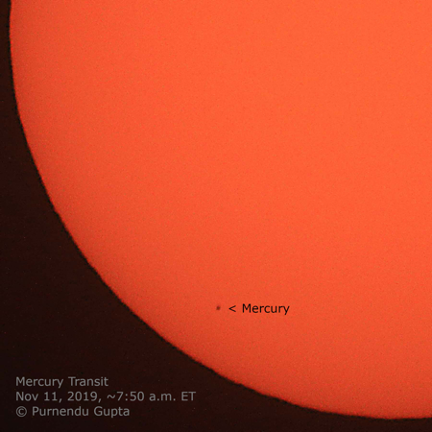
Our nearest star seen against its closest neighbor Mercury during the transit event in November 2019. Mercury appears as a tiny speck a few pixels wide. It is amazing to think that the Earth, from the same perspective, would only be about 2.5 times larger – still just a few pixels wide. If the Sun was the size of a basketball, on a relative scale, Mercury would be a pinhead about 30 feet away.
– Purnendu Gupta
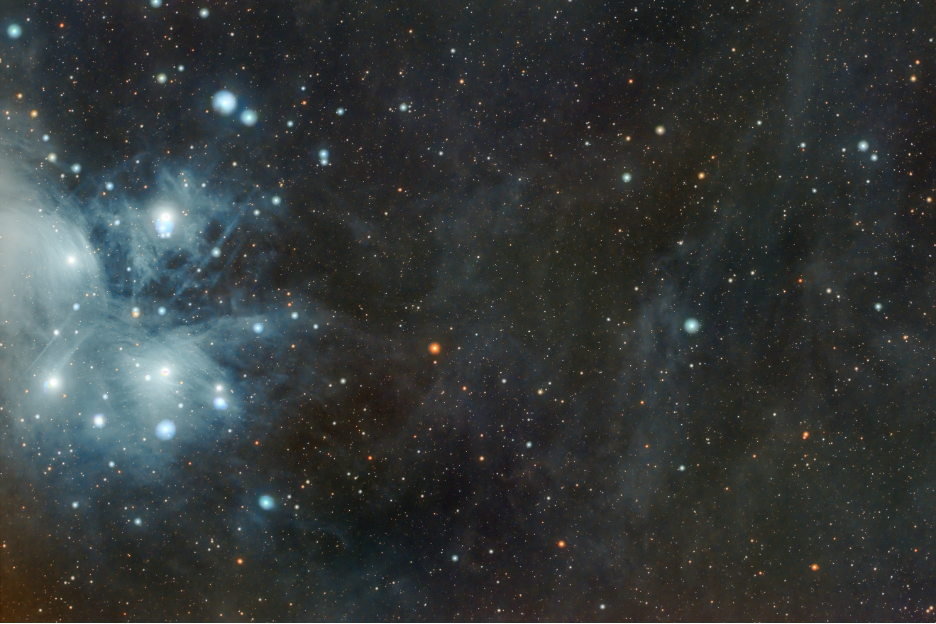
This image is of IC353, located in the Taurus constellation, taken on or about December 8th, 2023. IC353 was discovered by E.E. Barnard in 1893. IC353 is a vast diffuse reflection nebula that is just north-east of the Pleiades star cluster, and is probably physically connected to the Pleiades nebulosity. It is described in the Index Catalog as “very faint, extremely large,” with a diameter of about 3 degrees.
— Joseph Matthews

This image is of M78 the brightest reflection nebula in the night sky and is referred by many as the Casper the Friendly Ghost Nebula. It is located in the constellation Orion at magnitude 8.3 and is approximately 1,600 light years from Earth with an approximate diameter of 10 light years. M78 is lit by a stellar nursery of young stars that illuminate the dust particles reflecting and scattering blue light. This image was taken by a ZWO ASI533MC Pro at gain 101on a Celestron C8 SCT at f/6.3 with a Celestron AVX mount. Integration of 200x120sec stacked images and processed in PixInsight with BlurXTerminator and NoiseXTerminator and post processed in Lightroom.
– Daniel Mints

This image of NGC 1499 is known as the California Nebula, discovered by E. E. Barnard in 1884, and is an emission nebula located in the constellation Perseus approximately 1,000 light years from Earth at magnitude 6.0. It is fairly large stretching 2.5 degrees by a half degree wide.
NGC 1499 image was captured using a ZWO ASI183MC Pro camera on a William Optics Redcat 51 with an integration of 5 to 6 hours.
— Bill Murray

 Amateur Astronomers Association of Princeton