
by Michael DiMario
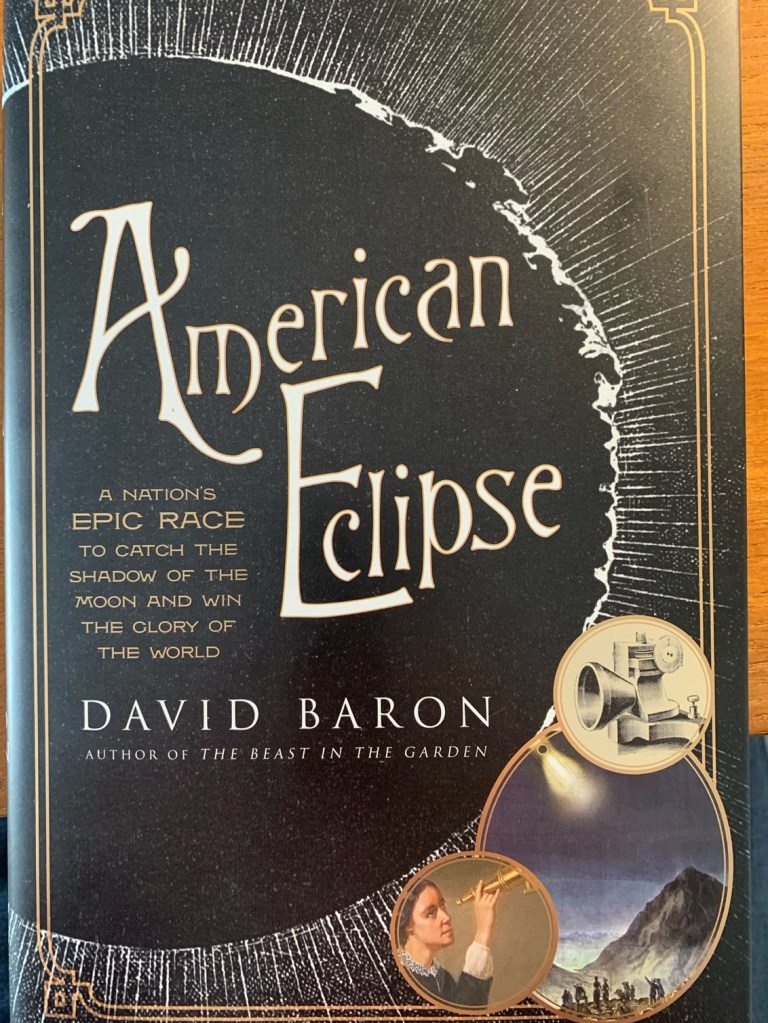
Title: American Eclipse – A Nation’s Epic Race To Catch The Shadow Of The Moon And Win The Glory Of The World
Author: David Baron
Publisher: Liveright Publishing Corporation, New York, NY
Publication Date: 2017
Total Pages: 352
The upcoming total solar eclipse Monday April 8, 2024 made this book attractive to read and I was not disappointed with the author David Baron, a former NPR science correspondent and an umbraphile (a person who chases eclipses), narrative of the challenges of a young and burgeoning science America to witness and collect scientific data on the total solar eclipse Monday July 29, 1878. Gilded Age America represented rapid economic, industrial, and technological growth becoming the envy of the world. The author elegantly describes how the United States was positioned to establish itself as a major leader in the world’s scientific community with the advent of the total solar eclipse.
The 1878 total solar eclipse followed a path stretching from northwest Montana, through Wyoming, Colorado, Oklahoma, Texas, and onto the Gulf of Mexico. The rapid industrialization and expansion of the railroads allowed coast to coast transit in less than a week. Rapid travel allowed for eclipse expeditions to move equipment from the east coast to points still considered the “Wild West.” The author describes these expeditions and the primary characters that were to usher the United States to join the world’s scientific community. The author’s story centers on three main characters – Thomas Edison whose primary goal was to test his prototype devise to measure temperature changes in the Sun’s corona introducing the concept of infrared telescopes and his eureka moments that lead to the light bulb; Maria Mitchell whose fame and attributes as a comet discoverer, Navy celestial navigation woman computer, a Vassar College professor, and presiding over the Women’s Congress to promote women in science, and an astronomer James Watson whose goal was to locate the planet Vulcan orbiting between the Sun and Mercury. The author Baron describes as well the Princeton College eclipse expedition, Henry Draper expedition, as well as a myriad of other intriguing characters of the Gilded Age. The story includes the ambitions and personalities of the primary characters with the difficulty of scientific expeditions in the still “Wild West” United States with train robberies, Indian uprisings, and Wild West outlaws and the immediate justice system.
The author depicts the Gilded Age and all its glory and promise dampened by the Wild West and the pressure of scientific and technical advancement using the Eclipse of 1878. The book details the theory of the planet Vulcan and its continuous belief of its existence to be extinguished by Albert Einstein and Thomas Edson’s infrared measurement device and other inventions he was working on at this time. The author David Baron does not disappoint as the book is an enjoyable read with its many facets and weaving stories

 Amateur Astronomers Association of Princeton