
by Victor Davis, Program Chair
December Meeting Is Zoom only (not meeting at Peyton Hall in Dec)
The December, 2023 meeting of the AAAP will take place virtually via Zoom only, December 12th at 7:30 PM (link below). As usual, the Zoom meeting is open to AAAP members and the public. Participants can join the Zoom session as early as 7:00 pm to chat informally before the meeting begins. This evening’s guest speaker is Mario Motta, MD, a retired cardiologist living in Gloucester, MA. From his special perspective as a physician, Dr. Motta will talk about the medical and environmental consequences of light pollution.
Options for Attending the December Meeting
You may choose to attend the meeting in person or participate via Zoom or YouTube as we’ve been doing for the past few years. (See How to Participate below for details). Due to security concerns, if you log in before the host has set up internet connectivity in Peyton Hall, you may need to wait in the Waiting Room for a few minutes until the host is prepared to admit you into the meeting. You’ll need to unmute yourself to make comments or ask questions. It’s polite, though not required, for you to enable your camera so other participants can see you.
Guest Speaker will be Virtual Dr. Motta will be zooming from his home outside Boston. Our meeting hall will be equipped to show Dr. Motta and his visuals on the large video projection screen. Otherwise, the meeting will be accessible as usual
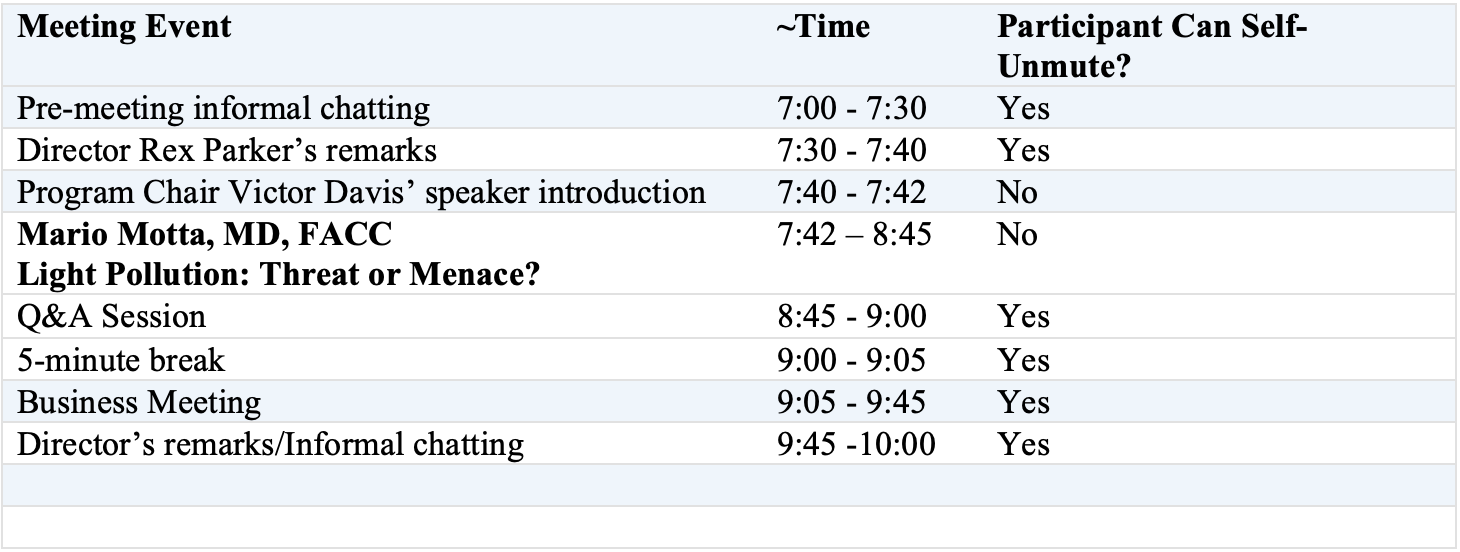
Here’s the anticipated agenda for December’s monthly meeting of the AAAP:
Getting to Peyton Hall
The parking lots across the street (Ivy Lane) from Peyton Hall are now construction sites, unavailable for parking. We’ve been advised by the administration of the astrophysics department that we should park in the new enclosed parking garage off Fitzrandolph street and walk around the stadium and athletic fields. Here’s a map of the campus and walking routes from the parking garage to Peyton Hall. The map shows the recently completed East Garage. Not shown is an access road Sweet Gum that connects from Faculty Road to an entrance at the lower left corner of the garage. Stadium Road connects from Fitzrandolph Road to another entrance at the opposite corner (and higher level) of the garage. It’s about a 10-15 minute walk from the parking garage to Peyton Hall.


Featured Speaker:
Mario Motta, MD, FACC
drmariomotta@gmail.com
“The Environmental and Medical Consequences of Light Pollution”
The Environmental and Medical Consequences of Light Pollution
There are strong economic and climate-related arguments for use of LED of street lighting around the world. However, not all LED light is optimal. Some LED lighting fixtures produce excess blue emission, harmful to both human health and the environment. The problem is with the disruption of circadian rhythmicity through suppression of melatonin production by the pineal gland. Melatonin has been shown to be an important adjuvant to the human immune system, and thus when suppressed has detrimental human health effects. Many white LED street lights have a spectrum that contains a strong spike in the blue wavelength, which is most effective at suppressing melatonin during the night. There is now voluminous data showing a higher risk of hormonally linked cancers with melatonin suppression.
Also, improperly designed lighting fixtures can result in glare, and create a road hazard condition. This can be greatly mitigated by proper design, shielding and installation so that no light shines above 80 degrees from the horizontal. The visual hazard by these very intense point sources is magnified by higher color temperature LEDs because blue light scatters more in the human eye, leading to increased disability glare and has serious implications for night-time driving visibility.
Mario Motta, MD, FACC
Dr. Motta had been in practice at North Shore Medical Center in Salem, Massachusetts, since 1983, recently retiring in 2022. He is a graduate of Boston College, with a BS in physics and biology, and of Tufts Medical School. He is boarded in and is a fellow of the American College of Cardiology and of the American Society of Nuclear Cardiology. He is an associate professor of medicine at Tufts University School of Medicine. Dr. Motta has long been active in organized medicine, both in the American Medical Association (AMA) and in the Massachusetts Medical Society (MMS), holding a number of posts through the years. He is a past President of the MMS, and was elected to the AMA council of Science and public Health where he has served 8 years, and elected to the Board of Trustees of the AMA in 2018, recently completing his term.
Dr. Motta also has a lifelong interest in astronomy, and has hand built a number of telescopes and observatories through the years to do astronomy research, including his entirely homemade 32 inch F6 relay telescope located in Gloucester, MA. He has been awarded several national awards in astronomy, including the Las Cumbras award from the Astronomical Society of the Pacific in 2003, and also the Walter Scott Houston award from the northeast section of the Astronomical League, and in 2017 the Henry Olcott Award from the American Association of Variable star Observers (AAVSO). He has also served as a president of the ATM’s of Boston, and has served as a council member of the AAVSO, and is a past president as well. He has also served on the Board of the IDA. He has worked on light pollution issues, and published several white papers on LP as a member of the AMA council of science and public health. He served on a UN committee (COPUOS) representing the AMA on light pollution for a worldwide effort to control LP and satellite proliferation. Finally, several years ago the International Astronomical Union awarded Dr Motta an asteroid in part for his work on light pollution as well as amateur research, asteroid 133537MarioMotta.
How to Participate
Zoom
Join Zoom Meeting
https://us06web.zoom.us/j/88161503767?pwd=rLK683KpnlSlbz3WT6XvzbqsL72A5D.1
AAAP webcast: This month’s AAAP meeting, beginning with Rex’s opening remarks and ending at the beginning of the business meeting, will be webcast live on YouTube and recorded for subsequent public access on AAAP’s YouTube channel. Be aware that your interactions during this segment, including questions to our guest speaker, may be recorded for posterity.
Join YouTube Live to listen to the speaker using the link below –


A look ahead at future guest speakers:
| Date | Featured Speaker | Topic | |
| January 9 2024 | Dr. Lia Medeiros Institute for Advanced Study | Dr. Medeiros will talk about her research and experiences searching for compact objects as a member of the Event Horizon Telescope Collaboration. Suggested be Michael DiMario. | |
| February 13 2024 | Prof. David John Helfand Columbia University djh@astro.columbia.edu  | The Universal Timekeepers: Reconstructing History Atom by Atom By utilizing the basic building blocks of matter as imperturbable little clocks, we are now able to reconstruct in quantitative detail a remarkable range of human and natural events. From detecting art forgeries to dating archeological sites, and from laying out a detailed history of human diet and the Earth’s climate to revealing the events surrounding the origin of life, of the Solar System and of the Universe itself, atoms provide us with a precise chronology from the beginning of time to the moment humans emerge to contemplate such questions. Copies of Prof. Helfand’s book will be for sale and he’ll be available to sign them. | |
| March 12 2024 | Erika Hoffman Graduate student, University of Maryland ebhoff@umd.edu | Erika will describe her research using high-resolution x-ray spectroscopy to investigate ionized outflows from active galactic nuclei (AGNs). Suggested by Bill Thomas. | |
| April 9 2024 | Eclipse Observations | Since this meeting will take place the day after the Total Solar Eclipse of 08 April 2024, and many members will be out of town or returning from their trips, I’m suggesting that we host an online roundup of eclipse observations, with members (and perhaps others) Zooming in to share their experiences. | |
| May 14 2024 | Dr. Tea Temim Research Astronomer, Princeton University Department of Astrophysics | Dr. Temim will describe her research using JWST imagery to study supernova remnants. Suggested by Gene Allen. temim@astro.princeton.edu | |
| June 11 2024 | NJ State Museum planetarium’s Bill Murray, and Jacob Hamer, Assistant Curator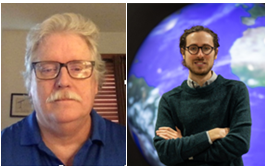 | AAAP’s traditional annual pilgrimage to the NJ State Museum planetarium in Trenton, where members will experience a presentation and a preview of the planetarium’s latest sky show. |
As always, members’ comments and suggestions are gratefully accepted and much appreciated.
victor.davis@verizon.net
program@princetonastronomy.org
(908) 581-1780 cell

 Amateur Astronomers Association of Princeton