
by Purnendu Gupta
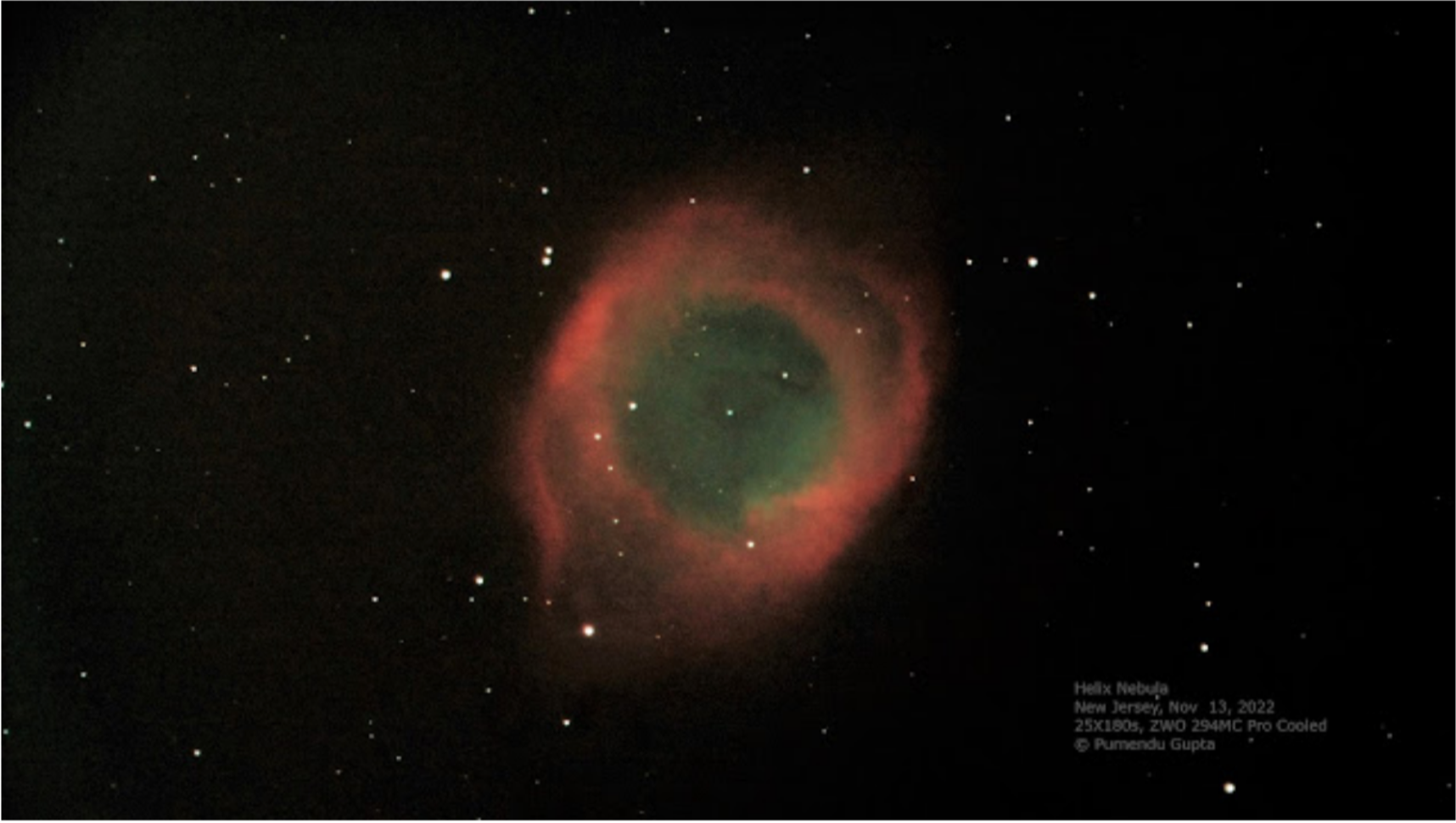
End of Days
Where do stars like the sun go when they die? At five billion years old, our sun is a middle aged star. In the stellar spectral classification it is also a middle class, yellow star; neither too hot nor too cold.. When stars of this type reach the end of life, they do what humans do at the end of their working lives. They retire.
That’s right. They do not explode into a supernova like their big brothers, or collapse into black holes like their superstar cousins. They gently walk into … the sunset. And when they do, they leave behind what is known as a planetary nebula like the one you see in the image above. The Helix Nebula is also known as the Eye of God, for its unique shape. The nearest example of its kind, it is at about 650 light years distant in the constellation of Aquarius.
I took the image above from my backyard in November of 2022 using a five inch Maksutov-Cassegrain scope. This is light gathered over an hour and a quarter using a narrowband filter.
The image below is a false-color composite of the same object in visible and invisible “light” as seen by four special purpose NASA telescopes that see in different wavelengths. These include Infrared (Spitzer), optical (Hubble), UV (Galaxy Evolution Explorer) and X-Ray (Chandra) telescopes.

Stars are nuclear fusion reactors that exist at a self adjusting balance between the inward pull of gravity and the outward pressure of hot fusing matter. A bit like a balloon that exists at the sweet spot between the compressing force of its skin, and the expanding force of the air inside. It first lights up when fusion is triggered in the core of the proto-star, among the simplest atom of all – primordial Hydrogen that has atomic number one. This is forced by enormous gravity to combine with its neighbor transforming into the next heavier element in the Periodic Table, Helium, with atomic number two. As Hydrogen is exhausted, three of these Helium atoms will combine to form Carbon with atomic number six and so on. The nuclear alchemy goes on to magically cook heavier elements from lighter ones releasing energy in the process.
About 12,000 years ago, the progenitor star of the Helix nebula started to run out of its hydrogen fuel. The star cooled some and lost some of its ability to hold itself up against gravity. The core shrank, and the outer layers slipped away from its grip into space cooling and expanding into a red giant. This was the end of the “middle class sun” phase of life of the star. Any planets that may have existed in that solar system experienced the last sunset as the red giant engulfed the inner planets.
The Star Within a Star
Once the outer veil got lifted what lay exposed was the star’s stopped nuclear engine. While no longer undergoing fusion, it is held up by another force known as electron degeneracy pressure. A bright core made mostly of a soup of electrons, carbon nuclei and some other elements, on its way to becoming a white hot midget star – a white dwarf.
A white dwarf contains about half the mass of the original star but is compressed by gravity into a ball merely the size of the earth or only 1/100th of the sun’s original diameter. As a result the densities are enormous. A teaspoon could weigh as much as an average car on earth. For comparison, a spoonful of the sun’s core would be much lighter at only 750 grams. By the time the white dwarf forms, the expelled shell has not had time to go very far – and is perhaps a light year or two away from the core. Instead of being a perfect sphere, the expanding shell takes on beautiful shapes due to pre-existing asymmetries. The radiation from the white dwarf core lights up the expanding gas in concentric shells of colors. The Hydrogen glows red and the Oxygen glows blue and green.
Our sun is expected to have a similar fate. In its first red-giant phase after all hydrogen is exhausted, it would engulf the orbits of Mercury and Venus. The next phase would comprise of a helium burn and as that fuel exhausts as well, it would undergo a second red giant phase known as a Asymptotic Giant Branch (AGB) red giant on the HR (Hertzsprung-Russell) diagram of stellar evolution. At this time it is expected to have a radius of once astronomical unit (1 AU), and will engulf the orbit of the Earth.
Eventually the sun will “retire” as a white dwarf that will last many tens of billions of years cooling very slowly. But before that happens, for a few thousand years, it will form a planetary nebula like the Helix. The whorls of colorful gas around it will expand into space and fade away relatively quickly, like a cosmic flower in final bloom. To an alien astronomer, this may be the only reminder that we were ever here.
Imaging Specs:
————————
25x180s light frames (total 1 h 15 min integration) with calibration frames. Optolong L-enhance narrowband filter. ASI294MC Pro cooled camera. Guided exposure with Celestron 127 SLT Mak-Cass on Celestron AVX mount

 Amateur Astronomers Association of Princeton