

by Rex Parker, PhD director@princetonastronomers.org
Next meeting at the Planetarium – in Person Only. We want to see you in person at the next monthly meeting of AAAP on June 13 meeting (7:30pm) at the Planetarium in Trenton. This is the last meeting of the academic season and will be held in-person-only because of technical barriers to broadcasting the dome show. For more info see Victor’s article below.
Profound Events. Having spent a few days last week reflecting on the philosophical aspects of life turning 70, there’s no experience more ineffable than the astronomical. There may seem to be great portent in recent events here, which may resonate with AAAP members. From a 4 billion year old meteorite landing close to the AAAP Observatory, with a black bear roaming around nearby (see photo below), to the sudden flare of a supernova in the great spiral galaxy Messier 101. The M101 supernova SN 2023ixf first appeared on May 19 (my date of great reflection) and is well positioned for observing, transiting around 11pm locally now. The credit for discovery of the supernova has gone to amateur astronomer Koichi Itagaki from Japan, confirmed the next day (May 20) by the Zwicky Transient Facility (ZTF) at Palomar CA.
Infrared photo of a bear in the Washington Crossing Park area near the Observatory taken on May 25 at night using a wildlife camera.

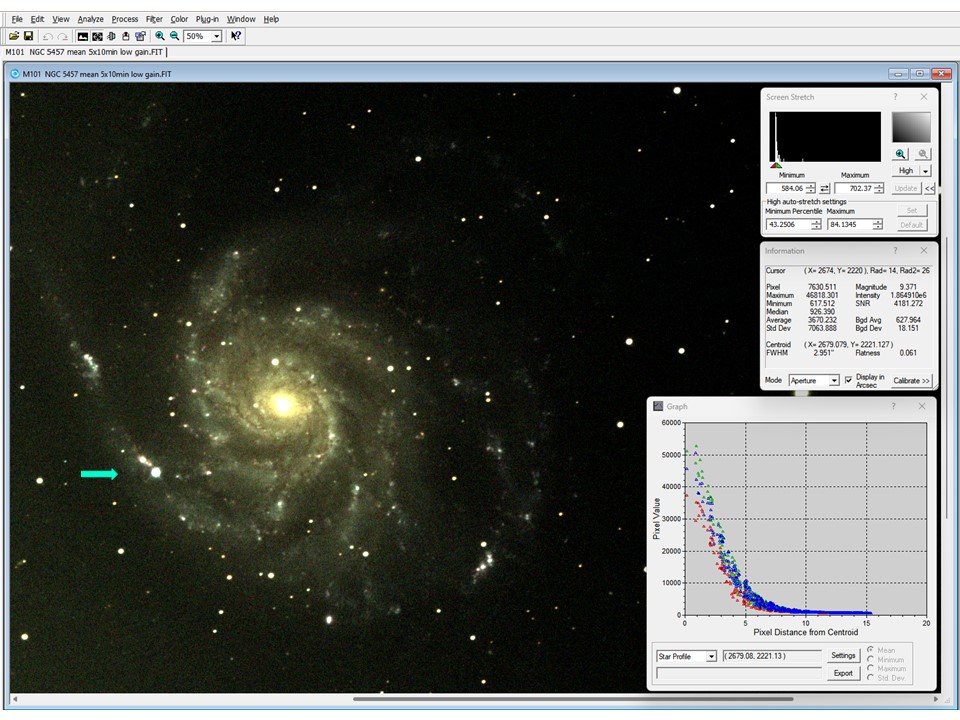
Several members of the AAAP astroimaging sub-group obtained interesting images of the supernova. I offer mine here with some interpretation of the color. The galaxy M101 has a magnitude about 7.9, but low apparent surface brightness being a face-on spiral. Although it is 21 million light years away it is relatively close as galaxies go, and easy to find in a scope near the naked-eye double star Alcor and Mizar in the handle of the big dipper. I used Maxim-DL’s Pinpoint Astrometry with the data in this image to obtain a calibrated magnitude = 9.37 for SN 2023ixf (see image below). Its color appears bluish-white. This is a type 2 supernova, formed from the rapid collapse and violent explosion of a massive star, and is typically low in red H-alpha emissions. This is because the spectrum of type 2 SN’s have strong Balmer hydrogen absorption lines (remember my Unjournal talk a couple months ago!), including absorption in the well-known H-alpha band at 656nm (red). This is one feature distinguishing Type 2 from type 1 SN. Absorption is the inverse of emission, and this aspect of the physics would appear to explain my observation that the SN starlight profile is deficient in red. Shown in the graph on the right of the image, the RGB filters of the CMOS sensor array provide a form of rough spectroscopy. It can be seen in the profile graph that the blue and green intensities are higher than the red in the profile, consistent with the physics of a type 2 supernova.
The spiral galaxy Messier 101 with the supernova SN 2023ixf indicated by the cyan arrow on the left. The graph shows the light profile of the SN recorded by the CMOS sensor R,G,B Bayer matrix filters. Image is the mean of 5x10min exp. with a ZWO ASI2400MC camera and 12.5” f/6.7 reflector. Software is Diffraction Limited’s Maxim DL v6, image by RA Parker.

 Amateur Astronomers Association of Princeton